TL;DR

Get backup power and energy gear delivered free — and shop member deals
- Fast, free delivery on millions of items
- Access to Prime Big Deal Days deals on October 6–7
- Prime Video, Amazon Music and more included
China Huaneng says both 350 MW units at the 700 MW Jintan salt-cavern compressed-air energy storage project completed integrated startup testing on Sept. 12. The plant is moving to pre-grid-connection tests and commissioning; it has not yet been reported as connected to the grid or in commercial operation.
China Huaneng’s 700 MW Jintan salt-cavern compressed-air energy storage project completed full-system startup testing of its two generating units on Sept. 12, a milestone ahead of grid-connection tests and system commissioning. The plant in Changzhou, Jiangsu province, has two 350 MW units; the project has not yet been reported as grid-connected or commercially operating.
The project’s second phase stores energy by using electricity to compress air and inject it into four underground salt caverns roughly 1,000 meters deep. The caverns have a combined storage volume of about 1.2 million cubic meters. During charging, air pressure exceeds 130 atmospheres, while heat produced by compression is captured for reuse rather than released.
When the plant generates electricity, the stored air is reheated and expanded through turbines without burning natural gas. Project documents describe a full charging cycle as storing about 2.8 GWh of electricity, with an approximately eight-hour charging period and four hours of generation at rated output. The documents also give a round-trip efficiency above 70%, an expected operating schedule of about 330 charge-discharge cycles a year, and projected annual generation of about 924 GWh. These are design and forecast figures, not reported operating results.
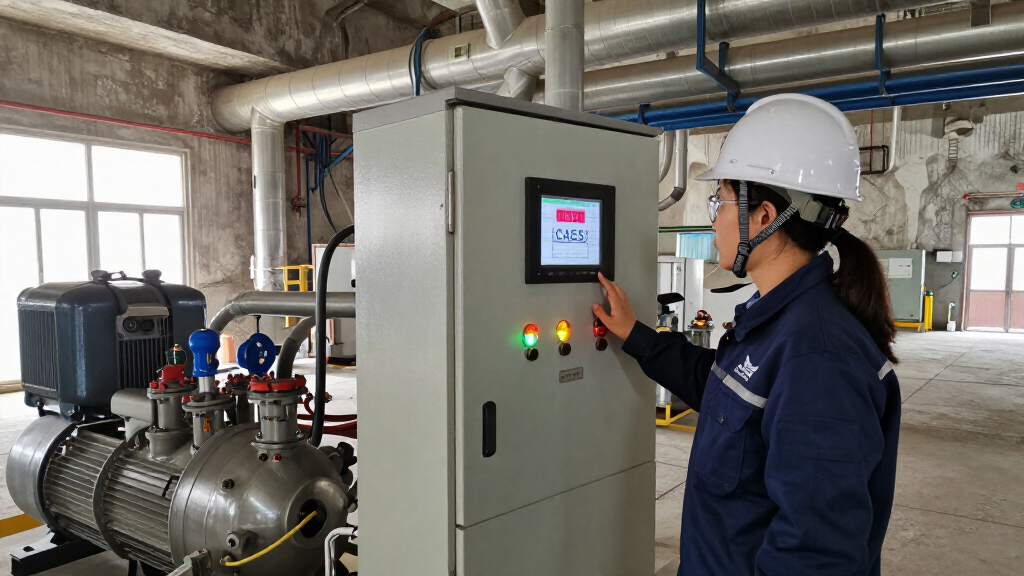
The startup tests involved both units operating in integrated conditions. According to the report by Energy Storage, the project will now undergo pre-grid-connection testing and commissioning. Those steps are needed before the facility can be confirmed as connected and operating as part of the power system.
A Larger Store for Grid Flexibility
At its planned 700 MW power capacity, Jintan’s second phase would be substantially larger than the project’s first phase, which was rated at 60 MW/300 MWh and commissioned in 2022. Energy Storage describes it as the largest installed power-capacity salt-cavern CAES facility currently reported worldwide. That ranking is specific to the reported category and may change as other projects come online.
Compressed-air storage can shift electricity across hours: the plant consumes power while charging and returns power during discharge. If Jintan completes commissioning and performs as designed, its four-hour rated generation period could support peak shifting and renewable integration, among other grid-balancing services. The project’s expected generation and efficiency figures remain projections until measured in operation.
The startup milestone also signals a move from smaller demonstration facilities toward several-hundred-megawatt storage projects. Its scale does not by itself establish how often it will run, how much electricity it will deliver to the grid, or its costs. Those outcomes will depend on commissioning, operating performance and the power system’s needs.
home salt cavern energy storage system
As an affiliate, we earn on qualifying purchases.
As an affiliate, we earn on qualifying purchases.
How Jintan’s Second Phase Scales Up
Jintan’s first phase, rated at 60 MW/300 MWh, was commissioned in 2022. The second phase raises power capacity to 700 MW and uses a dual-line, four-stage compression system designed to handle greater airflow. Each unit has a 350 MW air turbine with three reheating stages and four expansion stages. The turbine’s main air pressure is specified at 13.5 MPa, and its design efficiency is stated as more than 93%.
Thermal storage is another change from the earlier phase. The second phase replaces heat-transfer oil with pressurized water. Sixteen spherical tanks, each with a capacity of 3,500 cubic meters, provide 56,000 cubic meters of thermal storage. Project details say pressurization allows the water to reach around 180 C, so compression heat can be recovered and reused during generation.
China Huaneng and China Salt Group jointly developed the project, with technical support from Tsinghua University and Xi’an Thermal Power Research Institute. Huaneng Jiangsu and China Salt’s salt-cavern business are responsible for development, construction and operations. PowerChina subsidiary SEPCO1 undertook construction and installation work for Unit 2.
“More than 70% round-trip energy conversion efficiency.”
— Project documents, as reported by Energy Storage
compressed air energy storage unit
As an affiliate, we earn on qualifying purchases.
As an affiliate, we earn on qualifying purchases.
Grid Connection and Performance Still Pending
The report does not give a date for completion of grid-connection testing, commissioning or commercial operation. It also does not say whether either unit has begun delivering electricity to the grid. The Sept. 12 milestone confirms integrated startup testing, not full operational status.
Figures for annual generation, cycling frequency, charging duration and efficiency are presented as project expectations or design parameters. The source provides no operating data to confirm how the plant performs under routine conditions, or whether testing will lead to changes in those specifications. Details of commissioning results and the plant’s eventual dispatch pattern are not yet available.
As an affiliate, we earn on qualifying purchases.
Testing Before Grid Operation
The next reported steps are pre-grid-connection tests followed by system commissioning. These processes will assess the plant’s systems and readiness before grid connection. The source does not provide a timetable or state what test results are still outstanding.
Further updates would be needed to confirm when the facility is connected, when it enters operation, and whether its measured output and efficiency match the design figures. Until those milestones are reported, the project’s 700 MW rating and projected annual generation should be understood as specifications and forecasts rather than demonstrated grid performance.
industrial compressed air energy storage
As an affiliate, we earn on qualifying purchases.
As an affiliate, we earn on qualifying purchases.
Key Questions
What happened at the Jintan project?
Both 350 MW generating units completed integrated startup testing on Sept. 12, according to Energy Storage. The project is moving to pre-grid-connection tests and commissioning.
Is the plant already connected to the grid?
The available report does not say that it is. It identifies grid-connection testing and commissioning as upcoming steps.
How does the facility store and release energy?
It uses electricity to compress air into underground salt caverns, captures heat from compression, then reheats and expands the air through turbines to generate electricity. The stated process does not burn natural gas.
How much electricity can Jintan store?
Project documents describe about 2.8 GWh per full charging cycle, an approximately eight-hour charging period and four hours of generation at rated output. These are project specifications, not reported results from routine operation.
When will the project begin commercial operation?
No commercial-operation date is given in the source. The next identified milestones are pre-grid-connection testing and system commissioning.
Source: rss
Halloween Picks
halloween
As an affiliate, we earn on qualifying purchases.