Home battery backup systems range from compact power stations for essential devices to expandable storage designed for larger household loads. My best overall pick is the Jackery Solar Generator 5000 Plus, which pairs 120V/240V output with expansion potential up to 60kWh; the EF ECOFLOW DELTA Pro Ultra stands out for buyers seeking a larger integrated backup setup, while the ECO-WORTHY Powermega offers substantial battery capacity for a compatible 48V system. The main tradeoff is between plug-and-play convenience and the capacity, electrical compatibility, and planning a more involved home setup requires. Solar bundles can add charging flexibility, but panels alone do not determine how much of a home you can power. Read on for a comparison of all 11 options and guidance on matching a system to your outage needs.

Get backup power and energy gear delivered free — and shop member deals
- Fast, free delivery on millions of items
- Access to Prime Big Deal Days deals on October 6–7
- Prime Video, Amazon Music and more included
Complete the kit


Key Takeaways
- The Jackery Solar Generator 5000 Plus is the most home-oriented all-rounder in this lineup: its 120V/240V output and stated expansion potential suit buyers planning for more than small appliances, though installation and system compatibility still need checking.
- Capacity does not equal a complete backup system: the ECO-WORTHY Powermega provides 16.07kWh of battery storage, but buyers must match its 48V battery format with a compatible inverter and supporting equipment.
- The EcoFlow DELTA Pro Ultra and Jackery 5000 Plus serve different scaling plans: EcoFlow is a bundled 12kWh station-and-extra-battery option, while Jackery advertises expansion up to 60kWh.
- Solar bundles favor buyers who want a ready-to-pair charging setup: the Jackery HomePower 3600 Plus, HomePower 3000, and Growatt HELIOS 3600 include panels, while standalone stations leave panel selection to the owner.
- Smaller stations solve narrower outage problems: the DELTA 3 Classic, Explorer 2000 v2, and Anker SOLIX S2000 are more suited to selected devices and shorter backup needs than whole-home coverage.




| home battery backup system | Capacity |
|---|---|
| EF ECOFLOW DELTA 3 Classic Por | 1,024Wh |
| ECO-WORTHY Powermega 48V 314Ah | 314Ah |
| Jackery HomePower 3600 Plus Po | 3,584Wh |
| Jackery Solar Generator 5000 P | — |
| Growatt HELIOS 3600 Portable P | 3,600Wh |
| Jackery HomePower 3000 Portabl | 3,072Wh |
| Jackery HomePower 3600 Plus Po | 3,584Wh |
| Jackery Explorer 2000 v2 Porta | — |
| EF ECOFLOW DELTA Pro Ultra 12 | — |
| Anker SOLIX S2000 Portable Pow | 2,010Wh |
| ECO-WORTHY Solar Panel Kit LiF | — |
More Details on Our Top Picks
EF ECOFLOW DELTA 3 Classic Portable Power Station, 1024Wh, 1800W
The DELTA 3 Classic suits buyers who want a grab-and-go backup for essential devices rather than a system sized for major household loads. Its 1,024Wh capacity and 1,800W output can cover electronics and selected appliances, while under-10ms UPS switching helps keep sensitive equipment powered during an outage. AC charging reaches 80% in 45 minutes, a useful advantage when outages are intermittent and there is little time to recharge. Compared with the much larger Jackery HomePower 3600 Plus, this EcoFlow is easier to carry at 26.7 pounds but stores far less energy. LiFePO4 cells and app-based controls add practical long-term and monitoring benefits. The tradeoff is limited runtime for household loads, and solar charging requires a separately purchased panel; it also cannot use DELTA 2 or DELTA 3 extra batteries.
Pros:- Reaches 80% charge in 45 minutes on AC power
- Under-10ms UPS switching can help prevent interruptions to sensitive electronics
- LiFePO4 battery is rated for over 10 years of daily use
- App controls support monitoring and charging schedules
Cons:- 1,024Wh capacity limits how long it can run household loads
- Solar panel is optional, adding a separate purchase for solar recharging
- Not compatible with DELTA 2 or DELTA 3 extra batteries
Best for: Apartment residents and homeowners who need portable backup for internet equipment, phones, and a few smaller appliances, with quick recharge between outages.
Not ideal for: Households aiming to run large appliances or maintain power for long outages; its 1,024Wh capacity is far below the Jackery HomePower 3600 Plus and larger expandable systems.
- Capacity:1,024Wh
- Output:1,800W
- Surge output:3,600W
- Battery chemistry:LiFePO4
- AC charging:0–80% in 45 minutes
- UPS switching:Under 10ms
- Weight:26.7 pounds
Our verdict“Choose the DELTA 3 Classic for quickly recharged, portable essential-device backup, not extended whole-home coverage.”
ECO-WORTHY Powermega 48V 314Ah LiFePO4 Battery, 16.07kWh
The ECO-WORTHY Powermega is the lineup’s clearest choice for buyers building a substantial, stationary backup system rather than seeking a ready-to-carry power station. Its 16.07kWh capacity starts well above the Jackery HomePower 3600 Plus’s 3,584Wh, and support for up to 15 units in parallel gives system planners room to expand. A 200A smart BMS, active cell balancing, UL 1973 certification, and aerosol fire suppression make safety and battery management central to its design. The touchscreen and wireless monitoring also expose system data that compact stations are not built to provide. The tradeoff is installation and delivery logistics: this is a large battery shipped on a pallet by truck, not a portable all-in-one backup unit. Buyers need compatible system components and a suitable delivery location, so it is a poor fit for anyone wanting a simple plug-in outage solution.
Pros:- 16.07kWh capacity provides substantially more stored energy than portable stations such as the Jackery HomePower 3600 Plus
- Supports expansion to as many as 15 units in parallel
- UL 1973 certification, active cell balancing, and aerosol fire suppression
- Touchscreen, WiFi, Bluetooth, RS485, and CAN support monitoring and system integration
Cons:- Large, heavy form factor is suited to stationary installation rather than portable backup
- Palletized truck delivery requires an address that can accommodate freight
- A standalone battery requires compatible system equipment to provide usable household backup
Best for: Homeowners and system installers planning a fixed 48V storage setup with high energy needs, compatible equipment, and room to expand.
Not ideal for: Renters, apartment residents, or buyers who need an all-in-one portable station; it is a large standalone battery shipped by truck and requires a compatible system.
- Energy:16.07kWh
- Voltage:51.2V (48V nominal)
- Capacity:314Ah
- Battery chemistry:LiFePO4
- BMS:200A smart BMS with active cell balancing
- Expansion:Up to 15 units in parallel
- Safety certification:UL 1973
- Warranty:10 years
Our verdict“Pick the Powermega for a planned, expandable stationary battery system, and skip it if you need a portable plug-in power station.”
Jackery HomePower 3600 Plus Portable Power Station with Two 200W Solar Panels
The Jackery HomePower 3600 Plus offers a middle ground between compact emergency stations and large, expandable systems. Its 3,584Wh capacity and 3,600W output give it more room for household essentials than the 1,024Wh DELTA 3 Classic, while wheels and a telescopic handle make moving it more manageable. It can accept AC, solar, generator, or hybrid charging, which gives owners more ways to replenish power when grid access is uncertain. Parallel operation adds a path to 240V and higher output, although that capability depends on connecting units rather than using one unit alone. Two 200W solar panels are included, a convenience not offered with the DELTA 3 Classic, but they take about four hours for solar charging and the station and panels ship separately. Its size and shipping arrangement make this less convenient for frequent transport than its wheeled design may suggest.
Pros:- 3,584Wh capacity and 3,600W output exceed the DELTA 3 Classic’s storage and output
- AC, solar, generator, and hybrid charging offer flexible ways to recharge
- Wheels and telescopic handle ease movement compared with stationary batteries such as the ECO-WORTHY Powermega
- Includes two 200W solar panels
Cons:- Solar charging takes about four hours according to the listed specifications
- Station and included solar panels ship separately
- 240V output and higher parallel output require connecting multiple units
Best for: Homeowners who want several hours of backup for essential appliances, multiple charging routes, and a wheeled unit that can also serve outdoor or RV use.
Not ideal for: Buyers seeking a compact, fast-to-move backup or a single-unit 240V supply; its 240V operation requires parallel connection, and the larger station and separate shipments add logistics.
- Capacity:3,584Wh
- AC output:3,600W
- Parallel output:7,200W
- Voltage:120V; 240V in parallel
- Expandable capacity:Up to 21kWh per unit or 43kWh with multiple units
- Battery cycle life:6,000 cycles
- Included solar panels:Two 200W panels
- Hybrid charging time:2 hours
Our verdict“Choose this Jackery for movable, multi-source backup with more capacity than a compact station, while accepting slower solar charging and separate shipments.”
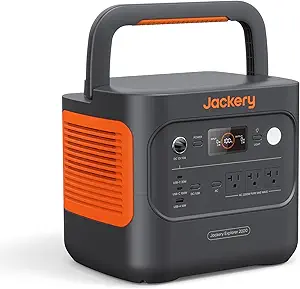
Jackery Solar Generator 5000 Plus Portable Power Station – 5040Wh LiFePO4, 7200W AC Output (120V/240V), Expandable to 60kWh
The Jackery Solar Generator 5000 Plus is the strongest fit here for buyers who need substantial output now and a route to much larger storage later. With 7,200W continuous output, 14,400W surge power, and 120V/240V AC, it is aimed at demanding appliances rather than just phones and networking gear. Its 5,040Wh starting capacity is also larger than the HomePower 3600 Plus’s 3,584Wh, and expansion to 60kWh makes it the more ambitious Jackery option for extended backup. Up to 4,000W of solar input can shorten recharge time when paired with suitable panels, but those panels are separate. That scale comes with a clear portability compromise: this is a large, heavy unit, not an easy carry-around station. Compared with the ECO-WORTHY Powermega, it is a more integrated power station, while the Powermega offers more energy per battery at the outset.
Pros:- 7,200W continuous output and 14,400W surge power support demanding loads
- 120V/240V AC output is specified for the unit
- Expandable capacity reaches up to 60kWh
- Up to 4,000W solar input can support fast solar recharging with suitable panels
Cons:- Large, heavy construction limits practical portability
- Solar panels for optimal solar charging are not included
- Its 5,040Wh starting capacity is lower than the ECO-WORTHY Powermega’s 16.07kWh
Best for: Homeowners or RV users with demanding 120V/240V loads who want a high-output power station and plan to add substantial battery capacity.
Not ideal for: Buyers who need lightweight, frequent portability or a complete solar setup in the box; the unit is large and heavy, and solar panels are separate.
- Battery capacity:5,040Wh
- Continuous output:7,200W
- Surge power:14,400W
- Output voltage:120V / 240V AC
- Expandable capacity:Up to 60kWh
- Maximum solar input:4,000W
- Battery type:LiFePO4 with ChargeShield 2.0
- Runtime:336 hours
Our verdict“Choose the 5000 Plus for high-power household loads and a large expansion path, provided its size and separate solar-panel needs fit your setup.”
Growatt HELIOS 3600 Portable Power Station with 400W Solar Panels
The Growatt HELIOS 3600 distinguishes itself with a mix of included solar hardware, cold-weather capability, and room to scale. Its 3,600Wh capacity and 3,600W continuous output place it in the same general class as the Jackery HomePower 3600 Plus, while its 15ms EPS switching is a practical match for keeping some connected equipment powered through a brief interruption. Two 200W panels come in the package, unlike the panels for the Jackery 5000 Plus, which are separate; however, the included 400W total is well below the HELIOS’s 2,000W maximum solar input. Its expansion ceiling of 36kWh is substantial, though below the Jackery 5000 Plus’s 60kWh. The LFP battery is rated to retain 80% capacity after 4,000 cycles, and operation down to -22°F adds a useful cold-weather distinction. Buyers should check system requirements before counting on the maximum parallel output or capacity.
Pros:- Includes two 200W solar panels
- 3,600W continuous output and 3,600Wh capacity suit a range of backup loads
- LFP battery is rated to retain 80% capacity after 4,000 cycles
- Specified operation down to -22°F and 15ms EPS switching support cold-weather and backup use
Cons:- Included 400W of solar panels is well below the 2,000W maximum solar input
- Reaching maximum parallel output and capacity may require additional compatible units
- 36kWh expansion ceiling is lower than the Jackery 5000 Plus’s stated 60kWh
Best for: Cold-climate households, RV owners, and off-grid users who want a 3,600Wh station with included solar panels and a path to expanded storage.
Not ideal for: Buyers who want the included panels alone to deliver the station’s maximum solar charging rate, or who need maximum expansion beyond 36kWh.
- Capacity:3,600Wh
- Continuous output:3,600W
- Included solar panels:2 × 200W
- Maximum solar charging:2,000W
- Parallel output:7,200W at 240V
- Expandable capacity:Up to 36kWh
- EPS switching:15ms
- Minimum operating temperature:-22°F
Our verdict“Pick the HELIOS 3600 for cold-weather use and included solar panels, but plan for additional compatible equipment to reach its full expansion potential.”
Jackery HomePower 3000 Portable Power Station with Two 200W Solar Panels
The Jackery HomePower 3000 pairs a 3,072Wh battery with 3,600W AC output, giving it enough capacity and power for several household essentials without stepping up to a larger expandable system. Its 20ms-or-less UPS switching can keep connected equipment supplied during an outage, while the included two 200W panels offer a solar option without sourcing panels separately. Compared with the Jackery Explorer 2000 v2, it has more stored energy and higher output, but the Explorer is lighter and easier to carry. The HomePower 3000’s LiFePO4 battery is rated for 4,000 cycles to 70% capacity, a shorter stated cycle life than the HomePower 3600 Plus. Solar charging with the included panels can take nine hours to reach 80%, and the station and panels may arrive in separate packages.
Pros:- 3,072Wh capacity and 3,600W AC output suit multiple household essentials.
- UPS switching of 20ms or less supports connected devices during power interruptions.
- Two 200W solar panels are included, so panel shopping is not required.
- LiFePO4 battery is rated for 4,000 cycles to 70% capacity.
Cons:- Included panels can take nine hours to charge the station to 80% using solar.
- The power station and solar panels may arrive in separate packages.
- Its stated cycle life is lower than the HomePower 3600 Plus’s 6,000-cycle rating.
Best for: Households seeking a single portable backup unit with included solar panels for essential appliances and electronics.
Not ideal for: Buyers who need fast solar replenishment, long-duration whole-home backup, or a compact unit that is easy to carry.
- Capacity:3,072Wh
- AC output:3,600W
- Surge output:7,200W
- UPS switching time:≤20ms
- Battery chemistry:LiFePO4
- Battery cycle life:4,000 cycles to 70% capacity
- Included solar panels:2 × 200W
- Ports:AC, USB-C, USB-A, DC, TT-30 RV
Our verdict“Choose the HomePower 3000 if you want substantial portable backup with panels included, and can accept slower solar charging.”
Jackery HomePower 3600 Plus Portable Power Station, 3584Wh, 3600W
The Jackery HomePower 3600 Plus is a stronger fit than a fixed-capacity station for households that may need to add storage over time. It starts with 3,584Wh and 3,600W output, then supports expansion up to 21kWh per unit or 43kWh across multiple units. Hybrid AC/DC charging can refill it in two hours, and its wheeled handle makes relocation less awkward than carrying the 39.5-pound Jackery Explorer 2000 v2. The 6,000-cycle battery rating also exceeds the HomePower 3000’s stated 4,000 cycles. This is still a large, bulky system rather than an easy carry-anywhere power bank. Its 240V output requires parallel operation, and buyers wanting substantial capacity beyond the base unit will need additional batteries or units.
Pros:- 3,584Wh capacity and 3,600W output provide substantial portable backup.
- Expandable to 21kWh per unit or 43kWh with multiple units.
- Wheels and a telescopic handle make it easier to move than a carry-only station.
- Hybrid AC/DC charging is listed at two hours, and the battery is rated for 6,000 cycles.
Cons:- Its large capacity still makes the unit bulky to transport.
- 240V output requires parallel operation rather than a single unit.
- Expansion requires additional batteries or power stations.
Best for: Homeowners who want a wheeled backup station now and plan to expand storage for longer outages.
Not ideal for: Buyers who need a lightweight station, native 240V output from one unit, or a fixed setup with no expansion purchases.
- Capacity:3,584Wh
- AC output:3,600W; up to 7,200W in parallel
- Voltage:120V; 240V in parallel
- Expandable capacity:Up to 21kWh per unit or 43kWh with multiple units
- Charging options:Hybrid AC+DC, AC, solar, and gas generator
- Recharge time:2 hours hybrid AC+DC; 2.5 hours AC or gas generator; 4 hours solar
- Battery cycle life:6,000 cycles
- Operating temperature:Down to -4°F
- Design:Wheels and telescopic handle
Our verdict“Pick the HomePower 3600 Plus if you value expandable storage and wheeled mobility more than a compact footprint.”
Jackery Explorer 2000 v2 Portable Power Station
The Jackery Explorer 2000 v2 makes more sense for a few essential circuits and electronics than for running a broad set of household appliances. It offers 2,042Wh and 2,200W output in a 39.5-pound body, with a 20ms UPS function for connected equipment and silent charging below 30dB. That makes it a more manageable, quieter option than the larger Jackery HomePower 3600 Plus, though the Plus supplies more energy and supports capacity expansion. The Explorer can reach 80% on AC in 66 minutes, which helps when an outage warning is short. Its 120V output and limited capacity constrain heavier or longer-duration backup, and solar charging requires compatible panels that may not be included. I’d shortlist it for focused backup, not whole-home coverage.
Pros:- 2,042Wh capacity and 2,200W output cover a useful range of essential devices.
- 20ms UPS switching supports connected equipment during outages.
- Silent Charging Mode operates below 30dB.
- AC charging reaches 80% in 66 minutes.
Cons:- At 39.5 pounds, it may be cumbersome to carry frequently.
- Its capacity and 120V output are less suited to extended or heavy household backup than the HomePower 3600 Plus.
- Solar charging requires compatible panels, which may not be included.
Best for: Apartment residents and homeowners who need UPS-backed power for electronics, communications, and a few essential devices.
Not ideal for: Households seeking long runtimes for several large appliances, 240V support, or an included solar-panel setup.
- Battery capacity:2,042Wh
- Output power:2,200W
- AC ports:3
- USB-C output:100W PD
- Battery type:LiFePO4
- Weight:39.5lb
- AC charging time:0–80% in 66 minutes
- UPS switching time:20ms
- Operating noise:Less than 30dB in Silent Charging Mode
Our verdict“Choose the Explorer 2000 v2 for quieter, focused UPS backup when portability matters more than expandable capacity.”
EF ECOFLOW DELTA Pro Ultra 12 kWh Power Station with Extra Battery
The EF ECOFLOW DELTA Pro Ultra is the clear choice in this group when the goal is more than keeping a refrigerator and a few devices running. Its 7,200W output at 120V or 240V supports heavier household loads, and capacity can scale from 6,144Wh to 90kWh with added batteries. Three inverters can deliver up to 21.6kW AC output, far beyond the portable Jackery HomePower 3000 or Explorer 2000 v2. Its 0ms UPS transfer time is another differentiator for devices that need uninterrupted power. That capability comes with a larger, modular setup: the inverter and battery arrive separately, and the maximum capacity requires substantial additional equipment. This is a better fit for a planned home backup installation than for buyers who want a simple station to move between rooms.
Pros:- 7,200W output supports heavier household loads than the portable Jackery options.
- Provides both 120V and 240V output.
- Capacity can expand from 6,144Wh to 90kWh.
- 0ms UPS transfer time supports devices that need uninterrupted power.
Cons:- Inverter and battery arrive in separate packages.
- Reaching the maximum stated capacity requires additional batteries.
- The modular, high-capacity setup is less suited to buyers seeking a simple portable station.
Best for: Homeowners planning high-output backup for major appliances or multiple circuits, with room to add batteries and inverters.
Not ideal for: Buyers seeking a compact, ready-to-carry station or a system that reaches its maximum capacity without additional equipment.
- Output:7,200W
- Voltage:120V and 240V
- Base battery capacity:6,144Wh
- Maximum expandable capacity:90kWh
- Maximum AC output with three inverters:21.6kW
- Charging options:Solar, wall outlets, EV charging stations, and outdoor generators
- UPS transfer time:0ms
Our verdict“Choose the DELTA Pro Ultra for scalable, high-output home backup if you are prepared for a larger modular system.”
Anker SOLIX S2000 Portable Power Station 2010Wh 1500W
The Anker SOLIX S2000 prioritizes efficient, space-conscious backup over high appliance-starting power. Its 2,010Wh capacity and stated low idle draw support long refrigerator runtimes, while a 35.7-pound weight and compact dimensions make it easier to place or move than the 39.5-pound Jackery Explorer 2000 v2. The Anker also claims a 10,000-cycle LFP battery life and accepts up to 400W of solar input, giving it a strong longevity and replenishment story for its size. The tradeoff is its 1,500W continuous output, below the Explorer’s 2,200W, so some higher-draw appliances may be out of reach. It also lacks a dedicated 12V DC port, limiting direct use with automotive accessories.
Pros:- 2,010Wh capacity and low idle draw support long refrigerator runtimes.
- At 35.7 pounds, it is lighter than the Jackery Explorer 2000 v2.
- LFP battery is rated for 10,000 cycles and a 15-year lifespan.
- Accepts up to 400W solar input and offers six charging methods.
Cons:- 1,500W continuous output is lower than the Explorer 2000 v2’s 2,200W.
- No dedicated 12V DC port for automotive accessories.
- Its 35.7-pound weight may still be heavy for frequent carrying.
Best for: Buyers who want a relatively light 2kWh backup station for a refrigerator and common devices, with an emphasis on battery longevity.
Not ideal for: Households needing more than 1,500W of continuous output or users who regularly power 12V automotive accessories directly.
- Capacity:2,010Wh
- Continuous output:1,500W
- Peak output:3,000W
- Battery type:314Ah LFP cells
- Cycle life:10,000 cycles; 15-year lifespan
- Weight:35.7lb
- Maximum solar input:400W
- Number of outlets:8, front and rear
- Idle power draw:6W
Our verdict“Pick the SOLIX S2000 for efficient, lighter 2kWh backup when its lower continuous output fits your appliance needs.”
ECO-WORTHY Solar Panel Kit LiFePO4 Energy Storage System for Home Backup
For buyers seeking a substantial home backup system rather than a portable power station, this ECO-WORTHY kit stands apart with 30+ kWh of usable storage, a 10 kW hybrid inverter, and six solar panels included. Its 120 V/240 V split-phase output is suited to a broader range of household circuits than compact options such as the EF ECOFLOW DELTA 3 Classic, while the solar array can help replenish the batteries when conditions allow. Wi-Fi and Bluetooth monitoring, active battery balancing, and fire-suppression features add oversight and safety features to the package.
The tradeoff is scale: the rack and panels require substantial space, freight delivery, and more involved installation than a self-contained portable unit. The description does not specify installation requirements or runtime for particular appliances, so buyers should confirm system compatibility and plan professional electrical support as needed. This is a stronger fit for planned home backup than for buyers who want quick setup or easy portability.
Pros:- 30+ kWh of usable energy provides substantially more stored power than the portable stations in this roundup.
- 10 kW hybrid inverter with 120 V/240 V output supports a wider range of home backup needs.
- Six 590 W solar panels are included for solar generation and battery charging.
- Active-balancing BMS, fire-suppression features, and app monitoring add useful system oversight.
Cons:- The large panel array and battery rack need significant space and truck delivery.
- Installation can be complex for buyers without electrical experience.
- The inverter appearance varies, and the system is less convenient to relocate than portable power stations.
Best for: Homeowners planning a fixed or semi-permanent backup setup who want substantial battery storage, solar charging, and 120 V/240 V output.
Not ideal for: Apartment residents, occasional-outage users, and DIY buyers without electrical installation experience who need a compact system that is simple to move and connect.
- Solar panels:6 × 590 W N-type monocrystalline
- Inverter:10 kW hybrid inverter
- MPPT efficiency:99.9%
- Battery configuration:2 × 48 V, 314 Ah LiFePO4 batteries
- Usable energy:30+ kWh
- Output voltage:120 V / 240 V split-phase
- Battery monitoring:Wi-Fi and Bluetooth
- Panel dimensions:89.68 × 44.65 × 1.18 in.
Our verdict“Choose this kit if you want high-capacity, solar-supported home backup and have the space and installation support for a substantial system.”
How We Picked
I ranked these home battery backup systems by how clearly their capacity, output, and configuration match common outage plans—not by battery size alone. I weighed usable household power against the ability to run higher-demand equipment, support 120V/240V loads, add storage, and pair with solar. I also considered how much system planning a buyer must do: a portable station is simpler to deploy, while a 48V battery or a larger home-focused setup may require compatible equipment and qualified installation.
The order favors options with a convincing balance of home-relevant output, practical expandability, and straightforward system fit. A large battery does not rank highly by itself if the buyer still needs to source an inverter or confirm system compatibility. Bundled panels count as a convenience, not proof of fast or sufficient solar recharge. Since these products span portable power stations, batteries, and kits, I distinguish their roles rather than treating every listing as a complete whole-home solution.
Factors to Consider When Choosing Home Battery Backup Systems
Before choosing a system, I would start with the outage plan rather than the product headline. These products range from portable stations to battery components and solar kits, so matching the equipment to household circuits matters as much as comparing watt-hours.
Choose Loads Before Comparing Battery Capacity
List the devices you expect to power and how long each must run, then separate essential loads from conveniences. A refrigerator, modem, lights, and medical equipment can call for a different setup than an electric range, central air conditioner, or well pump. Battery capacity estimates runtime, while the inverter’s continuous output and surge capacity determine whether an appliance can start and keep running. A common mistake is buying a large battery that cannot supply the needed output. Leave room for real-world variation, including appliance cycling, conversion losses, and changing household use.
Check Voltage, Circuits, and Connection Method
Portable stations typically power devices through their own outlets, while larger home backup plans may need to connect with selected circuits or a transfer arrangement. Confirm whether the loads you care about use 120V or 240V and whether the system supports the required output. A 120V unit can keep many essentials running but may not serve equipment that requires 240V. Do not assume that a high wattage figure means a unit can feed a home panel. For panel connections or permanently installed equipment, ask a qualified electrician about local rules and the required hardware before buying.
Match Runtime to Recharge Opportunities
Estimate how long an outage may last and whether you can recharge between periods of use. Solar can extend operation, but panel wattage is only one part of the calculation; sunlight, orientation, weather, charge limits, and daily consumption affect actual replenishment. A bundled panel kit can simplify matching, but it may not supply enough energy for heavy household loads. Grid charging can be useful before a storm or between outages, while a generator may be part of a longer-duration plan. Avoid planning around ideal solar conditions if reliable backup is the priority.
Decide Whether You Need a Complete System or a Battery Component
A portable power station generally combines a battery, inverter, and outlets in one package. A standalone battery, such as a 48V storage unit, may instead require a compatible inverter, controls, cabling, and a safe installation plan. Solar kits also vary in what they include, so check whether the listing supplies the equipment needed to store energy and deliver household power. Buyers sometimes compare a battery’s capacity with a complete station’s capacity without accounting for the missing parts. Make a component checklist and confirm compatibility with the manufacturer or installer before treating a battery-only product as ready backup.
Pay for Expandability Only If Your Plan Can Use It
Expandable systems can support longer runtime or larger loads, but expansion adds equipment, space needs, and compatibility decisions. Consider whether you expect your backup needs to grow, or whether a fixed-capacity station already covers your essential circuits. Check the supported battery configuration and limits rather than assuming any extra battery will work. Larger systems may also need a dedicated location and professional setup. If your goal is occasional backup for a few devices, paying for expansion you will not use can add complexity without improving the experience.
Plan for Placement, Noise, and Upkeep
Think about where the battery will sit, how you will move or access it, and what operating conditions the manufacturer permits. Portable systems are easier to reposition than heavy, expandable home setups, but their weight can still make frequent carrying impractical. Keep the equipment away from unsuitable temperatures and moisture, and follow the maker’s charging and storage guidance. Check warranty terms, battery chemistry, service options, and any required maintenance before purchase. A system that fits the home and can be kept ready may be more useful than one with higher capacity that is awkward to store or deploy.
Frequently Asked Questions
Can a portable power station run my whole house during an outage?
Usually, a portable station is best treated as backup for selected devices, not automatic whole-house power. Its inverter output, available outlets, voltage, and connection method set practical limits even if the battery capacity appears large. To power home circuits, check whether the model supports an approved transfer setup and whether its output matches those circuits. Higher-demand equipment such as electric heating or central air may exceed a portable unit’s capabilities. Make a load list and have an electrician review any planned connection to household wiring.
Is a 16.07kWh battery enough without an inverter?
Battery capacity alone cannot deliver usable AC power to household appliances. A 48V battery such as the ECO-WORTHY Powermega needs a compatible inverter and the required controls, cabling, and protective equipment to form a working backup system. The inverter’s output also determines which appliances can run at once, while the battery’s capacity influences runtime. Confirm voltage, communication compatibility, permitted expansion, and installation requirements before purchasing a battery-only product. If you want a ready-to-use setup, compare complete power stations instead.
Should I choose a 120V/240V system or a standard 120V power station?
Choose based on the appliances and circuits you want backed up, not on voltage as a general measure of quality. Many small appliances use 120V, while some household equipment requires 240V and will not run from a standard 120V output. A 120V station may be a simpler fit for devices connected directly to its outlets. A 120V/240V system can serve a broader set of planned loads, but home integration still depends on compatible equipment and installation. Check each appliance label and consult an electrician if you intend to connect the system to a panel.
Are solar panels included with a battery backup system worth choosing?
A bundled panel setup can make component matching simpler and provide a way to recharge when grid power is unavailable. It is most useful when you have a suitable sunny location and can adjust usage to the energy the panels produce. Included panel wattage does not guarantee a particular daily recharge, since clouds, season, placement, and system input limits all affect output. If your outage plan depends on solar, check the station’s solar input specifications and estimate energy needs across several days. Buyers with limited outdoor space or frequent shade may value grid charging or another backup source more.
How much expandability should I buy for future outages?
Start with the loads you need to support now, then decide whether longer outages or planned home changes could raise that need. Expansion can extend runtime, but it does not automatically increase inverter output or make unsupported appliances compatible. Verify which extra batteries work with the system and whether expansion requires additional hardware or professional installation. If you mainly need to keep a few devices running for short interruptions, a smaller station may be easier to store and manage. A larger expandable platform makes more sense when you have a defined plan for added capacity and a suitable place to install it.
Conclusion
For the broadest home-backup fit in this group, I would start with the Jackery Solar Generator 5000 Plus: its 120V/240V output and expansion path make it the best overall choice for buyers planning beyond a few portable devices. The best value depends on the scope of your setup: the Jackery HomePower 3600 Plus with panels is a practical bundled option, while the ECO-WORTHY Powermega may suit experienced buyers who already have or are planning compatible 48V equipment. For a premium, higher-capacity direction, compare the EcoFlow DELTA Pro Ultra with the Jackery 5000 Plus based on the configuration and expansion plan you need. Beginners are better served by a self-contained station such as the Jackery HomePower 3000 or 3600 Plus than by a standalone battery. For compact, device-focused backup, consider the EF ECOFLOW DELTA 3 Classic, Jackery Explorer 2000 v2, or Anker SOLIX S2000; for solar-bundled portable charging, compare the Growatt HELIOS 3600. Choose the system whose output, installation demands, and recharge plan match your actual outage loads.
Fall Picks
fall essentials
As an affiliate, we earn on qualifying purchases.