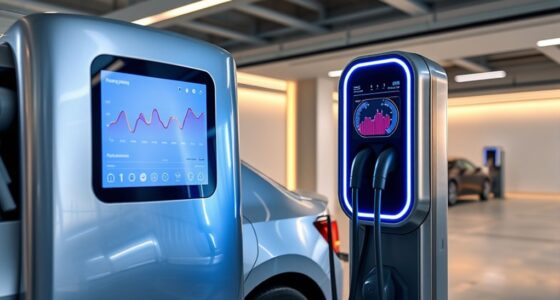
A Wi-Fi EV charger lets you monitor and manage home charging through an app, but the right choice depends just as much on your electrical setup and charging speed. My best overall pick is the Emporia Level 2 EV Charger, which combines Wi-Fi with 48-amp charging and a 25-foot cable. The Autel 40A stands out as a 25-foot-cable Level 2 option, while the Lectron Level 1 suits drivers who need a standard-outlet setup and can accept slower charging. The main tradeoffs are charging speed, circuit compatibility, cable reach, and how much app control you actually need. Read on for the full comparison and guidance on matching a charger to your home.

Get backup power and energy gear delivered free with Prime
- Fast, free delivery on millions of items
- Prime Video, Amazon Music and more included
- Member-only deals all year
Key Takeaways
The lineup’s clearest high-output option is the Emporia 48A; its higher amperage may support faster charging, but only when the home circuit and vehicle can accommodate it.
Several plug-in Level 2 picks combine 40A charging and a 25-foot cable, so cable reach, app features, certification details, and brand support become key differentiators.
The Lectron Level 1 is the only clearly specified 120V, 15A option, making it a fit for standard outlets rather than buyers seeking Level 2 charging speed.
Wi-Fi capability does not make every charger equally convenient: confirm app functions and home-network coverage before treating remote monitoring or scheduling as a deciding feature.
The portable dual-level charger may offer plug flexibility, while fixed Level 2 options are better suited to a regular home charging spot; verify its supported voltage, amperage, and outlet requirements before choosing it.





| ev charger with wifi | Connector | Cable length | Connectivity | Maximum current |
|---|---|---|---|---|
| AIMILER Level 2 EV Charger | J1772 | 25 ft | Wi-Fi app | — |
| AIMILER Level 2 Electric Vehic | J1772 | 25 ft | Wi-Fi, Bluetooth | 40A; adjustable 16A–40A |
| Lectron Level 1 J1772 EV Charg | J1772 | — | Wi-Fi | — |
| AIXINE Level 2 EV Charger | J1772 | 25 ft | Wi-Fi, app control | 40A; adjustable 10A–40A |
| Lectron Level 2 J1772 Wi-Fi EV | J1772 | — | Wi-Fi | — |
| DREAMDASH Level 2 Wi-Fi EV Cha | SAE J1772 | 25 ft | — | 40A |
| Emporia Level 2 EV Charger | SAE J1772 | 25 ft | 2.4 GHz Wi-Fi | 48A hardwired; 40A with NEMA 14-50 plug |
| Level 2 EV Charger with WiFi A | J1772 | 25 ft | — | 48A hardwired; NEMA 14-50 plug option |
| Autel 40A Level 2 EV Charger | SAE J1772 | 25 ft | — | 40A |
| Portable Level 1 and Level 2 J | — | — | — | — |
More Details on Our Top Picks
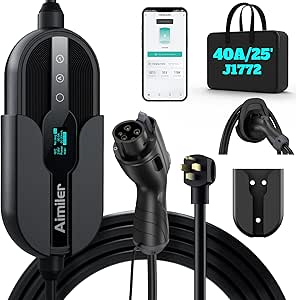
AIMILER Level 2 EV Charger, 32A, 25 ft Cable, Wi-Fi App, NEMA 14-50 Plug, J1772 Connector
I’d choose this AIMILER when Wi-Fi scheduling and adjustable current matter more than the highest charging rate. Its 16A–32A range lets a driver match charging to the vehicle or available circuit, while the screen makes basic charging details visible without opening the app. The 25-foot cable also offers more reach than the 16-foot Lectron Level 2 model, which can make a difference when the outlet and parking spot are not close together.
The tradeoff is its 32A ceiling: the 40A AIMILER and AIXINE models can deliver more power when the car and circuit support it. This unit also calls for protection from direct sun and rain, so it is a less convincing choice for exposed outdoor parking. Tesla and NACS drivers need a separate adapter.
Pros:- Adjustable 16A–32A current supports different charging needs
- Wi-Fi app provides scheduling and charging-status tracking
- Screen shows charging details at the unit
- 25-foot cable reaches farther than the 16-foot Lectron Level 2 cord
Cons:- 32A maximum output is below the 40A AIMILER and AIXINE options
- Tesla and NACS vehicles require a separate J1772 adapter
- Product guidance advises against direct sunlight and rain exposure
Best for: J1772 drivers with a NEMA 14-50 outlet who want Wi-Fi scheduling, a long cable, and the option to limit charging current.
Not ideal for: Drivers seeking the fastest charging available from a 40A charger, or those who need a unit intended for exposed outdoor conditions.
- Charging level:Level 2
- Voltage:240V
- Adjustable current:16A–32A
- Connector:J1772
- Plug:NEMA 14-50
- Cable length:25 ft
- Connectivity:Wi-Fi app
- Certifications:ETL, FCC
Our verdict“Choose this AIMILER for flexible, app-managed charging and extra cable reach if 32A output and sheltered placement suit your setup.”
AIMILER Level 2 Electric Vehicle Charger, 40A, 25ft Cable, ETL Certified, NEMA 14-50 Plug with J1772 Connector
This AIMILER is a stronger match than the 32A AIMILER for drivers whose vehicle and dedicated circuit can use up to 40A and 9.6kW. Its Wi-Fi app adds remote monitoring, scheduling, and cost tracking, while Bluetooth offers another connection option. The IP66-rated housing and 25-foot cable also make it better suited to variable home or driveway conditions than the 32A AIMILER, whose product guidance cautions against rain exposure.
Those advantages come with a setup caveat: the app’s Wi-Fi connection may require specific 2.4GHz router settings or a reset. The AIXINE also offers 40A, a longer 10A–40A adjustment range, and an IP67 claim, so buyers focused on those specifications may prefer it. This AIMILER still needs a NEMA 14-50 outlet for full output, and Tesla or NACS drivers need an adapter.
Pros:- Up to 40A and 9.6kW output
- Wi-Fi app supports remote monitoring, scheduling, and cost tracking
- IP66 water-resistance rating
- 25-foot cable and touch screen support flexible placement and local control
Cons:- Wi-Fi setup may require 2.4GHz router adjustments or a factory reset
- Full performance requires a dedicated 240V NEMA 14-50 outlet
- Tesla and NACS vehicles require an additional adapter
Best for: J1772 EV owners with a dedicated NEMA 14-50 circuit who want 40A charging, app-based scheduling, and a long cable.
Not ideal for: Buyers who want a simple Wi-Fi setup, lack a suitable 240V outlet, or drive a Tesla or NACS vehicle without an adapter.
- Maximum current:40A; adjustable 16A–40A
- Maximum power:9.6kW
- Input voltage:240V
- Connector:J1772
- Plug:NEMA 14-50P
- Cable length:25 ft
- Connectivity:Wi-Fi, Bluetooth
- Water resistance:IP66 / NEMA Type 4
- Certification:ETL
Our verdict“Pick this AIMILER if you want a 40A J1772 charger with a long cable and app features, and can accommodate its outlet and Wi-Fi setup needs.”
Lectron Level 1 J1772 EV Charger with Wi-Fi, 120V, 15A, NEMA 5-15 Plug, 16 ft Cord
Unlike the plug-in Level 2 AIMILER and Lectron options, this Lectron works from a standard 120V NEMA 5-15 outlet. That makes it the most accessible pick here for renters, occasional drivers, or anyone who cannot add a 240V circuit. Wi-Fi monitoring and remote current adjustment still give it a connected-charger advantage over a basic portable cord, and the IP65 enclosure adds dust and water resistance for travel or home use.
The compromise is speed: Level 1 charging is substantially slower than the 40A Lectron Level 2 charger, so overnight charging may not restore enough range for high-mileage driving. Its 16-foot cord is also shorter than the 25-foot AIMILER cables. I’d treat its stated 40–50 miles of overnight range as approximate, since actual replenishment depends on the vehicle and charging conditions.
Pros:- Uses a standard 120V NEMA 5-15 outlet
- Wi-Fi app supports monitoring and remote current adjustment
- Portable handheld form suits travel and visits
- IP65-rated enclosure resists dust and water
Cons:- Level 1 charging is much slower than the Level 2 models in this roundup
- 16-foot cord provides less reach than the 25-foot AIMILER chargers
- Requires a NEMA 5-15 outlet near the vehicle
Best for: J1772 drivers with modest daily mileage who need Wi-Fi monitoring from a standard household outlet and want a portable charger.
Not ideal for: High-mileage drivers who need quick overnight replenishment or owners without a NEMA 5-15 outlet near their parking space.
- Charging level:Level 1
- Input voltage:120V
- Amperage:15A input; 12A output
- Power:1650W
- Connector:J1772
- Plug:NEMA 5-15 (Type B)
- Cord length:16 ft
- Connectivity:Wi-Fi
- Ingress protection:IP65
Our verdict“Choose this Lectron if a standard outlet and portable Wi-Fi monitoring matter more than fast charging.”
AIXINE Level 2 EV Charger, 40Amp J1772, 25ft Cable, WiFi App, NEMA 14-50 Plug
The AIXINE is the most adaptable 40A option in this group on paper: its current settings span 10A to 40A, wider than the 16A–40A range of the 40A AIMILER. That gives buyers more room to dial charging down to fit their setup. A 3.1-inch LCD and Wi-Fi app provide both local controls and remote scheduling, while the 25-foot cord matches the longer AIMILER models rather than the 16-foot Lectron Level 2.
Its IP67 rating and stated ETL/UL safety certifications make it appealing for buyers seeking a weather-resistant portable unit, though the supplied information does not spell out the specific certification standards. It still requires a NEMA 14-50 outlet and its J1772 connector does not directly suit Tesla/NACS vehicles. Compared with the 40A AIMILER, it offers lower minimum current and a higher stated water-resistance rating, but carries a 2-year warranty.
Pros:- Adjustable 10A–40A current range
- Wi-Fi app supports monitoring, scheduling, and cost tracking
- 25-foot cable and 3.1-inch LCD offer flexible use and local control
- IP67 water-resistance rating is higher on paper than the 40A AIMILER’s IP66
Cons:- Requires a NEMA 14-50 outlet for use
- J1772 connector does not directly fit Tesla/NACS vehicles
- The listed warranty is two years
Best for: J1772 drivers who want 40A capacity, a low 10A current setting, a long cable, and app or screen control.
Not ideal for: Tesla or NACS owners without an adapter, and households without a NEMA 14-50 outlet or a suitable 240V circuit.
- Maximum current:40A; adjustable 10A–40A
- Maximum power:9.6kW
- Voltage:240V
- Connector:J1772
- Plug:NEMA 14-50
- Cable length:25 ft
- Connectivity:Wi-Fi, app control
- Water resistance:IP67
- Warranty:2 years
Our verdict“Choose the AIXINE if you want the widest stated current adjustment among these 40A picks and value both app and screen controls.”
Lectron Level 2 J1772 Wi-Fi EV Charger, 240V 40A, NEMA 14-50 Plug, 16 ft Cord
This Lectron stands out for buyers who want a portable 40A Wi-Fi charger that is easy to pack away: a carrying case comes with the unit, and the app supports monitoring, schedules, and energy controls. Its 9.6kW ceiling matches the 40A AIMILER and AIXINE, so it can deliver similar stated power when paired with a suitable NEMA 14-50 outlet and vehicle. The ETL, FCC, and UL 2251 listings add useful certification details to compare against the lineup.
The main compromise is reach. Its 16-foot cord is nine feet shorter than the 25-foot cords on both AIMILER Level 2 chargers and the AIXINE, which can limit parking flexibility. It also offers no stated adjustable-current range, unlike those alternatives. I’d favor this Lectron for portable storage over driveway reach or fine-tuned current settings; Tesla and NACS vehicles need a compatible adapter.
Pros:- 40A output delivers up to 9.6kW
- Wi-Fi app supports monitoring, scheduling, and energy controls
- Included carrying case helps with transport and storage
- Lists ETL, FCC, and UL 2251 certifications
Cons:- 16-foot cord is shorter than the 25-foot AIMILER and AIXINE cables
- Requires a compatible NEMA 14-50 outlet
- J1772 connector limits direct compatibility with Tesla/NACS vehicles
Best for: J1772 drivers who move or store their charger regularly and want a carrying case with app-managed 40A charging.
Not ideal for: Drivers whose outlet is far from the vehicle, or buyers who need a specified adjustable-current range or direct Tesla/NACS compatibility.
- Charging level:Level 2
- Input voltage:240V
- Current:40A
- Power:9.6kW
- Connector:J1772
- Plug:NEMA 14-50
- Cord length:16 ft
- Connectivity:Wi-Fi
- Included items:USB cable, carrying case
Our verdict“Pick this Lectron if a carrying case and portable storage matter more than the longer reach offered by the 25-foot alternatives.”
DREAMDASH Level 2 Wi-Fi EV Charger, 40A, 240V, NEMA 14-50 Plug, J1772 Connector
The DREAMDASH makes sense for drivers who want to fine-tune charging without giving up a useful 25-foot reach. Its current range adjusts from 6A to 40A, and both the LCD and app provide control, so you can adapt charging to your home circuit or schedule. Compared with the Autel 40A Level 2 Charger, it offers similar plug-in output and cable length, while Autel adds RFID access and a NEMA 4X enclosure. DREAMDASH instead lists IP66 protection and a wider stated operating-temperature range, appealing to buyers who prioritize environmental protection. The tradeoffs are a required NEMA 14-50 outlet and 2.4 GHz Wi-Fi for app setup. Touch controls also require unplugging the connector first, making on-unit adjustments less immediate.
Pros:- Adjustable 6A–40A current gives flexibility to match charging to the electrical setup.
- LCD and app controls offer both on-unit adjustment and remote scheduling.
- 25-foot cable provides reach across many garage or driveway layouts.
- IP66 enclosure and listed safety shutoffs support indoor or outdoor use.
Cons:- Requires a 240V NEMA 14-50 outlet.
- App setup requires 2.4 GHz Wi-Fi.
- Touch controls cannot be used while the connector is plugged into the vehicle.
Best for: J1772 EV owners with a NEMA 14-50 outlet who want adjustable charging current, app scheduling, and a long cable.
Not ideal for: Drivers without a 240V NEMA 14-50 outlet, or buyers who need app setup on a Wi-Fi network that only supports 5 GHz.
- Charging level:Level 2
- Maximum current:40A
- Adjustable current:6A–40A
- Maximum power:9.6 kW
- Input voltage and plug:240V; NEMA 14-50
- Connector:SAE J1772
- Cable length:25 ft
Our verdict“Choose DREAMDASH if you want a plug-in 40A charger with flexible current settings and strong stated weather protection.”
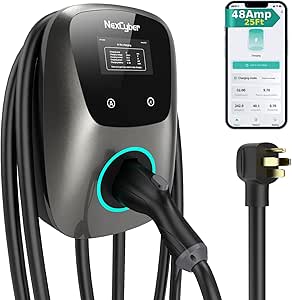
Emporia Level 2 EV Charger, 48 Amp, 240V, Wi-Fi, J1772 Connector, 25 ft Cable
Emporia earns this role by offering a clear upgrade path: use the NEMA 14-50 plug at up to 40A, or have it hardwired to reach 48A. That distinction matters for buyers planning a higher-capacity home charging setup, since the plug-in configuration does not deliver the maximum stated output. Its Wi-Fi features go beyond basic scheduling with energy monitoring and mobile controls, giving owners a way to track charging activity. Compared with the plug-in DREAMDASH 40A, Emporia can provide more current when hardwired, but it calls for professional installation to do so. The 25-foot cable and J1772 connector suit many North American EVs; Tesla drivers need a compatible adapter. Buyers who want a simple outlet-based installation may find the hardwire upgrade unnecessary.
Pros:- Supports up to 48A when hardwired, with a 40A plug-in option.
- Wi-Fi app offers energy monitoring, mobile control, and scheduled charging.
- 25-foot cable and J1772 connector suit a wide range of North American EVs.
- UL listed and ENERGY STAR certified.
Cons:- Reaching 48A requires hardwiring rather than using the NEMA 14-50 plug.
- Professional installation is recommended.
- The plug-in configuration tops out at 40A.
Best for: EV owners planning a professional hardwired installation who want Wi-Fi energy monitoring and the option to charge at up to 48A.
Not ideal for: Drivers seeking the highest output from a plug-in setup or those who want installation without electrician involvement.
- Maximum current:48A hardwired; 40A with NEMA 14-50 plug
- Voltage:240V
- Connector:SAE J1772
- Cable length:25 ft
- Installation:NEMA 14-50 plug or hardwired
- Connectivity:2.4 GHz Wi-Fi
- Dimensions:3.39 × 9.06 × 12.6 in
- Certifications:UL listed; ENERGY STAR certified
Our verdict“Pick Emporia if you want smart monitoring now and the option to move to 48A through a hardwired installation.”
Level 2 EV Charger with WiFi App and Plug‑Play, 48 A NEMA 14‑50P, 25 ft Cable, ETL Certified – Home EVSE Car Charger w/ J1772 Connector
This charger combines Wi-Fi monitoring and scheduling with a touchscreen for local adjustments, making it a fit for households where not every driver wants to manage charging through an app. Its stated output depends on installation: up to 48A when hardwired, or a stated 38 miles of range per hour through the NEMA 14-50 plug. That flexibility resembles the Emporia 48A charger, though the product data gives Emporia a clearer description of its plug-in and hardwired current limits. This model’s 25-foot military-grade cable and IP65 protection suit a garage or exposed parking area, while ETL, ENERGY STAR, and FCC certifications add useful reference points. The drawbacks are the electrician requirement for hardwiring, a potentially confusing touchscreen button sequence, and no included Tesla connector.
Pros:- Wi-Fi app supports monitoring, scheduling, and cost tracking.
- Touchscreen provides a local control option alongside the app.
- 25-foot military-grade cable and IP65 protection suit varied parking setups.
- ETL, ENERGY STAR, and FCC certifications are listed.
Cons:- Professional electrician installation is needed for hardwired operation.
- The button sequence may be confusing for some users.
- Tesla vehicles need an adapter because a Tesla connector is not included.
Best for: Households that want app scheduling plus a physical touchscreen for adjusting charging at the unit.
Not ideal for: Tesla owners seeking a ready-to-use connector, or buyers who want the full stated 48A output without professional hardwiring.
- Output and input voltage:240V
- Maximum current:48A hardwired; NEMA 14-50 plug option
- Connector:J1772
- Cable length:25 ft
- Controls:Wi-Fi app and touchscreen
- Weather protection:IP65
- Warranty:3 years
- Certifications:ETL, ENERGY STAR, FCC
Our verdict“Choose this model if touchscreen control matters as much as Wi-Fi features and you are comfortable with its installation and connector requirements.”
Autel 40A Level 2 EV Charger, 240V NEMA 14-50 J1772, WiFi, 25ft Cable
Autel is the strongest fit here for drivers who want a plug-in charger with outdoor-focused protection and useful access controls. Its NEMA 4X-rated enclosure is designed for indoor or outdoor settings, while the app handles remote current adjustment and scheduled charging. RFID access adds a practical layer for a shared driveway or other location where owners want to control who can start charging. Compared with the DREAMDASH 40A, Autel has the lower stated maximum current range starting at 16A, but its RFID feature distinguishes it from that model’s LCD-and-app approach. Both use a 25-foot cable and a NEMA 14-50 outlet. The main limitation is dependence on that dedicated outlet, plus a single port that cannot charge two vehicles simultaneously.
Pros:- NEMA 4X-rated enclosure is suited to indoor or outdoor installation.
- App supports remote current adjustment and scheduled charging.
- RFID access can help manage use in shared parking areas.
- Adjustable 16A–40A output accommodates different charging needs.
Cons:- Requires a dedicated NEMA 14-50 outlet.
- Single port does not support simultaneous charging for two vehicles.
- Maximum output is limited to 40A.
Best for: J1772 EV owners with a NEMA 14-50 outlet who need an outdoor-rated charger and RFID access for a shared parking area.
Not ideal for: Households without a dedicated NEMA 14-50 outlet or drivers who need two vehicles to charge at the same time.
- Maximum current:40A
- Adjustable current:16A–40A
- Voltage and plug:240V; NEMA 14-50
- Connector:SAE J1772
- Cable length:25 ft
- Connectivity and access:Wi-Fi app; RFID
- Certification and warranty:CSA; 3 years
Our verdict“Autel suits plug-in buyers who value outdoor protection and RFID access more than hardwired 48A capability.”
Portable Level 1 and Level 2 J1772 EV Charger with Wi-Fi App Control
This portable unit stands apart from the 40A and 48A home chargers in the lineup: it trades charging speed for the ability to work with both 120V and 240V outlets. That makes it a practical choice for J1772 drivers who need one charger for home and travel, or who may not have a higher-capacity setup available. Wi-Fi app controls, scheduling, and an LCD add more oversight than a basic portable cable, while its 7.61-pound weight and 25-foot cable support moving it between locations. Compared with the DREAMDASH 40A, this model has a much lower maximum Level 2 output at 3.68 kW and tops out at 16A. Its 12-month warranty is also shorter than the three-year warranties listed for Autel and the touchscreen model. Treat it as a flexible backup or modest-use charger, not a fast home unit.
Pros:- Supports Level 1 and Level 2 charging from compatible outlets.
- Wi-Fi app offers scheduling and charging information alongside an LCD.
- 25-foot cable and 7.61-pound weight support portable use.
- Includes over-temperature, over-current, over-voltage, and short-circuit protection.
Cons:- Maximum Level 2 output is 3.68 kW at 16A, well below the 40A and 48A options.
- Level 1 charging is limited to 12A.
- 12-month warranty is shorter than the listed three-year warranties on several alternatives.
Best for: J1772 EV and plug-in hybrid owners who need a portable charger that can use both common 120V and suitable 240V outlets.
Not ideal for: Drivers seeking fast daily Level 2 charging, since its maximum Level 2 output is 3.68 kW at 16A.
- Charging levels:Level 1 and Level 2
- Voltage:110V–240V
- Adjustable current:8A–16A
- Maximum Level 2 output:3.68 kW at 240V, 16A
- Plugs:NEMA 5-15 and NEMA 6-20
- Connector and cable:SAE J1772; 25 ft
- Controls and protection:Wi-Fi app, timer, LCD; IP65
- Weight and warranty:7.61 lb; 12 months
Our verdict“Choose this portable charger for outlet flexibility and travel use, not when high-output home charging is the priority.”

How We Picked
I compared these chargers on the details that shape everyday home use: charging level and stated amperage, plug and voltage requirements, cable length, Wi-Fi or app capability, and the clarity of the available specifications. I gave greater weight to products that describe a practical Level 2 setup, provide a useful cable reach, and make their electrical requirements easier to judge. I also treated certification claims and portability as decision factors, while avoiding assumptions where a listing did not provide enough detail.
The ranking favors a balanced fit over the highest amperage alone. That puts the Emporia 48A first for buyers seeking a higher-output Wi-Fi charger, while 40A plug-in models follow as alternatives whose fit depends on their cable length, listed certification, and intended use. The Lectron Level 1 and portable dual-level option serve narrower needs rather than competing directly with standard Level 2 home setups. Before purchase, I would confirm circuit capacity, connector compatibility, installation requirements, and exact app functions with the manufacturer or a qualified electrician.
| ev charger with wifi | Connector | Plug |
|---|---|---|
| AIMILER Level 2 EV Charger | J1772 | NEMA 14-50 |
| AIMILER Level 2 Electric Vehic | J1772 | NEMA 14-50P |
| Lectron Level 1 J1772 EV Charg | J1772 | NEMA 5-15 (Type B) |
| AIXINE Level 2 EV Charger | J1772 | NEMA 14-50 |
| Lectron Level 2 J1772 Wi-Fi EV | J1772 | NEMA 14-50 |
| DREAMDASH Level 2 Wi-Fi EV Cha | SAE J1772 | — |
| Emporia Level 2 EV Charger | SAE J1772 | — |
| Level 2 EV Charger with WiFi A | J1772 | — |
| Autel 40A Level 2 EV Charger | SAE J1772 | — |
| Portable Level 1 and Level 2 J | — | — |
Factors to Consider When Choosing Ev Charger With Wifi
Wi-Fi is only one part of choosing an EV charger. I would start with the home’s electrical supply and the car’s charging limits, then check whether the cable and app fit the way the charging spot is used.
Match Charger Output to Your Circuit and Vehicle
A charger’s stated amperage is not a promise that your car will charge at that rate. The home circuit limits available output, and the vehicle’s onboard charger sets another ceiling. Ask an electrician to confirm the circuit’s capacity and any installation work before buying a higher-amperage unit. A 48A model can be a poor fit if the home cannot support its requirements, while a lower-output charger may already meet a driver’s overnight needs. Check the vehicle manual for its AC charging limit rather than choosing by amperage alone. This step prevents paying for capacity the car or electrical system cannot use.
Check the Outlet, Plug, and Installation Plan
A NEMA 14-50 plug-in charger can simplify installation when a suitable outlet is already present, but that does not mean every existing outlet is appropriate for continuous EV charging. Have a qualified electrician check the circuit, outlet condition, and charger requirements. Hardwired and plug-in installations have different costs, serviceability, and compatibility, so decide how permanent the setup should be before comparing models. Also verify the connector matches the vehicle; the listed J1772 options are aimed at vehicles with a compatible inlet, while some drivers may need an adapter. Do not assume a familiar plug guarantees a safe or compatible installation.
Measure Cable Reach Before Choosing a Charger
Cable length determines whether the charger can reach the vehicle’s inlet from the planned mounting point, especially if cars park in different directions. Measure the route with the cable’s path in mind, rather than measuring a straight line across the garage. A 16-foot cord may work well for a close, fixed parking position but leave little room for a second vehicle or awkward inlet placement. The 25-foot options offer more placement flexibility, though extra cable needs a safe storage spot. Plan for the farthest regular parking position and avoid stretching a cable across walkways or driveways.
Decide Which Wi-Fi and App Features Matter
App control can be useful for checking charging status or managing a schedule, but Wi-Fi branding alone does not tell you which controls are included. Look for clear details on scheduling, session history, notifications, and whether the charger can operate when the network is unavailable. A garage with weak wireless coverage may limit remote access even when the charger itself is capable. If you mainly plug in at night, basic monitoring may be enough; frequent schedule changes can make richer controls more valuable. Choose based on specific app tasks, not a vague promise of smart connectivity.
Treat Portability and Dual-Level Use as Tradeoffs
A portable Level 1 and Level 2 charger can suit drivers who need to charge in more than one location, but flexibility depends on the included plugs and supported electrical ratings. Confirm exactly which outlets it can use and what output each setup provides; the product name alone does not establish those details. A dedicated Level 2 unit may be a simpler choice for a permanent home charging bay, while a portable model can add value for occasional travel or changing parking arrangements. Portability is useful only when the connection options match your actual locations. Check storage, cable handling, and outdoor-use instructions as well.
Verify Certification, Weather Suitability, and Support
Certification claims can help buyers compare products, but check the exact model and certification rather than relying on a broad listing statement. If the charger will be installed outdoors, review its stated weather protection and the manufacturer’s mounting guidance. Warranty terms, replacement parts, app support, and customer service can matter over years of routine use, yet these details are not fully specified for every option in this lineup. Ask the seller or manufacturer for written answers before purchase. Clear documentation matters most when a product’s electrical, outdoor, or app specifications are incomplete.
Frequently Asked Questions
Can I install a 40A or 48A charger on any NEMA 14-50 outlet?
No. The plug shape does not confirm that the outlet and circuit are suitable for the charger’s stated output or continuous charging use. Have a qualified electrician check the circuit rating, wiring, breaker, outlet condition, and the charger’s installation instructions. The vehicle may also draw less than the charger can supply. Confirm the complete electrical setup before selecting a higher-amperage model.
Will a Wi-Fi EV charger keep working if my home internet goes down?
That depends on the model and how its controls are designed. Some basic charging functions may remain available while remote monitoring, schedule changes, or notifications may require a network connection. The product descriptions here do not establish offline behavior for every charger, so check the manual or ask the manufacturer. If your garage has weak Wi-Fi, ask whether setup requires a connection and whether schedules remain saved offline.
Should I choose the 48A Emporia or a 40A plug-in charger?
I would choose based on the electrical installation and vehicle limit, not the amperage number alone. The Emporia’s 48A rating makes it the higher-output choice in this group, but that capacity is useful only if the circuit, installation, and vehicle support it. A 40A plug-in model may be a more suitable match where its required outlet and circuit are already available. Compare installation needs, cable reach, and the features you want from its app before deciding.
Is a 120V Level 1 Wi-Fi charger enough for home charging?
It can work for drivers with modest daily mileage, long parking periods, or no practical access to a 240V circuit. Level 1 charging is slower than Level 2, so it may not replace enough range overnight for drivers with heavy daily use. The Lectron Level 1 in this lineup uses a standard 120V outlet, but buyers should still confirm outlet condition and charging needs. Estimate your usual daily driving and the time the car sits parked before choosing it.
What should I confirm before buying the portable dual-level Wi-Fi charger?
Check the exact outlet adapters included, the voltage and amperage available with each connection, and whether the charger supports your vehicle’s connector. The listing name describes both Level 1 and Level 2 use, but buyers should not infer specific outlet compatibility or output without the detailed specifications. Also confirm its weather-use rating, cable length, and app functions. If you plan to use it away from home, verify that each destination has a compatible, suitable outlet rather than assuming portability means universal compatibility.
Conclusion
For a higher-output smart home setup, my best overall recommendation is the Emporia 48A, provided the vehicle and electrical system can support it. The best value fit is one of the 40A, 25-foot-cable plug-in models when its outlet requirements and documentation match the home; compare the AIMILER, AIXINE, DREAMDASH, Lectron, and Autel details before choosing among them. For a premium-leaning choice based on stated output, the Emporia is also the standout, while the Lectron Level 1 is the clearest beginner option for drivers who need a 120V setup and can live with slower charging. Choose the portable dual-level charger for a need that genuinely involves multiple charging locations, and consider the Lectron Level 2’s 16-foot cord only if that reach suits the parking layout. The final decision should follow a circuit check, vehicle compatibility check, and cable measurement—not the Wi-Fi label alone.
Halloween Picks

Kalolary 12ft Halloween Witch Haunted House Inflatable Archway

10.5 ft Lighted Pumpkin and Ghost Halloween Inflatable Archway

MGparty 14.5 ft Halloween Inflatable Walk-In Pumpkin House with LED Lights
As an affiliate, we earn on qualifying purchases.