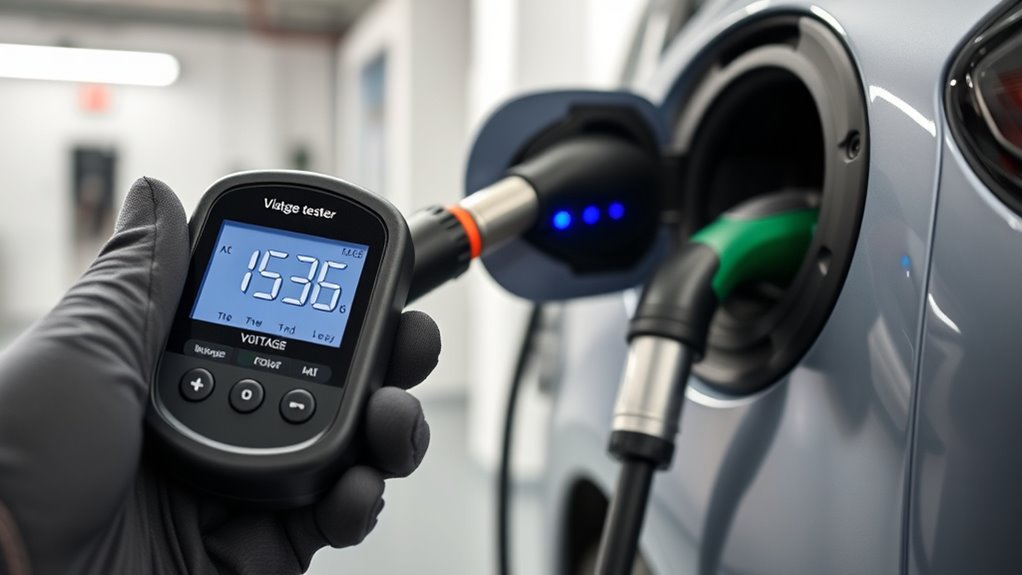
If you’re looking for the best voltage testers for EV charging, I’ve found a range of accurate, reliable tools that guarantee safe and proper operation. From versatile multimeters to specialized adapters, these devices help verify wiring, ground connections, GFCI safety, and vehicle compatibility. Whether you’re a technician or DIY enthusiast, choosing the right tool is essential for safety. Keep exploring, and you’ll discover which options suit your needs best.
Key Takeaways
- The top voltage testers include models like Fluke FEV100, Triplett TEV300, and Tesla EV Charger adapters for precise safety checks.
- These testers verify wiring, grounding, GFCI functions, and vehicle communication, ensuring safe and compliant EV charging.
- Many devices support multiple charging standards (Level 1, Level 2, Type 1/2, Tesla) for versatile testing.
- Features like digital displays, fault simulation, and safety protections enhance reliability and ease of use.
- Suitable for technicians, safety inspectors, and DIY users, these tools are essential for safe, efficient EV charging maintenance.
Fluke FEV100 Adapter Kit for EV Charging Station Testing

If you’re a technician testing EV charging stations, the Fluke FEV100 Adapter Kit is an essential tool because it simplifies verifying both the performance and safety of your installations. It allows you to simulate an electric vehicle’s presence, evaluate AC charging station performance, and test different charging states effortlessly with a single button. The kit also verifies charging voltage using a digital multimeter and checks wiring connections to make certain proper installation. Its PE pre-test feature confirms the protective earth is functioning correctly, while GFCI troubleshooting guarantees safety features are operational. Designed for Level 1 and Level 2 testing, it streamlines your workflow and enhances safety verification.
Best For: technicians and electrical professionals who perform testing, safety verification, and troubleshooting of electric vehicle charging stations.
Pros:
- Simplifies testing of charging performance and safety features with a single device
- Verifies wiring, grounding, and GFCI functionality to ensure proper installation
- Supports Level 1 and Level 2 AC EVSE testing, enhancing versatility
Cons:
- May require familiarity with EVSE testing procedures for optimal use
- Limited to AC charging station testing; does not support DC fast chargers
- Additional training or experience might be needed to interpret all test results accurately
Triplett TEV300 Electric Vehicle Charger Test Kit

The Triplett TEV300 Electric Vehicle Charger Test Kit is an ideal choice for technicians and professionals who need reliable, straightforward testing tools for EV charging systems. It features LED GO/NO GO indicators for quick assessments, ensuring compliance with key standards like EMC Directive and EN61010-1. The kit provides clear status indicators for the output socket, simplifying inspection. It also includes Proximity Pilot (PP) and Control Pilot (CP) simulations, enabling testing of current capacity and vehicle communication. Additionally, fault simulation capabilities allow testing of safety responses to short circuits, making this a exhaustive tool for ensuring safe, compliant EV charging installations.
Best For: EV charging station technicians and safety inspectors seeking a comprehensive, easy-to-use testing kit to ensure compliance and safety of EV charging systems.
Pros:
- Provides quick, clear LED GO/NO GO indicators for efficient assessments
- Includes advanced Proximity Pilot and Control Pilot simulations for thorough testing of vehicle communication and current capacity
- Capable of fault simulation, such as CP error “E,” to evaluate safety response mechanisms
Cons:
- May require some technical knowledge to interpret complex simulation results
- Limited to testing AC charging systems; not suitable for DC fast chargers
- The kit’s detailed features might be more than necessary for casual or non-professional users
Eversame 2-in-1 USB Type C Tester with LCD Display

The Eversame 2-in-1 USB Type C Tester with LCD Display stands out for its versatile measurement capabilities, making it ideal for anyone needing detailed insights into their charging devices. It features an LCD color screen that displays voltage, current, capacity, power, and impedance, with multiple modes for clear data visualization. Support for QC3.0, QC2.0, BC1.2, and PD protocols means you can quickly test fast chargers and device performance. Its safety features protect against over-voltage and over-current, ensuring safe operation. Plus, it supports a wide voltage and current range, making it compatible with many USB-C devices and chargers for exhaustive testing.
Best For: tech enthusiasts, technicians, and users seeking detailed testing and monitoring of USB-C charging devices and accessories.
Pros:
- Supports multiple fast-charging protocols (QC3.0, QC2.0, BC1.2, PD) for comprehensive testing.
- Features an LCD color display with customizable modes for clear data visualization.
- Equipped with safety protections to prevent over-voltage, over-current, and safeguard connected devices.
Cons:
- Requires inserting a small adapter for accurate parameter display and PD charging function.
- Limited to USB-C devices, which may not include all types of chargers or older USB standards.
- The device may require some technical knowledge to interpret advanced measurements accurately.
MOTOPOWER 12V Digital Car Battery Tester (MP0514A)

Designed for both professionals and car enthusiasts, the MOTOPOWER 12V Digital Car Battery Tester (MP0514A) stands out with its simple “plug-and-test” operation, making battery testing quick and hassle-free. Just connect it to the battery, and you can read the battery’s status without starting the vehicle. It also quickly checks the alternator after startup. Weighing only 150 grams with a durable rubber surface, it’s portable and comfortable to handle. Safety features like reverse connection and over-voltage protection enhance reliability. Its accurate 4-digit LCD display and LED indicators provide clear, instant insights, making it an excellent tool for routine checks and troubleshooting.
Best For: both professional mechanics and car enthusiasts seeking a reliable, easy-to-use battery and alternator tester for routine maintenance and troubleshooting.
Pros:
- Simple “plug-and-test” design allows quick, hassle-free operation without complex setup
- Accurate readings with a 4-digit LCD display and visual LED indicators for clear status updates
- Compact, lightweight, and durable with safety features like reverse connection and over-voltage protection
Cons:
- Limited to voltage detection from 4V to 20V, primarily suited for 12V systems
- May require extension cables for testing in hard-to-reach or awkward positions
- Does not provide detailed diagnostic information beyond basic battery and alternator status
MakerHawk USB Multimeter with LCD Display

If you’re looking for a versatile and easy-to-read multimeter for EV charging, the MakerHawk USB Multimeter with LCD Display fits the bill perfectly. It features a large 1.44-inch LCD screen that supports 360-degree rotation, making readings simple from any angle. The device detects current direction with two-way insertion, and its four buttons and five ports provide flexible operation. It measures voltage, current, load, and power across various USB devices, supporting fast-charging protocols like PD and QC. Plus, its alarms alert you to temperature, voltage, or current issues, ensuring safe charging. MakerHawk’s responsive support guarantees reliable performance and peace of mind.
Best For: tech enthusiasts, EV chargers testers, and USB device users seeking an accurate, versatile, and easy-to-read multimeter for safe and efficient charging.
Pros:
- Large 1.44-inch LCD screen with 360-degree rotation for easy viewing from any angle
- Supports multiple fast-charging protocols including PD and QC for versatile compatibility
- Equipped with temperature, voltage, and current alarms for safe operation and damage prevention
Cons:
- Initial power-up may require flipping the connector or using the built-in Type-C interface for proper connection
- No automatic load or power supply without proper protocol and connection setup
- Limited to USB and Type-C ports, not suitable for non-USB electrical measurements
Fluke Test Adapter and Connector for Tesla and EV Charging Stations

For professionals who need reliable testing tools for Tesla and EV charging stations, the Fluke Test Adapter and Connector stands out as a top choice. It’s compatible with Type 1, Level 1, and Level 2 AC charging stations, making it versatile for various setups. This adapter simulates vehicle presence, tests wiring and earth connections, and verifies GFCI safety functions—all essential for ensuring proper operation and safety. Its user-friendly design allows quick testing of different charging states and voltage measurement with a digital multimeter. Overall, it’s an invaluable tool for maintenance, troubleshooting, and confirming the safety and reliability of EV charging infrastructure.
Best For: professionals involved in maintenance, troubleshooting, and safety verification of Tesla and EV charging stations seeking a reliable testing tool.
Pros:
- Compatible with Type 1, Level 1, and Level 2 AC charging stations for versatile use
- Facilitates comprehensive testing of wiring, earth connections, GFCI safety, and vehicle presence simulation
- User-friendly design allows quick testing of multiple charging states and voltage verification with a multimeter
Cons:
- May require familiarity with electrical testing procedures for optimal use
- Limited to testing and verification; not intended for repair or repair parts
- Dependence on compatibility with digital multimeters for voltage measurement
ANCEL BM200-US Car Battery Tester, Bluetooth Automotive Battery Load Tester with Voltage Monitoring

The ANCEL BM200-US Car Battery Tester stands out as an ideal choice for both automotive professionals and enthusiasts who want real-time, remote monitoring of their vehicle’s battery health. Its Bluetooth connectivity allows quick, stable access within 15-30 feet, providing accurate voltage, cranking, and charging data. Compatible with 12V lead-acid and lithium batteries across various vehicles, it records trip history and battery status, alerting you to issues before breakdowns. Easy to install and durable with IP67 waterproof casing, it offers long-term monitoring without draining your battery. Overall, it’s a reliable, user-friendly tool that keeps your vehicle’s battery performance in check effortlessly.
Best For: automotive professionals, car enthusiasts, and vehicle owners seeking reliable, real-time remote battery monitoring and diagnostics for 12V lead-acid and lithium batteries across various vehicle types.
Pros:
- Provides accurate real-time voltage, cranking, and charging data via Bluetooth within 15-30 feet.
- Durable IP67 waterproof casing with easy installation, suitable for long-term use without draining vehicle battery.
- Supports monitoring multiple vehicles simultaneously with comprehensive trip and battery health history records.
Cons:
- Requires smartphone compatibility and Bluetooth connection, which may be challenging in areas with interference.
- GPS-based location tracking needs user permissions, which could raise privacy concerns.
- Installation is recommended after the vehicle has been off for two hours for the most stable voltage readings.
DROK USB Tester with Dual USB Ports and LED Display

The DROK USB Tester with Dual USB Ports and LED Display stands out as an excellent choice for anyone needing precise, real-time monitoring of their charging devices. It features dual USB-A and USB-C inputs that support fast charging protocols like PD and QC 3.0, making it versatile for various devices. The digital color LED display shows voltage, current, power, and capacity, with multiple modes to suit your needs. Its user-friendly design includes just two buttons for easy mode switching and activating output. Whether testing solar panels, power banks, or USB cables, this tester guarantees safe, efficient charging and clear insights into your device’s performance.
Best For: tech enthusiasts, DIYers, and professionals who need precise, real-time monitoring of USB charging devices and power sources.
Pros:
- Supports dual USB-A and USB-C ports with fast charging protocols like PD and QC 3.0 for versatile device compatibility
- Clear digital LED display with multiple modes for detailed voltage, current, power, and capacity readings
- User-friendly with only two buttons for easy mode switching and output activation, suitable for both beginners and experts
Cons:
- Limited to devices operating between 3.2V to 30V and 0-5A, which may not cover all high-power applications
- The reliance on manual mode switching could be less convenient for frequent users needing quick information
- May require careful handling to avoid short circuits or over-voltage conditions during testing
Klein Tools NCVT1P Voltage Tester, Non-Contact AC Voltage Pen

If you’re searching for a reliable non-contact voltage tester that’s perfect for quick and safe inspections, the Klein Tools NCVT1P stands out. It detects 50V-1000V AC in cables, outlets, switches, and fixtures with a bright LED indicator and beeping alert, ensuring clear, immediate feedback. Its compact, lightweight design features a pocket clip and durable build, including 6.6-foot drop protection. With auto power-off and a CAT IV 1000V safety rating, it offers both convenience and safety. Ideal for diverse electrical tasks, this pen-style tester makes voltage detection simple, accurate, and reliable during your EV charging inspections.
Best For: DIY homeowners, electricians, and maintenance professionals seeking a quick, safe, and reliable way to detect AC voltage in various electrical applications.
Pros:
- Non-contact detection with clear LED indicators and beeping alerts for immediate feedback
- Compact, lightweight design with pocket clip and durable construction including 6.6-foot drop protection
- Broad detection range of 50V-1000V AC with trusted CAT IV 1000V safety rating
Cons:
- May require calibration or replacement if LED indicators or beeping alerts become inconsistent
- Not suitable for tamper-resistant outlets; requires models NCVT-2P or NCVT-3P for those applications
- Limited to AC voltage detection; cannot measure DC voltage levels
Schumacher 100A Car Battery Load Tester and Voltmeter

Designed for automotive enthusiasts and professionals alike, the Schumacher 100A Car Battery Load Tester and Voltmeter offers a straightforward way to diagnose battery health and charging system issues. It supports 6V and 12V batteries up to 1000 cold cranking amps, making it versatile for various vehicles, including motorcycles, boats, and light trucks. The device performs battery analysis, charging system assessment, and starter motor evaluation with a simple load test. Its easy-to-read meter, durable steel case, and heavy-duty clamps ensure reliable performance. This tester helps identify weak batteries, charging failures, and excessive starter current draw quickly and accurately.
Best For: automotive enthusiasts and professionals seeking an accurate, durable, and easy-to-use tool for diagnosing battery and charging system issues across a variety of vehicle types.
Pros:
- Supports both 6V and 12V batteries up to 1000 CCA for versatile use
- Performs comprehensive tests including battery health, charging system, and starter draw in one device
- Durable construction with a steel case and heavy-duty clamps for reliable, long-term use
Cons:
- Initial use may produce a brief smoke or burning smell during burn-in period
- Requires manual interpretation of meter readings, which may need some familiarity
- Not suitable for batteries exceeding 1000 CCA or for vehicles outside specified voltage ranges
Diymore USB Tester with LED Display

For anyone seeking a reliable and portable way to monitor USB charging performance, the Diymore USB Tester with LED Display stands out. It measures voltage from 3.0V to 7.5V and current up to 2.5A, providing accurate readings of device consumption, output voltage, and current. Its upgraded color display shows voltage in blue and current in red, with large, easy-to-read text. The compact, plug-and-play design requires no external power, making it perfect for on-the-go testing of USB, USB-C, mobile chargers, and disks. Its high-precision components ensure stable, reliable measurements, helping you verify charging quality and speed effortlessly.
Best For: anyone looking for a portable, accurate tool to monitor USB charging performance and ensure device safety.
Pros:
- Precise measurement of voltage (3.0V-7.5V) and current (up to 2.5A) for reliable readings.
- Easy to use with plug-and-play design that requires no external power source.
- Clear, large color display showing voltage, current, and battery capacity simultaneously for quick assessment.
Cons:
- Limited to USB voltage range (3.0V-7.5V), not suitable for higher voltage devices.
- May require calibration for ultra-precise measurements in critical applications.
- Compact size means small display area, which might be less comfortable for users with poor eyesight.
KAIWEETS Voltage Tester with LCD Display and Buzzer

The KAIWEETS Voltage Tester with LCD display and buzzer stands out as an ideal choice for both professional electricians and DIY homeowners who need quick, reliable voltage detection. It features multiple alarms via sound and light, with the tip glowing red and beeping when voltage is detected. The LCD screen clearly shows voltage levels with color codes—red for high voltage and green for low. It automatically detects live or neutral wires using NCV inductive probe, and adjustable sensitivity allows for precise testing of various voltages. Compact and durable, it includes a bright LED flashlight and a low-battery indicator, making it a versatile tool for safe, accurate voltage assessments.
Best For: DIY homeowners and professional electricians seeking a reliable, easy-to-use voltage tester with clear alerts and adjustable sensitivity.
Pros:
- Provides quick and accurate voltage detection with audible and visual alarms
- Compact, pocket-sized design with additional features like LED flashlight and low-battery indicator
- Meets IEC safety standards and is CE compliant, ensuring reliable safety performance
Cons:
- May require familiarity with sensitivity adjustments for precise low-voltage detection
- Battery life could be limited if used frequently without replacement
- Automatic power-off after inactivity might be inconvenient if testing multiple points consecutively
Klein Tools ET920 USB Power Meter

If you need a reliable tool for testing USB power sources, the Klein Tools ET920 USB Power Meter stands out with its extensive monitoring capabilities. It supports both USB-A and USB-C connections, testing voltage from 3 to 20V DC and measuring current up to 5A. The device tracks voltage, current, capacity, energy, and resistance, providing detailed insights over continuous data collection for up to 1000 hours. It stores up to 10 readings for comparison and features overload protection for safety. Its high-resolution LCD makes readings clear, and its compact, durable design guarantees it’s perfect for on-the-go testing.
Best For: tech enthusiasts, technicians, and professionals needing accurate, portable testing of USB power sources for troubleshooting and quality assurance.
Pros:
- Supports both USB-A and USB-C connections with voltage testing from 3 to 20V DC.
- Tracks extensive parameters including voltage, current, capacity, energy, and resistance, with up to 1000 hours of continuous data collection.
- Compact, durable design with drop protection, making it ideal for on-the-go use and jobsite environments.
Cons:
- Stores only up to 10 readings, which may require manual data management for extensive testing.
- Limited current measurement to 3A for USB-A ports, which may not cover high-current applications.
- Requires inline connection, which might be less convenient for quick, frequent testing compared to standalone meters.
YOJOCK USB C Power Meter and Tester (Digital Multimeter 3.6-32V, 0-8A)

When testing the performance of USB-C chargers and devices, the YOJOCK USB C Power Meter and Tester stands out as an essential tool thanks to its thorough measurement capabilities. It measures voltage (3.6V-32V), current (0-8A), power, capacity, and even temperature, providing extensive data on charging efficiency and device health. Its upgraded IPS color display with multiple interface options makes reading data quick and easy. Compatible with various protocols like PD, QC, and BC1.2, it’s perfect for testing wall chargers, power banks, and mobile devices. Built-in safety protections ensure safe operation, making it a reliable choice for accurate EV charging assessments.
Best For: tech enthusiasts, engineers, and professionals who need precise testing and diagnostics of USB-C charging performance and device health.
Pros:
- Provides comprehensive measurements including voltage, current, power, capacity, and temperature for detailed analysis.
- Features an upgraded IPS color display with multiple interface options for easy and quick data reading.
- Supports various protocols (PD, QC, BC1.2) and is compatible with a wide range of devices and charging standards, ensuring versatility.
Cons:
- May require familiarity with electrical testing to interpret data accurately.
- The device’s small display size could be limiting for users with poor eyesight.
- Battery life or power source details are not specified, which might impact long-term use during extensive testing.
EVSE Charger Tester for Electric Vehicle Charging Stations

For professionals and technicians testing electric vehicle charging stations, the EVSE Charger Tester stands out due to its ability to simulate real-world charging scenarios and guarantee safety compliance. It tests Type 2 connector EVSEs by triggering the charging process and evaluating cable capabilities. With support for up to 250V single-phase and 430V three-phase systems, it ensures stations meet safety standards like IEC 61851-1. Built with durability and safety features such as overcurrent protection and thermal regulation, it offers reliable testing in various environments. Weighing around 938 grams, it’s a practical, certified tool essential for maintaining safe, compliant EV charging infrastructure.
Best For: professionals and technicians who need reliable, safety-compliant testing of Type 2 electric vehicle charging stations to ensure proper operation and safety standards.
Pros:
- Supports electrical safety and functional testing for Type 2 EVSEs.
- Compatible with single-phase (up to 250V) and three-phase (up to 430V) systems.
- Durable construction with safety features like overcurrent protection and thermal regulation.
Cons:
- Weighs approximately 938 grams, which may be slightly heavy for extended handheld use.
- Requires careful handling to avoid damage to sensitive components during testing.
- Limited to testing Type 2 connectors; not compatible with other charging connector types.
Factors to Consider When Choosing a Voltage Tester for EV Charging

When choosing a voltage tester for EV charging, I focus on how well it matches my charger’s specifications and meets safety standards. I also consider how easy it is to use, its durability, and whether it provides accurate readings. These factors guarantee I select a reliable tool that keeps me safe and confident during testing.
Compatibility With EV Chargers
Choosing a voltage tester for EV charging requires guaranteeing it’s compatible with the station’s specific voltage standards and connector types. I always check if the tester supports the voltage levels used, whether Level 1 (120V), Level 2 (240V), or higher AC voltages in EVSE systems. It’s also vital to verify support for the connector type—Type 1, Type 2, Tesla, or others—to ensure accurate readings. For DC fast chargers, I confirm that the tester can measure both AC and DC voltages. Compatibility with safety features like GFCI and earth connections is essential for reliable testing. Lastly, I look for testers that can interface with communication protocols or safety signals, such as control or proximity pilots, for thorough evaluation. This guarantees safe, accurate, and efficient testing of EV charging stations.
Measurement Accuracy Standards
Ensuring measurement accuracy is essential when selecting a voltage tester for EV charging, as it directly impacts safety and reliability. A reliable tester should meet industry standards like IEC 61010-1 and carry appropriate CAT safety ratings to guarantee safe operation. For precise voltage readings, look for testers with a resolution of at least 0.01V and a measurement accuracy of ±1% or better. Calibration certificates and traceability to national standards help verify that the device maintains its precision over time. Digital displays and auto-ranging functions further reduce user error, enhancing reliability. Regular calibration and testing are crucial to uphold accuracy standards, ensuring your EV charging setup remains safe and compliant. Accurate measurements aren’t just a convenience—they’re a critical safety component.
Safety Certification and Ratings
Safety certifications and ratings are critical factors to contemplate because they verify that your voltage tester meets essential safety standards. Look for certifications like IEC, UL, or CE, which ensure the device complies with international safety requirements. Check the CAT (Category) ratings, such as CAT III or CAT IV, to confirm the tester is suitable for the voltage levels and environments you’ll encounter, especially in EV charging stations. Confirm the device is rated for at least 1000V for adequate safety margins. Features like overvoltage protection, insulated probes, and automatic shut-off are crucial to prevent electrical hazards during testing. Finally, verify that the tester has been tested and certified for use in relevant environments, whether industrial or residential, for peace of mind and reliable performance.
Ease of Use Features
When selecting a voltage tester for EV charging, ease of use is crucial to guarantee accurate and safe testing. I look for testers with intuitive controls, like single-button operation or simple interfaces, so I can quickly get readings without confusion. Clear visual indicators, such as LED lights or digital displays, help me interpret voltage levels instantly. A compact, lightweight design makes handling easier, especially when inspecting tight spaces. Automatic detection features that identify voltage levels without manual adjustments save time and reduce mistakes. Safety features like auto power-off and warning signals give me confidence that I can operate the tester safely, even with minimal training. Overall, user-friendly features ensure efficient, accurate, and safe testing every time.
Durability and Build Quality
Durability and build quality are critical factors because EV charging environments can be tough on testing equipment. A rugged, impact-resistant casing helps the tester withstand drops and rough handling, guaranteeing longevity. High-quality materials like reinforced plastics or rubberized coatings provide resistance against environmental factors such as moisture and dust, which are common outdoors. An IP54 rating or higher assures protection against water and dust ingress, essential for outdoor use. Reinforced or insulated probes and connectors prevent damage from voltage surges or mechanical stress. A well-built device maintains calibration and accuracy over time, even after exposure to harsh conditions. Investing in a durable tester ensures reliable performance, reduces replacement costs, and provides peace of mind during every charging session.
Additional Testing Functions
Choosing a voltage tester with additional testing functions can considerably enhance the safety and reliability of EV charging stations. These features allow me to troubleshoot GFCI issues, verify wiring, and check safety features, ensuring the station operates correctly. Some testers can simulate vehicle presence or different charging states, giving me a complete view of system performance. Advanced models often include digital multimeter functions like voltage and current measurement, providing detailed diagnostic data. Features such as PE pre-test and fault simulation help identify wiring problems or safety faults before use, preventing hazards. By combining voltage testing with safety and functionality checks, I can perform thorough inspections, ensuring the EVSE installation is both safe and efficient. This exhaustive approach minimizes risks and promotes reliable charging.
Price and Brand Reputation
Opting for voltage testers from established brands guarantees I get reliable, high-quality tools that meet industry standards. Well-known brands often deliver better customer support, warranties, and after-sales service, which are essential for safety-critical tasks like EV charging. Price can reflect brand reputation; premium brands tend to charge more but offer certified, durable, and accurate devices. These reputable brands usually adhere to industry standards and certifications such as IEC, UL, or CE, ensuring safety and compliance during testing. Choosing a voltage tester from a recognized brand helps me avoid counterfeit or substandard products that could compromise safety or measurement accuracy. While the upfront cost might be higher, the reliability and peace of mind these trusted brands provide make the investment worthwhile.
Frequently Asked Questions
How Do Different Voltage Testers Ensure Compatibility With Various EV Charging Standards?
Different voltage testers guarantee compatibility with various EV charging standards by supporting multiple voltage ranges and connector types. I look for testers that can handle AC and DC voltages, match the specific standards like CHAdeMO or CCS, and have adjustable settings. This way, I can confidently test different charging stations, ensuring safety and proper functioning without worrying about incompatible equipment.
What Safety Features Are Integrated Into Advanced EV Voltage Testers?
Ever wonder if your advanced EV voltage tester has a built-in superhero cape? Well, it probably should! These testers include safety features like automatic shutoff to prevent shocks, overload protection to avoid damage, and non-contact voltage detection for safer testing without touching live wires. They’re designed to keep you safe while you conquer the electric vehicle world, making sure your charging adventures stay shock-free and hassle-free!
Can Portable Voltage Testers Detect Intermittent or Fluctuating Voltages?
Yes, portable voltage testers can detect intermittent or fluctuating voltages if they have features like high sampling rates and True RMS measurement. I recommend using testers with these capabilities, as they can accurately capture voltage variations over time. Regularly testing for fluctuations helps make sure safe and reliable EV charging, giving you peace of mind that your equipment operates correctly and safely.
How Often Should Voltage Testers Be Calibrated for Accurate Readings?
I recommend calibrating your voltage tester at least once a year to guarantee accuracy. If you use it frequently or in vital situations, consider calibrating every six months. Also, check the manufacturer’s guidelines for specific intervals. Regular calibration helps maintain precise readings, which is essential for safe EV charging. Don’t forget, if you notice inconsistent or unexpected results, recalibrate sooner to stay safe and accurate.
Are There Specific Certifications or Standards for EV Charging Voltage Testers?
Yes, there are specific certifications and standards for EV charging voltage testers. I always look for testers that meet OSHA, UL, or IEC standards to guarantee safety and accuracy. These certifications verify that the device complies with rigorous safety protocols and performs reliably under various conditions. When selecting a tester, checking for these standards gives me confidence that I’m using a dependable, safe tool for accurate voltage measurements.
Conclusion
Choosing the right voltage tester is vital for safe EV charging, blending precision with reliability. Just like a trusted tool in your hand, it guarantees safety amid complex electrical systems. While high-tech features matter, nothing beats the confidence of knowing you’re protected. In the end, it’s about peace of mind—because in EV charging, accuracy isn’t just a feature, it’s your safety net. Stay vigilant, stay safe.