Electric cars are generally safer in accidents than traditional vehicles, with about 17% fewer crashes and advanced safety features like collision warnings and automatic braking. They’re also less prone to fires post-collision, as high-voltage systems shut off quickly, making fires extremely rare. Crash test results show many models earn high safety ratings, and the lower center of gravity improves stability. To understand the safety benefits and potential risks better, keep exploring the details that make EVs a safer choice.
Key Takeaways
- Electric vehicles have about 17% fewer accidents and generally safer crash ratings than traditional cars.
- EV fires are extremely rare, accounting for just 0.004% of the fleet, and high-voltage systems are designed to shut off after collisions.
- Crash severity and injury claims tend to be higher for EVs due to vehicle weight and energy absorption, but overall safety features mitigate risks.
- Advanced safety systems like collision warnings and automatic braking help prevent accidents and reduce crash impact severity.
- Modern EV design and safety tech significantly enhance crashworthiness and fire safety, making them a safe choice for drivers.

NexCyber Level 2 EV Charger(WiFi APP/Plug-Play), 48A Nema 14-50p, 25ft Cable ETL Certified, Home Level 2 EVSE Car Charger w/ J1772 Connector, Electric Vehicle Charging Stations (46)
- Charging Speed: Up to 9x faster charging
- Charging Rate: 46 miles/hour via hardwired
- Plug Type: NEMA 14-50p, 40-48A
As an affiliate, we earn on qualifying purchases.
How Do Electric Vehicles Compare to Traditional Cars in Accidents?
When comparing electric vehicles to traditional cars, the data generally shows that EVs have a lower accident rate. Across multiple studies, electric cars experience about 17% fewer accidents than internal combustion engine vehicles. For example, Tesla’s Autopilot recorded just one crash per 6.69 million miles driven in Q2 2025, far below the national average of one crash per 702,000 miles. Drivers not using Autopilot also outperform the average, with one crash per 963,000 miles. Some insurance data from Switzerland suggests higher crash frequencies for electric vehicles, but details remain unpublished. Advanced safety features, such as collision warning systems and driver-assistance technologies, contribute to these lower accident rates. Additionally, sector performance metrics are increasingly utilized to assess the safety features and technological advancements in electric vehicles. Overall, electric vehicles tend to be safer in terms of accident frequency compared to traditional cars.

EVIQO Level 2 EV Charger, 40 Amp 240V, J1772 for Non-Tesla EVs, 25ft Cable, WiFi (2.4GHz) Smart App, Weatherproof Indoor/Outdoor (IP66, NEMA 4), UL & ETL Certified, NEMA 14-50 Plug-in, 9.6kW
- Plug-in Installation: No electrician needed, requires NEMA 14-50 outlet
- High Power Output: 40A, 240V, 9.6kW charging capacity
- Universal Compatibility: Works with all North American EVs and PHEVs
As an affiliate, we earn on qualifying purchases.
What Is the Severity of Crashes Involving Electric Cars?
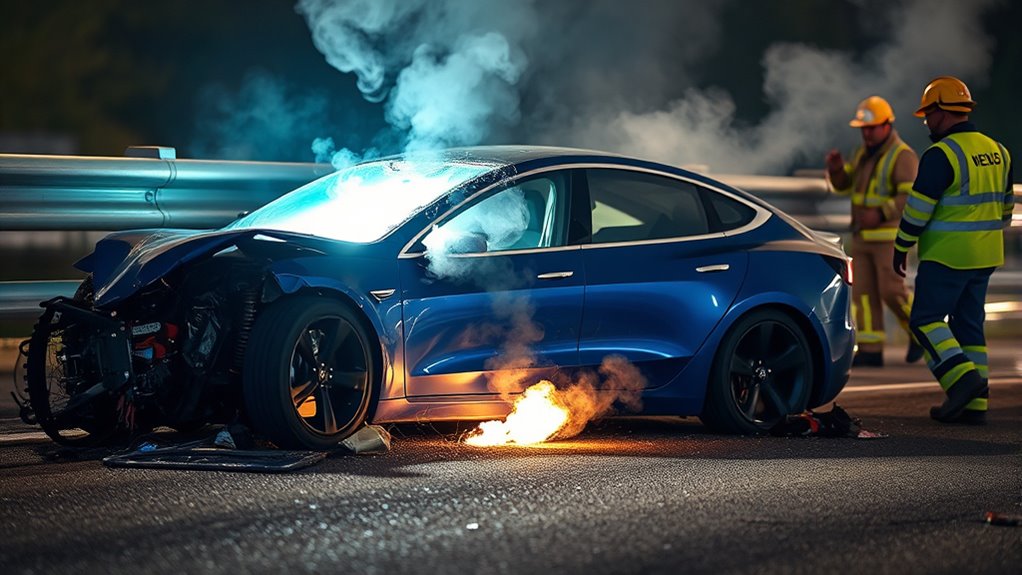
Crashes involving electric cars tend to cause more damage and injuries than those with conventional vehicles. You might notice injury claims for electric vehicle crashes are about 23% higher on average, reflecting increased severity. Understanding these trends can help you better assess electric vehicle safety risks. Additionally, the net worth of notable figures associated with the industry can influence public perception and safety regulations.
Higher Damage Levels
Electric vehicle crashes tend to be more severe than those involving internal combustion engine cars, with the average severity increasing by approximately 8%. This higher damage level stems from factors like greater vehicle weight and energy absorption during impact. When electric cars are involved, you’re more likely to see extensive structural damage, increased repair costs, and longer recovery times. The added weight of batteries amplifies crash force, causing more significant deformation. Additionally, the high-voltage systems can contribute to complex repairs and potential hazards if not managed properly. Color accuracy and other technological factors also influence the extent of damage in electric vehicle accidents, affecting repair strategies and safety measures.
Injury Claim Trends
Research indicates that crashes involving electric vehicles tend to result in higher injury claims, reflecting increased severity. While accident frequency may be lower, the injuries tend to be more serious due to factors like vehicle weight and crash dynamics. For example, bodily injury claims average 23.1% higher for electric cars, though personal injury claims decrease by 23.7%. The table below summarizes injury trends across different aspects:
| Aspect | Electric Vehicles | Conventional Vehicles |
|---|---|---|
| Average injury claims | Higher (23.1%) | Lower |
| Personal injury claims | Decreased (23.7%) | Increased |
| Injury severity score | Slightly elevated | Lower |
Understanding these trends helps you better assess the risks associated with electric vehicle crashes and the crash dynamics that influence injury outcomes.

ChargePoint HomeFlex Level 2 EV Charger J1772 - Fast Smart Battery Power Charging at Home for Electric Automobile Vehicles - Hardwired for Electric Car
- Reliable Home Charging: Builds dependable EV charging stations
- 24/7 Support: Around-the-clock assistance available
- Mobile App Control: Manage charger via smartphone app
As an affiliate, we earn on qualifying purchases.
Are Electric Vehicles More Prone to Fires After Collisions?

Are electric vehicles more prone to fires after collisions? The answer is generally no. Statistics show that EV fires are rare and often less frequent than those in conventional cars. In Sweden, EV fires accounted for only 0.004% of the fleet in 2022, with similar data from Norway. The high-voltage systems are designed to shut off immediately after a crash, reducing electrical fire risks. Despite concerns, EV fires do not occur more often after accidents. Instead, research indicates that the risk of fire in electric vehicles is lower than in traditional vehicles overall.
EV fires are extremely rare and less frequent than in conventional cars, even after collisions.
- High-voltage systems turn off instantly in crashes
- EV fire incidents are extremely rare
- Batteries are designed to prevent thermal runaway
- Conventional car fires are more common statistically

Jackery Explorer 300 Portable Power Station,292Wh
- Lightweight Design: Only 7.5 lbs with 292Wh capacity
- Multiple Device Compatibility: Power for laptops, drones, cameras, and more
- Versatile Charging Ports: 2 AC outlets, USB-C, USB-A, car port
As an affiliate, we earn on qualifying purchases.
How Do Safety Features in Electric Cars Enhance Protection?

Safety features in electric cars substantially enhance protection by actively preventing accidents and reducing their severity. They include systems like lane departure warning, forward collision warning, crash imminent braking, and dynamic brake support. These technologies alert you to potential dangers and automatically intervene if needed, helping avoid crashes altogether. Additionally, the lower center of gravity from battery placement improves stability, while a simpler drivetrain reduces mechanical failures. Here’s how these features contribute:
| Safety Feature | Benefit |
|---|---|
| Lane departure warning | Keeps you in your lane, preventing accidents |
| Forward collision warning | Alerts you of imminent frontal crashes |
| Crash imminent braking | Automatically applies brakes to avoid impact |
| Dynamic brake support | Enhances braking efficiency during emergencies |
| Tesla FSD technology | Demonstrates markedly lower crash rates |
Furthermore, the integration of local automation can enhance the overall safety system by enabling more precise responses in complex driving scenarios.
Together, these systems work to keep you safer on the road.
What Do Crash Test Results Reveal About Electric Vehicle Safety?
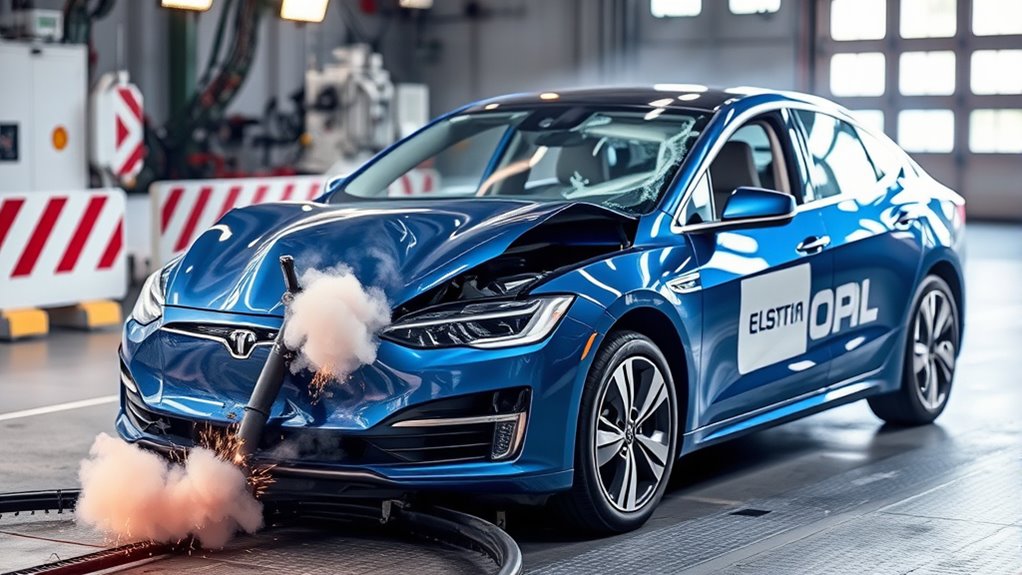
Crash test results provide a clear picture of how electric vehicles perform in real-world collision scenarios. These tests reveal that many electric models earn high safety ratings, especially in frontal crash tests. Vehicles like the BMW i4, Chevrolet Blazer EV, and Volkswagen ID.Buzz received good ratings, indicating strong crashworthiness. However, some models, like the Ford F-150 Lightning, scored poorly in certain tests. The Nissan Ariya showed increased risks for chest, head, and neck injuries for rear-seat passengers, despite good driver protection. Pedestrian safety also varies, with some EVs excelling in crash prevention. Headlight performance remains a weak point across many models. Overall, crash test results highlight that electric vehicles can be very safe, but performance varies by model and specific crash scenario. Understanding crashworthiness helps consumers make informed safety choices about electric vehicles.
Industry Insights: Risks and Concerns in Electric Vehicle Usage

While electric vehicles generally offer safety advantages, industry insiders remain vigilant about unique risks and concerns. One issue is the variability in crash data; some studies suggest higher crash severity and bodily injury claims with EVs, while others show lower accident rates thanks to advanced driver-assistance systems. Fire risks are often debated, but statistics indicate electric vehicle fires are rare and less frequent than those in conventional cars. High-voltage batteries and electrical systems require specialized handling, posing risks during accidents or repairs. Additionally, the industry faces concerns about the durability of safety features like crash prevention and pedestrian detection, especially in emerging models. As EV adoption increases, ongoing research and safety innovations are essential to address these risks and guarantee driver and public safety. European cloud innovation plays a crucial role in supporting the development of safer, more reliable EV technologies through data management and cybersecurity.
The Impact of Vehicle Design and Technology on Safety Performance
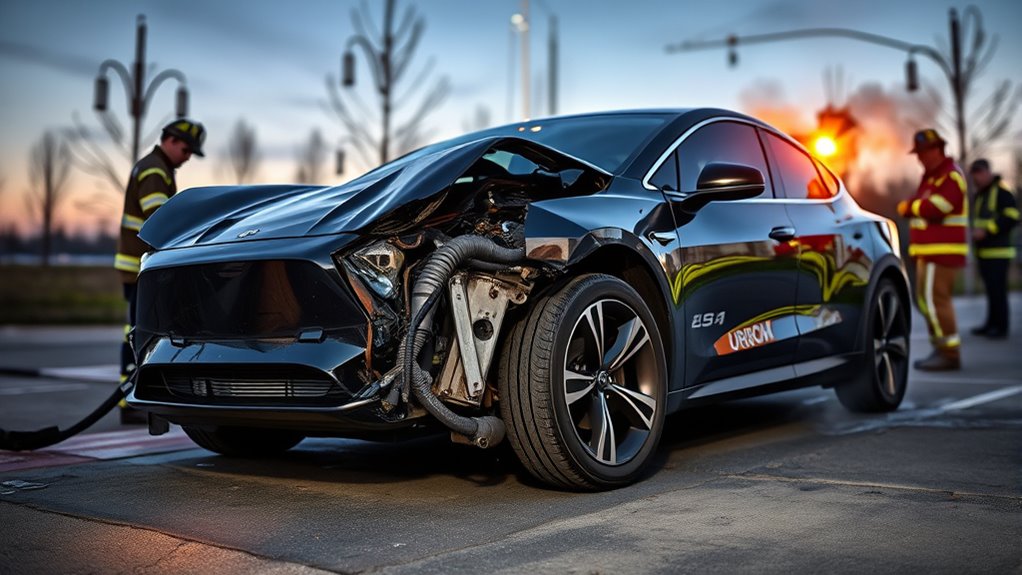
Vehicle design and technology play an essential role in shaping the safety performance of electric cars. Modern designs incorporate features that enhance crashworthiness and reduce risks. For example, a lower center of gravity from battery placement improves stability, minimizing rollover chances. Advanced driver-assistance systems like collision warnings and automatic braking help prevent accidents. Simplified drivetrains reduce mechanical failures, increasing reliability. High-voltage electrical systems are engineered to shut off instantly during crashes, lowering fire risks. These innovations contribute to better safety outcomes. Key points include:
- Improved structural integrity for crash protection
- Advanced safety features like lane departure and collision alerts
- Battery placement optimizing vehicle stability
- Electrical systems designed for rapid disconnection in accidents
- Vehicle design improvements further enhance overall crash safety and reliability
Final Considerations: Are Electric Cars a Safe Choice?

When considering electric cars, you should weigh their overall safety performance against fire and crash risks. While electric vehicles tend to have lower fire risks, some data shows they experience more accidents in certain areas. Additionally, advancements in high-heat outdoor cooking technology demonstrate how safety and precision are crucial in managing thermal risks, which is equally important when evaluating vehicle safety. Ultimately, understanding these factors helps you decide if an electric car is a safe choice for your needs.
Overall Safety Performance
Electric cars generally offer a safer driving experience compared to conventional vehicles, thanks to advances in technology and safety features. You benefit from lower accident rates, improved stability, and innovative driver-assistance systems. While some data indicates slightly higher crash severity or bodily injury claims, overall, electric vehicles perform well in safety assessments. Their simpler drivetrain reduces mechanical failures, and features like lane departure warnings and crash mitigation enhance driver safety. Additionally, electric vehicle fires are rare and generally less risky than those in combustion cars, thanks to high-voltage system safety measures. You also gain from industry-standard crash test ratings, with many models earning good or acceptable scores. Overall, electric cars present a reliable, safe option backed by technology and safety innovations. Studies show that modern electric vehicles incorporate smart appliances and connected systems that further enhance safety through real-time monitoring and automated responses.
Fire and Crash Risks
Although electric cars contain high-voltage batteries, their fire risk is actually lower than that of conventional vehicles. Statistically, EV fires are rare, making up only 0.004% of the national fleet in countries like Sweden and Norway. When collisions occur, high-voltage systems switch off instantly, reducing electrical fire risks. Crash data shows electric vehicles tend to have slightly higher severity and injury claims, but overall crash rates are often lower or comparable to traditional cars, especially with advanced driver-assistance features. Modern electric vehicles undergo rigorous crash testing and include safety tech that enhances protection. While some concerns exist about battery fires, the evidence indicates they are less frequent and less severe than fires in gasoline-powered cars. Overall, electric cars offer a safe alternative for drivers.
Frequently Asked Questions
How Do Electric Vehicle Crash Rates Compare Across Different Countries?
You’ll find that electric vehicle crash rates vary by country. For example, Swiss insurance data shows electric cars crash 50% more often, but this data isn’t fully published. In contrast, Tesla Autopilot crashes are extremely rare, with one crash per 6.69 million miles driven. In Norway and Sweden, EV fire risks are very low, around 0.004%, often lower than combustion engine vehicles. These differences highlight how local factors influence safety statistics.
What Is the Safety Record of Electric Vehicles in Severe or Multi-Vehicle Crashes?
In severe or multi-vehicle crashes, electric vehicles generally perform well, with insurance data showing only about 8% higher severity compared to conventional cars. You’re less likely to sustain injuries, as bodily injury claims are lower in EVs. Plus, modern safety features like collision warning systems and crash mitigation tech help reduce risks. Electric vehicles’ lower fire risk and advanced safety tech make them a safer choice in serious crashes.
Are Electric Vehicle Fires More Difficult to Extinguish Than Traditional Car Fires?
You’ll find electric vehicle fires are generally more manageable than traditional car fires. Their high-voltage systems are designed to switch off instantly in a crash, reducing ongoing risks. Firefighters benefit from this quick shutdown, making extinguishing easier. While electric fires might seem more complex initially due to batteries, their lower overall fire risk and simplified electrical systems mean they’re often less stubborn once the fire is contained.
How Effective Are Electric Vehicle Safety Systems in Preventing Accidents?
Electric vehicle safety systems are highly effective in preventing accidents. You benefit from advanced driver-assistance features like lane departure warnings, forward collision alerts, and crash imminent braking, which actively reduce your risk of crashing. Tesla’s Autopilot and Full Self-Driving tech have demonstrated crash rates markedly lower than the national average. These systems work together to enhance your driving safety, helping you avoid accidents before they happen and providing peace of mind on the road.
Do Electric Vehicle Crash Test Ratings Vary Significantly Between Manufacturers?
While electric vehicle crash test ratings do show some variation among manufacturers, you’ll find most models earn favorable assessments, reflecting impressive safety standards. Brands like BMW, Chevrolet, and Tesla often perform well, earning good or acceptable ratings in front crash tests. However, some models, such as Ford’s F-150 Lightning and Nissan Ariya, face challenges in certain categories, reminding you that safety ratings can differ slightly depending on design choices and testing parameters.
Conclusion
Overall, electric cars are as safe as traditional vehicles, with crash tests showing comparable results. While about 25% of EV fires involve post-collision incidents, advanced safety features and modern design help protect you better than ever. Remember, choosing an electric car means embracing innovative technology that prioritizes safety. So, rest assured—your chances of being involved in a severe accident or fire are low, making EVs a smart and secure choice for your next vehicle.