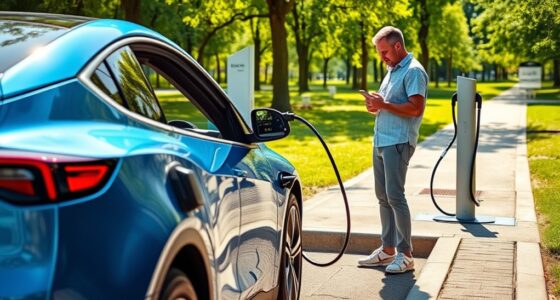
To plan a successful coast-to-coast EV road trip, map out your route with charging stations along the way using apps that show real-time availability. Prioritize routes with dense charging infrastructure and verify your vehicle’s compatibility with station types. Keep track of your battery levels and plan top-ups before running low. Staying flexible with your stops and options ensures a smooth journey. To discover more tips, explore how to optimize your trip for comfort and efficiency.

Get backup power and energy gear delivered free with Prime
- Fast, free delivery on millions of items
- Prime Video, Amazon Music and more included
- Member-only deals all year
Key Takeaways
- Map out your route with charging stations, prioritizing areas with dense charging infrastructure for convenience.
- Use real-time apps to locate available chargers, filter by type, and ensure compatibility with your EV.
- Plan charging stops to maintain a safe battery buffer and incorporate backup options for flexibility.
- Confirm station features and compatibility beforehand to avoid delays and choose fast chargers for quick top-ups.
- Schedule overnight stays at accommodations with charging facilities to optimize charging and rest efficiently.

Starting on a cross-country EV road trip offers an exciting way to explore the nation while embracing sustainable travel. To make your journey smooth and enjoyable, careful route planning is essential. One of the most important aspects is knowing where to find charging stations along your route. Unlike traditional gas stations, charging stations are less widespread, so you need to plan your stops carefully. Use apps and online maps that show real-time locations of charging stations, filter by charger type, and check for availability. This way, you won’t get stuck searching for a place to recharge or, worse, running low on battery. Pre-planning your charging stops ensures you maintain a safe buffer, giving you peace of mind and avoiding unnecessary delays.
As you plot your route, consider the range of your EV and how it aligns with the distances between charging stations. Some routes have dense networks of chargers, while others require more strategic planning. Prioritize routes that feature frequent charging opportunities, especially if you’re new to long-distance EV travel. It’s also smart to identify high-speed chargers, like DC fast chargers, which can considerably cut down your charging time—saving you hours of waiting at the station. Incorporate these stops into your itinerary, and be flexible; sometimes, chargers might be busy, or a station might be temporarily out of service. Having backup options along your route prevents delays and keeps your trip on track.
You should also consider the type of charging stations available at different locations. Not all chargers are compatible with every EV, so double-check your vehicle’s charging specifications. Consider installing charging station apps that provide detailed info about the type, power output, and whether a station is currently operational. Planning your route with these details in mind ensures you won’t face compatibility issues or unexpected detours. Additionally, look into accommodations with charging stations if you plan to stay overnight. Many hotels now offer EV charging, turning your overnight stay into a convenient top-up session.
Finally, keep an eye on your EV’s battery status regularly, especially as you approach planned charging stops. A little extra planning goes a long way in avoiding range anxiety and keeps your journey stress-free. With thoughtful route planning and a good understanding of charging station locations, you’ll enjoy a seamless, eco-friendly adventure across the country. Understanding the importance of high-quality projectors can help you make informed decisions about your home entertainment setup. Embrace the flexibility and unique experience of traveling in an electric vehicle, knowing you’re making a positive impact while discovering new places along the way.
Products Worth Considering

Autel MaxiCharger Level 2 EV Charger, 40A, 240V, Indoor/Outdoor, 25‑Foot Flexible Cable, NEMA 14‑50 Plug (White)

Autel Home EV Charger up to 50A J1772 Hardwired Level 2 Charger with 25 ft Cable

Autel 40A Level 2 EV Charger, 240V NEMA 14-50 J1772, WiFi, 25ft Cable
As an affiliate, we earn on qualifying purchases.
Frequently Asked Questions
How Do I Find Charging Stations in Remote Areas?
To find charging stations in remote areas, you should use charging station networks like PlugShare or ChargePoint, which provide real-time maps and user reviews. Before your trip, plan your route with these tools, focusing on remote area navigation. Download offline maps and confirm your EV’s navigation system is updated. Staying connected and aware of station availability helps prevent unexpected stops, making your journey smoother and stress-free.
What Is the Best EV Model for Long-Distance Travel?
Think of the Tesla Model S as your trusty steed—its impressive battery capacity and access to extensive charging infrastructure make it ideal for long-distance travel. Its range surpasses many competitors, ensuring you can cover vast distances without frequent stops. Plus, Tesla’s supercharger network helps you recharge quickly in remote areas. For the best long-distance EV experience, prioritize models with high battery capacity and widespread charging options.
How Can I Estimate Charging Times Accurately?
To estimate charging times accurately, consider your EV’s battery efficiency and the charging station density along your route. Use your vehicle’s onboard info or apps like PlugShare to identify stations and their power levels. Keep in mind that faster chargers reduce charging time, while higher station density means less waiting. Regularly plan breaks around charging stops, and check real-time station availability for the most precise estimates.
Are There Any Apps to Help Plan My Route?
Yes, several apps like PlugShare, A Better Route Planner, and ChargePoint can help you plan your route effectively. They show nearby charging stations, estimate charging times, and suggest ideal stops. While using these apps, remember EV maintenance tips and charging etiquette to ensure smooth stops. Being courteous at chargers and keeping the ports clean makes your journey enjoyable and helps others on their trip too.
What Should I Pack for a Cross-Country EV Trip?
You should pack your essential items like a reliable charging cable, spare adapters, and a portable power bank. Don’t forget comfort items such as travel pillows, snacks, and a blanket for long stretches. Bring your valid driver’s license, vehicle registration, and a basic first aid kit. These packing essentials guarantee you’re prepared, comfortable, and ready to handle any surprises along your coast-to-coast EV journey.
Conclusion
As you carve your way across the open highway, your EV becomes more than just a vehicle; it’s your ticket to adventure and discovery. With every charging stop, you’re weaving a tapestry of memories, turning the journey into a vibrant story. Embrace the thrill of the road, knowing you’re part of a new era of exploration—where innovation meets freedom. So, hit the road with confidence, and let your cross-country voyage become a symphony of discovery and joy.