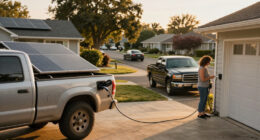
When driving your EV in the mountains, hills markedly affect your range—climbing sups up power and drains the battery faster, while descending allows regenerative braking to recover energy. To prepare, plan your route with charging stations, maintain moderate speeds, and use regenerative braking on downhills. Cold weather can also lower efficiency, so precondition your vehicle. Keep these tips in mind, and you’ll learn how to maximize your range and stay charged during mountain adventures.

Get backup power and energy gear delivered free — and shop member deals
- Fast, free delivery on millions of items
- Access to Prime Big Deal Days deals on October 6–7
- Prime Video, Amazon Music and more included
Key Takeaways
- Uphill climbs increase energy consumption, reducing EV range; plan routes with manageable inclines when possible.
- Use regenerative braking downhill to recover energy and extend battery life during mountain drives.
- Map out charging stations ahead of time, especially in remote mountain areas, to prevent range anxiety.
- Maintain steady speed and precondition your EV to optimize battery performance in variable weather conditions.
- Monitor battery levels actively and stay flexible with stops to adapt to energy fluctuations on rugged terrain.

Starting on an EV road trip through the mountains offers an exhilarating blend of adventure and sustainability. But as you ascend and descend those hills, you’ll notice your vehicle’s range can change markedly. Hills impact your EV’s efficiency because climbing steep inclines demands more power, which drains the battery faster. To get the most out of your trip, it’s vital to plan ahead, especially when it comes to charging stations and battery management. Knowing where charging stations are located along your route can help prevent range anxiety and guarantee you’re never stranded. Map out charging spots beforehand using apps or navigation tools that highlight charging stations in real-time, so you can time your stops efficiently. This way, you won’t waste precious time searching for a charger or worry about running out of power on a remote mountain road.
Proper battery management becomes essential in mountainous terrain. As you navigate uphill sections, your vehicle’s battery will deplete faster because of the increased energy demand. To conserve power, maintain a steady, moderate speed instead of accelerating aggressively, which consumes more energy. Use regenerative braking whenever possible on downhill stretches; this feature recovers some energy and extends your range. Keep in mind that frequent rapid charging isn’t ideal for battery longevity, so plan your charging stops accordingly. Balance your battery’s state of charge by avoiding letting it get too low or charging it excessively beyond 80%, which can strain the battery over time. Additionally, consider the weather conditions—cold temperatures can reduce battery efficiency, so preconditioning your EV before starting the trip can help. Preconditioning warms the battery and interior, making your vehicle more efficient and comfortable. Being aware of how hills impact range and adjusting your driving habits accordingly will help you maximize efficiency throughout your mountain journey.
Monitoring your battery’s status throughout your journey is key. Use your vehicle’s dashboard or companion app to keep an eye on charge levels, especially when climbing or descending steep hills. Adjust your driving habits based on these readings; for instance, if your battery drops rapidly during a climb, you might choose to slow down slightly or plan an earlier charging stop. Remember that mountain driving often involves winding roads and elevation changes, which can increase energy consumption unpredictably. Staying flexible with your route and stops will help you adapt to these fluctuations. By combining strategic planning for charging stations with mindful battery management, you’ll enjoy a smooth, eco-friendly mountain adventure without unnecessary stress or range worries. This approach not only enhances your trip but also promotes sustainable travel, proving that you can explore nature responsibly while keeping your EV powered and ready for the next adventure.
EV charging station portable charger
As an affiliate, we earn on qualifying purchases.
As an affiliate, we earn on qualifying purchases.
Frequently Asked Questions
How Do Mountain Elevations Affect EV Battery Performance?
Higher mountain elevations can reduce your EV battery efficiency because altitude effects cause thinner air, making your motor work harder. As you ascend, the increased effort can drain your battery faster, lowering your overall range. To prepare, keep an eye on your battery level, plan charging stops accordingly, and drive smoothly to minimize power usage. Understanding altitude effects helps you optimize your trip and avoid unexpected range issues in mountainous terrain.
What Are Best Practices for Charging in Remote Mountain Areas?
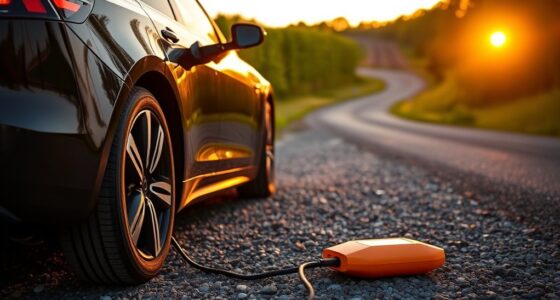
Imagine you’re on a mountain trip and need to charge your EV. You should plan ahead by locating nearby charging stations and utilizing power management features on your vehicle. For example, in remote areas, you might carry a portable charger or backup power source. Always conserve energy, avoid rapid charging, and monitor your battery to ensure you reach the next station safely. Proper planning keeps your trip smooth and stress-free.
How Does Altitude Influence EV Range Calculations?
Altitude effects can reduce your EV’s range because higher elevations often decrease battery efficiency. When you’re in the mountains, the thinner air causes your vehicle to work harder, which drains your battery faster. To prepare, plan for slightly lower range estimates and consider charging stations along your route. Keep your driving smooth, avoid rapid acceleration, and stay aware of how altitude changes impact your EV’s performance for a successful mountain trip.
Are There Specific EV Models Better Suited for Mountain Trips?
Think of choosing an EV for mountain trips like picking a trusty steed for rugged terrain. Some models, like Tesla Model S or Audi e-tron, excel thanks to better battery efficiency and robust power. These vehicles are built to handle elevation changes with less range loss, making vehicle selection vital. When you pick wisely, you guarantee your adventure continues smoothly, even when climbing steep hills.
What Safety Precautions Should I Take for Mountain EV Travel?
You should check mountain weather forecasts before your trip and be prepared for sudden changes. Carry emergency supplies like blankets, water, and a first aid kit, and guarantee your EV has a full charge. Keep a roadside emergency kit handy, including a flashlight and basic tools. Inform someone of your route, and avoid traveling alone in remote areas. Staying prepared helps you handle unexpected situations safely during mountain EV travel.
As an affiliate, we earn on qualifying purchases.
Conclusion
As you plan your mountain EV road trip, remember that hills can reduce your range by up to 20%. Preparing by charging in advance and understanding elevation impacts can keep your journey smooth. Imagine climbing those steep slopes knowing you might lose a fifth of your battery’s capacity—that’s like losing almost 15 miles on a 75-mile trip. With the right planning, you’ll enjoy breathtaking views without range anxiety, turning every mountain pass into a memorable adventure.
mountain road trip EV accessories
As an affiliate, we earn on qualifying purchases.
As an affiliate, we earn on qualifying purchases.
As an affiliate, we earn on qualifying purchases.
Halloween Picks
halloween
As an affiliate, we earn on qualifying purchases.