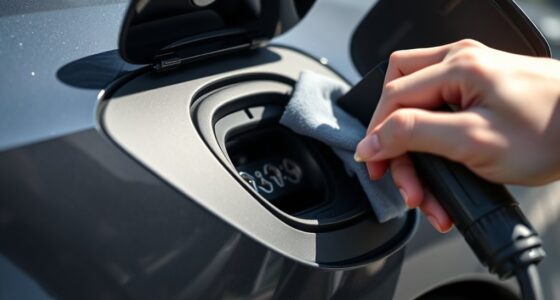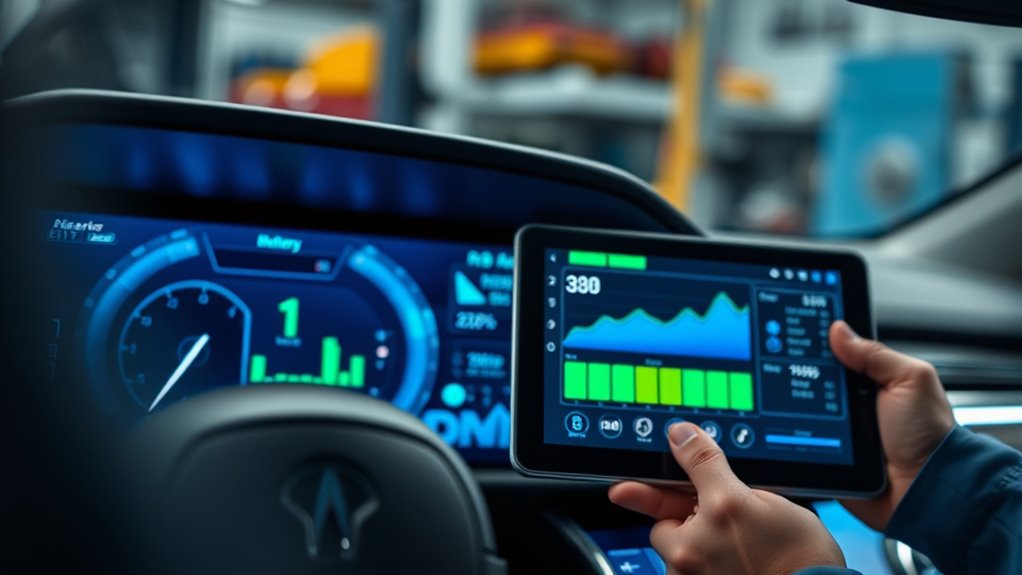

To check your EV’s battery health, start with built-in vehicle tools or your mobile app that often show capacity and cycle count. You can also use diagnostic tools compatible with your car to analyze capacity loss and degradation. Regular calibration, which involves full charging and discharging cycles, helps improve accuracy. Keep an eye on performance changes like range drops or longer charging times. If you’re interested in more tips and tools, you’ll find useful insights to help maintain your battery’s longevity.
Key Takeaways
- Use built-in vehicle diagnostics or dedicated apps to check real-time battery health and cycle count.
- Perform regular full charge and discharge cycles to calibrate your battery for accurate readings.
- Monitor changes in range, charging times, or performance as signs of potential degradation.
- Utilize third-party diagnostic tools for detailed capacity loss and health reports.
- Keep track of charge cycles and schedule maintenance or replacements proactively based on data.

Electric vehicle batteries are essential to your car’s performance and longevity, so regularly checking their health is necessary. One of the most effective ways to do this is through battery calibration, which ensures your vehicle’s battery management system accurately reads the state of charge. Over time, battery calibration can drift, leading to inaccurate readings that may cause you to underestimate your battery’s remaining capacity. To calibrate your battery, fully charge it to 100%, then let it discharge completely until the vehicle indicates it’s empty. Repeat this process a couple of times to reset the battery’s internal sensors, helping your car’s system provide more precise data about your battery’s health.
Alongside calibration, charge cycle analysis plays an important role in monitoring your EV’s battery degradation. Every charge and discharge cycle slightly wears down the battery, gradually reducing its capacity over time. By tracking how many charge cycles your battery has undergone, you can gauge its overall health and anticipate when it might need maintenance or replacement. Many EVs provide built-in tools or apps that record charge cycle counts, giving you a clear picture of how your battery is aging. If your vehicle doesn’t offer this feature, you might consider third-party diagnostic tools that connect to your car’s onboard systems, providing detailed reports on cycle counts and capacity loss.
Monitoring charge cycles helps you assess your EV battery’s health and plan maintenance or replacements proactively.
Using these tools regularly allows you to spot early signs of degradation, such as a rapid decline in range or inconsistent charging behavior. If you notice your battery isn’t holding a charge like it used to, or if the calibration process reveals inaccurate readings, it might be time to consult a professional or consider servicing options. Keeping an eye on charge cycle analysis and maintaining proper calibration can extend your battery’s lifespan and ensure you get reliable performance from your EV. Regular battery monitoring can help catch issues before they become critical, saving you time and money.
In addition to these technical checks, pay attention to how your vehicle performs during daily use. Sudden drops in range or longer charging times can signal underlying issues. Combining regular calibration with charge cycle tracking offers a thorough approach to maintaining your EV’s battery health. By staying proactive, you not only maximize your battery’s lifespan but also ensure your vehicle remains dependable for years to come. Remember, understanding your battery’s condition empowers you to make informed decisions about usage and maintenance, ultimately saving you money and frustration in the long run.

Autel EVDiag Box EV Diagnostics Upgrade Kit Professional Electric Vehicle Scanner for EV High-Voltage Sys & Battery Pack Diagnostics Test Compatible with MaxiSys Ultra/Ultra ADAS/ MS919/ MS909
【Turn Your MS909/MS919/Ultra Tablet Into Pro-level EV Scanner】 Combining MaxiSys scanner with Autel EV kit does intelligent diagnostics,…
As an affiliate, we earn on qualifying purchases.
As an affiliate, we earn on qualifying purchases.
Frequently Asked Questions
How Often Should I Check My Ev’s Battery Health?
You should check your EV’s battery health at least once a year to guarantee ideal battery longevity. Regular monitoring fits into your maintenance schedule and helps catch issues early. If you notice reduced range or charging problems, check more frequently. Staying proactive with these checks lets you maintain battery performance, extend its lifespan, and avoid costly repairs down the line. Remember, consistent care keeps your EV running smoothly for years to come.
Can I Assess Battery Health Without Specialized Tools?
You can assess your EV’s battery health without specialized tools by performing battery calibration and using software diagnostics. Battery calibration involves fully charging and discharging your battery to reset its state of charge indicator, revealing potential issues. Software diagnostics, often accessible via your vehicle’s dashboard or app, can provide basic health insights. While these methods offer some information, for a detailed assessment, professional tools are more accurate.
What Are Signs My EV Battery Is Degrading?
You’ll notice your EV’s battery degrading if you see reduced range or longer charging times. As your battery weakens, you might need battery replacement sooner than expected. Pay attention to your charging habits too; frequent fast charging can accelerate degradation. If these signs appear, it’s wise to get a professional assessment to determine if your battery needs replacement, helping you maintain ideal performance and avoid unexpected breakdowns.
Does Battery Health Impact Vehicle Range Significantly?
Yes, your EV’s battery health can substantially impact vehicle range. As the battery’s lifespan decreases, it holds less charge, reducing how far you can go on a single charge. Your charging habits, like frequent fast charging or letting the battery drain deeply, can accelerate degradation. To maintain ideal range, charge gradually, avoid extreme states of charge, and monitor your battery’s health regularly. Proper care helps extend battery life and keeps your range consistent.
How Does Climate Affect EV Battery Degradation?
Climate impact is huge—your EV’s battery can suffer faster degradation in extreme temperatures. Temperature effects are real; hot weather accelerates chemical reactions, leading to quicker wear, while cold weather hampers performance and reduces range. To protect your battery, avoid leaving your EV in direct sunlight or freezing conditions for long periods. Maintaining ideal climate conditions helps preserve your battery’s health and keeps your vehicle running smoothly for years.

ANCEL BM200-US Car Battery Tester 12V Automotive Battery Monitor Bluetooth Auto Battery Load Tester with Cranking Charging Test Alarm Record Voltage History Voltmeter for Car/RV/Motorcycle/Truck/Boat
🔋High Value Battery Tester: BM200 is your go-to solution for 12V lead-acid and lithium battery. Equipped with advanced…
As an affiliate, we earn on qualifying purchases.
As an affiliate, we earn on qualifying purchases.
Conclusion
Regularly monitoring your EV’s battery health guarantees ideal performance and longevity. While some might think it’s complicated or time-consuming, using simple tools and tips makes it straightforward and manageable. Plus, staying proactive helps catch potential issues early, saving you money and stress down the line. Don’t wait until your range drops considerably—by checking your battery’s health now, you’re investing in your vehicle’s future reliability and value.

BildeeMait for battery Capacity Indicator LCD Digital Meter DC 8-100V Voltage Monitor With Auto Calibration SOC Curve Import Alarm for RV EV for battery Systems(C)
[INTERCHANGEABLE LCD CAPACITY INDICATOR] The digital display provides precise capacity and voltage readings for DC 8-100V systems with…
As an affiliate, we earn on qualifying purchases.
As an affiliate, we earn on qualifying purchases.

lukar EV Charger Pedestal,EV Charger Stand with Roof and Side Protection
Perfect Weatherproof Protection:This electric vehicle charging dock has a sturdy top cover and side protection, which can protect…
As an affiliate, we earn on qualifying purchases.
As an affiliate, we earn on qualifying purchases.