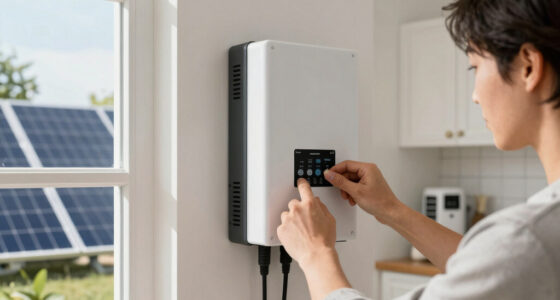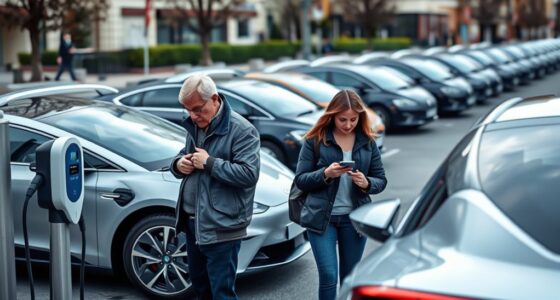
You can’t get an EV to charge itself because that would break the basic laws of physics, specifically energy conservation. An EV needs an external power source, like the grid or renewable energy, to recharge its battery. Self-charging or perpetual motion devices are myths that ignore how energy transfer works in real systems. Keep exploring, and you’ll discover the facts behind how EVs actually operate and the truth about energy use.

Get backup power and energy gear delivered free with Prime
- Fast, free delivery on millions of items
- Prime Video, Amazon Music and more included
- Member-only deals all year
Key Takeaways
- EVs require external energy sources; they cannot generate power internally or perpetually recharge.
- Self-charging EVs would violate fundamental physics principles and the law of conservation of energy.
- Charging involves connecting to external power like the grid or renewable sources, not internal energy.
- Technological advances improve battery efficiency but do not enable self-sustaining or perpetual charging.
- The idea of self-charging EVs is a myth; reliable charging depends on external, available energy sources.
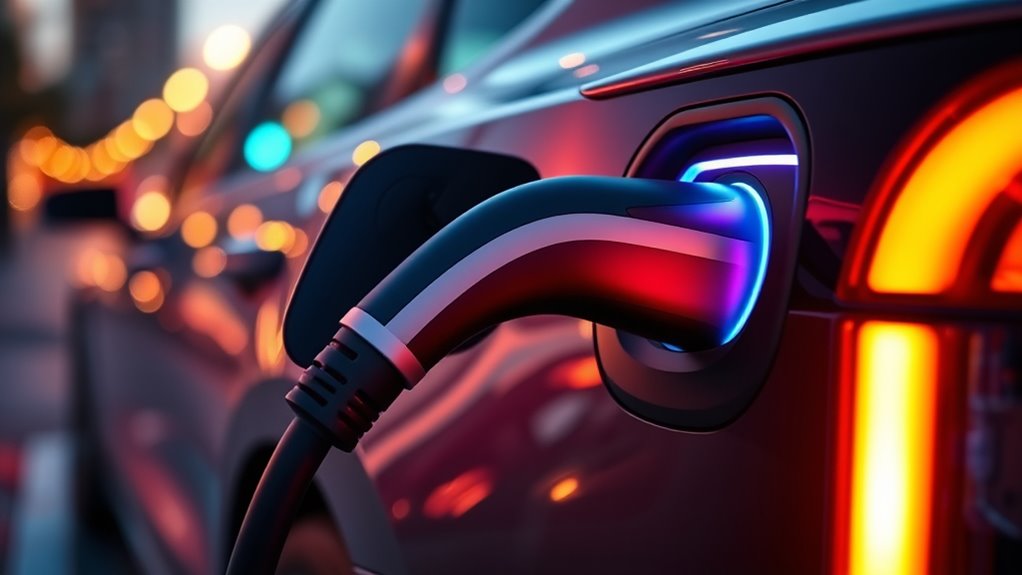
Have you ever wondered if charging an electric vehicle (EV) is complicated or costly? It’s a common concern, but understanding how EVs operate can clear up many misconceptions. One key aspect involves battery efficiency, which directly impacts how well your vehicle holds a charge and how quickly it can be replenished. Unlike perpetual motion machines, EV batteries aren’t self-sustaining or capable of generating power on their own. Instead, they store energy supplied through the charging infrastructure, making the process straightforward and reliant on external sources.
Battery efficiency is essential because it determines how much energy your EV can store relative to what you put in. Modern batteries are designed to maximize this efficiency, allowing you to travel longer distances with less charge. While no battery is perfect—some energy is always lost during charging and discharging—advances in technology continue to improve overall performance. This means fewer stops for charging and more reliable range, dispelling the myth that EVs are constantly running out of power or need constant babysitting.
Charging infrastructure plays a critical role in making EV charging simple and accessible. Today’s network of charging stations is expanding rapidly, from fast chargers along highways to local charging points at shopping centers and workplaces. This widespread infrastructure ensures you can recharge conveniently, often during routine errands or overnight at home. You don’t need special skills or equipment; most chargers are user-friendly, with clear instructions and standard connectors. This setup contrasts sharply with the idea of an EV that could charge itself—such a concept defies the basic laws of physics and is rooted in misconceptions.
It’s tempting to think that EVs could somehow generate their own power or perpetually charge themselves, but that’s a misunderstanding of energy conservation. Electricity must come from an external source—be it the grid, solar panels, or other renewable energy. The charging infrastructure acts as the bridge, delivering reliable power to your vehicle’s battery. As long as the source provides energy, your EV can be recharged efficiently and safely. Additionally, battery technology continues to improve, making the process even more efficient and reliable over time. There’s no need to worry about constantly fueling or “feeding” the vehicle; it’s simply a matter of connecting it to a power source, much like charging your phone.
In essence, EVs don’t charge themselves because doing so would violate fundamental principles of physics. The efficiency of your battery and the availability of charging infrastructure work together to make recharging convenient and predictable. Understanding this helps you see that EV charging isn’t a mysterious or overly complicated process but a practical, well-supported part of modern transportation.
Products Worth Considering

Autel Home EV Charger up to 50A J1772 Hardwired Level 2 Charger with 25 ft Cable

Autel 40A Level 2 EV Charger, 240V NEMA 14-50 J1772, WiFi, 25ft Cable

Autel MaxiCharger Level 2 EV Charger, 40A, 240V, Indoor/Outdoor, 25‑Foot Flexible Cable, NEMA 14‑50 Plug (White)
As an affiliate, we earn on qualifying purchases.
Frequently Asked Questions
Can EVS Generate Their Own Electricity From Motion?
EVs can’t generate their own electricity from motion because of battery efficiency limits and energy transfer losses. When you drive, the motion can produce small amounts of energy through regenerative braking, but this isn’t enough to fully recharge the battery. The energy transfer isn’t perfect, and significant energy is lost as heat, so self-charging isn’t feasible. Instead, EVs rely on external power sources to keep their batteries charged.
Are There Any Technological Breakthroughs That Could Enable Self-Charging EVS?
Right now, there are no breakthroughs that let EVs fully self-charge. You might see concepts like solar panels or kinetic energy recovery systems in development, but they can’t generate enough power to keep the vehicle moving indefinitely. While solar panels can add some charge and kinetic energy systems can recover limited energy during braking, these methods are supplementary. They don’t replace the need for external charging stations.
Do Regenerative Braking Systems Violate Conservation of Energy?
Regenerative braking systems don’t violate energy conservation because they don’t create energy; they recover it. You transfer kinetic energy into electrical energy, boosting system efficiency, but you don’t get more energy than you started with. This process respects conservation of energy, simply recycling it to extend your EV’s range. It’s a clever way to improve performance without breaking fundamental physical laws or creating perpetual motion.
Could Future Innovations Make Perpetual Motion Machines Feasible?
Future innovations won’t make perpetual motion machines feasible because magnetic energy and quantum fluctuations, while intriguing, still obey the laws of physics. You might think these could generate endless energy, but magnetic fields lose energy over time, and quantum fluctuations don’t produce continuous, usable power. The laws of thermodynamics remain intact, so perpetual motion, in the true sense, remains impossible despite advancing technology.
Is Wireless Charging Capable of Powering EVS Indefinitely?
Wireless charging isn’t capable of powering EVs indefinitely because of limited wireless efficiency and energy transfer losses. While it can extend driving range, the system can’t provide continuous, sufficient energy without interruptions. You’d need a highly efficient and constant energy transfer, which current technology doesn’t support. So, even with advancements, wireless charging won’t replace traditional charging entirely but can help reduce downtime during your trips.
Conclusion
Remember, just like the sun’s rays can’t power itself without the sky, EVs can’t charge themselves without external energy. The myth of perpetual motion is a shadow that distracts us from real progress—true sustainability requires understanding our limits and harnessing reliable sources. Embrace this truth as a lantern guiding your journey, illuminating the path toward innovation rooted in reality. Only then can we truly drive forward, fueled not by myth, but by mindful energy.