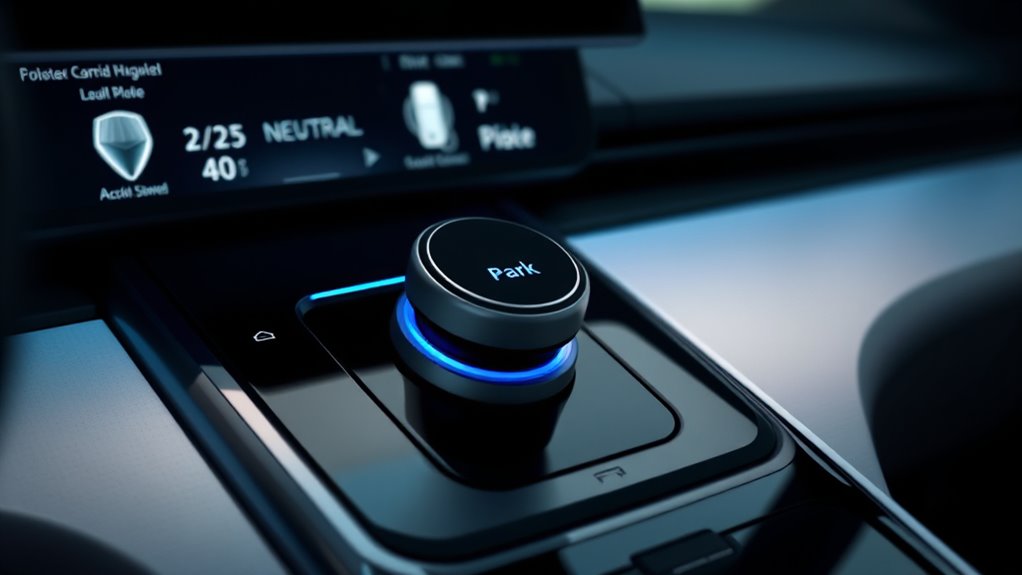
Yes, electric vehicles have a neutral gear, but it works differently from traditional cars. Instead of multiple gears, EVs typically feature a single-speed transmission or direct drive system, and the neutral disconnects the motor from the wheels, allowing free coasting or towing. This simplifies operation and reduces maintenance. When you switch to neutral or park, the vehicle’s control system manages the process seamlessly. Keep exploring to understand how these features guarantee safety and ease of use.

Get backup power and energy gear delivered free with Prime
- Fast, free delivery on millions of items
- Prime Video, Amazon Music and more included
- Member-only deals all year
Key Takeaways
- EVs typically have a neutral setting that disconnects the motor from the wheels for coasting or towing.
- Unlike traditional cars, EV neutral does not involve multiple gear engagement, simplifying operation.
- The neutral function in EVs allows the vehicle to roll freely without engine engagement, similar to neutral in conventional cars.
- Most EVs automatically shift into park when turned off, engaging a parking lock for safety.
- Electric vehicles’ gear systems are simplified, often with a single-speed transmission, eliminating traditional gear shifting complexity.
Electric vehicles (EVs) are transforming the way we think about transportation, and understanding how gears work in traditional cars can help you appreciate their simplicity. Unlike conventional vehicles that rely heavily on gear mechanics and various transmission types to manage power delivery, most EVs don’t have a multi-gear transmission system. Instead, they typically feature a simplified single-speed transmission or direct drive system, which eliminates the need for complex gear shifting. This design choice streamlines operation and reduces maintenance, making EVs easier to operate and more reliable in the long run.
In traditional cars, gears are crucial for controlling the engine’s power output, maximizing fuel efficiency, and providing smooth acceleration. You shift between different transmission types—manual, automatic, or continuously variable transmissions—to match driving conditions. These systems contain multiple gears that you manually or automatically engage, allowing the engine to operate within its ideal RPM range. This process involves a clutch or a torque converter, which manages power transfer from the engine to the wheels. When you switch to neutral, the transmission disconnects the engine from the wheels, enabling you to coast or stop without stalling the engine.
In EVs, the concept of a neutral gear still exists but differs markedly. Since electric motors produce instant torque across a wide RPM range, they don’t require multiple gears for different speeds. Instead, the vehicle’s control system manages power delivery smoothly, providing seamless acceleration without gear changes. When you put the car in “neutral,” the system basically disconnects the motor’s drive to the wheels, allowing the vehicle to coast freely. This neutral setting is especially useful when you want to push or tow the vehicle or when idling without moving.
Furthermore, the park function in EVs operates similarly to traditional cars, engaging a parking pawl that physically locks the transmission. This guarantees the vehicle remains stationary when parked, regardless of the electric motor’s simplicity. You don’t need to worry about shifting into park to prevent rolling, as the system does this automatically when you turn off the vehicle. Some EVs also include additional safety and parking features, like electronic parking brakes, which further improve convenience and security.
As an affiliate, we earn on qualifying purchases.
Frequently Asked Questions
Can You Shift EVS Into Gear While Moving?
No, you can’t shift EVs into gear while moving because of their gearless operation and transmission absence. Electric cars use a single-speed transmission, so there’s no need to shift gears like in traditional vehicles. Instead, you control acceleration and deceleration with the accelerator and brake pedals. Shifting gears isn’t necessary or possible while the vehicle is in motion, ensuring smooth, straightforward operation without the complexities of gear changes.
Do All EVS Have a Traditional Transmission System?
Not all EVs have a traditional transmission, and many don’t use a gear mechanism like conventional cars. Instead, they rely on a single-speed transmission or direct drive, simplifying the drivetrain. This design eliminates the need for shifting gears, making acceleration smoother, maintenance easier, and driving more straightforward. So, if you’re wondering whether all EVs have a traditional transmission, the answer is no—most use simplified, gearless systems for efficiency and ease.
Is “Neutral” Necessary During EV Charging?
You don’t need to put your EV in neutral during charging, as it’s designed for safe charging in parked position. While battery maintenance is key for longevity, ensuring proper charging safety is essential. Keep your vehicle in park, follow manufacturer instructions, and use recommended chargers. This avoids accidental movement and protects your battery, making charging safer and more effective without needing neutral gear.
How Does Regenerative Braking Affect Gear Use?
Regenerative braking in EVs doesn’t require gear changes because of gearless operation, which simplifies driving. When you brake, the system captures energy for battery management, converting kinetic energy into electrical energy. This process helps slow your vehicle smoothly without needing to shift gears, making your ride quieter and more efficient. So, regenerative braking works seamlessly with gearless operation, enhancing battery life and overall driving experience without the complexity of traditional gear systems.
Are There Safety Risks in Leaving an EV in Neutral?
Leaving your EV in neutral can pose safety concerns because it increases neutral risks, such as unintended vehicle movement if the brake isn’t engaged or on an incline. It’s safer to keep the car in park during stops, especially on hills, to prevent accidents. Always follow your manufacturer’s recommendations. Keeping your vehicle in gear when parked reduces safety risks and helps avoid accidental rollaways or other hazards.
As an affiliate, we earn on qualifying purchases.
Conclusion
So, now you know that most electric vehicles don’t have a traditional neutral gear but use a park mode instead. Remarkably, a recent study shows that over 70% of EV drivers find the parking process easier without a neutral gear. This simplicity not only enhances safety but also streamlines driving. As EV technology continues to evolve, understanding these differences helps you become a more confident and informed driver.
As an affiliate, we earn on qualifying purchases.
As an affiliate, we earn on qualifying purchases.
Halloween Picks
halloween
As an affiliate, we earn on qualifying purchases.