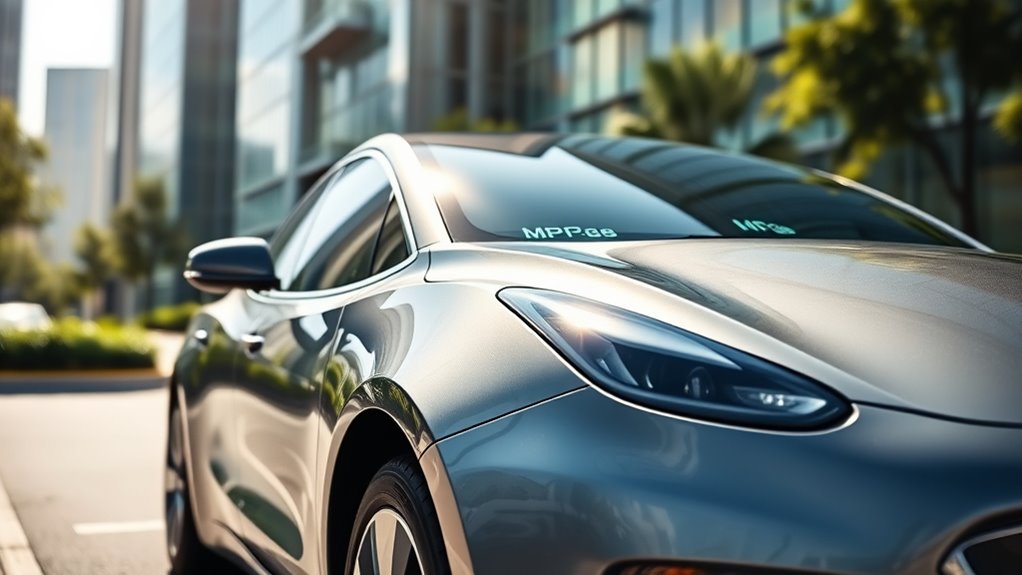

MPGe, or miles per gallon equivalent, is a way to measure how efficiently your electric vehicle uses energy by translating electrical consumption into a familiar miles-per-gallon figure. It helps you compare electric cars to traditional gas-powered vehicles regarding energy use and range. A higher MPGe means your car uses less energy to travel further. To understand how this impacts your driving and charging options, keep exploring how MPGe relates to battery capacity and infrastructure.
Key Takeaways
- MPGe (miles per gallon equivalent) measures how far an electric vehicle can travel on the energy contained in one gallon of gasoline.
- It allows comparison of electric vehicle efficiency to traditional gas-powered cars by converting electrical energy into miles driven.
- Higher MPGe indicates greater energy efficiency, meaning the vehicle can travel farther on less energy.
- Factors like battery capacity, driving habits, and external conditions influence actual MPGe performance.
- MPGe helps consumers understand the efficiency and practicality of electric vehicles relative to conventional cars.

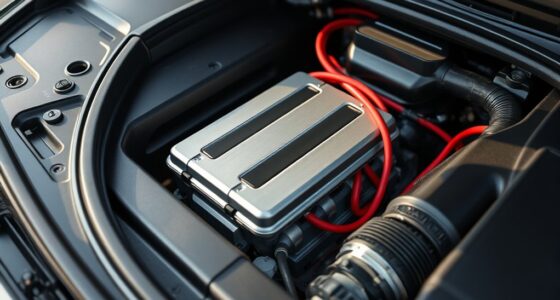
Electric car efficiency ratings can seem confusing at first, but understanding them is essential for making informed purchasing decisions. One of the key metrics you’ll encounter is MPGe, or miles per gallon equivalent. Unlike traditional gasoline vehicles, electric cars don’t rely on fuel consumption but instead measure how efficiently they convert electrical energy into driving distance. To grasp MPGe, it’s helpful to contemplate two important factors: battery capacity and charging infrastructure. Battery capacity determines how much energy the vehicle can store, directly influencing the car’s range and how often you’ll need to recharge. A larger capacity generally translates to more miles per charge, but it also impacts the vehicle’s overall efficiency rating. Meanwhile, the charging infrastructure plays a critical role in how conveniently and quickly you can replenish that energy. A robust charging network allows you to maintain ideal efficiency by minimizing downtime and ensuring you can recharge as needed, especially during long trips.
Understanding MPGe involves recognizing how it equates electricity consumption to a familiar measure—miles per gallon—making it easier for you to compare electric vehicles to traditional gas-powered cars. A higher MPGe indicates a more efficient vehicle, meaning it can travel further on less energy. However, this number isn’t just about raw efficiency; it also depends heavily on your driving habits, terrain, and how well the car’s battery capacity aligns with your typical daily range. For example, if your daily commute is short, a vehicle with a smaller battery capacity might still offer excellent MPGe, but if you regularly travel longer distances, you’ll want a car with a larger capacity and a well-developed charging infrastructure nearby to keep your trips smooth.
Keep in mind that the efficiency ratings don’t tell the whole story—they’re just a starting point. Real-world efficiency can vary based on how you accelerate, brake, and even external conditions like weather. Plus, the availability of charging stations can markedly impact your ability to maintain ideal efficiency, especially if you’re away from home charging options. If the charging infrastructure in your area is limited, you might find your vehicle’s MPGe less practical because you’ll spend more time planning routes around charging stations or waiting for your battery to recharge. Therefore, when evaluating electric cars, consider not just the MPGe but also the battery capacity and the local charging infrastructure to ensure the vehicle fits your lifestyle and travel needs.
As an affiliate, we earn on qualifying purchases.
Frequently Asked Questions
How Does MPGE Compare to Traditional Miles per Gallon?
MPGe measures how efficiently your electric car uses energy compared to traditional miles per gallon for gas-powered vehicles. While miles per gallon focuses on fuel economy, MPGe captures energy efficiency by showing how many miles you can travel on a set amount of electrical energy. You’ll find MPGe helps you compare electric vehicles’ efficiency with gas cars, making it easier to understand their fuel economy and overall energy savings.
Can MPGE Ratings Vary Between Different Electric Vehicle Models?
You’ll find MPGe ratings do vary between electric vehicle models. For example, a car with a larger battery capacity often achieves higher MPGe, but driving conditions like city vs. highway affect efficiency too. Interestingly, some models can achieve over 100 MPGe, making them more economical. So, when comparing, consider both battery capacity and typical driving conditions, as they notably influence each vehicle’s efficiency ratings.
Does Driving Style Affect an Electric Car’s MPGE?
Yes, your driving habits and acceleration styles definitely impact your electric car’s MPGe. Aggressive acceleration and rapid braking can decrease efficiency, using more energy and lowering your MPGe rating. Smooth, gradual acceleration and consistent speeds help maximize your vehicle’s efficiency. By adopting gentle driving habits, you can improve your electric car’s MPGe, making your trips more energy-efficient and cost-effective over time.
How Accurate Are MPGE Ratings for Real-World Driving?
MPGe ratings are generally a good estimate but can vary in real-world driving due to factors like real-world testing and your driver behavior. You might find that your actual efficiency differs because of terrain, speed, and acceleration habits. While ratings give a useful benchmark, expect some variation based on how you drive and road conditions, so don’t rely solely on MPGe for exact range predictions.
Are There Other Efficiency Metrics Besides MPGE?
Think of MPGe as just one piece of the puzzle. Besides MPGe, you can consider battery capacity, which shows how much energy your car can store, and charging efficiency, indicating how quickly and effectively it recharges. For example, a car with a large battery might have a high range, but if it charges slowly, you’ll want to weigh that. These metrics help you understand overall electric car efficiency better.
best electric vehicle charging stations
As an affiliate, we earn on qualifying purchases.
As an affiliate, we earn on qualifying purchases.
Conclusion
Now that you’ve uncovered the details of MPGe, you’re like a navigator steering through the vast ocean of electric car efficiency. Think of MPGe as your compass, guiding you toward smarter choices and greener horizons. With this knowledge, you can confidently chart a course, avoiding foggy pitfalls and sailing smoothly toward a sustainable future. Embrace the clarity MPGe offers, and let it be your lighthouse in the exciting journey of electric vehicle ownership.
electric vehicle battery charger
As an affiliate, we earn on qualifying purchases.
As an affiliate, we earn on qualifying purchases.
As an affiliate, we earn on qualifying purchases.