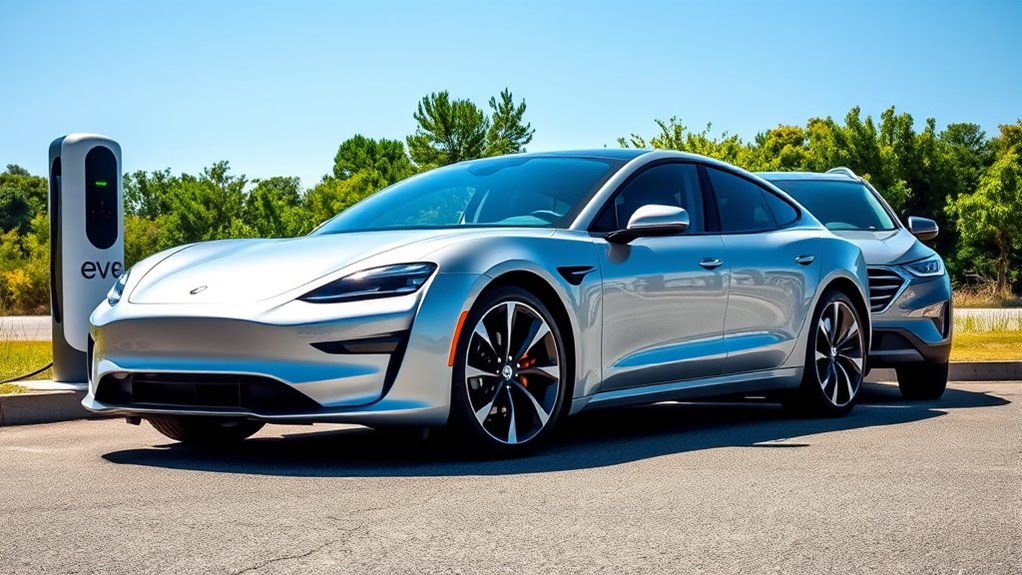
To decide if a full EV or a plug-in hybrid is best, consider your daily driving habits, access to charging stations, and trip length. If you mostly drive locally and have reliable home charging, a full EV offers cleaner energy and potential savings. But if you take long trips or lack charging access, a hybrid provides versatility without range anxiety. Keep exploring to find the option that fits your lifestyle and environment preferences best.
Key Takeaways
- Consider your daily driving distance and whether you have reliable access to home charging for full EVs.
- Evaluate if your typical routes include long trips, which hybrids handle better without charging infrastructure.
- Factor in available government incentives, often more substantial for full EVs, to reduce upfront costs.
- Assess your environmental priorities; full EVs produce zero emissions and support sustainability goals.
- Match your budget and lifestyle—full EVs suit city commutes, while hybrids offer flexibility for varied driving needs.

Are you unsure whether a full electric vehicle (EV) or a hybrid is right for your driving needs? Making this decision depends on understanding your daily routines, the availability of charging infrastructure, and financial incentives that can make your choice more affordable. Full EVs run solely on electricity, meaning you’ll need reliable access to charging stations. If your commute is mostly local and your home has a dedicated charger, an EV could be a perfect fit. However, if you frequently take long road trips or live in an area where charging stations are sparse, a hybrid might serve you better. Hybrids combine a gasoline engine with an electric motor, allowing you to switch seamlessly between power sources, reducing range anxiety and dependence on charging infrastructure.
Another essential factor to consider is the availability of tax incentives. Many governments offer attractive tax credits or rebates for purchasing EVs, which can considerably reduce your upfront costs. These incentives are designed to promote cleaner transportation options and are often more substantial for full EVs than for hybrids. If you’re looking to maximize savings and benefit from these perks, opting for a full EV might be the smarter choice. On the other hand, hybrids may not qualify for as many incentives, but they can still provide some savings on fuel and maintenance costs over time. It’s worth researching what’s available in your region because these incentives can differ widely depending on local policies.
Charging infrastructure plays a key role in your decision. If your home or workplace has easy access to charging stations, owning an EV becomes much more practical. Fast chargers are becoming increasingly common along highways, making long-distance travel more feasible with a full EV. Conversely, if charging stations are limited or you lack the ability to install a charger at home, a hybrid offers the convenience of gasoline refueling, which remains faster and more widespread. Additionally, the European focus on sustainable transportation supports the expansion of charging networks, further influencing your decision.
Ultimately, your choice hinges on your driving patterns and how much you want to invest upfront. If your daily driving is mostly within the city, and you can leverage government incentives and charging infrastructure, a full EV could be a great, eco-friendly fit. If you require flexibility, longer trips, or live in an area with limited charging options, a hybrid offers the best of both worlds until charging infrastructure becomes more widespread. By weighing these factors carefully, you can choose a vehicle that aligns with your lifestyle, budget, and environmental goals.

EV Charging Station Sign, 8 x 12 Inch Reflective Aluminum
- Sign Size: 8 x 12 inches
- Clear Messaging: Electric Vehicle Charging Station
- High-Contrast Graphics: White graphics for visibility
As an affiliate, we earn on qualifying purchases.
As an affiliate, we earn on qualifying purchases.
Frequently Asked Questions
What Are the Tax Incentives for Full EVS Versus Hybrids?
You can benefit from government incentives and tax credits when choosing a full EV or a plug-in hybrid. Typically, full EVs qualify for larger incentives, sometimes up to $7,500, encouraging you to go all-electric. Hybrids often receive smaller or no incentives, depending on your state. Check federal and local programs to maximize your savings. These incentives make full EVs more attractive financially, but your eligibility depends on your vehicle choice and location.
How Do Charging Infrastructure Differences Impact Daily Use?
Charging infrastructure differences markedly impact your daily use. Full EVs rely on widespread charging stations, so if your area has limited access, you might face inconvenience or longer charging times. Plug-in hybrids offer more flexibility, as they can run on the power grid or gas. Consider how close and accessible charging stations are in your routine, and think about your area’s power grid capacity to guarantee smooth, hassle-free charging every day.
What Maintenance Costs Are Expected for Each Type?
Like a trusty steed, your EV or plug-in hybrid keeps running smoothly with proper maintenance. You’ll face lower repair costs for regular service, but battery replacement is the main expense—full EVs might need it after 8-10 years, while hybrids tend to have less strain on their batteries. Overall, EVs often have higher upfront costs but lower ongoing maintenance, making them more economical over time.
How Do Driving Ranges Compare in Real-World Conditions?
In real-world conditions, full EVs typically offer a battery endurance of 150 to 370 miles, depending on the model, reducing range anxiety for most daily drives. Plug-in hybrids usually provide a shorter electric-only range of 20 to 50 miles but can switch to gasoline for longer trips. Your driving habits and daily distance will help determine whether the range difference impacts your convenience or if a hybrid better suits your needs.
Are There Specific Models That Combine Benefits of Both?
Imagine driving smoothly through city streets with a car that offers both electric silence and gasoline backup. Yes, there are models that combine benefits of both, thanks to advanced battery technology and increasing model availability. Vehicles like the Toyota RAV4 Prime or Ford Escape PHEV give you the flexibility of EV efficiency and hybrid range. These models let you enjoy the best of both worlds, adapting to your driving needs effortlessly.

Wireless Charging for Hybrid & Plug-in Hybrid 2026 Kia Sportage Accessories
- Vehicle Compatibility: Designed for 2026 Kia Sportage Hybrid/Plug-in
- Custom Fit: Precision-cut for OEM console dimensions
- Premium Materials: Heat-insulating, odorless silicone construction
As an affiliate, we earn on qualifying purchases.
As an affiliate, we earn on qualifying purchases.
Conclusion
Ultimately, choosing between a full EV and a plug-in hybrid depends on your driving habits and priorities. Did you know that by 2030, it’s estimated that over 50% of new car sales will be electric? If you want to reduce emissions and embrace the future, a full EV might be the way to go. But if you need flexibility for longer trips, a plug-in hybrid could suit you better. Whichever you choose, you’re helping drive a cleaner planet.

ChargePoint HomeFlex Level 2 EV Charger J1772 – Fast Smart Battery Power Charging at Home for Electric Automobile Vehicles – Hardwired for Electric Car
- Reliable Home Charging: Builds dependable EV charging stations
- 24/7 Support: Around-the-clock assistance available
- Mobile App Control: Manage charger via smartphone app
As an affiliate, we earn on qualifying purchases.
As an affiliate, we earn on qualifying purchases.

Electric Vehicles for Beginners: A Step-by-Step Guide to Understanding, Choosing, and Maintaining Your First Electric Car, Hybrid, or EV for Everyday Driving
As an affiliate, we earn on qualifying purchases.
As an affiliate, we earn on qualifying purchases.