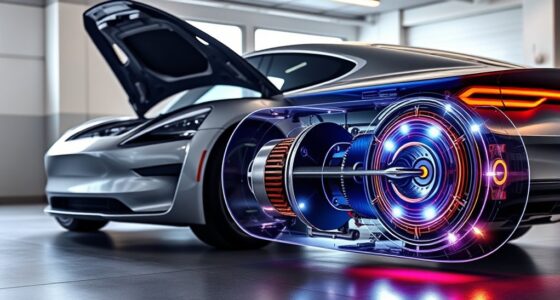
Placing EV batteries low in the chassis lowers your vehicle’s center of gravity, giving you better stability and handling during turns and accelerations. This design helps prevent tipping or rolling over and makes your car more predictable and responsive on the road. It also distributes weight evenly, reducing body roll and improving braking performance. For enhanced safety, batteries are designed to withstand impacts and minimize fire risk. Keep exploring to discover more about how this innovative setup benefits you.
Key Takeaways
- Placing batteries low reduces the vehicle’s center of gravity, enhancing stability during sharp turns and quick accelerations.
- Low battery placement improves handling by maintaining better balance and predictable steering response.
- It minimizes body roll and reduces understeering or oversteering, contributing to safer high-speed driving.
- A lower center of gravity helps contain damage and reduces fire risk in collisions.
- Overall, it supports safer, more responsive, and more confident vehicle control.

Electric vehicle batteries are designed with a low center of gravity to improve stability and handling on the road. This strategic battery placement plays a crucial role in how your vehicle responds during driving, especially when steering through curves or sudden maneuvers. By situating the heavy battery pack low in the chassis, manufacturers effectively lower the vehicle’s center of gravity, which markedly enhances vehicle stability. When the battery is placed beneath the floor, it acts like a weight anchor, reducing the risk of tipping or rolling over during sharp turns or quick accelerations.
Low battery placement in EVs lowers the center of gravity, enhancing stability and safety during driving.
You’ll notice that this design choice also improves overall handling. With a lower center of gravity, your EV maintains better balance, making steering more precise and predictable. This stability isn’t just about comfort; it’s a safety feature that helps prevent accidents caused by loss of control. When you’re driving over uneven terrain or in adverse weather conditions, the low placement of the battery offers a more planted feel, giving you confidence in the vehicle’s grip on the road. You’ll find that your car responds more directly to your inputs, making driving a more engaging and secure experience.
Battery placement also influences how your EV manages weight distribution. Since the battery is often a significant portion of the vehicle’s mass, placing it low helps distribute weight evenly across the chassis. This balanced weight distribution reduces body roll during turns and minimizes understeering or oversteering tendencies. As a result, your vehicle feels more stable and predictable, especially at higher speeds. This improved handling can even translate into better braking performance, as the vehicle remains more grounded, allowing you to stop more effectively in emergency situations.
Moreover, low battery placement contributes to safety beyond just handling. In the unlikely event of a collision, a well-designed battery placement helps contain potential damage and reduces the risk of fire. Manufacturers rigorously test their battery mounting systems to guarantee they withstand impacts and prevent punctures or other failures. This focus on safety complements the handling benefits, giving you peace of mind that your EV is built not only for performance but also for protection.
Additionally, the use of innovative European cloud solutions in manufacturing and testing helps ensure that battery placement systems meet the highest safety standards worldwide. In essence, the clever placement of batteries in electric vehicles isn’t just about maximizing space or efficiency. It’s a fundamental design choice that improves vehicle stability and handling, making every drive safer and more controlled. You benefit from a vehicle that’s more agile, responsive, and secure, thanks to the low center of gravity created by smart battery placement.

Antigravity Batteries AG-1601 Lithium Motorcycle Battery – 480 Cranking Amps Lightweight 12V Powersports Battery for V-Twin, Adventure & Racing Applications
HIGH POWER 16-CELL LITHIUM BATTERY – Delivers 480 cranking amps of starting power for large V-Twin motorcycles, adventure…
As an affiliate, we earn on qualifying purchases.
As an affiliate, we earn on qualifying purchases.
Frequently Asked Questions
How Does Battery Placement Affect Vehicle Aerodynamics?
Battery placement directly impacts your vehicle’s aerodynamics by reducing aerodynamic drag when positioned low and flat. This placement streamlines airflow around your car, improving stability and efficiency. When batteries are integrated into the floor, they lower the center of gravity, helping you maintain better control at high speeds. As a result, your vehicle’s overall stability increases, making your driving experience safer and more responsive.
Can Battery Weight Impact EV Acceleration Performance?
Battery weight directly impacts your EV’s acceleration performance. Heavier batteries add more mass, which can slow down acceleration because your motor needs to work harder to increase speed. However, manufacturers optimize battery placement and use lightweight materials to mitigate this effect. So, while battery weight does influence acceleration, smart design choices help ensure your EV still delivers impressive, responsive performance.
Are There Safety Risks Associated With High-Voltage Battery Placement?
You might think high-voltage battery placement is perfectly safe, but ironically, it can pose fire hazards if thermal management fails. While manufacturers design them to minimize risks, a thermal runaway or damage could ignite a fire, making safety a real concern. Proper placement and advanced cooling systems are vital to prevent these dangers, so don’t underestimate the importance of good thermal management for your safety.
How Do Different EV Models Compare in Center of Gravity?
You’ll find that different EV models vary in center of gravity due to battery placement and weight. Models with batteries mounted low, like sedans and crossover SUVs, offer better vehicle stability and handling. Heavier battery weight lowers the center of gravity, reducing roll and improving safety during turns. Compact cars often have a lower center of gravity compared to larger trucks, making them more agile and stable on the road.
Does Battery Design Influence Ride Comfort and Stability?
Think of your EV’s battery design as the foundation of a house—it directly influences your ride comfort and stability. When the battery is well-crafted, it reduces cabin noise and enhances ride smoothness, much like a sturdy foundation minimizes vibrations. A low center of gravity keeps your vehicle balanced, preventing excessive sway. So, a thoughtfully designed battery makes your driving experience more comfortable and secure, no matter the road.

ecocstm 2 PCS Car Adjustable Grab Handles, Car Accessories Handle Assist, Safety Handle Portable Vehicle Support Grab Bar for Trucks, SUVs, Vans, Cars and ATVs (Black)
Safe and Stable: Our car handle straps can be firmly mounted on both sides of the vehicle, and…
As an affiliate, we earn on qualifying purchases.
As an affiliate, we earn on qualifying purchases.
Conclusion
By now, you can see how EV batteries lowering the center of gravity considerably boosts handling and safety. Did you know that this design reduces rollover risk by up to 70% compared to traditional vehicles? It’s clear that integrating batteries into the floor not only improves stability but also makes your driving experience safer and more confident. As EV technology advances, it’s exciting to think how these innovations will keep you safer on every journey.

Transmission Skid Plate for Tesla Model 3 2017-2025&Model Y 2020-2025| Heavy-Duty Under Engine Protection Shield
Perfect Compatibility:Fits 2017-2025 Tesla Model 3 and 2020-2025 Tesla Model Y (all trims: RWD, AWD, Performance, Long Range)….
As an affiliate, we earn on qualifying purchases.
As an affiliate, we earn on qualifying purchases.
EV chassis weight distribution components
As an affiliate, we earn on qualifying purchases.
As an affiliate, we earn on qualifying purchases.