
TL;DR

Get backup power and energy gear delivered free — and shop member deals
- Fast, free delivery on millions of items
- Access to Prime Big Deal Days deals on October 6–7
- Prime Video, Amazon Music and more included
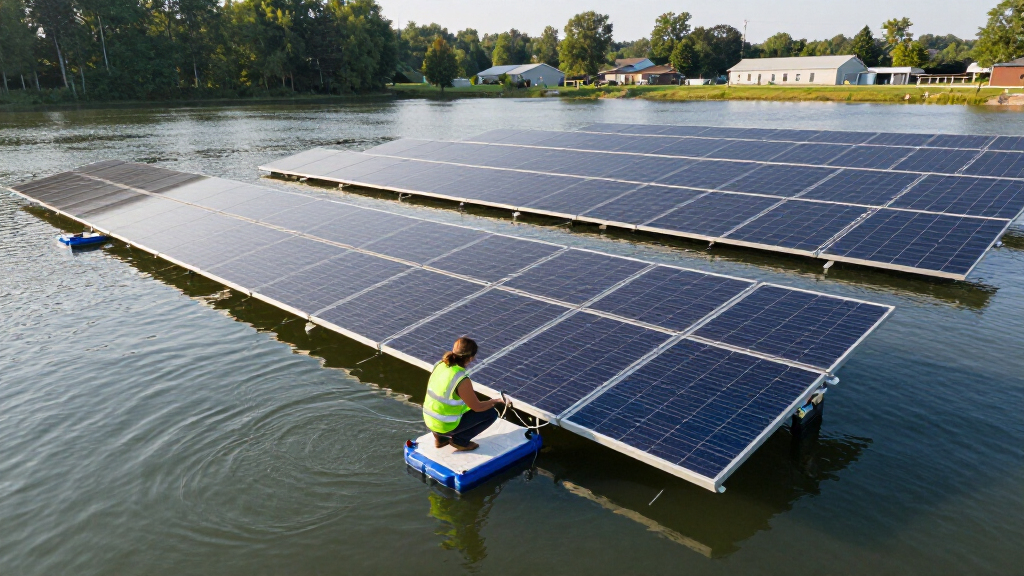
A floating solar array has been installed on a village reservoir in Ohio, according to a trending news item. The specific village, project size, cost, and operator have not been confirmed, but the development fits a growing pattern of municipalities deploying floating photovoltaic systems on water bodies.
A floating solar array has been installed on a village reservoir in Ohio, according to a recently circulating news item. The report signals growing interest in floating photovoltaic technology — solar panels mounted on buoyant structures over man-made water bodies — as small municipalities look for ways to generate local power without dedicating scarce land to it.
The core of the report is simple: a village in Ohio has placed a solar array that floats on the surface of its reservoir. This is a long-established technology category. Floating photovoltaic systems, sometimes called floatovoltaics, have been deployed commercially since the late 2000s, with large installations operating in Asia, Europe, and North America. Typical installations anchor buoyant racks to the bed or shore of a pond, quarry lake, or drinking-water reservoir and run cabling to shore-side inverters.
Reservoirs are considered attractive sites for this technology for several well-documented reasons. The water surface is typically an unshaded, unused area owned by a single entity — often the municipality itself — which simplifies permitting compared with private land assembly. Some studies have also reported that water can keep panels cooler than ground-mounted arrays, modestly improving output, and that partial surface coverage can reduce evaporation and algae growth, though results vary by site.
What the circulating item does not specify is the identity of the village, the size of the array in kilowatts or megawatts, the cost, the contractor, whether the power will serve village facilities or feed the grid, or how much of the reservoir surface is covered. Those details remain unconfirmed pending verification from local officials or the project developer.
Why Small-Town Floating Solar Draws Attention
If confirmed, the project would add to a small but growing set of examples of American municipalities using their own water infrastructure for power generation. For villages and small towns, reservoirs are often the largest contiguous assets they own. Floating solar lets a community convert that asset into electricity production without buying or rezoning land — a real constraint for communities with limited budgets and available acreage.
Interest in the approach has been rising for practical reasons. Ohio, like much of the Midwest, has abundant farmland, and proposals to convert agricultural land to solar fields have generated local opposition in several counties. Water-based siting sidesteps that land-use conflict entirely. It also pairs naturally with the energy needs of water treatment and pumping, which are typically among the largest electricity expenses a village government has.
The National Renewable Energy Laboratory has estimated that floating solar on man-made water bodies could supply a meaningful share of U.S. electricity generation, which is why individual municipal installations — even small ones — are watched as signals of broader adoption.
How Floating Solar Reached American Reservoirs
“Floating solar was first commercialized in Japan and Europe in the late 2000s, driven partly by land scarcity. The first utility-scale installations in the United States appeared in the mid-2010s, notably on wastewater treatment ponds and reservoirs in California. Since then, projects have spread to municipal water bodies in states including New Jersey, Florida, and Colorado, typically in the range of a few hundred kilowatts to several megawatts.
Ohio has an established solar sector, including large ground-mounted farms, and state law allows municipalities to operate their own electric generation for public facilities. Village-scale floating solar remains uncommon in the state, which is why a new installation would be newsworthy at the local level even if the array itself is modest in capacity.
The technology carries known trade-offs: higher installation costs per watt than ground-mounted solar, engineering challenges for anchoring and ice load in northern climates, and maintenance access by boat. Cold-climate floating solar has been demonstrated in Europe and North America, but winter performance remains a design consideration for Ohio projects.
What the Report Leaves Unverified
The trigger for the current coverage is unconfirmed. The circulating item identifies neither the village nor the project’s developer, and no primary source — a village announcement, utility statement, or contractor press release — has been verified for this article. The apparent spike in search and coverage interest suggests a specific project was recently completed or publicized, but the timing, scope, and cost are not established.
Specifically unknown: the array’s generating capacity, the fraction of the reservoir surface covered, whether the reservoir remains in active drinking-water service, how the power will be used or sold, whether state or federal incentives supported the project, and whether any permitting conditions apply. Readers should treat the installation as reported but unverified until local officials or the project operator confirm details.
Watching for Village and Developer Confirmation
Confirmation would be expected to come from one of several channels: a village council announcement, a statement from the municipal water or electric department, a press release from the engineering firm or developer that built the array, or local news coverage naming the community. Once identified, the key follow-up facts will be the project’s capacity, cost, financing, and expected energy output.
If the project performs as intended, it could become a reference case for other Ohio villages weighing similar installations on their own reservoirs and treatment ponds. Broader adoption will depend on cost, interconnection arrangements with utilities, and how the arrays weather Ohio winters over multiple seasons.
Key Questions
What is floating solar?
Floating solar, or floating photovoltaics, is a system of solar panels mounted on buoyant structures anchored over water bodies such as reservoirs, ponds, and quarry lakes, with cables running to shore-side electrical equipment.
Which Ohio village installed the array?
The specific village has not been confirmed in the circulating report. The project is reported to have occurred on a village reservoir in Ohio, but the community’s name and project details remain unverified pending official confirmation.
Why put solar panels on a reservoir instead of land?
Reservoirs offer unshaded surface area the municipality already owns, avoiding land acquisition and reducing land-use conflicts. Some studies also report reduced evaporation and cooler panel operating temperatures, though benefits vary by site.
Is floating solar reliable in cold climates like Ohio’s?
Cold-climate floating solar has been demonstrated in Europe and North America, but ice loading, anchoring, and winter maintenance are design considerations that add cost and engineering requirements compared with warmer regions.
How much power can a village-scale floating array produce?
Municipal floating solar projects in the U.S. typically range from a few hundred kilowatts to several megawatts — often enough to offset a large share of the electricity used for water treatment and pumping. The capacity of the reported Ohio project is not yet confirmed.
Source: rss
Fall Picks
fall essentials
As an affiliate, we earn on qualifying purchases.