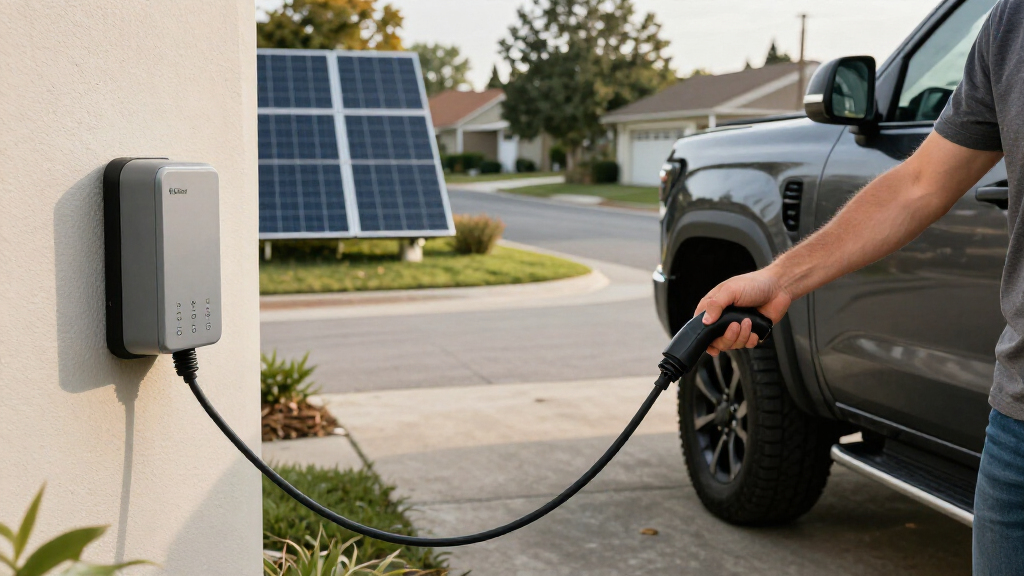
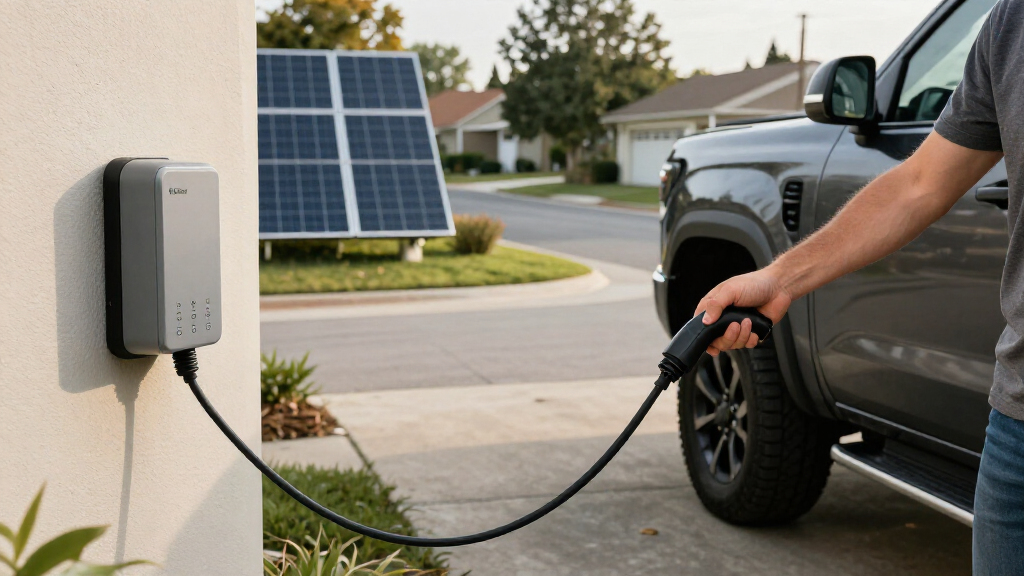
The best electric truck charging systems combine a suitable power level, a plug or installation that fits your home, and enough cable reach to park comfortably. My best overall pick is the Emporia Pro, whose 48-amp output and PowerSmart features make it the strongest fit for drivers who want high-capacity home charging. The ChargePoint HomeFlex stands out for a more established home-charging setup, while the EVDANCE 40A portable charger offers a useful middle ground for drivers who want flexibility without stepping up to 48 or 50 amps. The main tradeoffs are charging speed versus electrical-circuit capacity, and portability versus a more permanent installation. Read on for the full breakdown and guidance on matching a charger to your truck and home.

Get backup power and energy gear delivered free with Prime
- Fast, free delivery on millions of items
- Prime Video, Amazon Music and more included
- Member-only deals all year
Key Takeaways
- Emporia Pro leads on output: Its 48-amp rating gives it the highest listed current among these picks, but buyers need to check that their circuit and truck support the intended charging rate.
- Portable does not automatically mean more convenient: Several 40A and 50A options use a 25-foot cable, while the Grizzl-E supplies a 24-foot cable and the ChargePoint is aimed at a more permanent home setup.
- Low-power dual-voltage models solve a different problem: The Junsun and 12A/16A EVDANCE can work for occasional charging or limited electrical access, but they are not the strongest choice for fast daily replenishment of a large truck battery.
- Plug compatibility narrows the field: Many listed chargers use J1772 connectors, so buyers should confirm the truck’s inlet and whether an adapter is needed before choosing.
- Electrical readiness matters as much as charger amperage: A 50A label does not mean a home circuit can deliver that output; installation limits and the truck’s onboard charger can cap real charging speed.
| Junsun Portable Level 1 and Level 2 EV Charger, 32 A, 110–240 V, 20 ft Cable |  | Best for Level 1/Level 2 Flexibility | Connector: SAE J1772 | Charging levels: Level 1 and Level 2 | Input voltage: 110–240 V | VIEW LATEST PRICE | See Our Full Breakdown |
| EVDANCE Level 2 Portable EV Charger, 40 A, 240 V, 25 ft Cable |  | Best for Adjustable Level 2 Charging | Charger level: Level 2 | Input voltage: 240 V | Maximum current: 40 A | VIEW LATEST PRICE | See Our Full Breakdown |
| TopAutoGear 50A Level 2 Portable EV Charger with 25 ft Cable |  | Best for Maximum Portable Output | Charger level: Level 2 | Voltage: 240 V | Maximum current: 50 A | VIEW LATEST PRICE | See Our Full Breakdown |
| BETUMODA Level 2 EV Charger, 40A, 240V, 9.6 kW, 25 ft Cable |  | Best for Low-Current Adjustment | Charger level: Level 2 | Output voltage: 240 V AC | Maximum current: 40 A | VIEW LATEST PRICE | See Our Full Breakdown |
| ENERGYGENIE 50A Level 2 Portable EV Charger, 240V, NEMA 14-50 Plug, 25 ft J1772 Cable |  | Best for Warranty and Included Mounting | Charger level: Level 2 | Voltage: 240 V | Maximum current: 50 A | VIEW LATEST PRICE | See Our Full Breakdown |
| ChargePoint HomeFlex Level 2 EV Charger, J1772, NEMA 14-50 Plug |  | Best for App-Based Home Charging | Connector: J1772 | Plug: NEMA 14-50 | Output voltage: 240 volts | VIEW LATEST PRICE | See Our Full Breakdown |
| ELEGRP 40A Level 2 Portable EV Charger with J1772 Connector and 25 ft Cable |  | Best for Adjustable Current Settings | Maximum output: 9.6 kW | Maximum current: 40A | Current settings: 16A, 20A, 24A, 32A, and 40A | VIEW LATEST PRICE | See Our Full Breakdown |
| EVDANCE Portable Level 1 and Level 2 EV Charger, 25 ft Cable, 12A 120V / 16A 240V, J1772 |  | Best for Basic Portability and Outlet Flexibility | Charging levels: Level 1 and Level 2 | Current: 12A at 120V; 16A at 240V | Maximum power: Up to 3.84 kW | VIEW LATEST PRICE | See Our Full Breakdown |
| Emporia Pro Level 2 EV Charger with PowerSmart, 48 A, J1772 Connector, 25 ft Cable |  | Best for Energy-Aware High-Output Charging | Output voltage: 240V AC | Maximum current: 48A | Connector: SAE J1772 | VIEW LATEST PRICE | See Our Full Breakdown |
| Grizzl-E Level 2 40A EV Charger, NEMA 14-50 Plug, 24-Foot Cable, Avalanche Edition |  | Best for Rugged Outdoor Charging | Voltage and wattage: 240V; 10 kW | Maximum current: 40A | Adjustable current: 16A, 24A, 32A, and 40A | VIEW LATEST PRICE | See Our Full Breakdown |
| electric truck charging system | Cable length | Maximum current | Connector | Maximum power |
|---|---|---|---|---|
| Junsun Portable Level 1 and Le | 20 ft | 32 A | SAE J1772 | 7 kW |
| EVDANCE Level 2 Portable EV Ch | 25 ft | 40 A | — | 9.6 kW |
| TopAutoGear 50A Level 2 Portab | 25 ft | 50 A | SAE J1772 | 11.5 kW |
| BETUMODA Level 2 EV Charger | 25 ft | 40 A | — | 9.6 kW |
| ENERGYGENIE 50A Level 2 Portab | 25 ft | 50 A | — | — |
| ChargePoint HomeFlex Level 2 E | 23 feet, cold-resistant | — | J1772 | — |
| ELEGRP 40A Level 2 Portable EV | 25 feet | 40A | J1772 | — |
| EVDANCE Portable Level 1 and L | 25 feet | — | J1772 | Up to 3.84 kW |
| Emporia Pro Level 2 EV Charger | 25 feet | 48A | SAE J1772 | — |
| Grizzl-E Level 2 40A EV Charge | 24 feet | 40A | — | — |
More Details on Our Top Picks
Junsun Portable Level 1 and Level 2 EV Charger, 32 A, 110–240 V, 20 ft Cable
The Junsun is the most adaptable pick here if your truck charging setup may need to move between ordinary household outlets and a 240 V connection. Its included NEMA 5-15 and NEMA 14-50 options support Level 1 and Level 2 charging, while adjustable current settings help match the available circuit. That flexibility is a meaningful difference from the EVDANCE 40 A, which is Level 2 only but has a longer cable and higher output. Junsun tops out at 7 kW and 32 A, so it gives up charging speed compared with the 40 A and 50 A options in this group. The 20-foot cable is also shorter than their 25-foot leads. I’d choose it for mixed-outlet travel use, not for buyers prioritizing the fastest home charging.
Pros:- Supports both Level 1 and Level 2 charging with included NEMA 5-15 and NEMA 14-50 plug options.
- Adjustable current settings help fit charging to the available circuit.
- Portable design and 20-foot cable support flexible placement away from home.
- LCD displays charging current, voltage, energy amount, and time.
Cons:- Maximum output of 7 kW is below the 9.6 kW EVDANCE and 11.5 kW TopAutoGear options.
- The 20-foot cable is shorter than the 25-foot cables on several alternatives.
- SAE J1772 connector means Tesla vehicles need a compatible adapter.
Best for: J1772 truck owners who want one portable charger for household Level 1 outlets and compatible 240 V NEMA 14-50 outlets.
Not ideal for: Drivers seeking the highest charging output or a 25-foot reach; its maximum is 7 kW, and the cable is 20 feet.
- Connector:SAE J1772
- Charging levels:Level 1 and Level 2
- Input voltage:110–240 V
- Maximum current:32 A
- Maximum power:7 kW
- Plugs:NEMA 14-50 and NEMA 5-15
- Cable length:20 ft
- Warranty:1 year
Our verdict“Choose the Junsun if Level 1 and Level 2 flexibility matters more than the faster output and longer cable offered by other picks.”
EVDANCE Level 2 Portable EV Charger, 40 A, 240 V, 25 ft Cable
The EVDANCE makes the most sense for truck owners who already have a NEMA 14-50 outlet and want a useful range of charging settings without stepping up to a 50 A model. Its 10–40 A adjustment range gives more flexibility than the BETUMODA’s listed settings, which start at 8 A but top out at the same 40 A. A 25-foot cable can also make it easier to reach a truck parked farther from the outlet than the Junsun’s 20-foot lead. The 2.4-inch display and 1–12-hour delayed start add practical control, while its IP66 rating is a distinguishing protection claim in this group. The tradeoff is that this is Level 2 only, and Tesla owners need an adapter that is not included. I’d favor it over the TopAutoGear when 40 A is sufficient and broad current adjustment matters more than 50 A capacity.
Pros:- Adjustable current from 10 A to 40 A provides several settings for different circuit capacities.
- 25-foot cable offers more reach than the Junsun’s 20-foot cable.
- 1–12-hour delayed start and 2.4-inch TFT display provide scheduling and charging information.
- IP66 rating and listed electrical protections address exposure and electrical fault concerns.
Cons:- Requires a NEMA 14-50 outlet and does not offer Level 1 charging.
- Tesla adapter is not included.
- Its 9.6 kW maximum is lower than the 11.5 kW TopAutoGear and ENERGYGENIE.
Best for: J1772 truck and plug-in-hybrid owners with a NEMA 14-50 outlet who want fine current adjustment, a longer cable, and delayed charging.
Not ideal for: Buyers without a compatible 240 V NEMA 14-50 outlet, or Tesla owners who do not want to source a separate adapter.
- Charger level:Level 2
- Input voltage:240 V
- Maximum current:40 A
- Adjustable current:10 A, 16 A, 20 A, 24 A, 32 A, and 40 A
- Maximum power:9.6 kW
- Plug and connector:NEMA 14-50 and J1772
- Cable length:25 ft
- Delayed start:1–12 hours
Our verdict“Pick the EVDANCE if you want a feature-rich 40 A portable charger with a long cable and do not need 50 A output.”
TopAutoGear 50A Level 2 Portable EV Charger with 25 ft Cable
Among these portable options, TopAutoGear is the clear choice for buyers seeking the highest listed output: 50 A and up to 11.5 kW. That gives it more charging capacity than the EVDANCE and BETUMODA, both rated at 40 A and 9.6 kW, provided the truck and electrical setup can use the added output. The 25-foot cable, adjustable current settings, delay timer, and 3.5-inch LCD make it more than a bare high-output unit; the screen can show charging data and error codes. The tradeoff is substantial for a portable system: it still uses a NEMA 14-50 plug, so buyers need to confirm their outlet and circuit can support the selected setting. It also lacks the Junsun’s Level 1 option. Tesla owners must supply an adapter. I’d rank it for output first, not for outlet flexibility.
Pros:- Up to 50 A and 11.5 kW exceed the listed output of the 40 A EVDANCE and BETUMODA.
- Five current settings allow output to be reduced for a suitable electrical setup.
- 25-foot cable supports flexible positioning around a parked truck.
- 3.5-inch LCD shows charging information and error codes, with a delay timer for scheduled charging.
Cons:- Requires a compatible 240 V NEMA 14-50 receptacle and suitable circuit capacity.
- Tesla vehicles require an adapter that is not included.
- Does not provide Level 1 charging like the Junsun.
Best for: J1772 truck owners with a compatible NEMA 14-50 setup who want the highest listed portable charging output in this group.
Not ideal for: Drivers who need Level 1 charging, have a lower-capacity circuit, or want a charger that works with Tesla vehicles without a separate adapter.
- Charger level:Level 2
- Voltage:240 V
- Maximum current:50 A
- Maximum power:11.5 kW
- Connector:SAE J1772
- Plug:NEMA 14-50
- Cable length:25 ft
- Current settings:16 A, 24 A, 32 A, 40 A, and 50 A
- Display:3.5-inch LCD
Our verdict“Choose TopAutoGear when your outlet and vehicle can support 50 A and maximum portable charging output is your priority.”
BETUMODA Level 2 EV Charger, 40A, 240V, 9.6 kW, 25 ft Cable
BETUMODA’s strongest case is its 8 A minimum setting, the lowest listed starting point among the 40 A chargers here. That can give owners more room to dial back charging when sharing a circuit or working with a constrained electrical setup, though the circuit still needs to be properly grounded and suitable for the chosen setting. It matches the EVDANCE on 40 A, 9.6 kW, and 25 feet of cable, but its five settings are spaced at 8, 16, 24, 32, and 40 A rather than offering EVDANCE’s 10 A and 20 A options. The delay timer is useful for scheduled sessions, but this model is recommended for dry environments, a narrower fit than the IP66-rated EVDANCE. Tesla owners also need a separate adapter. I’d choose it for low-current flexibility, not for stronger weather protection or the fastest charging.
Pros:- Five current settings start at 8 A, allowing lower-output operation than the other listed 40 A option.
- 25-foot cable provides useful reach around a parked truck.
- 1–12-hour delay timer supports scheduled charging.
- Listed protections cover over-voltage, over-current, overheating, and short circuits.
Cons:- Recommended for dry environments, unlike the EVDANCE, which lists an IP66 rating.
- Maximum output is 9.6 kW, below the 11.5 kW TopAutoGear and ENERGYGENIE.
- Requires a NEMA 14-50 outlet, and Tesla vehicles need a separate adapter.
Best for: J1772 truck owners with a properly grounded NEMA 14-50 outlet who want the option to charge at a low 8 A setting.
Not ideal for: Drivers who need stronger stated weather protection, a Level 1 mode, or Tesla compatibility without buying an adapter.
- Charger level:Level 2
- Output voltage:240 V AC
- Maximum current:40 A
- Maximum power:9.6 kW
- Current settings:8 A, 16 A, 24 A, 32 A, and 40 A
- Plug and connector:NEMA 14-50 and SAE J1772
- Cable length:25 ft
- Delay timer:1–12 hours
Our verdict“Choose BETUMODA if its 8 A setting is useful for your electrical setup and you can keep the charger in a dry location.”
ENERGYGENIE 50A Level 2 Portable EV Charger, 240V, NEMA 14-50 Plug, 25 ft J1772 Cable
ENERGYGENIE pairs 50 A, 11.5 kW output with a three-year warranty, a storage bag, and a wall mount, giving it a more home-ready package than the similarly rated TopAutoGear. Both offer 25-foot cables and five current settings, so the choice comes down to the extras: ENERGYGENIE lists an IP54 housing for indoor and outdoor use, while TopAutoGear provides a larger 3.5-inch display and explicit error-code display. ENERGYGENIE’s LCD shows voltage, current, power, and charging status, and its timer offers fixed delay choices of 0, 2, 4, 6, or 8 hours rather than EVDANCE’s 1–12-hour range. It still depends on a compatible NEMA 14-50 outlet, and Tesla owners need their own adapter. I’d favor it for buyers who want portable and wall-mounted use with a longer stated warranty.
Pros:- 50 A maximum current and 11.5 kW output match the highest listed capacity in this group.
- Three-year warranty is longer than the Junsun’s one-year coverage.
- Includes both a storage bag and wall mount for portable or fixed placement.
- IP54 housing, LCD charging data, and listed safety protections support practical everyday use.
Cons:- Requires a compatible 240 V NEMA 14-50 outlet.
- Tesla adapter is not included.
- Delay timer offers set intervals of 0, 2, 4, 6, or 8 hours rather than the broader range of the EVDANCE.
Best for: J1772 truck owners with a compatible NEMA 14-50 outlet who want 50 A output, a wall mount, and a three-year warranty.
Not ideal for: Buyers who need Level 1 charging, fine-grained delay scheduling, or Tesla compatibility without sourcing a separate adapter.
- Charger level:Level 2
- Voltage:240 V
- Maximum current:50 A
- Maximum output:11.5 kW
- Connector and plug:SAE J1772 and NEMA 14-50
- Cable length:25 ft
- Current settings:16 A, 24 A, 32 A, 40 A, and 50 A
- Warranty:3 years
Our verdict“Choose ENERGYGENIE if you want 50 A portable charging with included mounting hardware and a three-year warranty.”
ChargePoint HomeFlex Level 2 EV Charger, J1772, NEMA 14-50 Plug
The ChargePoint HomeFlex is a strong fit for electric-truck owners who want app controls alongside a permanent home charging setup. Its 23-foot cold-resistant cable can make reaching a truck parked in a driveway easier through winter weather, while the app adds charging information and reminders. Charge speed is listed at up to 45 miles per hour, depending on the vehicle. Compared with the ELEGRP 40A Portable Charger, this model puts more emphasis on app-based charging management than adjustable current settings and portability. The tradeoff is a more specific installation requirement: you need an electrician and a 240V NEMA 14-50 outlet on a 40A or 50A circuit. Tesla owners also need a separate adapter, so I would favor it for J1772 truck households that value app features over flexible outlet compatibility.
Pros:- App provides charging information, controls, and reminders.
- 23-foot cable is cold-resistant and gives useful reach around a garage or driveway.
- Designed for indoor or outdoor installation.
- UL-listed and rated for charging speeds up to 45 miles per hour, vehicle dependent.
Cons:- Requires electrician installation and a compatible 240V NEMA 14-50 outlet.
- Tesla vehicles need a separate adapter.
- Less flexible for changing circuits than chargers with selectable current settings, such as the ELEGRP.
Best for: J1772 electric-truck owners with a suitable 240V NEMA 14-50 outlet who want app controls and a cable suited to outdoor use.
Not ideal for: Tesla owners who do not want to buy an adapter, or buyers seeking a portable charger with selectable current settings.
- Connector:J1772
- Plug:NEMA 14-50
- Output voltage:240 volts
- Charging speed:Up to 45 miles per hour, vehicle dependent
- Cable length:23 feet, cold-resistant
- Installation:Indoor or outdoor; 40A or 50A circuit required
- Certification:UL listed
- Warranty:3-year parts warranty
Our verdict“Choose the HomeFlex if you want app-managed home charging and have the required outlet and circuit in place.”
ELEGRP 40A Level 2 Portable EV Charger with J1772 Connector and 25 ft Cable
The ELEGRP 40A stands out for buyers who need a portable charger that can adapt to different electrical limits. Five current settings, from 16A to 40A, let an owner match charging draw to a compatible circuit rather than treating every outlet setup the same. Its 25-foot cable offers more reach than the ChargePoint HomeFlex’s 23-foot lead, and the IP67 rating supports indoor or outdoor use. A delay timer adds a simple way to postpone a charging session. Compared with the Grizzl-E 40A, ELEGRP offers a broader set of current steps and a stated timer, while Grizzl-E highlights power-outage recovery and safety protections. ELEGRP’s drawbacks are the need for a NEMA 14-50 outlet and a separately sold Tesla adapter; buyers should also confirm that the outlet and circuit suit their selected setting.
Pros:- Five selectable current settings range from 16A to 40A.
- 25-foot cable provides flexible reach in a garage or driveway.
- IP67-rated housing supports indoor and outdoor use.
- Includes a 1–12 hour delay timer and ETL certification.
Cons:- Requires a compatible 240V NEMA 14-50 outlet.
- Tesla vehicles need a separately sold NACS adapter.
- Two-year warranty is shorter than the ChargePoint HomeFlex’s stated three-year parts warranty.
Best for: Electric-truck owners who want a portable J1772 charger and need to set charging current to match their available 240V circuit.
Not ideal for: Tesla owners without a NACS adapter, or drivers who need a charger that connects to an outlet other than NEMA 14-50.
- Maximum output:9.6 kW
- Maximum current:40A
- Current settings:16A, 20A, 24A, 32A, and 40A
- Voltage and plug:240V; NEMA 14-50
- Connector:J1772
- Cable length:25 feet
- Certification and warranty:ETL; 2 years
Our verdict“Pick the ELEGRP if adjustable current and portable placement matter more than app-based charging controls.”
EVDANCE Portable Level 1 and Level 2 EV Charger, 25 ft Cable, 12A 120V / 16A 240V, J1772
The EVDANCE Level 1 and Level 2 charger is the most modest-output option in this group, but its ability to use 120V or compatible 240V outlets gives it a different job from the higher-current ELEGRP and Grizzl-E chargers. It can suit a truck owner who needs a portable backup or has limited charging access and accepts slower charging. The 25-foot cable, carry bag, and status display make it easier to place and monitor, while its 7-pound weight is lower than the Grizzl-E’s listed 16.79 pounds. The compromise is substantial for a large-battery truck: output tops out at 16A on 240V, or 3.84 kW, and the supplied connections do not cover NEMA 14-50 outlets. I would check vehicle and outlet compatibility before choosing it as a primary home charger.
Pros:- Supports 12A charging on 120V and up to 16A on 240V.
- 25-foot cable and included carry bag aid transport and placement.
- LED display shows charging status and errors.
- IP66-rated housing and built-in charging monitoring.
Cons:- Maximum output of 3.84 kW is lower than the 40A ELEGRP and Grizzl-E chargers.
- Does not connect directly to NEMA 14-50 or 10-30 outlets.
- Tesla vehicles require a separate adapter, and some vehicle models are listed as incompatible.
Best for: Electric-truck owners seeking a lighter portable backup for compatible 120V or 240V outlets, especially when charging speed is not the main priority.
Not ideal for: Drivers who need faster daily charging, use a NEMA 14-50 outlet, or own a vehicle listed as incompatible.
- Charging levels:Level 1 and Level 2
- Current:12A at 120V; 16A at 240V
- Maximum power:Up to 3.84 kW
- Connector:J1772
- Plugs:NEMA 5-15 with adapter; NEMA 6-20
- Cable length:25 feet
- Housing protection:IP66
- Weight and warranty:7 lb; 1 year
Our verdict“Choose this EVDANCE model for a lightweight, lower-output backup when your truck and available outlet are confirmed compatible.”
Emporia Pro Level 2 EV Charger with PowerSmart, 48 A, J1772 Connector, 25 ft Cable
For a household that wants high charging output plus a view of broader home energy use, the Emporia Pro is the most feature-rich fit in this set. Its 48A maximum current exceeds the 40A limits of the ELEGRP and Grizzl-E, while PowerSmart adjusts charging to available home electrical capacity. The included Vue 3 monitor, along with app scheduling and usage tracking, can help owners coordinate truck charging with household demand. It also offers a choice of NEMA 14-50 plug-in or hardwired installation, unlike the plug-only Grizzl-E. Those advantages bring added setup complexity: installation may call for an electrician, and the product data does not specify a maximum charging speed in miles per hour. Tesla owners need an adapter. I would choose it over the ChargePoint HomeFlex when energy monitoring and capacity management matter more than a simpler app-focused setup.
Pros:- Up to 48A output, higher than the 40A maximum of the ELEGRP and Grizzl-E.
- PowerSmart adjusts charging based on available home electrical capacity.
- Vue 3 energy monitor and app support energy tracking and scheduling.
- Supports NEMA 14-50 plug-in or hardwired installation and indoor or outdoor use.
Cons:- Installation may require an electrician, particularly for hardwired use.
- Tesla vehicles require an adapter that is not included.
- The provided product data does not state a miles-per-hour charging estimate.
Best for: Electric-truck households with a suitable 240V setup that want high-current charging, home energy monitoring, and charging that responds to available capacity.
Not ideal for: Buyers seeking a simple portable plug-in charger, or Tesla owners who do not want to source a separate adapter.
- Output voltage:240V AC
- Maximum current:48A
- Connector:SAE J1772
- Cable length:25 feet
- Installation:NEMA 14-50 plug or hardwired
- Included energy monitor:Emporia Vue 3
- Connectivity:Wi-Fi and Bluetooth
- Certification and use:UL; indoor and outdoor
Our verdict“Choose the Emporia Pro if you want high-output charging paired with home energy monitoring and capacity-aware control.”
Grizzl-E Level 2 40A EV Charger, NEMA 14-50 Plug, 24-Foot Cable, Avalanche Edition
The Grizzl-E Avalanche Edition is a practical pick for owners who value a weather-resistant build and built-in protection over connected features. Its IP67 rating, fire-resistant housing, and listed safety protections suit a charger installed in a garage or exposed outdoor location. Selectable settings from 16A to 40A let owners match charging draw to a compatible circuit, and power outage recovery can resume charging after an interruption. Compared with the ELEGRP, it offers a similar 40A ceiling and a slightly shorter 24-foot cable, but its product data highlights self-monitoring and outage recovery rather than a delay timer. Unlike the Emporia Pro, it does not include a home energy monitor or 48A output. It also requires a NEMA 14-50 outlet, and reaching 40A calls for a 50A circuit breaker.
Pros:- IP67 rating and fire-resistant housing support indoor and outdoor installation.
- Adjustable current settings range from 16A to 40A.
- Built-in ground fault, overcurrent, overvoltage, and temperature protections.
- Self-monitoring and power outage recovery are included.
Cons:- Requires a NEMA 14-50 outlet.
- Maximum 40A output requires a 50A circuit breaker.
- Lacks the included energy monitor and 48A capacity of the Emporia Pro.
Best for: Electric-truck owners who need a durable indoor or outdoor charger with adjustable current and built-in safety protections.
Not ideal for: Buyers without a NEMA 14-50 outlet, or those seeking 48A output, app-based energy monitoring, or a longer cable.
- Voltage and wattage:240V; 10 kW
- Maximum current:40A
- Adjustable current:16A, 24A, 32A, and 40A
- Plug type:NEMA 14-50
- Cable length:24 feet
- Ingress protection:IP67
- Certifications:UL; Energy Star
- Compatibility:North American EVs and PHEVs
Our verdict“Choose the Grizzl-E if rugged construction and safety features matter more than higher output or energy-monitoring tools.”
How We Picked
I ranked these systems by how well their stated output, connector, cable length, and installation style suit electric-truck ownership. Because truck batteries can be large, I gave more weight to higher-output Level 2 options for routine home charging, while still recognizing that a lower-current or dual-voltage unit can make sense for occasional use and flexible connection needs. I also considered whether a product is portable or better suited to a dedicated home location, since those approaches solve different problems.
The ranking reflects the information supplied for each model, not hands-on testing or claims about long-term reliability that cannot be verified from those details. A higher amperage rating helped only when it offered a meaningful advantage for a compatible truck and electrical setup; it did not automatically outrank usability or fit. That is why the 48A Emporia Pro leads, while the 40A and 50A portable options compete on practical flexibility, and the lower-output models sit lower for drivers prioritizing truck-sized daily charging.
| electric truck charging system | Connector |
|---|---|
| Junsun Portable Level 1 and Le | SAE J1772 |
| EVDANCE Level 2 Portable EV Ch | — |
| TopAutoGear 50A Level 2 Portab | SAE J1772 |
| BETUMODA Level 2 EV Charger | — |
| ENERGYGENIE 50A Level 2 Portab | — |
| ChargePoint HomeFlex Level 2 E | J1772 |
| ELEGRP 40A Level 2 Portable EV | J1772 |
| EVDANCE Portable Level 1 and L | J1772 |
| Emporia Pro Level 2 EV Charger | SAE J1772 |
| Grizzl-E Level 2 40A EV Charge | — |
Factors to Consider When Choosing Best Electric Truck Charging Systems
Choosing among these chargers starts with your truck, parking layout, and home electrical service—not the biggest amperage number on a product page. I would check the following factors before deciding whether a portable unit or a dedicated home charger fits your routine.
Match Charger Output to the Truck and Circuit
A charger’s rated amperage is only one part of the charging chain. The truck’s onboard AC charger sets a limit, and the home circuit must also be able to support the charger’s specified load. Ask a qualified electrician to confirm the circuit, receptacle, and installation requirements before buying a high-output unit. A charger rated above what your truck can accept may leave its extra capacity unused. On the other hand, a lower-output unit can mean longer overnight sessions when a large battery needs replenishing. Compare likely charging time against your daily driving rather than assuming the maximum rating is always necessary.
Check Connector and Adapter Compatibility
Confirm the connector used by your truck and the connector supplied with the charger before comparing features. Many products here list a J1772 connector, but a vehicle with a different inlet may need a compatible adapter. Adapter fit and permitted charging rates can vary, so check the truck maker’s guidance rather than relying on a general compatibility claim. Also distinguish the vehicle-side connector from the wall-side plug: they solve separate compatibility questions. Buying the wrong combination can add cost and inconvenience even when the charger’s power rating looks right. If more than one EV will use the system, verify compatibility for each vehicle.
Choose Portable or Fixed Around Your Parking Routine
A portable charger can be useful if you need to move the unit, travel between locations, or plug into an existing compatible receptacle. A fixed home charger may make more sense when the truck returns to the same parking spot and you want a repeatable setup. Portability does not remove the need for a suitable outlet, and carrying a charger does not make every available receptacle safe or compatible. Before choosing, identify where the truck parks and whether the cable can reach its charge port without crossing a walkway or sitting under strain. A longer cable can improve positioning, but it can also be heavier and harder to store. Choose for the way you actually park, not for an imagined best-case layout.
Plan Cable Reach and Cable Management
Measure the route from the planned outlet or charger location to the truck’s charge port, including the path around the vehicle. A nominal cable length may not provide the same usable reach if the charger must be mounted away from the parking space. Trucks can have charge ports in different locations, so leave enough slack for the vehicle you own and any future vehicle you may add. Avoid relying on an extension cord unless the manufacturer explicitly permits the arrangement and the electrical setup is rated for it. A tidy hook or storage point can reduce trip hazards and limit wear from dragging the cable. These details can matter more to daily convenience than a small difference in rated amperage.
Account for Installation, Weather, and Location
Before choosing a unit, decide whether it will live indoors, in a garage, or outside, and check the manufacturer’s installation and environmental guidance. The supplied product details do not establish every model’s weather protection, so do not assume that portable or hard-wired means suitable for exposed outdoor use. A plug-in unit still depends on a correctly installed, compatible receptacle and circuit. A permanent installation may require electrical work, which affects the total project beyond the charger itself. Have a qualified electrician review the panel capacity, route, and mounting location before purchase. That planning can prevent a high-output charger from becoming a poor fit for the home.
Pay for Useful Capacity, Not Unused Headroom
Higher output is most valuable when the truck can accept it, the home can supply it, and your schedule benefits from faster charging. If the vehicle stays parked overnight and daily driving is modest, a lower-current option may cover routine needs without upgrading the electrical service. Drivers with long commutes, multiple EVs, or short charging windows may value more capacity and load-management features. A premium feature set is only useful if it solves a real household constraint, such as coordinating available electrical load. Compare the cost of any required electrical work alongside the charger decision, even though the charger itself is only one part of that calculation. The best fit is the system that meets your charging routine without paying for capacity your setup cannot use.
Frequently Asked Questions
Will a 40A or 50A charger work with my electric truck?
It can, provided the truck’s charging inlet is compatible and its onboard AC charger supports the available rate. The home circuit and receptacle must also meet the charger’s installation requirements. A higher-rated charger can still operate at a lower rate when limited by the vehicle or electrical setup, but the exact behavior depends on the equipment. Check the truck manual and charger documentation, then ask an electrician to verify the circuit. Do not choose based on amperage alone.
Do I need a 48A or 50A charger for a large truck battery?
Not necessarily: the right output depends on how far you drive, how long the truck sits plugged in, and the vehicle’s onboard charging limit. More output can shorten charging sessions when the truck and circuit support it, but it may call for more electrical capacity or installation work. A lower-output Level 2 charger may be sufficient for routine overnight charging. Estimate your daily energy use and available parking time before paying for higher capacity. If you are uncertain, have an electrician and the vehicle maker’s specifications guide the decision.
Can I use a J1772 charger if my truck has a different charging inlet?
Possibly, if the truck maker approves a compatible adapter for AC charging and the adapter supports the needed rate. Connector compatibility does not guarantee that every adapter or charging mode will work. Confirm the truck’s inlet type, the adapter’s rating, and any manufacturer restrictions before purchase. Also check whether the charger’s cable can reach the vehicle’s charge port in your parking setup. If more than one vehicle will use the charger, verify each one separately.
Is a portable charger a substitute for installing a home charging circuit?
No. Portable describes the charger’s form and mobility; it does not mean it can safely use any outlet or avoid electrical requirements. A Level 2 portable unit still needs a compatible receptacle and circuit rated for its intended use. Avoid improvised adapters or extension cords unless the manufacturer and a qualified electrician approve the exact setup. If your home lacks a suitable circuit, installation work may be needed regardless of the charger being portable. Treat the outlet and wiring as part of the charging system.
Which matters more for truck charging: cable length or amperage?
Neither matters in isolation. Amperage affects the potential charging rate, subject to the truck and circuit, while cable length determines whether the charger can reach the vehicle conveniently. A high-output unit that cannot reach the charge port is a poor fit, and a long cable cannot make a low-output charger faster. Measure your parking layout and check the vehicle’s charging limit before comparing models. For many owners, a workable cable route and a compatible circuit are the first practical checks.
Conclusion
For most electric-truck owners seeking the strongest balance of output and capability, I recommend the Emporia Pro as the best overall pick, provided the truck and home circuit can use its 48A capacity. The best value in practical flexibility is the EVDANCE 40A portable charger, a middle-ground choice for buyers who want a substantial Level 2 option without choosing the highest listed output. For a premium home-focused setup, consider the ChargePoint HomeFlex; its role makes the most sense for drivers prioritizing a dedicated home-charging system. Beginners who want a simpler, lower-output starting point can look at the EVDANCE 12A/16A dual-voltage model, while accepting slower truck charging. For specific needs, choose the Junsun when dual-voltage flexibility matters, or the Grizzl-E when its 40A plug-in format and 24-foot cable suit your parking layout. Before ordering any of them, verify connector fit, outlet and circuit requirements, and cable reach.