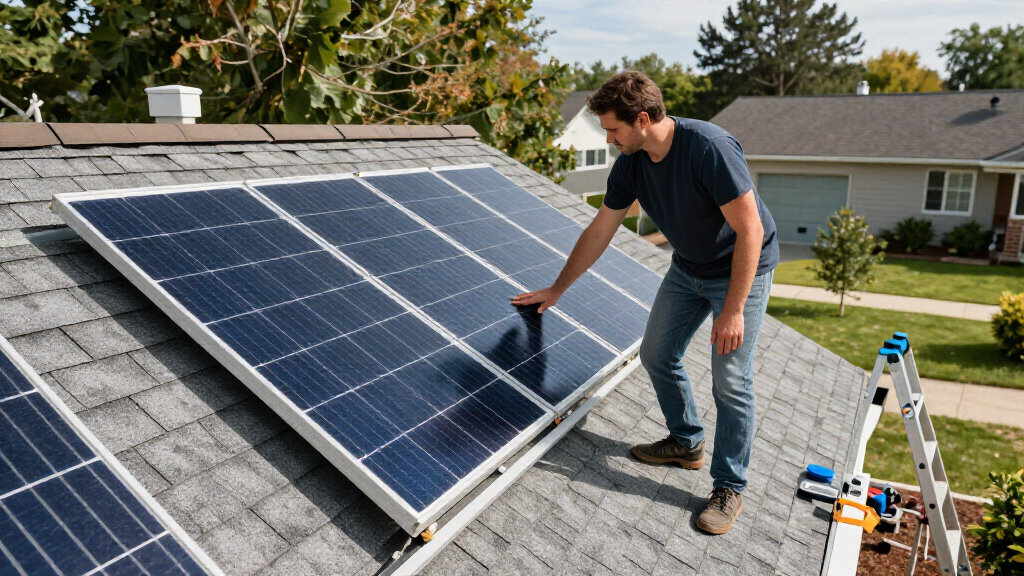

Solar panel kits for home use range from small 200W starter setups to 10kW whole-house systems with massive lithium battery banks, and the right choice depends almost entirely on how much of your household load you want to cover. After comparing specifications across 14 popular kits, the ECO-WORTHY 10kW kit with 10,620W of panels and 32.2kWh of storage stands out as the best overall pick for full off-grid living, thanks to its unusually generous battery capacity relative to panel wattage. For tighter budgets, the Renogy 400W Premium Kit with a 40A MPPT controller delivers the best entry-level value, while the ECO-WORTHY 1200W 48V kit with bifacial panels offers a smart middle ground for cabins and partial home backup. The main tradeoff in this category is upfront cost versus daily energy output — and whether a kit includes batteries and an inverter at all. Keep reading for the full breakdown of what each kit includes, who it fits, and where it falls short.

Get backup power and energy gear delivered free — and shop member deals
- Fast, free delivery on millions of items
- Access to Prime Big Deal Days deals on October 6–7
- Prime Video, Amazon Music and more included
Key Takeaways
- Panel wattage alone is misleading: the 10,620W ECO-WORTHY kit only makes sense because it pairs that array with 32.2kWh of storage, while kits with big inverters but small batteries (like the 3000W/5.12kWh system) will run out of stored power long before sunset.
- ECO-WORTHY dominates this lineup with 12 of 14 entries, so real differentiation comes down to system voltage (12V/24V/48V) and battery sizing rather than brand — 48V kits are the better choice for anything above 1500W of panels.
- Only two kits (the Renogy 400W and ECO-WORTHY 200W) are true DIY-friendly starters; the rest realistically need an electrician for safe wiring, permitting, and battery installation.
- Bifacial panels in the 1200W 48V kit capture reflected light and effectively outperform their rated wattage in snowy or bright ground-mount conditions — a hidden advantage over standard monocrystalline sets at similar prices.
- A 10kW inverter paired with under 3,000W of panels (kits #3 and #8) is oversized hardware: you pay for inverter capacity you can never use unless you plan to expand the array later.
| ECO-WORTHY 1200W 24V Off-Grid Solar System with Lithium Batteries |  | Best Overall Complete Starter System | Solar panels: 6 × 195W | System voltage: 24V | Battery storage: 7.168kWh (two 12.8V 280Ah lithium) | VIEW LATEST PRICE | See Our Full Breakdown |
| 3000W 24V Off-Grid Solar Power System Kit with 1440W Panels, 5.12kWh LiFePO4 Battery, and Pure Sine Wave Inverter |  | Best Value Mid-Size System | Inverter output: 3000W continuous / 6000W peak pure sine wave | Solar input: 1440W (12 × 120W monocrystalline) | Battery capacity: 5.12kWh (4 × 100Ah 12.8V LiFePO4) | VIEW LATEST PRICE | See Our Full Breakdown |
| ECO-WORTHY 10 kW Off-Grid Solar System Kit with 2,340 W Panels, 10 kW Inverter, and 10.24 kWh Battery Storage |  | Best Premium System for Whole-Home Expansion | Solar panels: 12 × 195W bifacial (2340W total) | Panel efficiency: 25% | Inverter output: 10,000W continuous, 120/240V | VIEW LATEST PRICE | See Our Full Breakdown |
| ECO-WORTHY 1200W 48V Solar Power Kit with 6 Bifacial Panels, 50Ah LiFePO4 Battery, and 3500W Inverter |  | Best Compact 48V Starter | Solar panels: 6 × 195W N-type bifacial | Panel efficiency: 25% | Inverter output: 3500W, 110/120V AC | VIEW LATEST PRICE | See Our Full Breakdown |
| ECO-WORTHY 10kW Off-Grid Solar Panel Kit with 10,620W Panels and 32.2kWh Battery Storage |  | Best Whole-Home Off-Grid Powerhouse | Inverter output: 10,000W continuous / 20,000W peak | Output voltage: 120V/240V split-phase | Solar panels: 18 × 590W (10,620W total) | VIEW LATEST PRICE | See Our Full Breakdown |
| ECO-WORTHY 10kW Off-Grid Solar Kit with 4,720W Panels and 16.1kWh Battery |  | Best for Full-Home Off-Grid Power | Inverter Continuous Output: 10,000W (20,000W peak) | Output Voltage: 120V or 120/240V split-phase | Solar Panels: 8 × 590W monocrystalline (4,720W total) | VIEW LATEST PRICE | See Our Full Breakdown |
| ECO-WORTHY 48V Off-Grid Solar System Kit (1600W, 6.24kWh) |  | Best Mid-Size Cabin System | System Power: 1600W | Daily Output: Approx. 6.24kWh | Solar Panels: 8 × 195W N-Type bifacial | VIEW LATEST PRICE | See Our Full Breakdown |
| ECO-WORTHY 10 kW Off-Grid Solar Power Kit with 2,950 W Panels and 16.1 kWh Battery |  | Best Storage-First Design | Inverter Output: 10,000W continuous; 20,000W peak | Output Voltage: 120V or 120/240V split-phase | Solar Panels: 5 × 590W monocrystalline (2,950W total) | VIEW LATEST PRICE | See Our Full Breakdown |
| Renogy 400W Premium Solar Kit with 40A MPPT Charge Controller |  | Best Expandable Starter Kit | Total Power: 400W (4 × 100W panels) | Panel Material: Monocrystalline silicon | Charge Controller: 40A MPPT | VIEW LATEST PRICE | See Our Full Breakdown |
| ECO-WORTHY 200W Monocrystalline Solar Panel Kit with 30A PWM Charge Controller |  | Best Budget Entry Point | Total Panel Power: 200W (2 × 100W) | Panel Type: Monocrystalline, up to 21.5% efficiency | Charge Controller: 30A PWM | VIEW LATEST PRICE | See Our Full Breakdown |
| ECO-WORTHY 10kW Off-Grid Solar System Kit with 5,310W Panels and 20.48kWh Battery Storage |  | Best for Full-Home Off-Grid Power | Inverter continuous output: 10,000W | Output voltage: 120V/240V split-phase | Total solar capacity: 5,310W (9 × 590W) | VIEW LATEST PRICE | See Our Full Breakdown |
| ECO-WORTHY 400W N-Type Monocrystalline Solar Panel Set, 4 × 100W |  | Best Expansion Panel Set | Total power: 400W (4 × 100W) | Cell type: N-type monocrystalline | Conversion efficiency: Up to 25% | VIEW LATEST PRICE | See Our Full Breakdown |
| ECO-WORTHY 5 kW Off-Grid Solar System Kit with 2340 W Panels, Inverter, and LiFePO4 Battery |  | Best Mid-Size Starter System | Inverter output: 5,000W, 48V off-grid | Output voltage: 120V | Total panel power: 2,340W (12 × 195W) | VIEW LATEST PRICE | See Our Full Breakdown |
| ECO-WORTHY Home Backup Solar Panel and LiFePO4 Energy Storage System |  | Best for Storage-Heavy Backup | Inverter power: 10kW hybrid | Output voltage: 120V / 240V | Total panel power: 3,540W (6 × 590W) | VIEW LATEST PRICE | See Our Full Breakdown |
| solar panel kits for home | Solar panels | Output voltage |
|---|---|---|
| ECO-WORTHY 1200W 24V Off-Grid | 6 × 195W | — |
| 3000W 24V Off-Grid Solar Power | — | — |
| ECO-WORTHY 10 kW Off-Grid Sola | 12 × 195W bifacial (2340W total) | — |
| ECO-WORTHY 1200W 48V Solar Pow | 6 × 195W N-type bifacial | — |
| ECO-WORTHY 10kW Off-Grid Solar | 18 × 590W (10,620W total) | 120V/240V split-phase |
| ECO-WORTHY 10kW Off-Grid Solar | 8 × 590W monocrystalline (4,720W total) | 120V or 120/240V split-phase |
| ECO-WORTHY 48V Off-Grid Solar | 8 × 195W N-Type bifacial | 110/120V AC |
| ECO-WORTHY 10 kW Off-Grid Sola | 5 × 590W monocrystalline (2,950W total) | 120V or 120/240V split-phase |
| Renogy 400W Premium Solar Kit | — | — |
| ECO-WORTHY 200W Monocrystallin | — | — |
| ECO-WORTHY 10kW Off-Grid Solar | — | 120V/240V split-phase |
| ECO-WORTHY 400W N-Type Monocry | — | — |
| ECO-WORTHY 5 kW Off-Grid Solar | — | 120V |
| ECO-WORTHY Home Backup Solar P | — | 120V / 240V |
More Details on Our Top Picks
ECO-WORTHY 1200W 24V Off-Grid Solar System with Lithium Batteries
This kit stands out because it ships with everything a small off-grid setup needs — six 195W panels, two 280Ah lithium batteries, a 60A MPPT controller, and a 3000W pure sine wave inverter. Compared with the 3000W 24V kit with 1440W panels, it offers more usable battery storage (7.168kWh versus 5.12kWh) despite having less panel wattage, which makes it the stronger pick for backup power through cloudy stretches. The 6000+ cycle battery rating and Bluetooth monitoring translate to years of low-maintenance ownership. The tradeoff: 1200W of panels recharges that big battery slowly, and ECO-WORTHY’s stated daily output figures are inconsistent between the title and description, so buyers should size expectations conservatively.
Pros:- Includes panels, batteries, controller, and inverter in one purchase
- 7.168kWh of lithium storage with a 6000+ cycle rating
- Pure sine wave inverter is safe for sensitive electronics
- Bluetooth monitoring and built-in battery management system
Cons:- Panel wattage is modest relative to battery size, so recharge times are slow
- Manufacturer’s stated daily output figures are inconsistent between title and description
Best for: Homeowners or cabin owners who want a genuinely complete off-grid kit with strong battery storage and don’t need maximum panel wattage
Not ideal for: Anyone running heavy daytime loads — 1200W of panels can’t keep up with sustained appliance use and will leave the large battery undercharged
- Solar panels:6 × 195W
- System voltage:24V
- Battery storage:7.168kWh (two 12.8V 280Ah lithium)
- Charge controller:60A MPPT
- Inverter:3000W pure sine wave
- MPPT tracking efficiency:Up to 99%
- Bluetooth monitoring range:82 feet
- Battery cycle life:More than 6000 cycles
Our verdict“This is the most balanced turnkey option for buyers who prioritize stored energy and completeness over raw solar harvest.”
3000W 24V Off-Grid Solar Power System Kit with 1440W Panels, 5.12kWh LiFePO4 Battery, and Pure Sine Wave Inverter
This kit earns its value spot through better panel-to-battery balance than the ECO-WORTHY 1200W system: 1440W of solar feeding a 5.12kWh LiFePO4 bank means the battery actually gets recharged daily in decent sun. Twelve smaller 120W panels also give flexibility on roofs where a large panel won’t fit. The inclusion of a PV combiner box with surge protection is a nice safety touch most competing kits skip, and the app-controlled 60A MPPT controller squeezes out over 99% tracking efficiency. The catch is storage — 5.12kWh runs a fridge and lights overnight but little else, and wrangling twelve separate panels plus four battery modules is a genuinely involved install that beginners will likely find frustrating.
Pros:- 1440W of panels charges the 5.12kWh battery quickly for a balanced daily cycle
- PV combiner box with surge protection adds a safety layer most kits omit
- Smaller 120W panels fit awkward roofs where large panels can’t
- Complete package includes brackets, cables, controller, and inverter
Cons:- 5.12kWh of storage limits overnight and cloudy-day runtime
- Twelve panels and four battery modules demand significant space and wiring effort
Best for: Budget-conscious cabin or shed owners with mounting space who want balanced daily charge cycles and clean sine wave power
Not ideal for: First-time installers — twelve panels, four batteries, a combiner box, and an inverter add up to a complex wiring project
- Inverter output:3000W continuous / 6000W peak pure sine wave
- Solar input:1440W (12 × 120W monocrystalline)
- Battery capacity:5.12kWh (4 × 100Ah 12.8V LiFePO4)
- Charge controller:60A MPPT with LCD and app control
- MPPT efficiency:Over 99%
- Battery protection:Built-in BMS, UN38.3 certified
- AC output:120V from 24V DC
Our verdict“The smartest choice for buyers who want a well-proportioned system and are comfortable with a hands-on installation.”
ECO-WORTHY 10 kW Off-Grid Solar System Kit with 2,340 W Panels, 10 kW Inverter, and 10.24 kWh Battery Storage
The headline here is headroom: a 10kW inverter with 120/240V split-phase output running on just 2340W of bifacial panels sounds lopsided, but that’s the point — this kit is built to grow. Compared with the smaller ECO-WORTHY 1200W 48V kit, it doubles the inverter capacity and storage while adding UL-certified components (UL 1741 inverter, UL 9540A batteries), which matters for permitting and insurance. The 25%-efficient bifacial panels and parallel inverter support give buyers a clear expansion path toward a true whole-home system. The tradeoffs are real, though: the 9.36kWh daily output estimate assumes four hours of full sun, and ECO-WORTHY explicitly recommends professional installation, which adds meaningful cost beyond the kit itself.
Pros:- 10kW split-phase inverter handles household appliances including 240V loads
- UL-certified inverter and batteries ease permitting and insurer concerns
- Parallel inverter support provides a clear expansion path
- 25%-efficient bifacial panels and app-based battery monitoring
Cons:- 2340W of panels underutilizes the 10kW inverter until you expand
- Professional installation recommended, adding significant cost
Best for: Homeowners planning a phased whole-home off-grid build who want certified components and room to expand later
Not ideal for: DIY-minded buyers on a budget — professional installation is recommended, and the oversized inverter is wasted money if you never add panels
- Solar panels:12 × 195W bifacial (2340W total)
- Panel efficiency:25%
- Inverter output:10,000W continuous, 120/240V
- Battery storage:10.24kWh (2 × 48V 100Ah lithium)
- Estimated daily output:9.36kWh under 4 hours of full sun
- Certifications:UL 1741 inverter; UL 1973 and UL 9540A batteries
- Connectivity:Bluetooth and Wi-Fi app monitoring
Our verdict“A future-proof foundation for buyers who intend to scale up to full home backup rather than start and finish with one box.”
ECO-WORTHY 1200W 48V Solar Power Kit with 6 Bifacial Panels, 50Ah LiFePO4 Battery, and 3500W Inverter
For buyers who want to step up to a 48V system architecture without buying a monster kit, this is the most sensible entry point in the lineup. The 3500W inverter with 7000W surge and 20ms UPS-style switching handles startup-heavy appliances like well pumps and refrigerators that would trip smaller systems, and the integrated 80A MPPT controller means one less box to wire. Compared with the ECO-WORTHY 1200W 24V system, you trade 7.168kWh of storage down to 2.56kWh — that’s the honest tradeoff: strong surge capability, weak overnight endurance. Wi-Fi monitoring and 4000+ cycle battery life round out a kit that’s well-suited to daytime loads and short outages rather than multi-day off-grid living.
Pros:- 48V architecture with integrated 80A MPPT simplifies wiring and future expansion
- 7000W surge power and 20ms UPS switching handle motor-driven appliances
- N-type bifacial panels at 25% efficiency in a compact six-panel array
- Wi-Fi monitoring for tracking output from anywhere
Cons:- Only 2.56kWh of usable battery energy limits overnight runtime
- Ships in multiple packages, so a single lost box can delay the whole build
Best for: Homeowners wanting backup for essential appliances during short outages with a modern 48V platform they can expand
Not ideal for: Off-grid cabins or multi-day outage coverage — 2.56kWh of storage won’t carry a fridge, lights, and devices through a long night-plus-cloudy-day stretch
- Solar panels:6 × 195W N-type bifacial
- Panel efficiency:25%
- Inverter output:3500W, 110/120V AC
- Surge power:7000W
- Battery:48V 50Ah LiFePO4 (2560Wh usable)
- MPPT controller:80A built-in
- Estimated daily generation:4.68kWh under 4 hours of full sun
- UPS switching time:20 ms
Our verdict“The right pick if surge capability and a scalable 48V platform matter more to you than deep battery reserves.”
ECO-WORTHY 10kW Off-Grid Solar Panel Kit with 10,620W Panels and 32.2kWh Battery Storage
This is the endgame option in the roundup, and it plays a different sport than the others. With 10,620W of panels, 32.2kWh of storage, a 20,000W peak split-phase inverter, and dual MPPT controllers, it’s sized to run an actual household off-grid — up to 39.36kWh of daily generation under good conditions. Against the ECO-WORTHY 10kW kit with 2340W panels and 10.24kWh storage, this one delivers more than three times the solar harvest and storage in a single purchase, so there’s no expansion phase needed. The PACE 200A BMS with RS485 and CAN communication also makes it friendlier to professional integrators. The costs of that scale are logistical: freight delivery on a pallet, a yard or roof that can host eighteen large panels, and a professional install that ECO-WORTHY itself recommends.
Pros:- 10,620W of solar and 32.2kWh of storage support genuine whole-home off-grid living
- Split-phase 120/240V inverter with 20,000W peak handles simultaneous heavy loads
- Dual MPPT controllers maximize harvest across different panel orientations
- PACE 200A BMS with CAN/RS485 communication integrates with mainstream inverters
Cons:- Requires truck/pallet freight delivery and space for eighteen large panels
- Professional installation strongly recommended for a system of this complexity
Best for: Households going fully off-grid or wanting true whole-home backup with serious multi-day autonomy
Not ideal for: Suburban homeowners with modest roofs or backup-only needs — the scale, freight delivery, and professional installation make it massively oversized
- Inverter output:10,000W continuous / 20,000W peak
- Output voltage:120V/240V split-phase
- Solar panels:18 × 590W (10,620W total)
- Maximum daily generation:Up to 39.36kWh under optimal conditions
- Battery storage:32.2kWh (2 × 48V 314Ah LiFePO4)
- Battery management:PACE 200A BMS
- MPPT controllers:Dual
- Connectivity:Bluetooth, Wi-Fi, PC, RS485, CAN
Our verdict“Buy this only if you’re committed to whole-home off-grid power; anything less and a smaller kit serves you better for far less hassle.”
ECO-WORTHY 10kW Off-Grid Solar Kit with 4,720W Panels and 16.1kWh Battery
For buyers who want to genuinely disconnect from the grid, this kit stands out for its balanced pairing of generation and storage. With 4,720W of panels feeding a 16.1kWh battery, it produces enough daily surplus to actually recharge the battery bank rather than just trickle-charging it — a problem with the smaller 2,950W version of the same system, which runs a bigger battery-to-panel ratio. The 10kW split-phase inverter means it can run 240V appliances like well pumps and dryers, not just lights and laptops.
The tradeoffs are real: professional installation is recommended, and everything arrives on a freight pallet, so a driveway that can’t take a box truck rules this out. Compared with the mid-size 1600W ECO-WORTHY kit, this is a different class of commitment — in budget, roof space, and wiring complexity.
Pros:- 10kW continuous output with 120/240V split-phase support runs heavy household loads
- 4,720W of panels keeps the 16.1kWh battery charged with healthy daily headroom
- Battery monitoring via display, Bluetooth, Wi-Fi, and PC connectivity
- Expandable to 15 parallel batteries and 6 parallel inverters for future growth
Cons:- Professional installation is strongly recommended, adding meaningful cost
- Freight delivery on a pallet requires truck-accessible delivery location
Best for: Homeowners building a primary off-grid residence who need whole-house power including 240V appliances
Not ideal for: DIY beginners or anyone without freight-friendly delivery access and an electrician on call — the scale demands professional handling
- Inverter Continuous Output:10,000W (20,000W peak)
- Output Voltage:120V or 120/240V split-phase
- Solar Panels:8 × 590W monocrystalline (4,720W total)
- Battery:48V 314Ah LiFePO₄, 16.076kWh
- Battery Management:PACE 200A BMS
- Charge Controllers:Dual MPPT
- Expansion:Up to 15 parallel batteries, 6 parallel inverters
Our verdict“This is the pick for a full off-grid homestead where split-phase power and real daily generation matter more than upfront simplicity.”
ECO-WORTHY 48V Off-Grid Solar System Kit (1600W, 6.24kWh)
Slotting neatly between the entry-level 400W kits and the big 10kW ECO-WORTHY systems, this 1600W package makes the most sense for cabins, sheds, and small homes that need daily power without a full off-grid build. The N-Type bifacial panels capture reflected light from the ground, boosting yield in snow or bright conditions, and the 48V 100Ah LiFePO₄ battery is rated for 6,000+ cycles — meaning it should outlive several cheaper battery chemistries.
Unlike the Renogy 400W kit, which only covers basics, this includes inverter, battery, and panels as a matched set, so there’s no guesswork about component compatibility. The 3500W inverter handles standard 110/120V appliances, though it won’t run 240V equipment the way the larger split-phase kits do. Shipping arrives across multiple packages, so verify contents on arrival.
Pros:- N-Type bifacial panels with 25% conversion efficiency maximize limited roof space
- 6,000+ cycle LiFePO₄ battery with charging down to -4°F for cold climates
- Complete matched kit with inverter, battery, panels, and MPPT controller included
- Wi-Fi and Bluetooth remote monitoring from a phone
Cons:- Ships in multiple separate packages, requiring careful verification on delivery
- 110/120V only — no split-phase output for heavy appliances
- Shorter track record of field performance data compared with established kits
Best for: Cabin or workshop owners who want a complete matched system for lights, appliances, and small tools without hiring an installer
Not ideal for: Households running 240V appliances or whole-home loads — the 3500W inverter and single battery can’t stretch that far
- System Power:1600W
- Daily Output:Approx. 6.24kWh
- Solar Panels:8 × 195W N-Type bifacial
- Battery:48V 100Ah LiFePO₄
- Inverter:3500W rated / 7000W peak
- Output Voltage:110/120V AC
- Minimum Operating Temp:-4°F
- Connectivity:Wi-Fi, Bluetooth
Our verdict“The sweet spot for a small off-grid structure that needs reliable daily power in one box, as long as no 240V loads are on the list.”
ECO-WORTHY 10 kW Off-Grid Solar Power Kit with 2,950 W Panels and 16.1 kWh Battery
This kit takes a different philosophy from its sibling, the 10kW ECO-WORTHY kit with 4,720W of panels: same 10kW split-phase inverter, same 16.1kWh battery, but fewer panels at 2,950W. That makes it better suited to homes with high evening consumption but modest daytime solar gain — or buyers in cloudy regions who plan to add panels later, since the inverter and battery infrastructure are already full-size.
The up to 11.8kWh daily generation estimate only holds under ideal sun, so in practice the battery will draw down faster than the larger-panel version would allow. The tradeoff works in your favor if you have limited roof space but still want whole-home inverter capacity. Like its bigger sibling, it arrives by freight and professional installation is recommended — this is not a weekend DIY project in any configuration.
Pros:- Full 10kW split-phase inverter capacity despite the smaller panel array
- 16.1kWh battery with 7-inch display, Bluetooth, Wi-Fi, and PC monitoring
- Improved shading tolerance on the 590W panels helps partial-sun installations
- Same expansion path as larger kits — up to 15 batteries and 6 inverters
Cons:- 2,950W of panels may under-recharge the large battery in poor conditions
- Freight pallet delivery and professional installation both add to the true cost
Best for: Buyers who want full-size inverter and battery capacity now but plan to expand panel count gradually
Not ideal for: High-consumption households expecting the panels alone to sustain the battery — generation capacity is the constraint here
- Inverter Output:10,000W continuous; 20,000W peak
- Output Voltage:120V or 120/240V split-phase
- Solar Panels:5 × 590W monocrystalline (2,950W total)
- Estimated Daily Generation:Up to 11.8kWh under optimal conditions
- Battery:48V 314Ah LiFePO₄, 16.076kWh
- Charging:Dual MPPT, up to 200A battery charging
- Expansion:Up to 15 batteries, 6 inverters
Our verdict“A smart staging strategy for off-grid builders — buy the big power electronics first, grow the array later — as long as daytime loads stay modest.”
Renogy 400W Premium Solar Kit with 40A MPPT Charge Controller
Where the big ECO-WORTHY systems demand an installer, this Renogy 400W kit is built for the DIY homeowner starting small. The 40A MPPT controller is the real story here — compared with the PWM controller in ECO-WORTHY’s 200W kit, MPPT tracking squeezes noticeably more usable power from the same sunlight, and the controller has headroom to accept additional panels later without replacing anything.
The catch is what’s missing: there’s no battery and no inverter, so this is a charging system, not a power system. Buyers wanting plug-and-play household backup should look at the 1600W ECO-WORTHY kit instead. But for charging a battery bank on a garage, shed, or van, the included Bluetooth monitoring module and mounting hardware make this one of the cleanest first installs available.
Pros:- 40A MPPT controller harvests more power than PWM alternatives and has room to grow
- Bluetooth module enables phone-based charge monitoring
- Includes Z-brackets, cables, and adapter kit for a complete installation
- Four-panel configuration spreads output across partial shade conditions
Cons:- No battery or inverter included — additional purchases required for usable AC power
- Spec sheet lists a 100W maximum power figure that conflicts with the 400W kit configuration, warranting verification with the seller
Best for: DIY-minded homeowners building a battery-charging setup incrementally on a garage, shed, or RV
Not ideal for: Anyone expecting home backup power out of the box — no battery or inverter is included
- Total Power:400W (4 × 100W panels)
- Panel Material:Monocrystalline silicon
- Charge Controller:40A MPPT
- System Voltage:12V
- Connector Type:MC4
- Dimensions:41.8 × 20.9 × 1.38 in per kit configuration
- Weight:56.4 lb
- Included Accessories:Bluetooth module, Z-brackets, cables, adapter kit
Our verdict“The right first step for a hands-on builder who values a quality charge controller and expandability over turnkey convenience.”
ECO-WORTHY 200W Monocrystalline Solar Panel Kit with 30A PWM Charge Controller
This is the lowest-commitment entry into the lineup, aimed at buyers who want to learn solar basics without financing a 10kW system. At 200W, it’s sized for keeping a battery topped up on an RV, boat, or shed — roughly 800Wh per day under four hours of full sun, which covers lights, a fan, and phone charging but not much beyond.
The tradeoff versus the Renogy 400W kit is the PWM controller, which is less efficient at converting panel output than MPPT — you lose a meaningful slice of harvest, particularly in variable light. On the other hand, everything needed to mount and wire it is in the box, including brackets and both cable sets, and the panels handle 2400Pa wind and 5400Pa snow loads for permanent outdoor mounting. The 12V/24V flexibility is a genuine plus for mixed-voltage setups.
Pros:- Complete out-of-the-box kit with panels, controller, brackets, and all cables
- Configurable for 12V or 24V systems for flexibility
- Corrosion-resistant aluminum frame rated for 2400Pa wind and 5400Pa snow loads
- 21.5% efficient monocrystalline panels for the size class
Cons:- PWM controller wastes harvest compared with MPPT options like the Renogy 400W kit
- Rated daily output assumes four full hours of direct sunshine
- Only a one-year warranty, shorter than the panel lifespans it serves
Best for: RV, boat, or shed owners who want a low-cost battery-maintenance setup with everything included
Not ideal for: Anyone powering real appliances — the 800Wh daily ceiling and PWM inefficiency cap what this system can deliver
- Total Panel Power:200W (2 × 100W)
- Panel Type:Monocrystalline, up to 21.5% efficiency
- Charge Controller:30A PWM
- System Voltage:12V or 24V
- Daily Output:Up to 800Wh under 4 hours of full sun
- Panel Dimensions:35.2 × 23.1 in
- Warranty:1 year, with 24/7 technical support
Our verdict“A fair-priced way to experiment with solar on an RV or outbuilding, provided expectations stay at battery-top-up level.”
ECO-WORTHY 10kW Off-Grid Solar System Kit with 5,310W Panels and 20.48kWh Battery Storage
This kit is the most balanced of ECO-WORTHY’s big off-grid systems because it pairs a genuine 10kW split-phase inverter with a solar array and battery bank that actually keep up with it. The 5,310W of panels and 20.48kWh of storage sit comfortably between the smaller ECO-WORTHY 10 kW kit with only 2,340W of panels — which under-solar its inverter — and the 32.2kWh flagship that many households simply don’t need. Split-phase 120V/240V output means it can run well pumps, dryers, and other heavy appliances that cheaper 120V-only kits like the 5kW system cannot touch. The tradeoff is scale: nine large-format panels arrive on a pallet by truck, and professional installation is strongly recommended rather than optional.
Pros:- True split-phase 120V/240V output runs heavy household appliances
- 20.48kWh of LiFePO4 storage covers overnight and cloudy-day use
- Solar array size is well matched to the inverter’s capacity
- Scalable design supports paralleling up to six inverters
Cons:- Professional installation is recommended, adding cost
- Nine large panels ship freight on a pallet, requiring truck access
- Batteries and inverter are heavy and complex to wire correctly
Best for: Homeowners going fully off-grid who need whole-house power including 240V appliances
Not ideal for: DIY beginners or anyone without delivery access for pallet freight and an electrician
- Inverter continuous output:10,000W
- Output voltage:120V/240V split-phase
- Total solar capacity:5,310W (9 × 590W)
- Total energy storage:20.48kWh (4 × 48V 100Ah LiFePO4)
- Charge controllers:Dual MPPT
- Monitoring:CAN/RS485, Bluetooth/WiFi
- Parallel inverter support:Up to 6 units
Our verdict“The most coherent whole-home off-grid kit in this lineup for buyers who can handle professional installation and freight delivery.”
ECO-WORTHY 400W N-Type Monocrystalline Solar Panel Set, 4 × 100W
Unlike every complete system in this roundup, this is a panels-only set — and that’s its value. Four 100W N-type panels with up to 25% conversion efficiency let you add generation to an existing setup without paying again for an inverter or batteries you already own. Compared with the Renogy 400W Premium Solar Kit, which bundles a charge controller for a turnkey starter system, this set makes more sense for someone whose controller already has spare capacity. The IP68 junction boxes and bypass diodes translate to dependable output in partial shade, a real advantage on RV roofs or boat decks where shadows move all day. The catch: no mounting hardware or racking is clearly specified, and the four panels arrive in two separate boxes, so plan your install timeline around that.
Pros:- N-type cells deliver up to 25% efficiency in a compact footprint
- IP68 junction boxes and bypass diodes handle harsh weather and partial shade
- Pre-drilled holes and MC4 connectors make for straightforward DIY mounting
- Works with both 12V and 24V system voltages
Cons:- No charge controller, inverter, or batteries included
- Mounting hardware is not clearly specified in the listing
- Ships in two separate boxes, complicating delivery timing
Best for: Owners of existing 12V/24V systems who want to add generating capacity cheaply
Not ideal for: First-time buyers expecting a complete kit — there’s no inverter, battery, or confirmed mounting hardware
- Total power:400W (4 × 100W)
- Cell type:N-type monocrystalline
- Conversion efficiency:Up to 25%
- System compatibility:12V/24V
- Connector type:MC4
- Dimensions per panel:35.63 × 23.03 × 1.18 in
Our verdict“A smart, low-commitment way to expand an existing off-grid rig rather than start one from scratch.”
ECO-WORTHY 5 kW Off-Grid Solar System Kit with 2340 W Panels, Inverter, and LiFePO4 Battery
This kit occupies the sensible middle ground between the 1600W/6.24kWh ECO-WORTHY starter kit and the 10kW giants that dominate the top of this roundup. With twelve 195W panels, a 5000W inverter, and a 5.12kWh LiFePO4 battery, it’s sized for a cabin, large RV, or a home that only needs to cover essentials during outages. The smaller 195W panels are a genuine practical advantage over the 10kW kit’s 590W panels: one person can lift and mount them without a helper or a pallet delivery. The tradeoff is single-phase 120V output — no 240V appliances here — and a battery bank that will run dry quickly if you try to power a whole house. Budget for wiring, breakers, and mounting racking, none of which are spelled out.
Pros:- Complete package with panels, inverter, and battery in one purchase
- Manageable 195W panels are realistic for solo DIY mounting
- 25% efficient monocrystalline panels suit roof, ground, or shed installs
- LiFePO4 chemistry offers long cycle life and deep discharge tolerance
Cons:- 120V-only output excludes 240V appliances like well pumps and dryers
- Wiring and mounting hardware requirements fall on the installer
- Listing specs may not describe every component in the full kit
Best for: Cabin and large-RV owners who want a complete off-grid system they can install themselves
Not ideal for: Households wanting whole-home backup — 120V-only output and 5.12kWh of storage won’t cover it
- Inverter output:5,000W, 48V off-grid
- Output voltage:120V
- Total panel power:2,340W (12 × 195W)
- Battery:51.2V 100Ah LiFePO4 (5.12kWh)
- Panel efficiency:25%
- Connector type:MC4
- Panel dimensions:58.86 × 26.18 × 1.18 in
Our verdict“The right scale for a part-time off-grid cabin or essential-circuits backup — not a whole-house solution.”
ECO-WORTHY Home Backup Solar Panel and LiFePO4 Energy Storage System
Where most kits in this roundup prioritize panel wattage, this one flips the ratio: 30kWh+ of LiFePO4 storage behind a 10kW hybrid inverter fed by six 590W panels. That makes it the pick when outage endurance matters more than daily generation — it can keep a household running through multi-day grid failures in a way the similarly powerful but 20.48kWh 10kW off-grid kit cannot. The 9000+ cycle battery rating at 80% depth of discharge also means the storage bank should outlive several generations of lead-acid alternatives. Safety engineering is a step up too, with active balancing, a circuit breaker, and fire suppression built in. Two real annoyances: the inverter version ships randomly with varying exterior appearance, and the whole system arrives on a freight pallet that demands serious delivery access.
Pros:- 30kWh+ of usable storage outlasts multi-day outages
- 9000+ battery cycles at 80% DoD promise a very long service life
- Hybrid inverter supports grid-tie backup, off-grid, and storage modes
- Battery safety features include active balancing and fire suppression
Cons:- Inverter version is selected randomly, with varying exterior appearance
- Large pallet freight shipment requires truck delivery access
- 3,540W of panels charges the big battery slowly on short winter days
Best for: Homeowners in outage-prone areas who prioritize multi-day battery endurance over maximum solar harvest
Not ideal for: Buyers wanting consistent, predictable equipment appearance or those without pallet-freight delivery access
- Inverter power:10kW hybrid
- Output voltage:120V / 240V
- Total panel power:3,540W (6 × 590W)
- Battery configuration:2 × 48V 314Ah LiFePO4
- Usable energy:30kWh+
- Battery cycle life:9000+ cycles at 80% DoD
- Monitoring:Bluetooth, WiFi, LCD screen
Our verdict“The strongest choice in this lineup for storage-first home backup, provided you can accept the freight logistics and random inverter variant.”

How We Picked
I evaluated each kit through the lens a homeowner actually faces: how much usable electricity does this system deliver per day, and what does it take to install and live with? The first filter was completeness — kits that bundled panels, charge control, inverter, and LiFePO4 storage ranked above panel-and-controller-only sets for whole-home use, because piecemeal sourcing of batteries and inverters is where most DIY solar projects go wrong. From there, I compared the ratio of battery capacity to panel wattage, since a kit that generates far more than it can store (or vice versa) wastes money on one component while starving the other.
The second tier of criteria covered system voltage, inverter sizing honesty, and expandability. A 48V architecture handles higher wattage with less current, thinner wiring, and less heat loss, so 48V kits ranked above 12V/24V equivalents at comparable output. I flagged kits where the inverter was oversized relative to the array — useful only if expansion is planned. Finally, I weighed installation realism: entry-level picks had to be genuinely plug-and-play for a beginner, while whole-house picks were judged on whether their component quality justified the professional installation they’d require. Ranking reflects this progression from starter kits to full off-grid systems, ordered by who each one serves best rather than raw wattage.
Factors to Consider When Choosing Solar Panel Kits For Home
Choosing between these kits comes down to matching system size to your actual consumption, not chasing the biggest wattage number. Before committing to any of the fourteen options above, work through the factors below — they explain why two kits with identical panel output can suit completely different households.Start With Your Real Daily Consumption, Not Panel Wattage
The single most common mistake in this category is buying a kit by its headline wattage instead of your household’s kilowatt-hour usage. Check a year of utility bills and calculate your average daily kWh — most American homes use 20–30kWh per day, which immediately rules out every kit under 3kW of panels as a primary power source. A 400W array produces roughly 1.5–2kWh daily in good sun, enough for lights, a fridge, and device charging but nothing more. Only the 10kW-class kits in this roundup can genuinely offset a full home, and even then only in regions with reliable sun hours. Sizing down deliberately is far cheaper than oversizing on hope, so let your load math drive the decision before price does.
System Voltage Matters More Than Most Buyers Realize
Kits in this lineup span 12V, 24V, and 48V architectures, and the difference is not cosmetic. Higher voltage means lower current for the same power, which allows thinner, cheaper cabling and reduces heat loss across long wire runs from a roof to a battery bank. A 3000W system at 12V would draw 250 amps — impractically heavy wiring — while the same wattage at 48V draws barely 63. As a rule, anything above roughly 1500W of panels belongs on 48V, which is why the 48V ECO-WORTHY kits rank above their 24V siblings at comparable output. If you plan to expand later, starting at 48V also avoids replacing your charge controller and inverter when you add panels.
Battery Chemistry and Capacity: The Real Cost Driver
Every battery-inclusive kit here uses LiFePO4 chemistry, which is the right call — it tolerates deep discharge, lasts thousands of cycles, and needs no maintenance unlike older flooded lead-acid banks. But capacity ranges from 0.64kWh to 32.2kWh across this lineup, and that spread matters more than panel wattage for off-grid reliability. Batteries carry you through nights and cloudy stretches, so a kit with 5kWh of storage covers an evening of typical use while 20kWh-plus buys multi-day autonomy. When comparing prices, remember that storage typically accounts for close to half the system cost. A cheaper kit with an undersized battery forces you into an expensive second purchase sooner, which erases the initial savings.
Inverter Sizing and the Pure Sine Wave Requirement
The inverter converts battery DC power into household AC, and two specs deserve attention: continuous wattage and waveform type. Pure sine wave inverters — standard on the complete kits here — are mandatory for running sensitive electronics, variable-speed motors in modern appliances, and anything with a compressor. Modified sine wave units cost less but can cause buzzing, overheating, and premature failure in refrigerators and well pumps. Also scrutinize whether the inverter’s rating matches your needs realistically: a 10kW inverter powered by under 3kW of panels is oversold hardware unless expansion is planned, while a 3500W inverter on a 1200W array makes sense only if you value surge headroom for motor startup. Match inverter capacity to your simultaneous load, not your array size.
Installation Reality: Permits, Electricians, and Wiring
Only the smallest kits in this roundup — the 200W and 400W sets — are realistic weekend DIY projects for a first-timer. Everything above 1kW involves high-current DC circuits, battery bank wiring, and grid-adjacent installation that most jurisdictions require a licensed electrician to sign off on, especially for a permanent home installation. Budget 10–20% of hardware cost for professional labor, and check local permitting rules before ordering, because some utilities restrict or inspect battery systems above certain capacities. Roof mounting adds structural considerations: rails, sealing, and wind-load rating. Ground-mounting simplifies installation and boosts bifacial panel output, at the cost of needing open land and trenching for cabling.
Future Expansion: Buy the Architecture, Not the Kit
Your energy needs will likely grow — an EV, a heat pump, a workshop — so the cheapest kit today can become the most expensive system overall if it can’t expand. Check whether the charge controller and inverter have headroom above the bundled array, and whether the battery bank accepts parallel additions without matching-voltage headaches. ECO-WORTHY’s 48V ecosystem is designed with this in mind, which is part of why those kits dominate the larger end of this list. Conversely, a 12V starter kit caps out quickly and forces a full rebuild when you outgrow it. If full energy independence is the end goal, buying a slightly larger controller and inverter than you currently need is usually money well spent.
Frequently Asked Questions
Can a home solar panel kit really take my house off the grid completely?
Only the largest kits in this comparison — the 10kW systems with 20kWh or more of battery storage — can plausibly run an entire average home, and even those depend heavily on your climate and consumption habits. A home using 25kWh daily needs roughly 7–10kW of panels plus substantial storage to survive cloudy stretches, which pushes total cost well beyond a single kit purchase. Most buyers get better results using a mid-size kit for partial offset: covering refrigeration, lighting, networking, and essential circuits while keeping grid connection as backup. Going fully off-grid also means giving up net metering, so any excess solar you generate in summer is simply lost unless your battery bank is enormous. Treat true off-grid living as a multi-stage project rather than a one-box purchase.
What’s the actual difference between the 24V and 48V ECO-WORTHY kits, and does it matter for my home?
The voltage difference affects efficiency, wiring cost, and expandability more than it affects raw power output. At 48V, the same wattage flows at half the current of a 24V system, which means thinner cables, less resistive heat loss, and safer operation over long wire runs between roof panels and an indoor battery bank. For any installation above roughly 1500W of panels, 48V is the standard choice and will save real money on copper cabling alone. The 24V kits still make sense for smaller cabins, sheds, or close-quarters installs where wire runs are short. If you anticipate expanding your array later, starting at 48V avoids replacing the charge controller and inverter, which are the most expensive components to swap out.
Do I need an electrician to install one of these kits, or can I do it myself?
For the 200W and 400W starter kits, a competent DIYer can handle the installation in a weekend with basic tools — the current levels are low and the wiring is straightforward. Anything above 1kW changes the calculus: high-current DC circuits, large LiFePO4 battery banks, and permanent home wiring typically require a licensed electrician, both for safety and to satisfy local code and insurance requirements. Improperly torqued battery terminals or undersized cabling at these power levels create genuine fire risk, not just performance problems. Most jurisdictions also require permits and inspection for permanent installations, particularly those involving batteries over certain capacities. Budgeting for professional labor on the larger kits is not optional padding — it’s part of the honest cost of the system.
Why do some kits include a huge inverter with relatively few solar panels — is that a good deal?
An oversized inverter, like the 10kW units paired with under 3kW of panels in this lineup, is only a good deal if you specifically plan to expand the array later. The inverter’s rating caps how much power you can draw at once, but the panels determine how much you can generate and how fast your batteries recharge — a 10kW inverter fed by 2,950W of panels will never produce more than the panels allow. The upside of oversizing is surge headroom for motor-driven appliances like well pumps, refrigerators, and power tools that briefly draw far above their running wattage at startup. The downside is paying for inverter capacity that sits idle. If expansion is on your roadmap, the oversized-inverter kits are actually the smarter buy; if not, match the inverter to your realistic load.
How much battery storage do I actually need with a home solar kit?
A practical starting point is enough storage to run your essential evening and overnight loads — for most homes that’s 5–10kWh, which covers refrigeration, lighting, computers, and a TV through the night. Homes aiming for multi-day autonomy through cloudy weather need 20kWh or more, which is why the 32.2kWh kit ranks so highly for full off-grid use. Remember that usable capacity is slightly below the rated figure because LiFePO4 batteries shouldn’t sit at zero charge routinely. Storage is also the most expensive component per kilowatt-hour, so oversizing batteries ‘just in case’ is the fastest way to blow a budget. A better approach is sizing storage to essentials first, then adding capacity later if you find yourself running short — most LiFePO4 banks accept parallel expansion.
Conclusion
The right kit from this lineup depends almost entirely on what you’re powering and for how long. For best overall whole-home capability, the ECO-WORTHY 10kW kit with 10,620W of panels and 32.2kWh of storage is the clear pick — no other option pairs that much generation with that much multi-day autonomy. For best value, the ECO-WORTHY 1200W 48V kit with bifacial panels delivers meaningful household backup and room to grow without whole-house cost, and its bifacial panels squeeze extra output from the same footprint. The premium choice is the 10kW kit with 5,310W of panels and 20.48kWh of storage, which balances generation and storage more evenly for homeowners who want grid-independence without extreme overkill. For beginners, the Renogy 400W Premium Kit with its 40A MPPT controller is the most forgiving entry point — real MPPT charging efficiency, simple wiring, and a painless learning curve. And for specific needs like essential-circuit backup or cabin use, the 3000W 24V system with 5.12kWh of storage hits a practical sweet spot for fridges, lights, and devices during outages. Whatever you choose, size to your actual consumption first — the kit that matches your real load will always beat the kit with the biggest numbers on the box.
Fall Picks
fall essentials
As an affiliate, we earn on qualifying purchases.