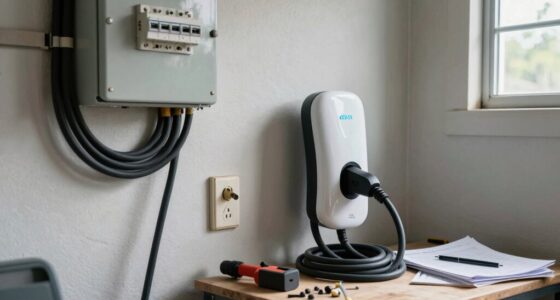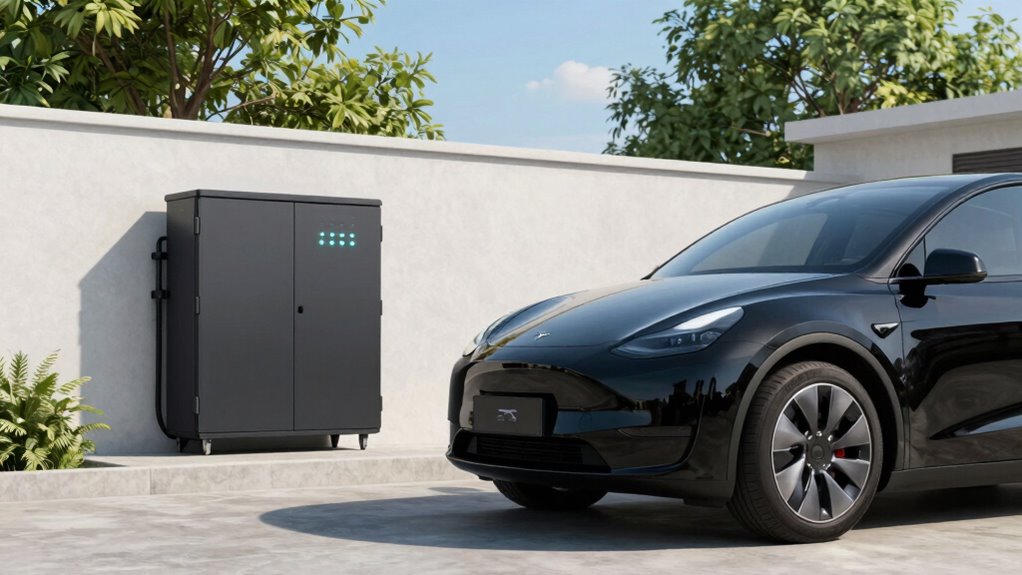

Before pairing your EV with a home battery system, make sure your energy management is optimized for cost savings by using time-of-use rates and storing excess energy. Check your utility’s policies and infrastructure support for seamless grid integration, and verify compatibility between your EV, battery, and home system. Upgrades might be necessary, and understanding future smart grid trends can boost system stability. Keep exploring to discover how to get the most out of your setup.

Get backup power and energy gear delivered free with Prime
- Fast, free delivery on millions of items
- Prime Video, Amazon Music and more included
- Member-only deals all year
Key Takeaways
- Verify utility policies and infrastructure support for two-way energy flow and grid integration.
- Ensure system compatibility between the EV, home battery, and existing electrical setup.
- Consider battery size and charging requirements to maximize energy savings and efficiency.
- Assess needed infrastructure upgrades to support optimal system performance and future expansion.
- Stay informed on smart grid developments to enhance system control, stability, and reliability.

Are you considering pairing your electric vehicle with a home battery system? If so, you’re exploring a smart way to maximize your energy use and potentially save money. But before jumping in, it’s important to understand how this setup impacts your home’s energy management, especially regarding grid integration and electric rates. When you connect your EV and home battery system, you create a more flexible energy network within your property. This grid integration allows your home to communicate with the utility grid more efficiently, enabling you to store excess energy during low-demand periods and draw from the grid when prices are higher. This level of control can help you optimize energy costs, especially if your utility offers time-of-use rates, where electricity is cheaper at certain times.
However, it’s essential to recognize that the success of this setup hinges on your utility’s policies and infrastructure. Not all grids are equipped to seamlessly handle two-way energy flow, which means your home battery and EV might face limitations or require additional equipment for proper integration. Before installation, check with your utility provider to understand their policies on grid interconnection and whether they support advanced energy management systems. Proper grid integration ensures your system can work harmoniously with the broader energy network, avoiding issues like power surges or outages and maximizing the financial benefits of your investment. Additionally, understanding technology compatibility between your EV, home battery system, and utility infrastructure is crucial for a smooth and efficient setup. A larger battery can store more energy, giving you greater flexibility and potential savings, but it also adds to the initial cost. Ensure the system you choose is compatible with your EV’s charging requirements and that it can deliver the power levels needed for quick, efficient charging. Being aware of grid infrastructure capabilities can help you determine whether your setup will function optimally and help you plan for any necessary upgrades. Moreover, understanding emerging trends in smart grid technology can provide insights into future advancements that could further enhance your system’s efficiency and integration. Recognizing the importance of grid stability can help prevent potential disruptions and ensure a reliable energy supply for your home and vehicle.
home battery system for EV charging
As an affiliate, we earn on qualifying purchases.
As an affiliate, we earn on qualifying purchases.
Frequently Asked Questions
How Does EV Charging Impact Overall Home Energy Costs?
Charging your EV can lead to energy savings if you time it during off-peak hours, which often costs less due to cost fluctuations. However, it might also increase your overall home energy costs if you charge frequently or during peak times. To optimize savings, monitor your energy use and take advantage of smart charging options, balancing your EV needs with your home energy consumption.
Can I Upgrade My Existing Home Battery System Later?
Yes, you can upgrade your existing home battery system later. Just guarantee the new battery has sufficient capacity to meet your needs and check system compatibility before making any changes. Upgrading often involves adding more storage or replacing components, so consult with a professional to confirm that your current setup supports the upgrade. This way, you optimize your battery capacity while maintaining reliable performance.
What Are the Insurance Implications of Pairing an EV With a Home Battery?
Pairing an EV with a home battery is like adding a new piece to a puzzle—you need to check insurance coverage first. It can affect liability considerations, especially if an accident involves your vehicle or battery system. Notify your insurer to make sure you’re protected, and clarify if any policy adjustments are necessary. Proper coverage helps you avoid surprises and ensures you’re financially protected in case of damages or accidents.
How Does Weather Affect the Efficiency of Paired Systems?
Weather variability considerably impacts the efficiency of paired EV and home battery systems. Cold temperatures can reduce solar efficiency, limiting energy production and battery performance, while extreme heat may cause overheating issues. Cloudy or rainy days also decrease solar efficiency, meaning you’ll generate less power. To optimize your system, consider weather patterns in your area and invest in weather-resistant components, ensuring consistent energy flow despite weather fluctuations.
Are There Specific EV Brands Better Suited for Pairing With Home Batteries?
Some EV brands stand out for better compatibility and easier battery integration, making your setup smoother. You might notice Tesla, with its advanced software and flexible charging systems, offers superior EV compatibility. Others like Nissan or Chevrolet also work well but may need additional equipment. Keep in mind, the right choice depends on your home system and future upgrades. Imagine the seamless energy flow once you find the perfect match—making your home and car smarter together.
smart grid compatible home battery
As an affiliate, we earn on qualifying purchases.
As an affiliate, we earn on qualifying purchases.
Conclusion
Pairing your EV with a home battery system is like balancing on a tightrope—you gain energy independence, but also face complexities that require careful planning. While it might seem like a seamless upgrade, the integration involves technical nuances and upfront costs that can trip you up if overlooked. Ultimately, the reward of a reliable, eco-friendly energy setup makes the challenge worth it. Just remember: a well-thought-out system today can power your tomorrow’s freedom.
EV charger compatible with home battery
As an affiliate, we earn on qualifying purchases.
As an affiliate, we earn on qualifying purchases.
time-of-use energy management system
As an affiliate, we earn on qualifying purchases.
As an affiliate, we earn on qualifying purchases.
Halloween Picks
halloween
As an affiliate, we earn on qualifying purchases.