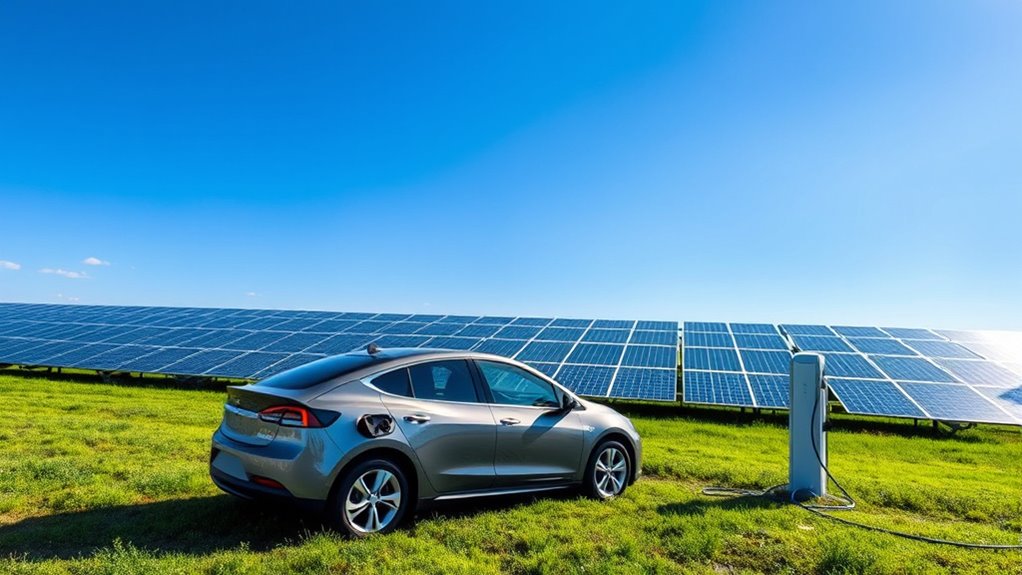

To charge your EV fully with solar power, you’ll likely need around 20 to 30 panels, depending on your battery size, panel efficiency, and sunlight in your area. For example, a 60 kWh battery might require about 30 panels producing 2 kWh daily each. Keep in mind, system losses and weather affect output. Want to find out how to optimize your setup? Keep exploring for detailed insights.
Key Takeaways
- A typical 60 kWh EV battery requires approximately 30 solar panels (300W each) producing around 2 kWh daily under optimal conditions.
- Solar panel efficiency and local sunlight hours directly influence the number of panels needed for full EV charging.
- System losses, shading, and weather reduce actual energy output, so including a safety margin is advisable.
- Estimating based on daily energy production per panel helps determine the total number needed for full charge.
- Consulting a solar professional ensures accurate, location-specific system design tailored to individual driving habits.
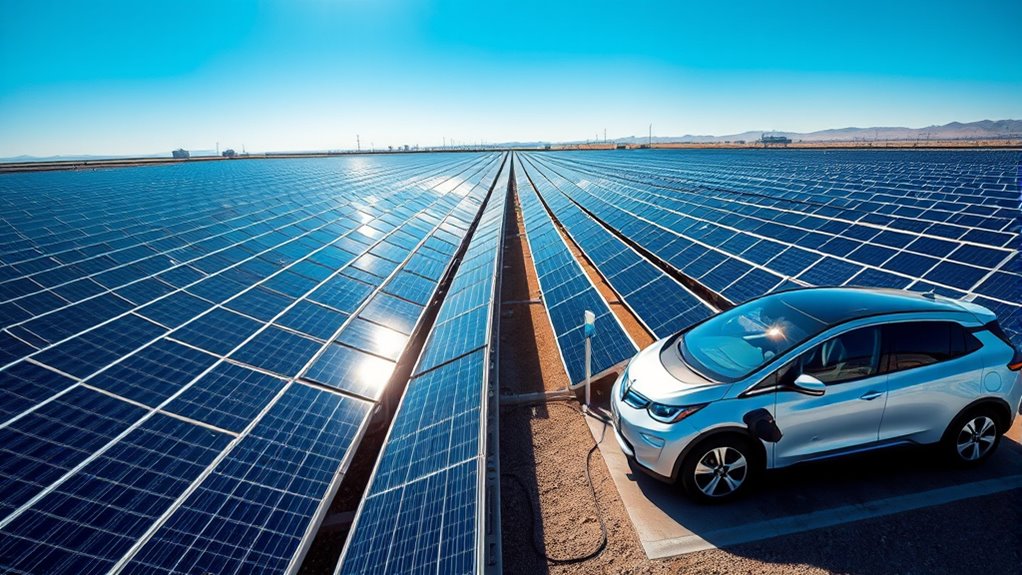
Have you ever wondered how many solar panels you need to fully charge your electric vehicle? The answer depends on a few key factors, primarily solar panel efficiency and your EV’s battery capacity. Solar panel efficiency measures how well a panel converts sunlight into usable electricity. Higher efficiency panels produce more power per square foot, meaning you need fewer panels to generate the same amount of energy. Meanwhile, your EV’s battery capacity, usually measured in kilowatt-hours (kWh), determines how much energy it requires for a full charge.
To figure out the number of solar panels needed, start with your EV’s battery capacity. For example, if your EV has a 60 kWh battery, that’s the total energy you need to replenish for a full charge. Next, consider the average solar panel efficiency, which typically ranges from 15% to 20%. Higher efficiency panels, say at 20%, can produce more electricity under the same conditions, reducing the number of panels you need.
Now, take into account the average solar insolation in your location, which is the amount of sunlight your area receives daily, measured in hours. For simplicity, let’s assume you get about 5 hours of peak sunlight per day. A typical 300-watt solar panel with 15-20% efficiency might generate around 1.5 to 2 kWh per day under optimal conditions. To determine how many panels you might need, divide your EV’s battery capacity by the daily energy production of a single panel. For a 60 kWh battery, and assuming each panel produces 2 kWh daily, you’d need approximately 30 panels (60 divided by 2).
Additionally, considering system losses such as inverter efficiency and shading can significantly impact your total energy output, so including a margin in your calculations is advisable. However, this is a rough estimate. Real-world factors like shading, panel orientation, system losses, and weather can lower actual energy production. It’s wise to add a safety margin or consult a solar energy professional to get a more precise calculation tailored to your location and setup. Keep in mind that a smaller, more efficient system might be enough if your daily driving habits don’t drain the entire battery regularly. Conversely, longer commutes or larger battery packs will naturally demand more panels.

200W Portable Solar Panel for Power Station, 24% High Efficiency ETFE Foldable Solar Panel Charger, QC3.0, Type-C 60W, MC4 Output, IP65 Waterproof, for Outdoor Camping, RV, Emergency Power Supply
【High Conversion Efficiency, Fast Charging】The upgraded A+ grade monocrystalline solar cells achieve a conversion rate of 24%, maximizing…
As an affiliate, we earn on qualifying purchases.
As an affiliate, we earn on qualifying purchases.
Frequently Asked Questions
How Does Weather Affect Solar Panel Efficiency for EV Charging?
Weather substantially affects solar panel efficiency for EV charging. Solar variability caused by cloudy days, rain, or snow reduces sunlight reaching the panels, lowering energy output. Seasonal changes also impact efficiency, as shorter days and lower sun angles in winter decrease power generation. You’ll find that on overcast days or during winter months, your panels produce less energy, so you might need extra panels or plan charges accordingly.
Can Home Solar Panels Fully Power an EV Long-Term?
Think of your home solar system as a steady heartbeat for your EV. Yes, it can fully power your vehicle long-term, but you need to contemplate solar panel costs and invest in reliable battery storage options. These batteries act as your energy reservoir, ensuring you have power even when the sun isn’t shining. With proper planning, your solar setup can become a sustainable, cost-effective solution that keeps you driving happily ever after.
What Is the Average Lifespan of Solar Panels Used for EV Charging?
Solar panels used for EV charging typically last 25 to 30 years, thanks to their durability. You’ll find that minimal maintenance is needed during this period, usually just annual inspections and occasional cleaning. Proper care extends their lifespan, ensuring they stay efficient. Keep an eye on performance, and if you notice a drop in energy output, it might be time for some maintenance to keep your system running smoothly long-term.
Are There Government Incentives for Installing Solar Panels for EVS?
Yes, there are government incentives for installing solar panels for EV charging. You can benefit from solar tax credits that reduce your federal tax bill, making installation more affordable. Additionally, many states offer installation subsidies or rebates, helping lower upfront costs. These incentives encourage clean energy use, so you should check local programs to maximize your savings and support your progression to sustainable transportation.
How Does the Type of EV Impact Solar Panel Requirements?
The type of EV impacts your solar panel needs because different vehicles have varying battery capacities and charging speeds. If you own a larger battery capacity EV with fast charging, you’ll need more solar panels to generate enough energy for full charges. Conversely, smaller or less powerful EVs require fewer panels. To optimize your setup, consider your vehicle’s charging speed and battery size, so you can efficiently meet your driving demands.

DOKIO 300W Foldable Solar Panel Kit for 12V Batteries & Power Stations, 15.2lb Monocrystalline Charger with PWM Controller, Dual USB, 9.85ft Cable, Folds to 19.3×37.4in for RV Camping
HIGH-EFFICIENCY MONOCRYSTALLINE CELLS: Premium mono-crystalline cells deliver higher conversion efficiency and steadier real-world output, giving you more usable…
As an affiliate, we earn on qualifying purchases.
As an affiliate, we earn on qualifying purchases.
Conclusion
So, if you’re dreaming of a future powered by the sun, remember it’s not as simple as plugging in a lamp. You’ll need enough solar panels—think of it like building a small fleet of flying machines—to charge your EV fully. It’s a bit like waiting for the dial-up to connect in an internet café; patience and planning are key. With the right setup, you’ll be cruising in your eco-friendly chariot, all thanks to our bright, sunny days.
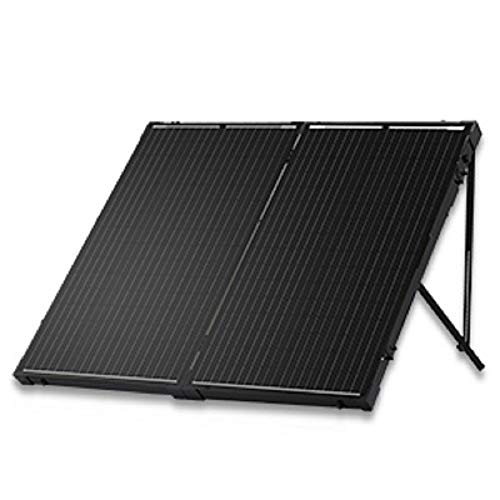
Renogy 200W Portable Solar Panel, 25% High Efficiency Solar Panel Kit with 20A Charger Controller for 12V Battery Power Station, N-Type Foldable Solar Panels w/Tempered Glass for RV, Camping Off-Grid
【25% High-Efficiency】Powered by N-Type cells boasting up to 25% conversion efficiency, this 200w solar panel delivers exceptional performance…
As an affiliate, we earn on qualifying purchases.
As an affiliate, we earn on qualifying purchases.

Planning of Hybrid Renewable Energy Systems, Electric Vehicles and Microgrid: Modeling, Control and Optimization (Energy Systems in Electrical Engineering)
As an affiliate, we earn on qualifying purchases.
As an affiliate, we earn on qualifying purchases.