
If you’re looking for the best 50 Amp GFCI breakers for your EV charger in 2025, I recommend considering models like ABB Q-Line, Siemens QF250A, Eaton BRN250GF, and Leviton receptacles, all known for their safety, durability, and reliable performance. These breakers feature advanced self-test functions, high fault current ratings, and outdoor ratings for weather resistance. Keep in mind compatibility and installation requirements to maximize safety. Stay with me to discover detailed options that combine safety and performance you can truly trust.
Key Takeaways
- Top GFCI breakers feature self-test functions, ensuring continuous ground fault safety and reliable performance in demanding applications.
- Designed for 50A, these breakers support high-power EV chargers, spas, and heavy-duty appliances with UL 943 certification.
- Durable, weather-resistant construction using impact-resistant plastics and corrosion-resistant metals guarantees outdoor safety and longevity.
- Easy plug-in installation with compatible receptacles like Leviton and VoltNGo offers flexibility for residential and commercial setups.
- Industry-leading brands provide extended warranties and meet safety standards, ensuring trustworthy performance and long-term support.
ABB Q-Line® 50A Double Pole Ground Fault Circuit Breaker
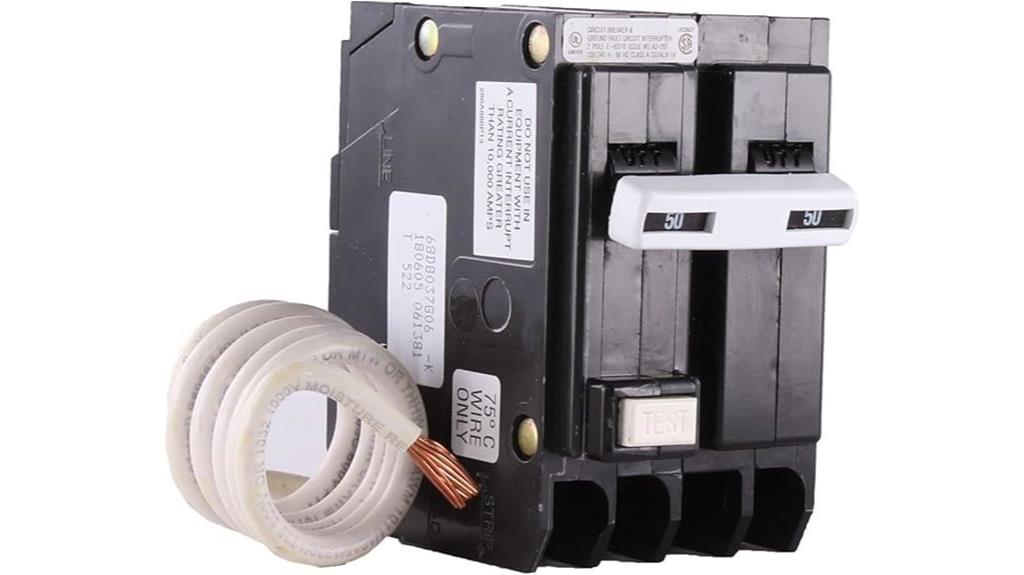
If you’re looking for a reliable GFCI breaker that’s easy to install and built for heavy use, the ABB Q-Line® 50A Double Pole Ground Fault Circuit Breaker is an excellent choice. It’s designed for both residential and commercial applications, offering 50 amps of power at 240V. Its self-test feature enhances safety by continuously monitoring for ground faults, immediately cutting off power if needed. Made from durable materials and meeting industry standards, it’s built to last and withstand heavy usage. With simple plug-in installation, it’s suitable for professionals and DIYers alike. Trust this breaker for reliable protection in your electrical system.
Best For: homeowners and professionals seeking a durable, easy-to-install GFCI breaker for residential or commercial electrical systems that provides reliable ground fault protection.
Pros:
- Self-test feature enhances safety by continuously monitoring for ground faults
- Easy plug-in installation suitable for both DIYers and professionals
- Built with durable materials and meets industry standards for heavy usage
Cons:
- Limited to 50A, which may not be suitable for higher power applications
- Only available in black plastic design, offering limited aesthetic options
- Requires careful verification of authenticity to avoid counterfeit products
Siemens QF250A Breaker Ground Fault Circuit Interrupter
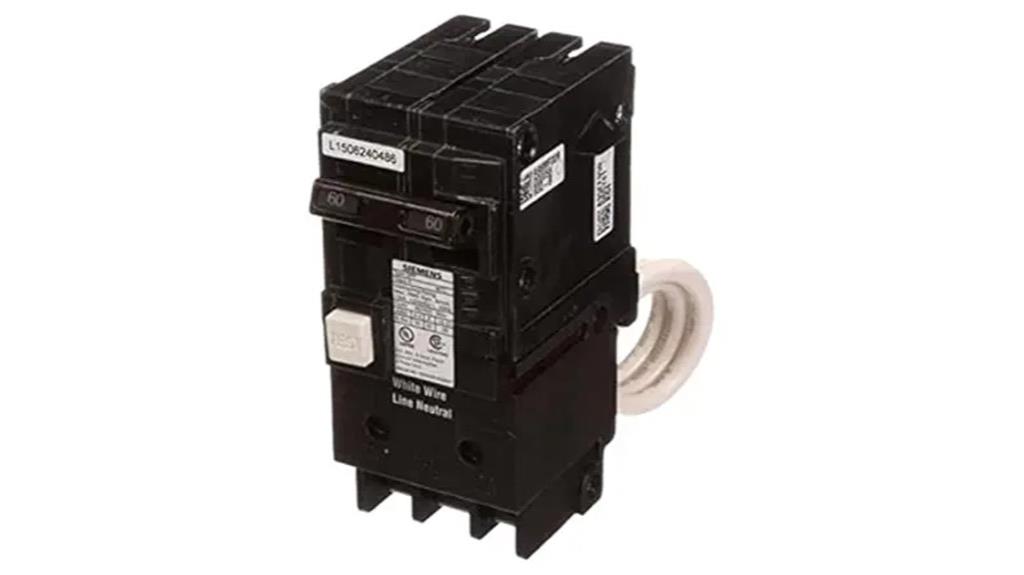
The Siemens QF250A Breaker Ground Fault Circuit Interrupter stands out as an excellent choice for those seeking reliable ground fault protection in both residential and commercial settings. With a 50-amp, double-pole design, it provides robust safety for circuits up to 240 volts, making it suitable for EV chargers, spas, and hot tubs. Its 10,000 AIC interrupting rating ensures dependable performance during faults. The breaker features a self-test function in line with UL 943 standards, guaranteeing ongoing safety. Overall, the Siemens QF250A combines durability, safety, and versatility, making it a top option for ensuring reliable ground fault protection.
Best For: homeowners, contractors, and electricians seeking reliable ground fault protection for residential or commercial circuits up to 240 volts, including applications like spas, hot tubs, and EV chargers.
Pros:
- Provides 50A, double-pole GFCI protection suitable for high-demand applications
- Features a self-test function complying with UL 943 for ongoing safety assurance
- High 10,000 AIC interrupting rating for dependable fault interruption
Cons:
- May be more expensive than basic circuit breakers without GFCI features
- Requires proper installation by qualified personnel for optimal safety
- Limited to specific applications; not suitable for all electrical systems
Eaton BRN250GF GFCI Circuit Breaker, 50A, Two-Pole
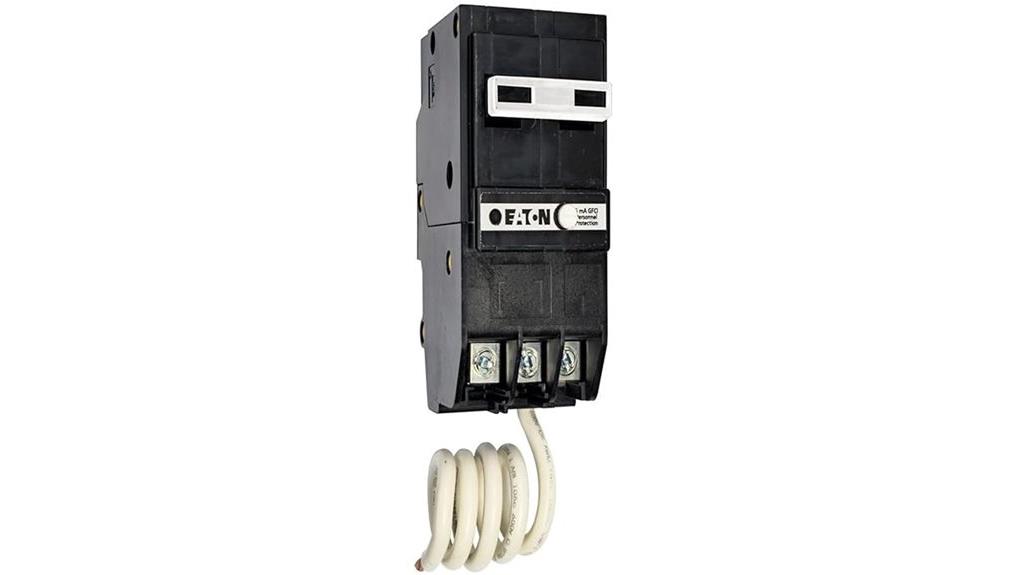
For those seeking reliable ground fault protection in their residential or commercial electrical systems, the Eaton BRN250GF GFCI Circuit Breaker stands out with its two-pole design and 50-amp capacity. It offers all-encompassing protection against ground faults, ensuring safety for both people and equipment. With a trip rating of 10 kAIC, it can handle significant fault currents without nuisance trips. The breaker features a GFI indicator for easy status monitoring and is compatible with standard electrical setups, making it a dependable choice for EV chargers and other high-demand applications. Its robust construction and reliable performance make it a top contender for anyone prioritizing safety and durability.
Best For: homeowners, electricians, and contractors seeking reliable ground fault protection for residential or commercial electrical systems, including high-demand applications like EV chargers.
Pros:
- Provides comprehensive two-pole GFCI protection for enhanced safety
- High trip rating of 10 kAIC allows handling of significant fault currents without nuisance trips
- Features a GFI indicator for easy status monitoring and quick diagnostics
Cons:
- May be more expensive than standard circuit breakers without GFCI features
- Requires professional installation due to complexity of wiring and compatibility considerations
- Limited to 50A capacity, which may not suit all high-load applications
ABB Q-Line® 50A Double Pole GFCI Circuit Breaker
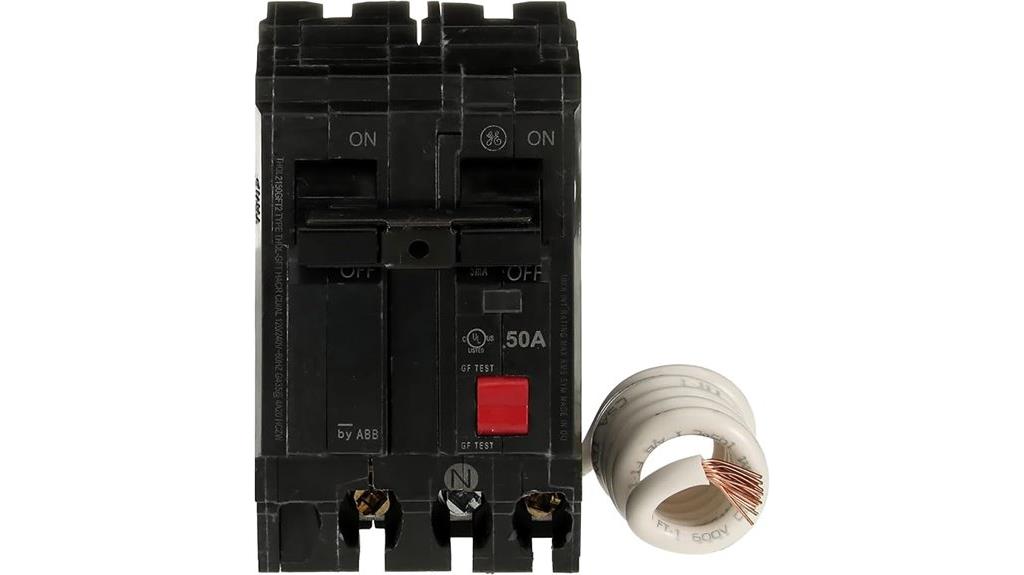
Designed with safety and durability in mind, the ABB Q-Line® 50A Double Pole GFCI Circuit Breaker offers reliable ground fault protection for both residential and commercial EV charging setups. It features GFCI technology with self-test capability, ensuring ongoing safety by detecting ground faults, overloads, and short circuits. Rated for 50 amps at 120/240 VAC, it’s built for heavy-duty use and long-lasting performance. Its robust construction and compliance with industry standards make it a trusted choice. Plus, its simple installation process suits both professionals and DIY enthusiasts, providing a seamless, secure way to protect your electrical system while charging your EV efficiently.
Best For: Residential and commercial property owners, electricians, and DIY enthusiasts seeking reliable and safe GFCI protection for EV charging and electrical systems.
Pros:
- Provides comprehensive ground fault, overload, and short circuit protection with self-test capability
- Durable construction designed for long-lasting, heavy-duty use
- Easy to install and suitable for both professionals and DIY users
Cons:
- Limited to 50A capacity, which may not suit all high-demand applications
- Requires compatible electrical panel for installation, possibly needing professional assistance
- May be more expensive than standard circuit breakers without GFCI features
Leviton 50 Amp EV Charging Receptacle/Outlet, Heavy Duty, 1450R, Black
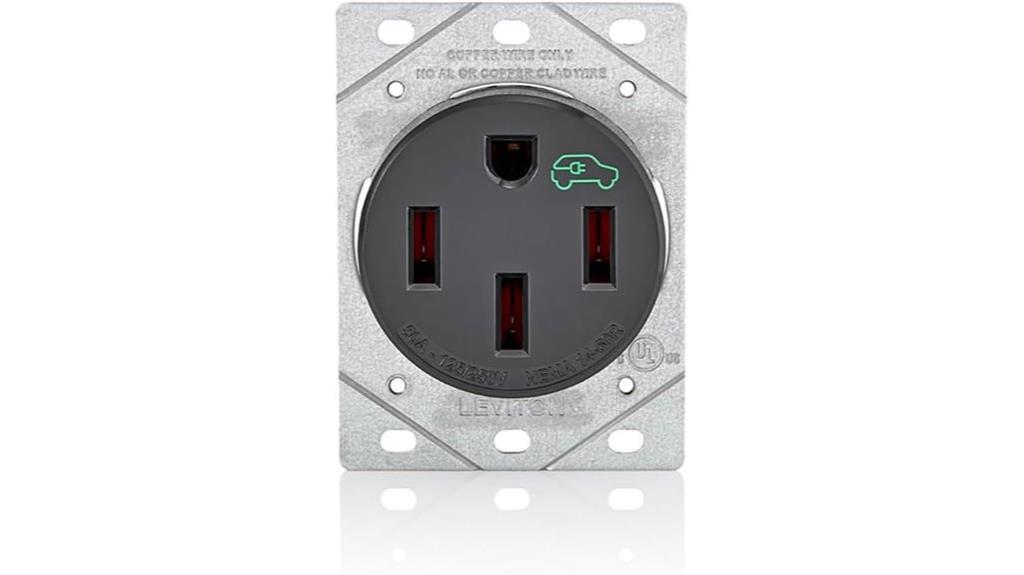
If you prefer a plug-in setup for your EV charger, the Leviton 50 Amp EV Charging Receptacle/Outlet, Heavy Duty, 1450R, Black stands out as a reliable choice. Built from durable high-impact nylon, it’s designed to withstand demanding environments and frequent use. Its pressure-wire terminal connections guarantee full contact with conductors, requiring 75 in-lbs of torque for a secure fit. Perfect for homeowners who favor plug-in units over hardwired systems, this receptacle supports extended charge times without degradation. It’s a heavy-duty, dependable option that combines safety, durability, and consistent performance for your EV charging needs.
Best For: homeowners seeking a durable, heavy-duty plug-in outlet for their EV chargers that can handle extended use and frequent connections.
Pros:
- Constructed from high-impact nylon for enhanced durability in demanding environments
- Pressure-wire terminal connections ensure full contact and secure fit with conductors
- Supports high-frequency use without degradation, ideal for long-term charging needs
Cons:
- Requires 75 in-lbs of torque during installation, which may necessitate specialized tools
- Designed specifically for plug-in setups, not suitable for hardwired configurations
- Black color may be less visible in certain outdoor or low-light settings
Leviton 2nd Gen Smart Circuit Breaker with Remote Control
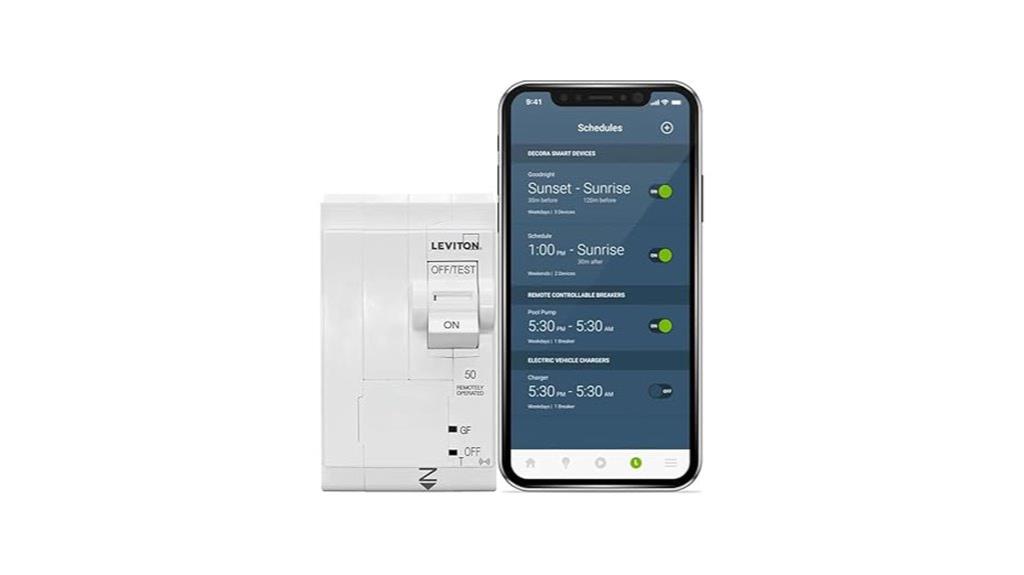
The Leviton 2nd Gen Smart Circuit Breaker with Remote Control stands out as an excellent choice for homeowners seeking advanced energy management and remote operation capabilities. This 50-amp GFCI breaker integrates seamlessly with the My Leviton app, allowing you to monitor energy use, turn circuits on or off remotely, and schedule operations for ideal efficiency. Its innovative design simplifies installation by enabling wiring before circuit breaker installation. Compatible with 120/240-volt and 120/208-volt systems, it offers reliable protection with a 10kA interrupt rating. Perfect for modern homes, this breaker combines safety, convenience, and smart technology for thorough electrical management.
Best For: homeowners seeking advanced energy management, remote control capabilities, and easy integration with smart home systems.
Pros:
- Allows remote control and scheduling via the My Leviton app for enhanced convenience and energy efficiency
- Seamless integration with Leviton Load Centers and compatibility with 120/240V and 120/208V systems
- Provides reliable circuit protection with a 10kA interrupt rating and built-in safety features
Cons:
- Requires a proprietary Leviton Load Center and Whole Home Energy Monitor (LWHEM) for full functionality
- May involve additional costs for compatible components and setup
- Limited to use with Leviton-specific hardware, reducing flexibility with other electrical systems
Leviton 50 Amp EV Charging Receptacle
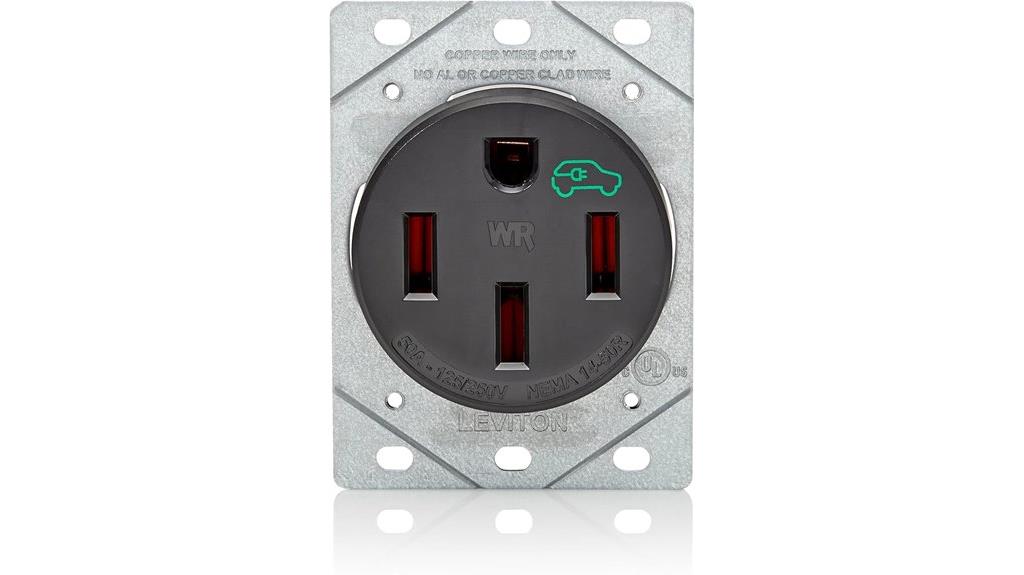
For homeowners seeking a reliable and durable plug-in option for their EV chargers, the Leviton 50 Amp EV Charging Receptacle stands out. It’s designed specifically for EV charging, supporting extended use and frequent plug-ins. Made from tough, weather-resistant nylon, it withstands outdoor conditions easily. With a 50-amp rating and 1450 watts, it handles high power loads efficiently. The receptacle features pressure-wire terminal connections, ensuring a secure fit with conductors. It’s ideal for those who prefer a plug-in setup over hardwired systems, providing a dependable, long-lasting connection for everyday EV charging needs.
Best For: homeowners seeking a reliable, weather-resistant, plug-in charging receptacle for their EVs that can handle high power loads and frequent use.
Pros:
- Durable construction from high-impact nylon for outdoor weather resistance
- Supports high power loads with a 50-amp, 1450W rating
- Secure connections with pressure-wire terminal design requiring 75 in-lbs torque
Cons:
- May require professional installation due to torque specifications
- Designed specifically for plug-in chargers, not compatible with hardwired systems
- Limited to outdoor use, less suitable for indoor environments
VoltNGo NEMA 14-50R EV Charger Socket

The VoltNGo NEMA 14-50R EV Charger Socket stands out as an ideal choice for homeowners and professionals seeking a versatile, weather-resistant outlet capable of supporting high-power EV charging. It’s compatible with major EV charging stations, Tesla, and Level 2 chargers, making it suitable for both home and outdoor use. Supporting 50 amps at 125/250V, it handles heavy-duty applications like RVs, dryers, and welders with ease. Its weather-resistant design and UL safety certification guarantee durability in harsh conditions. Easy to install with standard electrical boxes, the VoltNGo socket offers reliable, continuous power, making it a trusted option for high-capacity charging needs.
Best For: homeowners, electricians, and RV owners seeking a durable, weather-resistant high-capacity outlet for efficient EV charging and heavy-duty applications.
Pros:
- Compatible with major EV charging stations, Tesla, Level 2 chargers, and RVs for versatile use
- Weather-resistant and UL listed, ensuring safety and durability in outdoor or harsh environments
- Easy to install with standard electrical boxes, suitable for both DIYers and professionals
Cons:
- Limited to 50 Amp, 125/250V applications; not suitable for lower or higher voltage needs
- Requires proper electrical knowledge for safe installation, which may be a barrier for some DIY users
- May need additional adapters or accessories for specific EV models or applications
RVGUARD 50 Amp EV Charging Receptacle
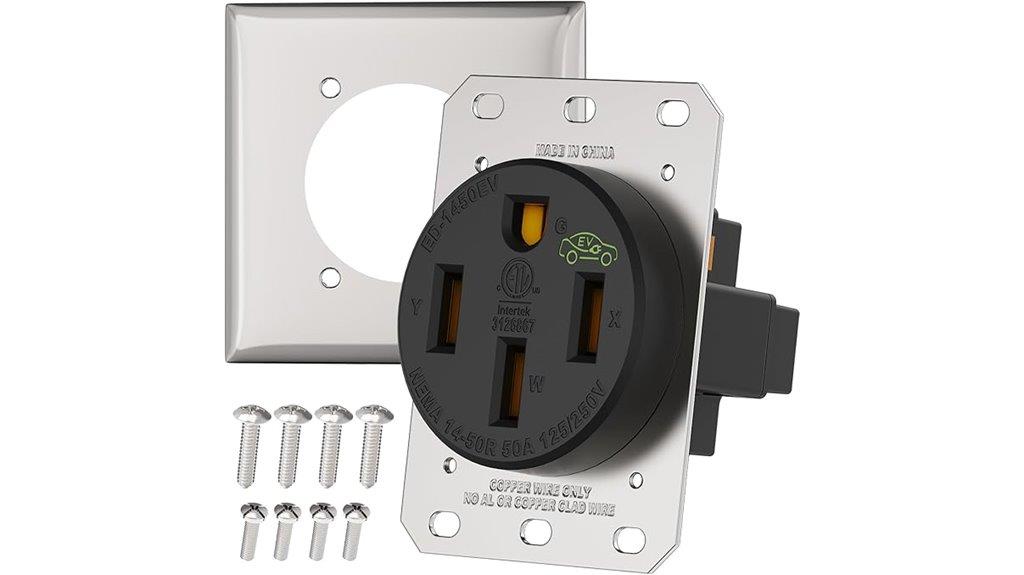
If you’re seeking a durable and reliable receptacle for your EV charging setup, the RVGUARD 50 Amp EV Charging Receptacle is an excellent choice. It’s designed for demanding applications like EV chargers, RVs, and large appliances, with a NEMA 14-50R configuration that’s fully rated for continuous use. Made from high-impact nylon with heavy-gauge brass contacts, it ensures durability and performance. It includes a stainless-steel wall plate and mounting screws for easy installation and is ETL listed, meeting safety standards. Compatible with #4, #6, or #8 AWG copper wire, this receptacle combines robust construction with safety, making it a dependable option for any high-power charging station.
Best For: EV owners, RV enthusiasts, and homeowners seeking a durable, high-capacity outlet for large appliances and electric vehicle charging.
Pros:
- Robust construction with high-impact nylon and heavy-gauge brass contacts ensures durability and long-term performance
- Fully rated for continuous use, suitable for demanding high-power applications like EV chargers and large appliances
- Includes a stainless-steel wall plate and mounting screws for easy installation and safety compliance
Cons:
- Requires a 2-gang or larger outlet box, which may necessitate additional wiring modifications
- Compatible only with copper wire sizes #4, #6, or #8 AWG, limiting flexibility with other wiring types
- Installation may require professional expertise to ensure proper setup and safety standards
Factors to Consider When Choosing a 50 Amp GFCI Breaker for Ev Charger
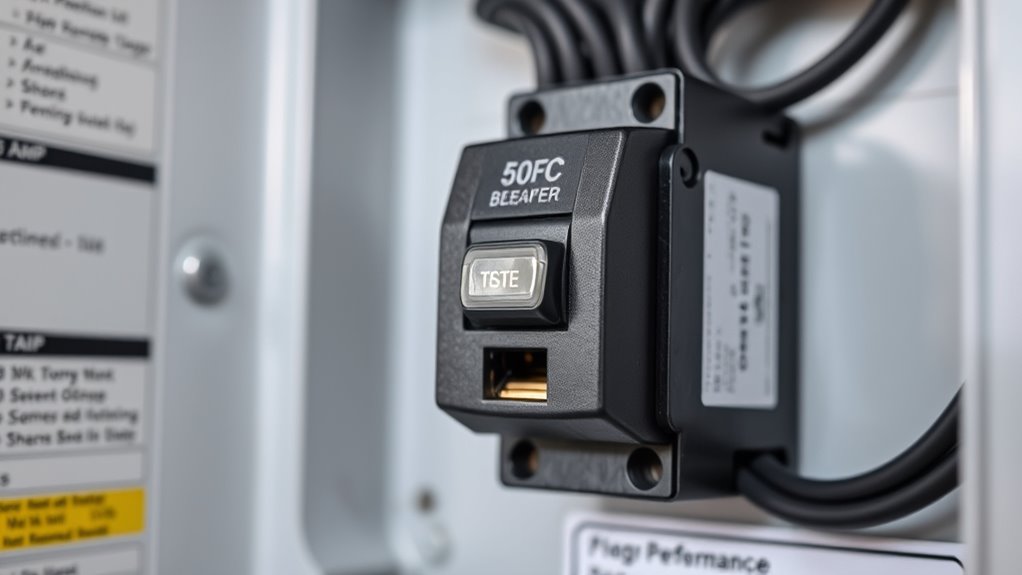
When selecting a 50 Amp GFCI breaker for your EV charger, I consider several key factors to guarantee safety and compatibility. It’s important to check the charger’s specifications, safety standards, and how easy the breaker is to install. I also look at the durability and build quality to make sure it will perform reliably over time.
Compatibility With Charger
Choosing the right 50 Amp GFCI breaker for your EV charger requires careful attention to compatibility. First, make sure the breaker has a 50-amp rating that matches your charger’s requirements. It’s also essential to verify that the breaker is compatible with your specific charger type and model, especially if it uses NEMA 14-50R connectors or others. Check that the voltage rating (typically 120/240V) aligns with your electrical setup to ensure safe operation. Additionally, confirm that the breaker’s pole configuration (usually double-pole) matches your wiring setup for proper connection. In conclusion, look for safety features like self-test functions and UL certification, which guarantee reliable performance and protection during charging. Being thorough here helps prevent compatibility issues down the line.
Current and Voltage Ratings
Ensuring the current and voltage ratings match your EV charger’s specifications is vital for safe and efficient operation. A 50 Amp GFCI breaker is designed to handle a maximum current of 50 amps, suitable for high-power EV chargers. It’s essential that the breaker’s voltage rating aligns with your circuit—typically 120/240 volts in residential setups—to prevent issues like overvoltage or undervoltage. Proper matching of current and voltage ratings ensures your system complies with electrical codes and operates reliably. Exceeding the current limit can cause nuisance tripping or damage, while mismatched voltage ratings could compromise safety and performance. Taking the time to verify these ratings guarantees your EV charging system functions smoothly, safely, and efficiently.
Safety and Certification Standards
Safety and certification standards are crucial factors to consider because they verify that a GFCI breaker meets established industry requirements. I always look for UL-listed breakers, especially those certified under UL 943, which is specific for ground-fault circuit interrupters. Confirming compliance with the NEC ensures the breaker adheres to national safety codes for residential and commercial setups. A recognized third-party certification mark, like Intertek (ETL) or CSA, adds extra assurance that the breaker meets rigorous safety standards. I also prioritize models with a self-test feature, which automatically checks the breaker’s functionality to maintain reliable ground fault protection. Lastly, the breaker should be rated correctly for the intended amperage and voltage, with a sufficient interrupting capacity (AIC) to handle potential fault currents safely.
Ease of Installation
When installing a 50 Amp GFCI breaker for your EV charger, compatibility with your electrical panel is vital. Check if the breaker’s mounting type matches your panel—whether it’s plug-in or bolt-on. Make sure the wiring connections are straightforward, with clear terminal labels to simplify setup. Review the installation instructions to ensure they match your skill level, whether you’re doing it yourself or hiring a professional. Confirm that the breaker’s size and dimensions fit comfortably within your panel’s available space to avoid any fitting issues. Finally, select a breaker with clear labeling and detailed manufacturer instructions, which will help guide you through a safe and correct installation process. Ease of installation is key to a hassle-free setup.
Durability and Material Quality
Choosing a durable 50 Amp GFCI breaker for your EV charger means paying close attention to the materials used in its construction. High-quality breakers are built with impact-resistant plastics and corrosion-resistant metals, helping them withstand frequent use and harsh environments. The internal components, like the trip mechanism and contacts, should be made from robust materials such as copper or silver alloy, ensuring reliable electrical performance and longevity. Proper insulation and protective coatings shield the breaker from moisture, dust, and temperature fluctuations, extending its lifespan. Heavy-duty construction guarantees the breaker maintains its structural integrity through repeated trips and high electrical loads. Certifications from UL and IEC confirm that these breakers meet rigorous safety and durability standards, giving you confidence in their long-term performance.
Cost and Warranty Options
Considering warranty options is vital when selecting a 50 Amp GFCI breaker for your EV charger, as it can substantially impact your long-term investment. Warranties typically range from 5 to 10 years, depending on the brand and product line. Many breakers include limited warranties that cover manufacturing defects but exclude damage from improper installation or misuse. Some brands offer extended warranties or service plans for extra protection beyond the standard coverage. It’s imperative to review warranty terms carefully, paying attention to whether they cover replacement parts or full product replacement. Cost differences often reflect warranty length and the manufacturer’s reputation for support and durability. Choosing a breaker with a solid warranty can provide peace of mind and save money on potential repairs or replacements later.
Frequently Asked Questions
How Do GFCI Breakers Detect Ground Faults in EV Charging?
GFCI breakers detect ground faults by monitoring the current flowing through the hot and neutral wires. If there’s an imbalance, meaning some current leaks to the ground, the GFCI quickly trips to prevent shocks or fires. I trust this technology because it continually checks for discrepancies, ensuring safety during EV charging. That way, you get reliable protection whenever your vehicle is plugged in.
Can GFCI Breakers Be Reset Without Professional Help?
Think of GFCI breakers like vigilant sentinels at your electrical gate—they can be reset without a pro’s help. When they trip, I simply flip the switch back to the “on” position, like opening a door after an alert. If it won’t reset, I check for underlying issues or consult the manual. Usually, it’s straightforward, and I feel confident handling it myself, ensuring my EV charger stays safe and ready.
Are There Compatibility Issues With Specific EV Charger Models?
Yes, there can be compatibility issues with certain EV charger models and GFCI breakers. I recommend checking both the charger’s specifications and the breaker’s compatibility list before installation. Some chargers may require specific breaker types or brands to ensure proper operation and safety. Always consult the manufacturer’s guidelines or a professional electrician to avoid any compatibility problems that could affect performance or safety.
What Is the Typical Lifespan of a 50A GFCI Breaker?
Like a sturdy oak weathering storms, a 50A GFCI breaker typically lasts between 10 to 20 years with proper maintenance. I’ve seen them perform reliably over a decade, but factors like usage frequency, electrical surges, and environment can influence lifespan. Regular inspections and timely replacements guarantee safety and performance stay intact. Keep an eye on any signs of wear, and you’ll enjoy dependable service for years to come.
Do GFCI Breakers Affect Charging Speed or Power Delivery?
GFCI breakers don’t affect charging speed or power delivery directly. Their main role is to protect against electrical faults, ensuring safety. However, if a GFCI breaker trips frequently due to nuisance issues or faults, it can interrupt your charging process, causing delays. So, while they don’t reduce power or speed, reliable, high-quality breakers help maintain consistent charging without unnecessary interruptions.
Conclusion
Did you know that installing the right 50 amp GFCI breaker can reduce electrical hazards by up to 70%? Choosing a high-quality, reliable breaker guarantees your EV charger stays safe and performs at its best. Whether you go with ABB, Siemens, or Leviton, prioritize safety and compatibility. Investing in the right breaker not only protects your vehicle but also gives you peace of mind every time you plug in. Your safety is worth it!