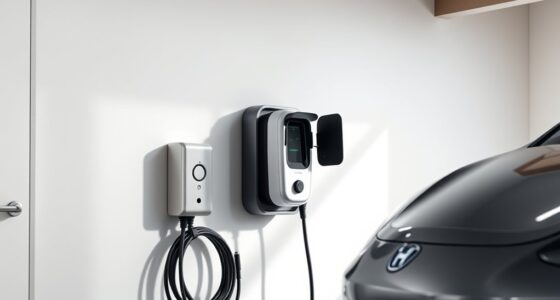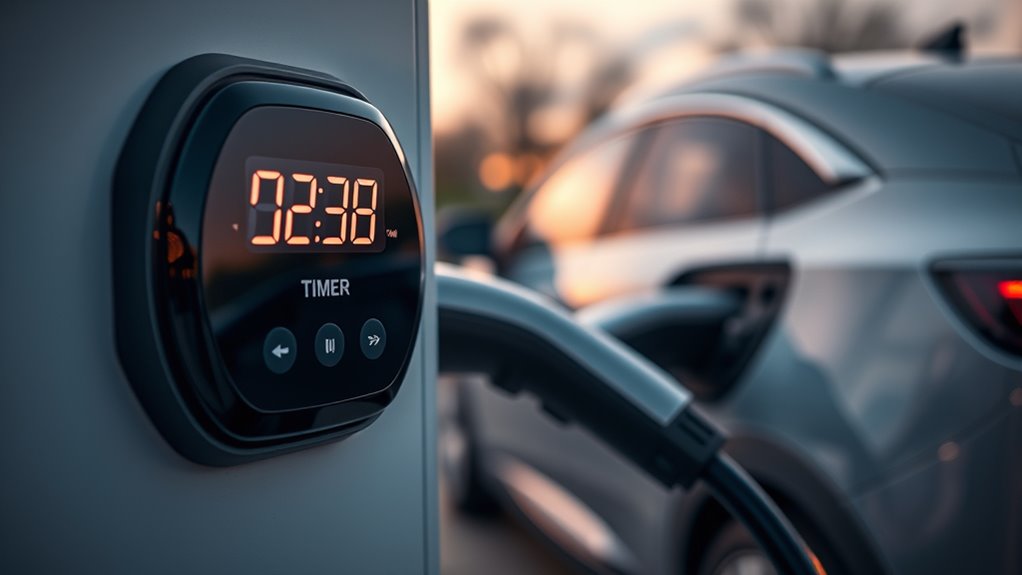

Looking for the best timer switches for EV charging in 2025? I recommend options like digital programmable timers, smart WiFi-enabled chargers, and durable indoor outlets that support energy-saving schedules and safety certifications. These timers help reduce costs, prevent overcharging, and optimize charging sessions. Keep in mind load capacities and compatibility with your EV setup. If you keep exploring, you’ll discover top picks that match your needs perfectly and guarantee safe, efficient power management.
Listen free for 30 days with Audible
Thousands of audiobooks and originals — cancel anytime.
As an affiliate, we earn on qualifying purchases.
Key Takeaways
- Programmable timer switches support customizable schedules to optimize EV charging and reduce energy costs effectively.
- Look for UL-listed or ETL-certified models with safety features for reliable indoor EV charger management.
- Ensure the timer’s power capacity matches your EV charger’s amperage and voltage requirements for safe operation.
- Smart timer switches with app control and remote scheduling enhance convenience and energy savings for EV charging.
- Select timers with multiple ON/OFF cycles and delay start options for flexible, efficient EV charging routines.
TEKLECTRIC Indoor Auto Shut Off Curling Iron and Hair Straightener Timer Safety Outlet

If you’re looking for a reliable timer switch to protect your curling iron, hair straightener, or other small appliances, the TEKLECTRIC Indoor Auto Shut Off Timer is an excellent choice. It automatically cuts power after set periods—1, 2, 4, 8 hours, or hold—saving energy and preventing overheating. Easy to operate with simple push buttons, it’s compatible with various devices like phones, lamps, and seasonal décor. UL-rated for safety, it handles up to 125V AC and 15A loads, including resistive and tungsten appliances. This timer offers peace of mind, ensuring your appliances turn off securely and efficiently every time.
Best For: individuals seeking a safe, energy-saving timer solution for curling irons, hair straighteners, and other small household appliances.
Pros:
- Easy to operate with simple push button settings for multiple time options
- UL safety rated, ensuring reliable protection and peace of mind
- Compatible with various devices including lamps, phones, seasonal decor, and lighting
Cons:
- Limited to indoor use only, not suitable for outdoor applications
- Supports up to 15A loads, which may not be sufficient for high-power appliances
- May not be compatible with appliances exceeding 1,000W tungsten or 500 VA electronic ballast
Charge-O-Matic Timer for Chargers

The Charge-O-Matic Timer for Chargers stands out for its programmable scheduling capabilities, making it an ideal choice for anyone seeking reliable, automated control over their EV or device charging. It transforms any charger into a smart device, managing charging cycles for USB gadgets, jump starters, mobility scooters, and more, all while following manufacturer specs. With customizable timers—30, 60, or 90 days—and the ability to power on for up to 99 hours, it offers flexible, energy-efficient operation. No Wi-Fi needed; it’s simple to program, supports automatic resumption after outages, and helps prevent unnecessary energy waste. It’s perfect for maintaining battery health and saving money.
Best For: individuals and businesses looking for a reliable, customizable, and energy-efficient solution to automate and manage charging cycles for a variety of electronic devices and batteries without the need for Wi-Fi or Bluetooth.
Pros:
- Easy to program and operate, suitable for users of all ages without technical expertise
- Supports customizable timers up to 90 days and automatic resumption after outages for flexible scheduling
- Promotes energy savings by automatically disconnecting power, reducing standby energy waste
Cons:
- Does not include Wi-Fi or Bluetooth connectivity for remote control or monitoring
- Limited to scheduled on/off cycles; may not suit real-time or dynamic charging needs
- Cannot handle very high power loads beyond its rated specifications, limiting certain heavy-duty applications
Digital Programmable Timer Switch for Electrical Outlets

A digital programmable timer switch for electrical outlets offers precise control over device operation, making it ideal for anyone looking to automate EV charging schedules. This 24-hour indoor timer (120V, 15A) features a large display for easy reading, a built-in battery to retain programs during outages, and a fireproof, child-safe housing. Its versatile 3-in-1 design supports daily on/off scheduling, countdown timing, and short cycle operations, giving you flexible control. By automatically managing power, it helps reduce energy waste, lower utility bills, and extend device lifespan. Plus, its silent operation and safety features make it a reliable, user-friendly choice for efficient home energy management.
Best For: individuals seeking automatic, customizable control over household or electronic device scheduling to save energy and enhance safety.
Pros:
- Versatile 3-in-1 design supports daily scheduling, countdown, and short cycles for flexible use
- Large display and silent operation make it user-friendly and unobtrusive in home environments
- Built-in battery backup and fireproof housing ensure safety and program retention during outages
Cons:
- Limited to indoor use with a maximum of 120V and 15A, not suitable for outdoor or high-power appliances
- May require some initial setup and familiarization with programming functions for new users
- Lacks smart connectivity features, limiting remote control options
NEARPOW Digital Timer Outlet with 20 ON/OFF Programs

The NEARPOW Digital Timer Outlet stands out for its incredible scheduling flexibility, making it ideal for users who need precise control over their devices. It offers four advanced modes, including a 7-day programmable schedule with up to 20 ON/OFF programs daily, totaling 140 weekly schedules. You can set customizable intervals with the Infinite and Timed Interval Cycle modes, perfect for complex routines like irrigation or lighting. Its large, easy-to-read display and intuitive controls make programming straightforward. Plus, a rechargeable battery guarantees your settings stay safe during power outages. This timer is perfect for automating indoor appliances, grow lights, or EV chargers with tailored, reliable schedules.
Best For: DIY enthusiasts and homeowners seeking precise, customizable scheduling for indoor appliances, grow lights, or holiday decorations.
Pros:
- Offers four advanced modes including a 7-day programmable schedule with up to 20 ON/OFF programs daily.
- Supports customizable intervals with Infinite and Timed Cycle modes for complex routines.
- Large, easy-to-read display and intuitive controls simplify programming and operation.
Cons:
- Rated for indoor use only, limiting outdoor application options.
- The complexity of multiple modes might be overwhelming for casual users.
- Limited to 15A/1875W, which may not accommodate higher power appliances.
DEWENWILS Indoor Countdown Timer (2 Pack)

Designed for indoor use, the DEWENWILS Indoor Countdown Timer (2 Pack) offers a straightforward solution for those who want to automate device shutoff without hassle. Its simple operation involves just pressing buttons to set the desired on-time, up to 7 hours 45 minutes, with a repeat function for daily use. The compact design features a polarized side outlet, so it doesn’t block the second socket. UL listed for safety, it’s suitable for various devices like chargers, lights, and security gadgets. Reliable and energy-efficient, this timer is perfect for managing indoor electronics, preventing overcharging, and saving power effortlessly.
Best For: those seeking a simple, reliable indoor timer to automate device shutoff and save energy without complex programming.
Pros:
- Easy to operate with straightforward button controls and a repeat daily setting
- Compact design with polarized outlet prevents blocking the second socket
- UL listed for safety and suitable for various indoor electronic devices
Cons:
- Limited to indoor use only, not suitable for outdoor environments
- Maximum on-time of 7 hours 45 minutes may not meet longer timing needs
- Does not support Wi-Fi or smartphone connectivity for remote control
SURAIELEC Mechanical Countdown Timer Switch

If you’re looking for a reliable way to control energy usage without relying on complex programming or batteries, the SURAIELEC Mechanical Countdown Timer Switch is an excellent choice. Its simple, mechanical design lets you set a countdown from 2 to 60 minutes by just turning a knob, making operation straightforward. No wiring complexities or batteries needed, and it fits easily into existing wall switch setups. Certified by ETL for safety, it’s perfect for managing exhaust fans, lights, or heaters in homes and offices. Plus, it helps cut electricity bills by up to 90 and improves safety by deterring intruders through simulated presence.
Best For: homeowners and office managers seeking a simple, battery-free timer switch to control lights, fans, or heaters efficiently.
Pros:
- No batteries or programming required, ensuring hassle-free operation.
- Easy installation compatible with existing switch plates, saving time and effort.
- ETL certified for safety and compliance, providing peace of mind.
Cons:
- Limited to a maximum of 60 minutes, which may not suit longer timing needs.
- Mechanical dial may wear out over time with frequent use.
- Lacks digital features or remote control capabilities for advanced customization.
Meross Matter Smart Plug 4-Pack

For those seeking a versatile and reliable smart plug to integrate into their EV charging setup, the Meross Matter Smart Plug 4-Pack stands out with its broad compatibility across major smart home platforms. It works seamlessly with Apple Home, Alexa, Google Home, Home Assistant, and SmartThings, supporting Matter over WiFi. I appreciate its energy monitoring feature, providing real-time power use and historical data to help optimize energy bills. Setup is straightforward—just plug in and connect via app or voice commands. Plus, its compact, fire-retardant design guarantees safety without blocking outlets. Overall, this pack offers an easy, secure way to control and monitor your EV charger remotely.
Best For: homeowners and EV owners seeking a versatile, secure, and easy-to-integrate smart plug for remote control and energy monitoring within a unified smart home ecosystem.
Pros:
- Compatible with all major smart home platforms including Apple Home, Alexa, Google Home, Home Assistant, and SmartThings
- Built-in energy monitoring provides real-time and historical power usage data for energy optimization
- Compact, fire-retardant design with safety features like overload protection and scheduling options
Cons:
- Does not support Thread protocol, limiting some advanced mesh network functionalities
- Requires a Matter-compatible hub for certain platforms, which may add setup complexity
- Does not support Thread, which is increasingly popular in some smart home devices
12V Programmable Timer Switch for DC/AC/Solar Batteries

The 12V Programmable Timer Switch for DC/AC/Solar Batteries stands out as an ideal choice for those seeking reliable, customizable automation for energy systems. It operates on 12V DC power, making it efficient and suitable for solar, DC, or AC sources. With support for up to 16 independent ON/OFF schedules, you can tailor it precisely to your needs, from minutes to days. Its user-friendly LCD screen and clear instructions simplify programming, while the power outage memory guarantees your settings stay intact. Perfect for DIY projects like automatic doors or feeders, this timer switch offers versatile, dependable control for a variety of energy applications.
Best For: DIY enthusiasts and automation hobbyists seeking customizable, reliable timing solutions for energy systems powered by 12V DC, solar, or AC sources.
Pros:
- Supports up to 16 independent ON/OFF schedules for versatile automation.
- Easy-to-program with an LCD screen and clear instructions, suitable for users of all skill levels.
- Maintains programmed settings during power outages thanks to built-in memory feature.
Cons:
- Requires a 12V power source, limiting use with higher voltage systems without additional components.
- May be complex for users unfamiliar with programming or automation setups.
- Limited to timing ranges from 1 minute to 7 days, which might not suit very long-term scheduling needs.
Digital Display USB Timer with Adjustable Countdown from 5 Minutes to 24 Hours

A digital display USB timer with adjustable countdown from 5 minutes to nearly 25 hours is an excellent choice for anyone seeking precise control over their USB-powered devices. Its digital screen allows real-time monitoring, making it easy to set and track the countdown. With support for 5V2A devices, it’s perfect for controlling fans, lights, water pumps, or fish tanks. The plug-and-play design simplifies setup, and the 140cm cable offers flexibility. Whether you want to automate device shutdowns or save energy, this timer provides reliable, adjustable timed operation, all in a compact, portable package. It’s a practical tool for energy efficiency and convenience in everyday use.
Best For: individuals seeking precise, automated control over USB-powered devices such as fans, water pumps, and lighting to enhance energy efficiency and convenience.
Pros:
- Digital display provides real-time countdown monitoring for accurate timing.
- Supports adjustable timing from 5 minutes up to nearly 25 hours, versatile for various needs.
- Plug-and-play design makes setup quick and straightforward without complex installation.
Cons:
- Does not support data transmission, limiting its use to power control only.
- Limited to 5V devices with a maximum current of 2A, not suitable for higher power applications.
- The cable length of 140cm may not be sufficient for all setups, requiring additional extension.
Generic USB Timer Switch Extension Cable for Fan and Lamp

If you’re looking for a simple yet reliable way to control your USB-powered fans and lamps, the Generic USB Timer Switch Extension Cable offers an excellent solution. It’s a 60cm black extension cable with a built-in timer switch, making it easy to automate your devices. With three preset timing options—0.5, 1.5, and 3 hours—you can easily manage power usage. Made from durable PP material, it’s built to last. Suitable for devices like LED strips, ceiling fans, or desk lamps, it provides convenient control while ensuring safety and efficiency. Its compact design makes it a versatile addition to your power management setup.
Best For: individuals seeking an easy and reliable way to automate and control USB-powered devices like fans, lamps, and LED strips efficiently and safely.
Pros:
- Easy to operate with multiple preset timer options for flexible scheduling.
- Made from durable, wear-resistant PP material ensuring long-term use.
- Compact design and universal USB compatibility make it versatile and space-saving.
Cons:
- Limited to devices drawing up to 2A and 10W, not suitable for high-power appliances.
- Only three fixed timer settings, which may not suit all user needs.
- The extension cable length of 60cm might be short for some setups.
Battery Charger Timer Kit with Hold Position Panel Mount

For those seeking a reliable timer switch that can handle continuous operation without requiring power, the Battery Charger Timer Kit with Hold Position Panel Mount is a great choice. It features a mechanical design with no need for AC or DC power, making it highly dependable. The kit includes a sturdy panel-mount switch rated at 13A/120VAC and 16A/250VAC, along with essential components like a knob, mounting nut, and connectors for easy installation. Its hold position function ensures uninterrupted operation, perfect for charging applications where consistent power flow is critical. Overall, it’s a durable, straightforward solution for EV charging setups requiring a simple, power-independent timer.
Best For: those seeking a reliable, power-independent timer switch for continuous operation in EV charging or similar applications.
Pros:
- Mechanical design eliminates the need for AC/DC power, ensuring high dependability.
- Durable panel-mount construction with reliable switch ratings for long-term use.
- Includes all necessary components for straightforward installation and setup.
Cons:
- Limited to approximately 120 minutes of operation before needing to reset or restart.
- No electronic or digital features for programmable timing or remote control.
- Requires manual operation or reset, which may not suit automated systems.
NSi Industries TORK 402B Heavy-Duty Indoor Mechanical Timer

The NSi Industries TORK 402B Heavy-Duty Indoor Mechanical Timer stands out as an excellent choice for those who need reliable, manual control over heavy-duty appliances and seasonal decorations. It’s designed for 125V devices like air conditioners, heaters, and holiday lights, offering straightforward, manual programming with captive tabs. You pull tabs up to turn off and push down to turn on, with 30-minute interval settings. The dial rotates clockwise for precise adjustments, and the programmed cycle repeats daily. Its compatibility with various bulb types and strong electrical ratings make it a versatile, durable option for automating household or commercial devices effortlessly.
Best For: homeowners and commercial users seeking reliable, manual control over heavy-duty appliances and seasonal decorations with simple, repeatable scheduling.
Pros:
- Easy manual programming with captive tabs for precise ON/OFF scheduling
- Repeats daily, ensuring consistent automation without daily adjustments
- Compatible with various bulb types and supports heavy-duty appliances up to 15A
Cons:
- Mechanical timer may require manual reset after power outages
- Limited to 30-minute interval settings, which may not suit all timing needs
- Indoor use only, not suitable for outdoor or moisture-prone environments
Portable Type 2 EV Wall Charger (8A-32A Adjustable, 7kW, Delay Timer)

A portable Type 2 EV wall charger with adjustable current (8A-32A) and a delay timer is an excellent choice for EV owners who need flexible, on-the-go charging options without the hassle of installation. It delivers 7.2 kW power and connects to a standard 220-250 VAC outlet, making it versatile for home or travel. The charger features a user-friendly mobile app to set start times, delay (1-15 hours), and current levels. Its robust safety features include overvoltage, short circuit, and temperature protections, plus waterproof IP54 rating. Packaged with a convenient carrying bag, it’s perfect for those seeking reliable, portable charging with customizable scheduling.
Best For: EV owners seeking a portable, flexible charging solution without installation, suitable for home, travel, or on-the-go use.
Pros:
- Adjustable charging current (8A-32A) for customized charging speed
- User-friendly mobile app for easy scheduling and control
- Robust safety features including overvoltage, short circuit, and waterproof IP54 rating
Cons:
- Limited to 7.2 kW power output, which may be slow for fast-charging needs
- Requires a compatible 220-250 VAC power outlet, which may not be available everywhere
- No fixed installation; dependance on portable setup may affect convenience in some situations
Level 2 Electric Vehicle Charger with WiFi App and J1772 Connector

If you’re looking for a reliable Level 2 EV charger that offers smart control and fast charging, this model with WiFi app connectivity and J1772 compatibility is an excellent choice. It delivers up to 7.68kWh high-speed charging with adjustable amperage from 16A to 32A, and it’s compatible with most North American EVs and PHEVs. The WiFi app lets you set schedules, monitor costs, and receive notifications, making charging more convenient. Built with safety features like leakage detection and weatherproofing, it’s suitable for outdoor use. The portable design and long cable make it versatile for home use, ensuring you always have a reliable charging solution.
Best For: EV owners seeking a reliable, fast, and smart-controlled Level 2 charger compatible with most North American EVs and PHEVs for convenient home charging.
Pros:
- Supports high-speed charging up to 7.68kWh with adjustable amperage from 16A to 32A.
- Features WiFi app control for scheduling, monitoring, and notifications, enhancing user convenience.
- Built with durable, weatherproof design suitable for outdoor installation and long-term use.
Cons:
- Not compatible with NACS connector vehicles such as Kia EV6 2025, Ariya 2025, or Ioniq 5 without an adapter.
- Requires a dedicated 240V NEMA 14-50 socket; using adapters for 110V charging results in significantly slower speeds.
- Setup and troubleshooting may involve resetting WiFi or router adjustments, which could be complex for some users.
2025 Upgraded Level 2 EV Charger with 25FT Cable

Electric vehicle owners seeking reliable and flexible charging options will find the 5 Upgraded Level 2 EV Charger with a 25FT Cable particularly advantageous, especially when needing extra reach for convenient placement. This portable charger by INFGO supports a wide range of EVs with J1772 ports and delivers fast charging up to 9.6kWh, markedly reducing charging time. Its 25-foot cable provides ample length for easier access, even in larger garages or outdoor setups. Certified for safety and durability, it features adjustable current settings, a real-time LCD display, and weatherproof design. With a 3-year warranty and positive customer feedback, it’s a dependable choice for hassle-free, efficient charging.
Best For: EV owners who need a reliable, high-speed, and flexible charging solution with extra reach for indoor or outdoor setups.
Pros:
- Supports a wide range of EVs with J1772 ports and delivers fast charging up to 9.6kWh.
- 25-foot cable provides ample length for convenient placement and accessibility.
- Certified safety features, weatherproof design, and adjustable current settings ensure durability and safe operation.
Cons:
- Excludes Toyota Prius and RAV4 models which require different connectors.
- Requires a 50A NEMA 14-50 outlet for optimal performance, which may not be available in all locations.
- Some users may find the initial setup process slightly technical, especially connecting the vehicle after powering the charger.
Factors to Consider When Choosing a Timer Switch for EV Charging

When selecting a timer switch for EV charging, I focus on compatibility with my charger, ease of programming, and safety certifications. It’s also important to take into account the power capacity limits and how simple the installation process is. These factors ensure I choose a reliable switch that fits my needs and keeps everything running smoothly.
Compatibility With EV Charger
Choosing a timer switch for your EV charger requires careful attention to compatibility with your charging setup. First, verify the switch matches your charger’s voltage and amperage, whether it’s 120V, 240V, 16A, or 32A. Next, confirm it supports your connection type—hardwired, plug-in, or NEMA outlet-based—to avoid installation issues. It’s also essential that the timer can handle your charger’s load capacity, especially for high-wattage units like 7kW or 9.6kWh chargers. Additionally, check if it’s compatible with your charger’s control features, such as WiFi or app scheduling. Finally, verify that the switch’s programming options align with your preferred charging schedule, including delay start and cycle repeats, to ensure seamless operation.
Timer Programming Options
Selecting a timer switch with the right programming options is essential to customizing your EV charging schedule effectively. I look for models that offer daily, weekly, or custom cycle schedules so I can tailor charging to my routine. Many switches support multiple ON/OFF settings per day, giving me precise control over charging times and helping me save energy. Features like countdown timers and delay start allow me to set charging within minutes or days, fitting my needs perfectly. Repeat cycle functions are helpful for automatic resumption after power outages. Advanced options, like interval cycling, randomization, and daylight saving time adjustments, add flexibility and efficiency. These programming features ensure I can optimize my charging schedule, save money, and reduce energy consumption effortlessly.
Safety Certifications and Ratings
Ensuring your timer switch has the proper safety certifications is vital for safe and reliable EV charging. Look for certifications like UL, ETL, or CSA, which confirm the device meets recognized safety standards. These certifications help guarantee the switch can handle electrical loads safely and reduce risks like electrical fires or malfunctions. Check that the ratings specify whether the switch is suitable for indoor or outdoor use, so it can withstand environmental conditions without compromising safety. It’s also important that the rated voltage and current align with your EV charger’s specifications to prevent overloads. Additionally, certifications indicating protection against short circuits, overcurrent, and overvoltage provide extra safety assurance. A fire-resistant housing and built-in safety features further minimize fire risks during prolonged use.
Power Capacity Limits
To prevent electrical issues and guarantee safe operation, it’s essential that the timer switch’s maximum load capacity matches your EV charger’s power requirements. Most EV chargers operate at 16A, 20A, or 40A, so choosing a timer switch rated accordingly is critical. Ensure the switch supports resistive and electronic loads up to its rated wattage—such as 1875W for 15A or higher for larger models—to handle your charging needs safely. It’s also important that the timer’s current rating aligns with your circuit breaker and wiring specifications to avoid overloads or faults. Additionally, verify that the voltage compatibility matches your setup, typically 120V or 240V. Exceeding these limits can cause damage or fire hazards, making it essential to select a timer switch with appropriate capacity.
Ease of Installation
Installing a timer switch for your EV charger can be straightforward if you choose a model that matches your existing electrical setup. Look for switches compatible with your outlet type and wiring system to simplify installation. Models with clear, simple wiring instructions and minimal components make setup easier and reduce the need for extra tools or professional help. Plug-and-play features or quick-connect terminals are especially convenient, allowing quick installation without complicated wiring. It’s also important to verify that the switch supports your charger’s power capacity to avoid overload issues. Finally, opt for devices with clear labels, safety certifications, and visual indicators. These features help ensure a safe, correct setup and give you confidence during installation, even if you’re not a professional electrician.
Smart Connectivity Features
Smart connectivity features add a new level of convenience to timer switches for EV charging by allowing you to control and schedule your charger remotely. With mobile apps or voice assistants, I can start, stop, or adjust charging sessions from anywhere, saving time and effort. Compatibility with Wi-Fi or Zigbee ensures these switches integrate seamlessly into my smart home ecosystem, making automation simple. Advanced timers send notifications, alerts, and energy reports, helping me monitor usage and optimize costs. Over-the-air firmware updates keep the device current with new features and security patches, enhancing longevity. Secure connectivity options like encrypted communication and user authentication protect my charging schedules from unauthorized access, giving me peace of mind while managing my EV charging efficiently.
Frequently Asked Questions
How Do Timer Switches Affect EV Charging Speed and Efficiency?
Timer switches don’t directly impact the charging speed of my EV, but they considerably improve efficiency. By setting the charger to run during off-peak hours, I save money and reduce energy waste. This scheduling ensures I’m not charging unnecessarily during high-demand periods, making the process more cost-effective and environmentally friendly. Overall, timer switches help optimize my charging routine without sacrificing speed.
Are There Compatibility Issues With Specific EV Models and Timer Switches?
Yes, I’ve found that some EV models may have compatibility issues with certain timer switches. For instance, older EV chargers or those with unique charging protocols might not work well with standard timers. I recommend checking your vehicle’s manual and the timer switch’s specifications to verify they’re compatible. Testing the setup beforehand helps avoid unexpected charging problems and ensures smooth, efficient operation.
Can Timer Switches Be Integrated With Smart Home Automation Systems?
Yes, timer switches can be integrated with smart home automation systems. I’ve set mine up using compatible smart switches and a hub like SmartThings or HomeKit. It’s pretty straightforward—just connect the switch to your network, sync it with your automation system, and you can control your EV charging schedule remotely. This integration helps me save energy and adds convenience to my daily routine.
What Safety Features Should I Look for in EV Charging Timer Switches?
Did you know that electrical fires caused over 50,000 incidents annually? I always look for EV charging timer switches with surge protection, ground fault interrupters, and overload protection. These features prevent dangerous overloads and electrical faults. Safety certifications like UL or ETL give me peace of mind, knowing the device complies with safety standards. Always prioritize these features to keep your home and EV protected during charging.
How Do Weather Conditions Impact Outdoor Timer Switch Performance?
Weather conditions can substantially impact outdoor timer switch performance. I’ve noticed that extreme cold can cause delays or malfunctions, while moisture from rain or snow may lead to corrosion or short circuits if the switch isn’t weatherproof. Heat can also affect internal components, making the switch less reliable over time. To guarantee ideal performance, I recommend choosing switches rated for your climate and installing protective enclosures.
Conclusion
In the world of EV charging, these timers are your secret weapon—saving you mountains of money and turning your power bill into a tiny pebble! Imagine effortlessly controlling your charger like a master conductor, orchestrating perfect charging sessions while you relax. With the right timer, you’ll feel invincible, as if you’ve unleashed the power to tame electricity itself. Don’t settle for less—grab one now and become the hero of your energy savings!
NFL season / tailgating Picks
team gear
As an affiliate, we earn on qualifying purchases.