
TL;DR
Beacon of Hope Food Pantry in Marshall has installed 56 solar panels and three batteries to support selected services during power outages. The roughly $100,000 project was funded mainly through a North Carolina grant program created for microgrids in counties affected by Hurricane Helene; the pantry says it paid nothing toward the project.
Beacon of Hope Food Pantry in Marshall, North Carolina, has installed a microgrid with 56 rooftop solar panels and three batteries, giving the nonprofit backup power for selected operations during future outages. The roughly $100,000 project was funded primarily through a state grant program for microgrids in counties affected by Hurricane Helene, according to reporting by Canary Media.

Get backup power and energy gear delivered free with Prime
- Fast, free delivery on millions of items
- Prime Video, Amazon Music and more included
- Member-only deals all year
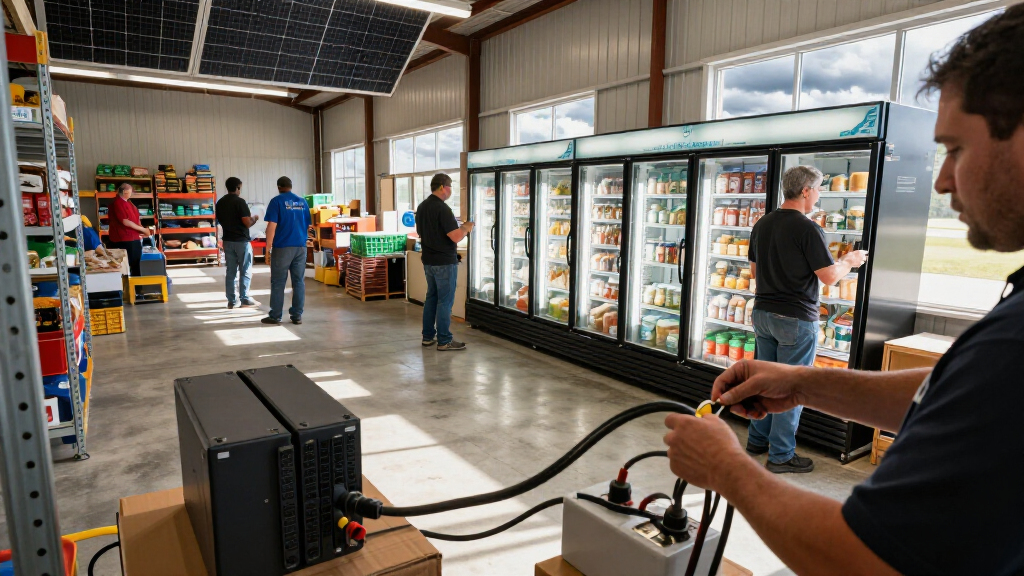
The system can store electricity generated by the panels and supply power when sunlight is unavailable. It is designed to support internet access, lighting, heating, cooling and refrigeration in the pantry’s food distribution area. The report does not say that the microgrid can power the entire building or provide backup indefinitely.
Executive director Jessi Koontz told Canary Media that the pantry paid nothing toward the project. North Carolina’s initiative is backed by a $5 million grant program established to install 24 sustainable microgrids in Helene-impacted counties. The report says Beacon received the largest share of project funding from the state, with additional help from philanthropic foundation BuildUS and a bridge loan from Invest Appalachia.
The installation is among the state program’s furthest-along projects. Sara Nichols of Land of Sky Regional Council told Canary Media that a microgrid at Bill’s Creek Community Center in Lake Lure is also close to completion. Beacon’s project is relatively small and has simpler wiring than some larger proposals, which can face delays related to federally funded infrastructure rules for equipment components.
Keeping Food Services Running
For a food pantry, an extended outage can threaten refrigeration, interrupt communications and make it harder to distribute supplies when residents need help. The new system is intended to keep specific essential functions available when the grid is down, rather than replace utility service across the whole facility. That could help Beacon continue serving people while power crews restore service or the wider community recovers.
Beacon serves about 1,700 families in Madison County each month, according to Canary Media. Its location was spared the worst flooding during Helene, but that did not remove the risk of future outages. Invest Appalachia communications and impact director Lauren Sowers told the outlet that even brief outages in rural western North Carolina can have a substantial effect. The project also shows how public funding and financing support can help nonprofits undertake energy installations that may otherwise be difficult to pay for upfront.
Products Worth Considering

DEWALT 20V MAX 5-Tool Combo Kit with Drill, Impact Driver, Reciprocating Saw, Circular Saw, Oscillating Tool, Battery and Charger

DEWALT 20V MAX XR 3-Speed Hammer Drill and Impact Driver Combo Kit with XR POWERPACK Batteries (DCK2101QQ2)

Chemical Guys 10-Piece Car Wash Kit with Foam Gun
As an affiliate, we earn on qualifying purchases.
From Helene Recovery to Backup Power
Hurricane Helene’s flooding damaged downtown Marshall in 2024, leaving businesses and community spaces without water or electricity and forcing some to close for months. Beacon’s building, about a five-minute drive from Main Street and at higher elevation, avoided major flood damage. Koontz told Canary Media the pantry retained water and power, with only a small puddle in its thrift store.
In the aftermath, Footprint Project and regional partners helped deploy temporary or clean-energy microgrids at locations including fire stations, nursing homes and mobile home parks, the report says. The state-backed program is a separate effort to fund longer-term installations. Governor Josh Stein’s administration announced the allocation for the initiative last August, drawing on funds from the federal bipartisan infrastructure law and working with Land of Sky and nongovernmental organizations.
Some proposed projects are larger and more complicated than Beacon’s. Nichols told Canary Media that equipment requirements associated with federal funding can make certain components difficult to use, and seeking a Department of Energy waiver can take time. The state initiative is scheduled to wrap up by next summer, and organizers are shifting attention toward smaller, more rural projects that can move through the process more readily.
System Capacity and Activation Date
The report does not specify when the microgrid will be switched on, how long its batteries can support the listed services, or the system’s generating and storage capacity. It also does not establish that the installation can keep every part of the pantry operating during a prolonged outage. Those details would be needed to assess how much service the system can maintain under different weather and electricity-use conditions.
The state program is intended to install 24 microgrids, but the report does not provide a final count of completed systems or identify all remaining sites. Beacon is described as the first project—or possibly the second—depending on when its system is switched on relative to the Lake Lure community center project.
More Rural Projects in the Queue
Land of Sky and its partners are continuing work on the state-funded initiative, which is scheduled to conclude by next summer, according to Canary Media. Nichols said the effort is shifting toward smaller, more rural microgrids as complex projects encounter equipment and approval delays. The Bill’s Creek Community Center installation in Lake Lure is also close to completion, though the report does not give a commissioning date.
The next milestones are the operation of Beacon’s system and progress on additional selected sites. The source does not provide a timetable for Beacon’s switch-on or a project-by-project schedule for the remaining grants.
Key Questions
What has Beacon of Hope installed?
The pantry has installed a 56-panel rooftop solar array and three batteries. The system is designed to support internet, lighting, heating, cooling and refrigeration in its food distribution area during outages.
How much did the microgrid cost, and who paid?
Canary Media reports a project cost of about $100,000. Executive director Jessi Koontz said Beacon paid nothing; the state grant program supplied most of the funding, with BuildUS also contributing and Invest Appalachia providing a bridge loan.
Was the pantry badly damaged by Hurricane Helene?
No major damage to the pantry is described in the report. Its building sits at higher elevation than downtown Marshall, and Koontz said it retained water and power, although a small area of its thrift store had a puddle.
When will the microgrid be switched on?
The report does not give an exact activation date. It says Beacon is among the state program’s furthest-along projects and notes that its place among the first completed sites depends on when the system is switched on.
Will the system power the entire food pantry during a long outage?
That is not established by the available reporting. The system is intended to power selected functions in the food distribution area, but its capacity, battery duration and ability to supply the full building are not specified.
Source: rss