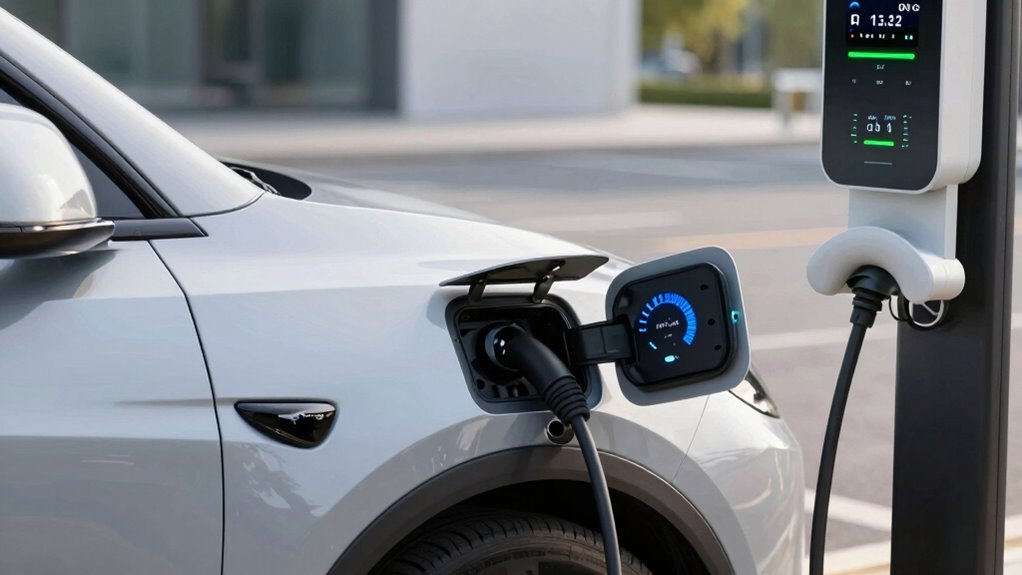

To compare charging power in miles per hour versus kW, you need to understand how each metric relates to your vehicle’s efficiency. kW shows the raw power delivered, while miles per hour indicates how fast your range increases during charging. For example, a 150 kW charger can add about 150 miles in 30 minutes for an efficient vehicle. Knowing both helps you choose chargers that maximize speed and longevity—learn more to optimize your charging experience.

Get backup power and energy gear delivered free with Prime
- Fast, free delivery on millions of items
- Prime Video, Amazon Music and more included
- Member-only deals all year
Key Takeaways
- Miles per hour measures range gained over time, reflecting real-world driving efficiency during charging.
- kW indicates the raw power transfer rate of the charger to the vehicle.
- Higher kW generally translates to more miles gained per hour, but vehicle efficiency and capacity affect actual gains.
- Comparing both metrics helps assess how quickly a charger adds usable range and its suitability for your vehicle.
- Consider vehicle compatibility and battery health to accurately interpret miles per hour and kW for optimal charging decisions.
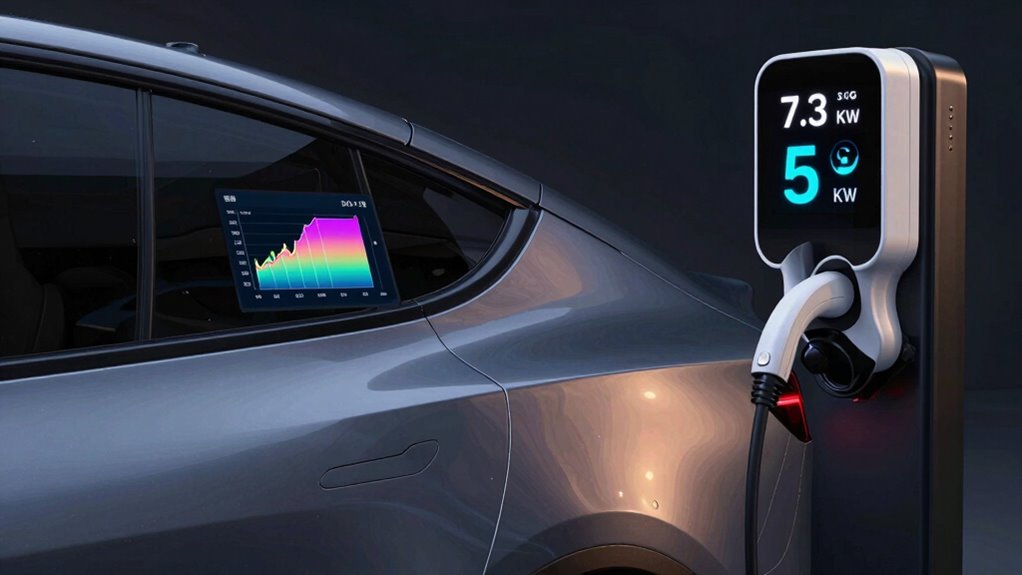
Ever wondered how to determine which charger delivers the fastest power? When you’re comparing charging options, it’s essential to understand how different metrics like miles per hour (mph) and kilowatts (kW) relate to your vehicle’s charging speed. Miles per hour give you an idea of how quickly your car can accumulate range during a charge, while kW measures the actual power transfer rate from the charger to your vehicle. The key is knowing how these figures connect so you can choose the best charging setup for your needs.
To start, consider that a higher kW rating usually means faster charging, but the actual miles gained per hour depend on your vehicle’s charging capacity and efficiency. For example, a charger rated at 150 kW might add 150 miles of range in about 30 minutes if your car consumes roughly 20 kWh per 100 miles. This means your vehicle is effectively adding miles at a rate of about 300 mph. Conversely, a charger with a lower kW rating, say 50 kW, will add fewer miles per hour—around 100 miles in the same time frame—assuming similar efficiency. So, comparing chargers in miles per hour gives you a practical sense of how quickly you’ll be back on the road, while kW tells you the raw power level.
Higher kW ratings mean faster charging, but actual miles per hour depend on your vehicle’s efficiency.
However, your ability to maximize charging speed isn’t just about the charger; it also hinges on your vehicle’s charging capacity and the state of your battery. Battery degradation, for instance, can influence charging performance. Over time, batteries lose some capacity, which may slow charging speeds and reduce the number of miles gained per hour. This means that even if you connect to a high-power charging station, your vehicle might not fully utilize the available power if the battery can’t handle it. That’s why charging infrastructure varies—some stations are designed for ultra-fast charging, but your car’s compatibility and battery health determine how much of that power you actually get. Additionally, sound healing science suggests that the interaction between charging technology and battery health is an area of ongoing research. Understanding battery health and how it impacts charging performance is crucial for making optimal choices.
Understanding these relationships helps you compare chargers effectively. A charger rated at 250 kW might seem impressive, but if your car can only handle 100 kW, you won’t see the full benefit. Similarly, charging infrastructure plays a role—more widespread fast-charging stations give you options to optimize your charging times and minimize battery degradation over time. Recognizing the impact of battery health on charging performance helps in making informed decisions for your vehicle’s longevity and efficiency. Being aware of charging capacity limitations ensures you select compatible chargers that deliver optimal performance for your specific vehicle. Ultimately, by looking at miles per hour, you get a real-world sense of how quickly you’ll regain range, while kW provides the technical capacity. Combining both insights allows you to pick chargers that truly maximize your driving efficiency without risking long-term battery health.
high power EV fast charger 150 kW
As an affiliate, we earn on qualifying purchases.
As an affiliate, we earn on qualifying purchases.
Frequently Asked Questions
How Does Charging Speed Affect Battery Lifespan?
Charging speed impacts battery lifespan because faster charging can accelerate battery degradation over time. You might notice reduced capacity if you frequently fast-charge, as high power levels stress the battery more. To prolong battery health, practice charging optimization by using slower chargers when possible and avoiding consistently charging to 100%. This approach helps minimize battery degradation, ensuring your vehicle maintains its range and performance longer.
Are Higher kW Chargers Always Faster?
Yes, higher kW chargers are generally faster, but it’s not the whole story. A powerful charging station with high power output can deliver energy quickly, but your vehicle’s ability to accept that power matters too. Some cars can’t utilize the full wattage, so the charging speed is limited. Think of it as pouring water into a small cup—regardless of how fast the tap runs, the cup’s capacity sets the limit.
Can Charging Power Vary With Different Vehicle Models?
Charging power can vary with different vehicle models because of battery compatibility and charging infrastructure. Some cars are designed to handle higher kW levels, enabling faster charging, while others may be limited by their battery or onboard charger. You should check your vehicle’s specifications to see compatible charging rates. Additionally, the availability of suitable charging infrastructure impacts how quickly you can charge, especially with high-power chargers.
What Factors Influence Real-World Charging Speed?
Your charging speed is a dance with multiple partners—battery health, station compatibility, and environmental factors. Battery degradation acts like wear on a dancer’s shoes, slowing the performance. Charging station compatibility ensures the right rhythm, providing steady power flow. External elements like temperature or power fluctuations can also disrupt your flow. To maximize speed, keep your battery healthy and always use compatible, high-quality charging stations.
Is Miles per Hour a Reliable Measure for Charging Efficiency?
Miles per hour isn’t a reliable measure for charging efficiency because it’s a form of charging terminology that primarily indicates distance added over time, not energy transferred. For measurement accuracy, kW is better, as it directly quantifies power in energy terms. Relying on miles per hour can be misleading since it ignores factors like battery capacity and charging conditions, making kW the preferred metric for precise comparison.
EV charging station with miles per hour display
As an affiliate, we earn on qualifying purchases.
As an affiliate, we earn on qualifying purchases.
Conclusion
In summary, mastering the measurement of miles per hour versus kilowatts makes your charging choices clearer and more confident. By balancing brightness with bandwidth, you’ll better understand your battery’s boost and your driving dynamics. Don’t delay—delve into data, decode differences, and drive with distinction. Remember, the more you know about charging power, the more you’ll maximize your mileage and minimize your misery. Make your motor mindful, and move more mindfully!
fast charging cable for electric cars
As an affiliate, we earn on qualifying purchases.
As an affiliate, we earn on qualifying purchases.
EV charger compatibility with battery health
As an affiliate, we earn on qualifying purchases.
As an affiliate, we earn on qualifying purchases.
Evergreen bestsellers Picks
bestsellers
As an affiliate, we earn on qualifying purchases.