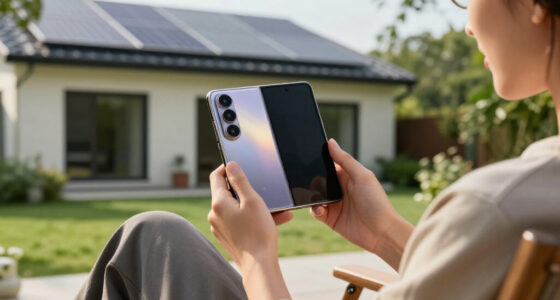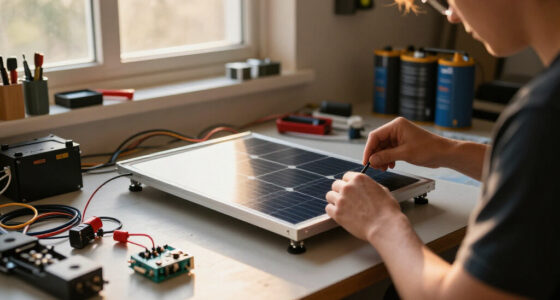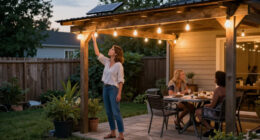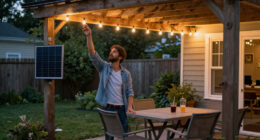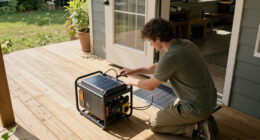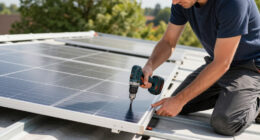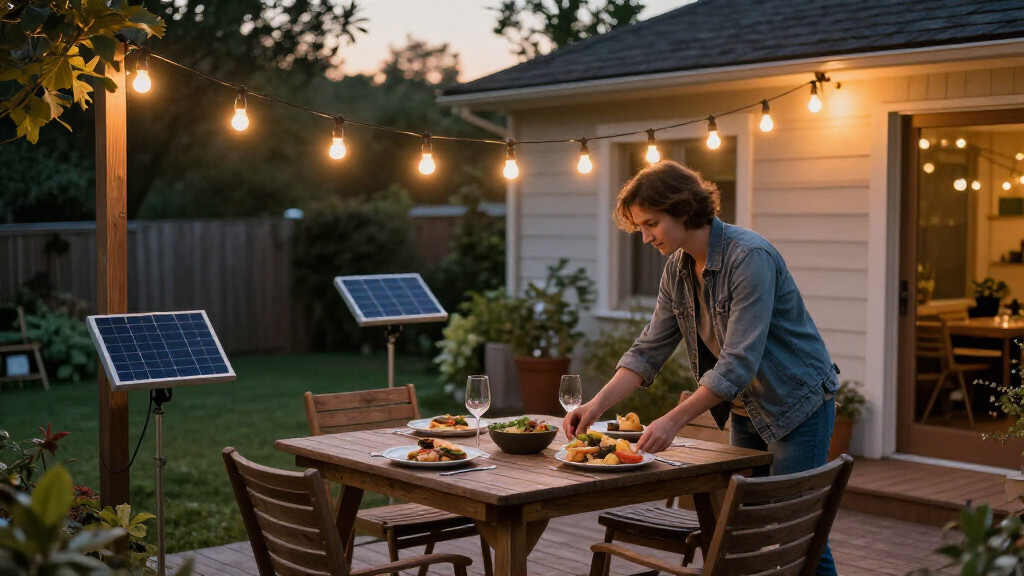
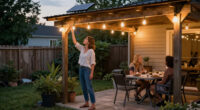
Solar-powered outdoor string lights solve one problem and create another: they avoid an outlet and wiring, but their performance depends on sunlight reaching a small panel. The real choice is between a string with its panel attached to the light unit and one with a separate panel connected by a cable. The first is easier to hang and move; the second can collect better sun when the lights need to sit under a roof, tree, or shaded pergola. That placement difference often matters more than extra modes or decorative details.

Get backup power and energy gear delivered free — and shop member deals
- Fast, free delivery on millions of items
- Access to Prime Big Deal Days deals on October 6–7
- Prime Video, Amazon Music and more included
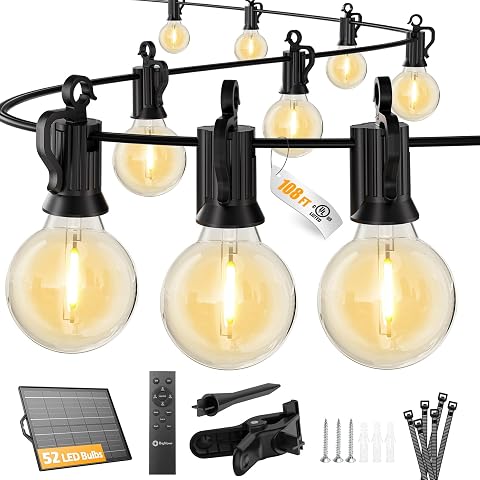
Brightown 108 ft Solar String Lights with Remote and USB Charging
- ✔ Length: 108 ft
- ✔ Bulbs: 50 G40 LED bulbs, plus 2 spares
- ✔ Bulb spacing: 2 ft

Brightown 100 ft Solar String Lights with 31+2 Shatterproof LED Bulbs
- ✔ Length: 100 ft
- ✔ Bulbs: 31 LED bulbs, plus 2 spares
- ✔ Color temperature: 2700 K
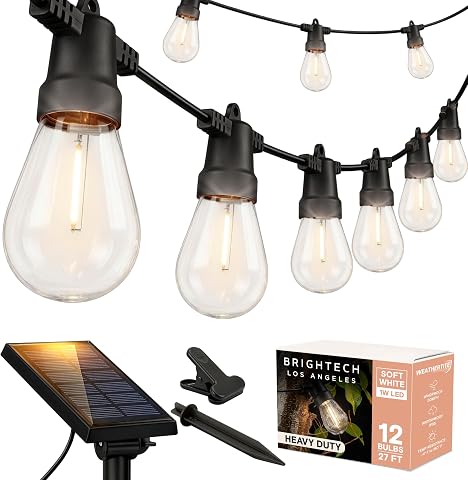
Brightech Ambience Pro Solar-Powered Outdoor String Lights, 27 ft, 12 Shatterproof LED Bulbs
- ✔ Length: 27 ft
- ✔ Bulbs: 12 shatterproof S14 LED bulbs
- ✔ Color temperature: 3000 K soft white
Choose an integrated-panel set if the lights and collector can both face a reasonably sunny area and you want the least complicated setup. Choose a separate-panel set if the bulbs need to hang in shade or you want to mount the collector independently. Brightness, battery capacity, bulb type, weather rating, and replacement parts vary by model, so compare those specifications rather than assuming either design is automatically brighter or longer-lasting.
At a Glance
| Criteria | Solar string lights with an integrated panel | Solar string lights with a separate panel and cable | Winner |
|---|---|---|---|
| Installation and setup | Fewer parts and a simpler installation | Requires routing and securing an extra cable | A |
| Panel placement and shade | Panel must remain near the light string | Panel can be placed in a sunnier location | B |
| Charging consistency | Good when the string itself gets direct sun | Often more reliable when lights hang in shade | B |
| Portability and appearance | Neater, self-contained appearance | More placement flexibility, with a visible cable to manage | A |
| Runtime and brightness | Depends on panel, battery, and light specifications | Depends on panel, battery, and light specifications | Depends |
| Weather resilience and repair | Fewer cable connections, but panel may be harder to reposition | Cable and connector add potential exposure points, but parts can be easier to position | Depends |
Brightown 108 ft Solar String Lights with Remote and USB Charging
For shoppers who want one strand to cover a long patio, yard edge, or pergola, 108 feet of coverage makes this Brightown the most adaptable option in the group. Its 50 warm-white G40 bulbs are spaced two feet apart, so the layout offers more points of light than the compact Brightech strand. The extra reach is useful for a large seating area, though it also means we need to plan the route and panel location rather than expect the lights to suit every small balcony.The deciding advantage is its solar plus USB-C charging. Solar keeps an outlet out of the installation, while USB-C gives us an alternative when the panel has not had dependable sun. The remote adds four brightness settings, three modes, and six- or eight-hour timers, making it easier to dial down the glow or set a predictable schedule. Compared with the 100-foot Brightown, this model lists a longer runtime—more than 36 hours—and a shorter USB-C charge time of four to five hours. Those are stated specifications; real results can vary with brightness and charging conditions.There are important limits. The strand cannot connect to additional strands, so a buyer with a larger area cannot extend it by linking another set. Solar charging still depends on sunlight, and its long length may be more than a small space needs. Its IP65 rating and shatterproof bulbs are useful practical features, but they do not remove the need to position and secure the lights appropriately. Compared with Brightech, this is the better choice for control and reach; Brightech makes more sense when a compact solar-only arrangement is the priority.
Pros:
- 108-foot strand with 50 bulbs spaced two feet apart
- Solar and USB-C charging provide two ways to replenish power
- Remote controls dimming, three modes, and six- or eight-hour timers
- IP65 rating, shatterproof bulbs, two spare bulbs, and mounting accessories
Cons:
- Cannot connect to additional strands
- Solar charging performance depends on available sunlight
- The long strand may be excessive for small outdoor spaces
Best for: Buyers lighting a large patio or outdoor entertaining area who want remote controls and USB-C charging as a backup to solar.
Not ideal for: Anyone who needs connectable strands, has a small balcony, or cannot give the solar panel a suitable charging location.
Bottom line: We recommend this as the most versatile pick for broad coverage because it pairs the longest strand with USB-C backup and extensive remote controls.
“We recommend this as the most versatile pick for broad coverage because it pairs the longest strand with USB-C backup and extensive remote controls.”
Brightown 100 ft Solar String Lights with 31+2 Shatterproof LED Bulbs
This 100-foot Brightown is the sensible alternative when we want a long decorative run but do not need the extra eight feet of the top-ranked model. It has 31 shatterproof bulbs plus two spares, compared with 50 bulbs on the 108-foot set, and its listed color temperature is 2700K for a warm glow. The lower bulb count is worth considering for buyers focused on how densely the strand is populated, not just how far it reaches.Its controls are a real strength. A remote offers four brightness levels, three lighting modes, and timer options, so we can adjust the atmosphere without walking to the panel. Like the longer Brightown, it supports both solar and USB-C charging and carries an IP65 rating. That makes it more flexible than Brightech for locations where sunlight can be inconsistent, although its solar charge is specified at seven to eight hours and USB-C charging at four hours. Its stated runtime reaches up to 26 hours—less than the 108-foot Brightown’s more-than-36-hour figure, but longer than Brightech’s five-to-six-hour specification.One operational wrinkle is the built-in light sensor, which may need to be covered if we want to use the lights during daytime. The listed wind resistance of up to 50 mph adds useful context for exposed settings, but installation still matters: secure the strand and place the panel where it can charge. Compared with the 108-foot model, this set trades length and stated runtime for a slightly shorter layout; compared with Brightech, it delivers more controls and a backup charging method, at the cost of a more involved setup.
Pros:
- 100-foot strand with warm 2700K light and shatterproof bulbs
- Solar and USB-C charging offer flexibility when sunlight is limited
- Remote includes dimming, three modes, and timer options
- IP65 water-resistance rating and listed wind resistance up to 50 mph
Cons:
- Solar charging is specified to take seven to eight hours
- The built-in light sensor may need covering for daytime operation
- Listed runtime is shorter than the 108-foot Brightown model
Best for: Buyers who want a long, controllable strand with both solar and USB-C charging, but do not need the longest option.
Not ideal for: Shoppers who need the longest stated runtime, want a simple sensor-free daytime setup, or prefer a short strand for a compact space.
Bottom line: We’d choose this for long-run coverage and flexible remote controls when the 108-foot model’s extra reach and longer listed runtime are not necessary.
“We’d choose this for long-run coverage and flexible remote controls when the 108-foot model’s extra reach and longer listed runtime are not necessary.”
Brightech Ambience Pro Solar-Powered Outdoor String Lights, 27 ft, 12 Shatterproof LED Bulbs
Brightech Ambience Pro is the outlier in this comparison—and that is precisely why it may be the right choice. At 27 feet with 12 S14 bulbs, it suits a smaller patio, balcony, or short run where the Brightown strands could leave us managing more cable than we need. Its soft-white 3000K light gives it a slightly different listed color temperature from the 2700K Brightown 100-foot set, so buyers should consider the look they want as well as the coverage.The detachable solar panel can be placed using its included stake or clip, giving us some freedom to seek a sunnier spot without keeping the panel immediately beside the lights. That is a useful setup advantage over a fixed panel arrangement, but it does not change the central charging limitation: power is solar-only. Unlike both Brightown models, it has no listed USB-C fallback. The product specifies five to six hours of light on a full charge, a much shorter window than either Brightown’s stated maximum, so it is better suited to early-evening ambiance than all-night illumination.Its shatterproof bulbs, weather-resistant cord, and two-year limited warranty support a straightforward small-space use case. The tradeoff is its IPX4 rating, which differs from the IP65 ratings on the Brightown sets; we should not treat those labels as interchangeable. Brightech also lists wind resistance up to 50 mph. Compared with the two Brightown models, it offers less reach, less control information, and no alternate charging route—but its compact length and detachable panel can make it easier to place where a small solar-powered setup is all we want.
Pros:
- Compact 27-foot length is easier to fit into small spaces
- Detachable solar panel includes a stake and clip for flexible placement
- Shatterproof S14 bulbs and weather-resistant cord
- Includes a two-year limited warranty
Cons:
- Solar-only charging, with no listed USB-C backup
- Stated runtime is about five to six hours per full charge
- IPX4 rating is lower than the IP65 ratings listed for the Brightown models
Best for: Buyers lighting a small patio, balcony, or short outdoor run who want a compact solar-only strand with a detachable panel.
Not ideal for: Anyone who needs lighting to last late into the night, wants USB-C backup, or needs broad coverage and extensive remote controls.
Bottom line: We’d pick Brightech for a small space and a simple solar setup, not for long runtimes or the broader control features of the Brightown options.
“We’d pick Brightech for a small space and a simple solar setup, not for long runtimes or the broader control features of the Brightown options.”
As an Amazon Associate we earn from qualifying purchases.
Key Differences
The decisive difference is where the panel can go. With an integrated design, the collector typically hangs with the lights or sits close to them. That works well over an open patio or along a sunny fence, but can limit charging if the string is installed beneath a covered deck. A separate panel adds a cable and some installation work, yet it can sit on a sunny wall, fence, or stake while the bulbs remain where they look best. For shaded installations, this flexibility can matter more than a modest difference in advertised capacity.
Neither design guarantees a particular brightness or number of evening hours. Those depend on the panel’s output, battery capacity and condition, the amount of direct sunlight, and how the lights are used. Check whether a listing states runtime at full brightness, whether brightness can be adjusted, and whether the battery is replaceable. Also compare weather protection for the bulbs, panel, battery housing, and connectors. Pay more for a separate-panel model when its placement advantage solves a real shade problem; otherwise, a well-specified integrated set is often the better-value and less fussy choice.
Detailed Comparison
Installation and setup (Solar string lights with an integrated panel wins — moderate)
Integrated-panel lights win on setup, a moderate practical advantage for people who want to hang the string and be done. There is no separate collector to mount and no cable to route around an eave or railing. Separate-panel lights take more planning: the panel needs a sunny position, the cable needs a safe route, and both ends need securing. That is manageable for a permanent installation, but less appealing if you want a quick, temporary decoration.
Panel placement and shade (Solar string lights with a separate panel and cable wins — major)
Separate-panel lights win by a major margin when the bulbs must hang in shade. Their collector can face the sun while the string sits under a pergola, awning, or tree canopy. Integrated models are a sensible fit when the whole installation gets sun, but the panel’s position may be compromised when the lights are tucked away. If the mounting area is shaded, solve placement before comparing decorative features.
Charging consistency (Solar string lights with a separate panel and cable wins — moderate)
Separate-panel designs usually have the advantage in locations with mixed sun and shade because the collector can be moved to a brighter spot. The gain is moderate to major depending on the site; a cable cannot compensate for cloudy weather or a poorly sized panel, but it can prevent the string’s location from dictating the panel’s exposure. In an open, sunny yard, the difference may be minor, and either design can charge adequately when matched to its specifications.
Portability and appearance (Solar string lights with an integrated panel wins — minor)
Integrated lights win for a tidy look and easy relocation. The panel stays with the string, so there is no extra cable to conceal or snag when you move the lights between a balcony and a garden. Separate-panel models offer more freedom to position the collector, but the cable can be visible and adds one more item to store. For a permanent setup where the cable can follow a railing or wall, that drawback is usually minor.
Runtime and brightness (major difference)
There is no reliable overall winner based on panel layout alone. Runtime depends on stored energy, solar charging, bulb power, and brightness settings; a longer string or high-output bulbs can use the battery faster. Compare published runtime claims carefully, especially whether they refer to low or full brightness and ideal charging conditions. This criterion is a tie between designs, but can become a model-specific win for either option when one has clearly stronger battery and panel specifications.
Weather resilience and repair (moderate difference)
Neither layout inherently lasts longer outdoors. Integrated lights avoid the separate cable and connector that can be exposed to damage, giving them a small simplicity advantage. Separate-panel lights may be easier to position for protection or service, and some models allow panel or battery replacement. Check the weather rating for every exposed component, not just the bulbs, and look for replaceable batteries, available parts, and clear warranty terms. Model construction matters more than the design category.
Solar string lights with an integrated panel: Pros and Cons
Pros:
- Simple installation with fewer components and connections
- Neater appearance and easier relocation
- Often the better value when the installation receives direct sunlight
Cons:
- Panel location is tied to the string or nearby mounting point
- May charge poorly if the lights hang beneath a roof or dense foliage
- Less convenient to aim the collector independently
Solar string lights with a separate panel and cable: Pros and Cons
Pros:
- Panel can be placed in direct sun while bulbs remain in shade
- Can improve charging consistency at difficult installation sites
- Allows more control over panel orientation and exposure
Cons:
- Extra cable and mounting steps complicate installation
- Cable and connector need protection from wear and weather
- May cost more without adding value in an already sunny location
Who Should Choose What
Choose Solar string lights with an integrated panel if:
- You are lighting an open patio, sunny fence, or garden where the panel can receive direct sun alongside the string.
- You want the simplest installation and expect to move or store the lights seasonally.
- You prefer a clean appearance without a cable running to a separate collector.
Choose Solar string lights with a separate panel and cable if:
- Your preferred bulb location is under a pergola, awning, balcony, or tree canopy.
- You can mount or stake a separate panel in a sunnier position than the lights.
- Reliable evening operation matters more than minimizing installation work, and the model’s panel and battery specifications justify its cost.
Skip both if: Skip both if the available panel location receives little useful daylight and dependable, long-duration lighting is a requirement; consider a plug-in or hardwired set, or a battery-powered system with a separately charged battery.
Value for Money
Integrated-panel lights are generally the better value when the installation is sunny and the model has adequate panel output, battery capacity, and weather protection. You avoid paying for a cable and separate mount that do not solve a problem. A higher price for a separate-panel set is worth it when shade is the main obstacle: better panel placement can make the lights more usable than a cheaper set whose collector remains shaded. Do not pay extra just for the separate-panel label. Compare the actual panel rating, battery details, claimed runtime, replaceability, and warranty. If those specifications are similar and both designs will receive sun, favor the simpler or less expensive set.
Final Verdict
For most open, sunny patios and gardens, choose integrated-panel lights: they are easier to install, look tidier, and usually provide better value when the collector can share the same sunny location as the string. Choose separate-panel lights when the bulbs need to hang in shade but you can put the collector in direct sunlight. In that situation, the placement flexibility is worth extra cost and setup effort. The biggest deciding factor is not the number of lighting modes; it is whether the panel can charge effectively where you can install it. If neither design has a realistic sunny panel location, choose another power source.
Frequently Asked Questions
Are solar string lights with a separate panel brighter?
Not by design alone. Brightness depends on the bulbs and electronics, while panel size and sunlight affect how much energy is stored for use. A separate panel may help the lights stay bright longer if its sunnier placement improves charging, but compare brightness ratings and runtime claims for the specific models.
Can integrated-panel lights work under a covered patio?
They can, but the collector still needs useful daylight. If the panel hangs beneath a roof or sits in deep shade, charging may be limited. A separate-panel set is usually the better match when you want bulbs under cover and have a sunny spot nearby for the collector.
Is a separate solar panel worth paying more for?
Yes when it lets you place the panel in substantially better sunlight than the string’s location. If both the panel and bulbs can sit in an open sunny area, the extra cable and cost may bring little practical benefit. Compare the battery, panel output, and warranty before paying a premium.
What specifications matter more than the panel layout?
Check battery capacity and replaceability, panel output, brightness settings, stated runtime conditions, weather ratings, and the length and spacing of the bulbs. Also verify whether the rating applies to connectors and the battery housing, not only the light string. Those details determine performance and service life more directly than the layout category.
Fall Picks
fall essentials
As an affiliate, we earn on qualifying purchases.