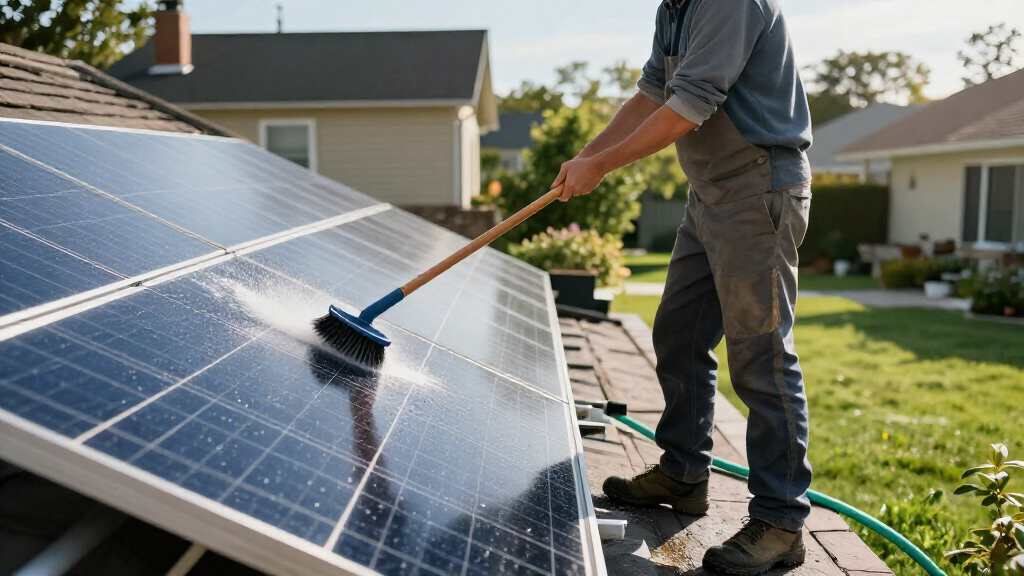
This checklist is for homeowners planning to clean solar panels and compare the tools and equipment listed for the job. The picks include brushes and water equipment, plus items whose names suggest a different use, so check each product’s stated purpose before choosing it.

Get backup power and energy gear delivered free with Prime
- Fast, free delivery on millions of items
- Prime Video, Amazon Music and more included
- Member-only deals all year
The sections follow the cleaning setup: brush, pole, solution, hose nozzle, deionized water system, and roof safety harness. Each slot explains its role and calls out where the product name alone leaves fit or compatibility questions unanswered.
Use the checklist to confirm that a product suits your panels, water source, and cleaning method. Read the full listing for dimensions, included parts, and intended use; do not assume compatibility from a product title alone.
Solar Panel Cleaning Brush
A brush is the direct-contact part of a panel-cleaning setup, so its head and reach should suit the panels and the way you can safely access them. The pick is named “Solar Panel Cleaning System with 18 ft Dual Rotating Brushes,” which identifies a cleaning system, an 18-foot reach, and dual rotating brushes. The product name does not specify brush material, head width, pole connection, or whether the system is intended for your panel surface. Confirm those details in the listing before using it.
A common buying mistake is treating a long reach or rotating heads as proof that the tool is suitable for every installation. Check the manufacturer’s directions for compatible surfaces and use, and consider how the tool will be controlled from your chosen work position. Verify the assembled dimensions and included components so the brush can reach the panels without forcing you to lean or stretch. Match the tool to your access plan, and follow the panel manufacturer’s cleaning guidance.
What to look for:
- Confirm the brush material and approved surfaces in the product listing.
- Check the assembled reach and head width against your panel layout.
- Verify how the system connects and which parts are included.
- Follow the panel maker’s instructions for contact and cleaning.
Solar Panel Cleaning System with 18 ft Dual Rotating Brushes

This solar panel cleaning system has a telescoping carbon fiber pole with a dual brush head and a flexible connector for adjusting the cleaning angle. Its water-fed hose connects to standard garden hoses or DI water systems, and it is available with AC, battery, or dual power options.
Pros:
- Carbon fiber pole is lightweight and designed to reduce fatigue.
- Telescoping length and adjustable-angle connector accommodate different cleaning positions.
- Connects to standard garden hoses and DI water systems.
- Offers AC, battery, and dual-power configurations.
Cons:
- Battery operation requires a separate battery set, and runtime is about 6 hours per charge.
- The AC option requires access to a power outlet.
Best for: Shoppers seeking a solar-panel cleaning system with dual rotating brushes
Not ideal for: Anyone who needs confirmed brush materials or compatibility from the product title alone
Bottom line: Check the full specifications and panel guidance before deciding whether this brush system fits your setup.
Telescoping Cleaning Pole
A pole can help position a cleaning head from a safer working location, but the attachment and reach must fit the task. The listed pick is “Telescoping Back Scratcher with 5 Detachable Heads – Pink, 10-34” Stai.” Its name describes a back scratcher with detachable heads and a 10–34-inch range; it does not identify it as a solar-panel cleaning pole. Do not infer cleaning compatibility from the word “telescoping.”
A common mistake is buying a pole based on reach alone without checking its connector, load limits, or intended use. This product name does not state whether a brush can attach, whether the heads are suitable for panels, or whether the tool can be used at the distance your installation requires. Check the complete listing for dimensions, attachment details, and manufacturer guidance. Compare those details with your chosen cleaning head, and use a tool only in the manner its manufacturer specifies. Confirm the fit before pairing tools; the title does not establish a compatible combination.
What to look for:
- Check the full dimensions and extended length in the listing.
- Verify whether a cleaning attachment can connect to the pole.
- Confirm the intended use and manufacturer’s instructions.
- Compare connector details with the specific brush head.
Telescoping Back Scratcher with 5 Detachable Heads – Pink, 10-34" Stainless Stee

The HEYAXA telescoping back scratcher features a stainless‑steel pole that extends from 10 to 34 inches and a comfortable rubber grip. It comes with five interchangeable heads—including dual‑side, bear claw, and rake designs—for customized scratching and massage.
Pros:
- Adjustable telescoping length reaches hard‑to‑reach areas on the back, neck, and limbs.
- Five interchangeable heads provide versatile scratching and massage options.
- Durable stainless steel and aluminum alloy construction ensures long‑term use.
- Compact storage pouch makes it easy to travel or give as a gift.
Cons:
- Only available in pink, limiting color choice.
- Rubber grip may wear over time with frequent use.
Best for: Shoppers reviewing a detachable-head back scratcher listing
Not ideal for: Anyone seeking a confirmed solar-panel cleaning pole
Bottom line: The product name does not establish that this back scratcher can serve as a cleaning pole.
Solar Panel Cleaning Solution
A cleaning solution should be selected according to the panel manufacturer’s care guidance and the product’s stated use. The pick is “SolarPlay Q3600 Portable Power Station with Two 400W Solar Panels,” which names a portable power station and two solar panels; it does not identify a cleaning liquid or cleaning solution. Its title does not describe a cleaning product, so it cannot establish what to apply to panels.
A common mistake is assuming that a solar-related product is suitable for cleaning solar panels. Before applying anything, consult the panel maker’s instructions and verify the label, ingredients, and intended surfaces of any cleaner you consider. The listed item’s name provides no cleaner details, dilution guidance, or compatibility information. Do not use a power station or solar panels as a substitute for a cleaning solution. Choose only a product labeled for the task and follow its directions alongside the panel manufacturer’s guidance.
What to look for:
- Confirm the item is labeled as a cleaning solution.
- Check the intended surface and product directions.
- Follow the solar-panel manufacturer’s cleaning guidance.
- Do not infer cleaner suitability from solar-related wording.
SolarPlay Q3600 Portable Power Station with Two 400W Solar Panels

The SolarPlay Q3600 is a 3840Wh portable power station with a LiFePO4 battery, 3600W output, and 5500W peak power. It includes two 400W solar panels and supports solar and AC charging, with multiple output ports, an ≤8ms UPS mode, and a wheeled design with a telescopic handle.
Pros:
- Large 3840Wh capacity with a durable LiFePO4 battery.
- Includes two 400W solar panels and supports up to 2000W solar input.
- Offers 15 output ports and an ≤8ms UPS mode.
- Wheels and a telescopic handle aid transport; operation is rated at ≤30dB.
Cons:
- Heavy at about 93 pounds.
- The stated one-hour runtime is listed without specifying the load or test conditions.
Best for: Shoppers considering a portable power station and solar panels
Not ideal for: Anyone looking specifically for a panel-cleaning liquid
Bottom line: This product name identifies power equipment, not a cleaning solution.
Garden Hose Nozzle
A hose nozzle controls water delivery during a rinse, so its connection and use should match your hose and cleaning approach. The pick is “Gilmour 572TFR Insulated Brass Hose Nozzles, 5-Pack.” The name identifies insulated brass hose nozzles and a five-pack, but it does not state the connection size, spray settings, or whether the nozzles are recommended for solar-panel rinsing. Verify the details in the listing before pairing one with your hose.
A common mistake is assuming that any hose nozzle’s spray pattern is appropriate for panels. Check the nozzle instructions and the panel manufacturer’s guidance for rinsing, and confirm that the connector fits your hose. The title does not specify a water treatment feature, so do not assume this nozzle provides deionized water. Consider whether you need one nozzle or multiple for your setup, based on the included quantity and your actual use. Match the connection and rinse method to your equipment and panel care instructions.
What to look for:
- Confirm the hose connection size and fitting type.
- Check the available spray patterns in the full listing.
- Follow panel guidance for rinsing and water delivery.
- Do not assume a nozzle treats or deionizes water.
Gilmour 572TFR Insulated Brass Hose Nozzles, 5-Pack

This five-pack of commercial-grade hose nozzles features insulated grips and threaded fronts for attaching accessories. Brass head inserts are designed to withstand hot water, while stainless steel springs and self-adjusting duck packing help resist rust and prevent leaks.
Pros:
- Five nozzles included
- Brass head inserts resist extremely hot water
- Insulated grips for commercial or industrial use
Cons:
- Designed for threaded hose connections
Best for: Shoppers looking for insulated brass hose nozzles
Not ideal for: Anyone needing confirmed spray settings or water treatment from the title alone
Bottom line: Verify the connector and rinsing guidance before using these nozzles on a panel-cleaning setup.
Deionized Water System
A deionized-water system is a distinct part of a cleaning setup, and its connections and operating requirements need to match the water source and intended use. The pick is “Spotless Water Systems DIC-20 Deionizing Water System for Vehicles and.” The name identifies a deionizing system and mentions vehicles, but it does not establish its capacity, included fittings, or suitability for solar panels. Check the full product listing for the missing specifications and stated applications.
A common mistake is assuming that a product described for vehicles is automatically approved for panels, or that its name alone guarantees spotless results. Verify the manufacturer’s intended uses, connection requirements, and any operating instructions before integrating it into a hose setup. Compare those details with your water source and the directions for your panels. The product title is truncated, so the complete listing matters especially here. Confirm the application and setup requirements rather than relying on the partial name.
What to look for:
- Read the complete listing and intended-use details.
- Confirm the inlet and outlet connections fit your setup.
- Check operating instructions and stated applications.
- Verify suitability against panel manufacturer guidance.
Spotless Water Systems DIC-20 Deionizing Water System for Vehicles and Surfaces
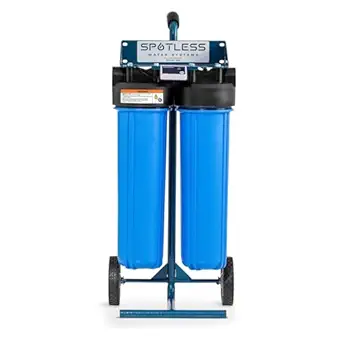
The DIC-20 provides approximately 300 gallons of mineral-free, de-ionized water for spot-free washing of vehicles, windows, solar panels, and more. It features two 20-inch de-ionization housings with refillable cartridges, mounted on a rust-resistant rolling cart for portability and convenience.
Pros:
- Provides spot-free, mineral-free water for various cleaning applications
- Portable with a durable, rust-resistant rolling cart
- Easy to set up with refillable cartridges and all necessary accessories included
- Suitable for vehicles, windows, solar panels, and more
Cons:
- Requires assembly out of the box
- Limited to approximately 300 gallons per refill
- Cartridge replacement needed over time
Best for: Shoppers researching a named deionizing water system
Not ideal for: Anyone relying on the partial title to confirm solar-panel suitability
Bottom line: Confirm the full application and connection details before adding this system to a panel-cleaning setup.
Roof Safety Harness
Roof access brings a separate safety consideration from the cleaning tools themselves. The pick is “Frontline Combat Complete Roofers Kit with 50′ Lifeline and Full Body.” Its name describes a roofer kit, a 50-foot lifeline, and a full-body item, but it does not provide the full product details or establish that the equipment suits your roof, body fit, or work conditions. Review the complete instructions and specifications before relying on it.
A common mistake is treating a harness kit as a complete safety plan. Confirm the exact included components, sizing range, adjustment method, and manufacturer’s requirements for compatible anchorage and use. The title is cut off, so check the full listing and directions rather than assuming what “complete” includes. If you cannot confirm that the equipment fits the intended setup, do not use it for roof work; consider a cleaning method that avoids roof access. Fit and correct use matter, and the product name alone cannot establish either.
What to look for:
- Confirm the full kit contents in the listing.
- Check sizing, adjustment, and fit instructions.
- Review manufacturer requirements for anchorage and use.
- Choose an access method consistent with the equipment directions.
Frontline Combat Complete Roofers Kit with 50′ Lifeline and Full Body Harness

This roofers kit includes a 50-foot lifeline and a full body harness, made from high tenacity polyester and galvanized steel. It is OSHA and ANSI compliant, providing a ready-to-use safety solution for roofing work.
Pros:
- OSHA and ANSI compliant for safety
- Includes a full body harness and 50′ lifeline
- Made from durable high tenacity polyester and galvanized steel
Cons:
- Hand wash only, may require careful maintenance
- Limited information on weight capacity
- No detailed instructions included
Best for: Shoppers reviewing a named roofer kit with a lifeline
Not ideal for: Anyone unable to confirm fit, contents, or intended use
Bottom line: Verify the kit’s complete specifications and instructions before considering it for roof work.
Build your checklist around the essentials for your chosen cleaning method: first confirm the brush and its reach, then check the water delivery and any treatment equipment. Resolve the pole and solution listings carefully, since their names do not establish that they serve those roles. Consider roof equipment only after checking its fit, contents, and instructions. Use the product listings and panel guidance to decide what belongs in your setup.
Take the process one item at a time, and choose tools whose stated purpose and compatibility you can verify. When a title leaves a key detail unclear, consult the complete listing or manufacturer instructions before buying or using it. A careful fit check makes it easier to assemble a cleaning approach suited to your panels and access plan.
Black Friday Picks

Sony WH-1000XM6 Wireless Noise-Canceling Headphones, Black
As an affiliate, we earn on qualifying purchases.