
After comparing 14 of the most popular home EV chargers, the EVIQO Level 2 48A Hardwired stands out as the best overall pick, thanks to its maximum 11.5 kW charging speed, smart app control, and hardwired durability at a competitive price point. If you want smart features without an electrician visit, the Emporia Level 2 48A with WiFi and a 25-foot cable is a close runner-up, while the Wallbox Pulsar Plus earns the premium spot for its compact design and native Tesla (NACS) compatibility. The main tradeoff in this category is amperage versus installation cost: 48A units charge fastest but demand a 60-amp circuit and hardwiring, while 32A plug-in models work with an existing NEMA 14-50 outlet and charge most EVs overnight anyway. Budget buyers face a second tradeoff between smart connectivity and simplicity — the cheapest dumb chargers work fine, but you lose scheduling that can cut your electricity bill. Read on for the full breakdown of all 14 chargers and which one fits your garage.

Get backup power and energy gear delivered free — and shop member deals
- Fast, free delivery on millions of items
- Access to Prime Big Deal Days deals on October 6–7
- Prime Video, Amazon Music and more included
Key Takeaways
- 48A hardwired units like the EVIQO only reach full speed on a 60-amp dedicated circuit — buyers with an existing NEMA 14-50 outlet (50A breaker, 40A sustained) will get identical real-world charging from a 40A model like the EVIQO plug-in or FlowGo.
- Smart connectivity is the single biggest differentiator in this lineup: WiFi chargers (Emporia, Wallbox, EVIQO) enable off-peak scheduling that can cut charging costs, while dumb units (Energbison, SEGUMA, AIMILER) trade that away for a lower price.
- The 16A and 12A portable chargers (the 110V/240V 16 Amp unit and EVDANCE) can serve as full Level 2 chargers on a 240V NEMA 6-20 circuit, making them the only realistic picks for renters or drivers without access to a 14-50 outlet.
- Only the Wallbox Pulsar Plus offers native NACS compatibility, letting Tesla owners skip the J1772 adapter — every other charger here uses J1772, which works with all non-Tesla EVs natively and Teslas via adapter.
- RFID and delay-timer features (the 40A Wi-Fi/RFID charger and TopAutoGear) are only worth paying for in shared-driveway or multi-driver households; solo owners can safely ignore them and save.
| Energbison Level 2 EV Charger, 32A, 240V, with 25 ft Cable and NEMA 14-50 Plug |  | Best Value Pick | Charging level: Level 2 | Output: 240V AC, 32A, up to 7 kW | Cable length: 25 ft | VIEW LATEST PRICE | See Our Full Breakdown |
| 16 Amp Level 1/2 EV Charger, 110V-240V, with NEMA 6-20 Plug/5-15 Adapter, 25ft Cable |  | Best for Beginners and Renters | Connector: J1772 | Input voltage: 110-240V | Amperage: 16 A (240V) / 12 A (120V) | VIEW LATEST PRICE | See Our Full Breakdown |
| FlowGo Level 2 EV Charger, 40A, J1772, 9.6 kW |  | Best Mid-Range Performer | Output power: Up to 9.6 kW | Voltage: 240V AC | Current: Adjustable 8A-40A | VIEW LATEST PRICE | See Our Full Breakdown |
| Emporia Level 2 EV Charger with J1772 Connector – 48 Amp, 240V, WiFi Enabled, 25ft Cable |  | Best Smart Charging Overall | Max amperage: 48 A (hardwired) / 40 A (NEMA plug) | Voltage: 240V | Cable length: 25 ft | VIEW LATEST PRICE | See Our Full Breakdown |
| Wallbox Pulsar Plus Level 2 EV Charger 40A, NACS (Tesla Compatible) |  | Best for Tesla Owners | Amperage: 40 A | Power output: 9.6 kW | Voltage: 240V | VIEW LATEST PRICE | See Our Full Breakdown |
| EVIQO Level 2 48A J1772 Hardwired EV Charger |  | Best Hardwired Powerhouse | Connector: J1772 | Installation: Hardwired | Max Current: 48A (50A with DIP switch, 70A circuit) | VIEW LATEST PRICE | See Our Full Breakdown |
| TopAutoGear Level 2 EV Charger 50A 240V Portable EVSE |  | Best Portable High-Speed Charger | Max Current: 50A (selectable 16/24/32/40/50A) | Max Power: 11.5 kW at 240V | Charging Speed: Up to 45 miles per hour | VIEW LATEST PRICE | See Our Full Breakdown |
| NexCyber Level 2 EV Charger, 48A, 25 ft Cable, J1772 Connector | 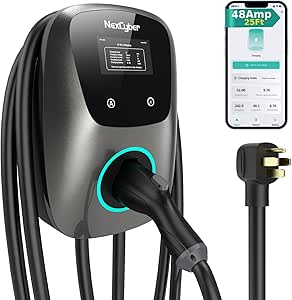 | Best Dual-Install Flexibility | Max Current: 48A hardwired / 40A plugged | Connector: J1772 | Charging Speed: Up to 46 mph hardwired; 38 mph with 14-50 plug | VIEW LATEST PRICE | See Our Full Breakdown |
| SEGUMA 32A Level 2 EV Charger with NEMA 14-50 Plug (J1772) |  | Best Value Plug-In | Max Current: 32A (adjustable 10/16/20/24/32A) | Plug Type: NEMA 14-50 | Connector: J1772 | VIEW LATEST PRICE | See Our Full Breakdown |
| EVDANCE Level 1&2 EV Charger, Portable J1772 EVSE with 25FT Cable |  | Best for Plug-in Hybrids and Travel | Connector: J1772 | Max Current: 16A | Level 2 Charging: 16A, 240V, 3.68kW (10–12 mph) | VIEW LATEST PRICE | See Our Full Breakdown |
| AIMILER Level 2 EV Charger, 32A, 25 ft Cable, J1772 Connector |  | Best Value Smart Charger | Connector: J1772 | Plug: NEMA 14-50 | Current: 16–32 A adjustable | VIEW LATEST PRICE | See Our Full Breakdown |
| EVIQO Level 2 EV Charger J1772 40A NEMA 14-50 240V Wall Charging Station |  | Best Overall Plug-In | Connector: J1772 | Amperage: 6–40 A adjustable | Plug: NEMA 14-50 | VIEW LATEST PRICE | See Our Full Breakdown |
| 40A Level 2 J1772 EV Charger with Wi-Fi, RFID, NEMA 14-50 Plug, and 25 ft Cable |  | Best for Shared Driveways | Charging Level: Level 2 | Maximum Current: 40 A (adjustable 10–40 A) | Maximum Power: 9.6 kW | VIEW LATEST PRICE | See Our Full Breakdown |
| ChargePoint Home Flex Level 2 EV Charger (J1772, NEMA 14-50 Plug) |  | Best App Ecosystem | Connector: J1772 (NEMA 14-50 plug, non-Tesla) | Voltage: 240 V | Charging Speed: Up to 45 mi/hr | VIEW LATEST PRICE | See Our Full Breakdown |
| electric vehicle charger | Cable length | Connector | Certifications |
|---|---|---|---|
| Energbison Level 2 EV Charger | 25 ft | — | — |
| 16 Amp Level 1/2 EV Charger | 25 ft | J1772 | — |
| FlowGo Level 2 EV Charger | 25 ft | J1772 | — |
| Emporia Level 2 EV Charger wit | 25 ft | SAE J1772 | UL Listed, ENERGY STAR |
| Wallbox Pulsar Plus Level 2 EV | 25 ft | NACS | UL, Energy Star |
| EVIQO Level 2 48A J1772 Hardwi | 25 ft | J1772 | UL, ETL, FCC, Energy Star |
| TopAutoGear Level 2 EV Charger | 25 ft | SAE J1772 | — |
| NexCyber Level 2 EV Charger | 25 ft | J1772 | ETL, FCC, Energy Star |
| SEGUMA 32A Level 2 EV Charger | 25 ft | J1772 | — |
| EVDANCE Level 1&2 EV Charger | 25 ft | J1772 | ETL Listed, FCC, CE |
| AIMILER Level 2 EV Charger | 25 ft | J1772 | ETL, FCC |
| EVIQO Level 2 EV Charger J1772 | 25 ft | J1772 | UL, ETL, FCC, Energy Star |
| 40A Level 2 J1772 EV Charger w | 25 ft | J1772 | — |
| ChargePoint Home Flex Level 2 | — | J1772 (NEMA 14-50 plug, non-Tesla) | — |
More Details on Our Top Picks
Energbison Level 2 EV Charger, 32A, 240V, with 25 ft Cable and NEMA 14-50 Plug
This Energbison unit is the simplest path to real Level 2 charging without paying for smart features you may never use. At 32A and roughly 7 kW, it charges about twice as fast as the 16A dual-mode charger in this roundup, making it a better everyday solution for drivers who log meaningful daily mileage. The 25-foot cable matches what pricier options offer, and the LCD display gives you charging status at a glance — something the more expensive smart chargers bury inside an app.
The tradeoff is straightforward: no WiFi, no scheduling, no energy tracking. Compared with the Emporia, you give up app control and UL certification for a lower cost of entry. It also requires a dedicated NEMA 14-50 outlet, so renters without one installed should look at the plug-adaptable alternatives instead.
Pros:- Genuine Level 2 speed at 32A / 7 kW for a budget-tier price
- 25-foot cable handles awkward garage and driveway parking
- LCD display shows real-time charging data without needing an app
- Four layers of built-in electrical protection
Cons:- No app connectivity, scheduling, or energy tracking
- Requires a professionally installed 240V NEMA 14-50 outlet
- 32A ceiling is slower than 40A+ options like the FlowGo or Wallbox
Best for: Budget-conscious EV owners who already have a NEMA 14-50 outlet and want dependable Level 2 charging without paying for app features
Not ideal for: Tesla drivers without a J1772 adapter, and anyone who wants scheduled off-peak charging or energy monitoring
- Charging level:Level 2
- Output:240V AC, 32A, up to 7 kW
- Cable length:25 ft
- Plug type:NEMA 14-50
- Compatibility:SAE J1772 EVs and plug-in hybrids
- Display:LCD
- Safety protections:Over-temperature, over-current, over-voltage, short-circuit
Our verdict“A no-frills charger that nails the fundamentals — buy it if you have the outlet and skip it if you want smart features.”
16 Amp Level 1/2 EV Charger, 110V-240V, with NEMA 6-20 Plug/5-15 Adapter, 25ft Cable
Most chargers in this roundup assume you have a 240V circuit. This one doesn’t — and that’s its whole appeal. The included NEMA 5-15 adapter means you can charge from any ordinary household outlet on day one, then step up to 240V charging later via a common NEMA 6-20 plug, the same circuit many homes already run for dryers or workshop tools. That dual-mode flexibility makes it the low-commitment entry point compared with the Energbison, which is stranded without its 14-50 outlet.
The tradeoff is speed. At 16A / 3.84 kW you’re looking at roughly 13 miles of range per hour — fine for plug-in hybrids and short commutes, frustrating for long-range EV drivers. Still, features like scheduled off-peak charging and an IP65 rating are things the cheaper dumb chargers here don’t offer.
Pros:- Charges from a standard 120V outlet or a 240V circuit with the included adapters
- Scheduled off-peak charging helps cut electricity costs
- IP65 weather resistance plus eight internal safety protections
- 25-foot cable plus storage bag makes it genuinely portable
Cons:- 16A output is roughly half the speed of 32A+ Level 2 units
- Tesla owners need to supply their own J1772-to-NACS adapter
Best for: Renters, first-time EV owners, and plug-in hybrid drivers who lack a dedicated 240V circuit or want a charger they can move between homes
Not ideal for: Long-range EV owners with long commutes — 16A charging is too slow to reliably recover a big battery overnight
- Connector:J1772
- Input voltage:110-240V
- Amperage:16 A (240V) / 12 A (120V)
- Max power:3.84 kW
- Cable length:25 ft
- Plugs:NEMA 6-20 with NEMA 5-15 adapter
- Display:2.8″ LCD
- Weather protection:IP65
Our verdict“The right first charger if you can’t or won’t install a 240V circuit — just know its speed ceiling before you buy.”
FlowGo Level 2 EV Charger, 40A, J1772, 9.6 kW
The FlowGo occupies a sweet spot that few chargers here hit: full 40A / 9.6 kW output at a price well below the smart-charger tier. That’s roughly 40% faster than the Energbison, enough to recover most EV batteries overnight even after a heavy driving day. The standout feature is adjustable current from 8A to 40A — useful if you share a circuit with other high-draw appliances, something the fixed-output budget chargers can’t do.
Unlike the Emporia or Wallbox, there’s no app or WiFi; the delay timer is handled on the unit itself. That’s a fair trade for the price, but it means no energy monitoring. Tesla drivers will also need an adapter, whereas the Wallbox Pulsar Plus ships with a native NACS connector and avoids that hassle entirely. The included wall holster and 3-year warranty round out a well-considered package.
Pros:- Adjustable 8A-40A output adapts to weaker circuits and shared loads
- 9.6 kW output recovers most batteries overnight
- IP65-rated casing and multiple electrical protections
- Includes wall holster and storage bag with a 3-year warranty
Cons:- No app connectivity or energy monitoring despite the delay timer
- Tesla vehicles require a separate J1772 adapter
Best for: Drivers who want near-flagship charging speed and current flexibility without paying for WiFi connectivity
Not ideal for: Tesla owners who want a native connector, and anyone who wants app-based scheduling or energy data
- Output power:Up to 9.6 kW
- Voltage:240V AC
- Current:Adjustable 8A-40A
- Connector:J1772
- Plug:NEMA 14-50
- Cable length:25 ft
- Weather protection:IP65
- Warranty:3 years
Our verdict“The best speed-per-dollar compromise in this lineup — ideal if smart features feel like extras rather than essentials.”
Emporia Level 2 EV Charger with J1772 Connector – 48 Amp, 240V, WiFi Enabled, 25ft Cable
The Emporia is the most capable all-around charger in this batch, and the reasons are concrete: 48A hardwired output good for up to 46 miles of range per hour, plus a genuinely useful app layer for scheduling and real-time energy monitoring. Compared with the FlowGo, you gain data-driven charging — if your utility bills by time-of-use, that monitoring pays for itself. The UL listing and ENERGY STAR certification also set it apart from the uncertified budget options like the Energbison, which matters for insurance and permitting in some jurisdictions.
The flexibility comes with caveats. To get the full 48A you must hardwire the unit, which typically means an electrician and added cost; the NEMA 14-50 plug caps you at 40A, matching the FlowGo’s output. It’s also heavier and less portable than the plug-and-go units here.
Pros:- Up to 46 miles of range per hour when hardwired at 48A
- WiFi scheduling and real-time energy monitoring help cut time-of-use electricity costs
- UL Listed and ENERGY STAR certified
- Works with all North American EVs including Tesla with an adapter
Cons:- Professional hardwiring required to unlock full 48A output
- Capped at 40A when using the NEMA plug
- Heavier and less portable than dedicated travel chargers
Best for: Homeowners who want maximum charging speed, certified safety, and app-based energy management in one unit
Not ideal for: Renters and anyone unwilling to pay an electrician — hardwiring is needed for full speed, and professional installation adds real cost
- Max amperage:48 A (hardwired) / 40 A (NEMA plug)
- Voltage:240V
- Cable length:25 ft
- Plug type:NEMA 14-50
- Connector:SAE J1772
- Connectivity:WiFi 2.4 GHz
- Certifications:UL Listed, ENERGY STAR
Our verdict“The most complete package here for a permanent home installation — plan for an electrician and it won’t disappoint.”
Wallbox Pulsar Plus Level 2 EV Charger 40A, NACS (Tesla Compatible)
Every other J1772 charger in this roundup asks Tesla drivers to keep an adapter on hand — and inevitably, that adapter is in the other coat pocket when you need it. The Pulsar Plus eliminates the problem with a native NACS connector that plugs straight into any Tesla and the growing wave of NACS-equipped EVs from other brands. Combined with a compact matte-black body, it’s the most polished option here aesthetically, and Wi-Fi plus Bluetooth app control matches the Emporia’s smart feature set.
Its Static Load Management is unique in this group — if you add a second charger later, power sharing is built in rather than an afterthought. The limits: at 9.6 kW it matches the FlowGo rather than beating it, and non-NACS vehicles (older J1772 cars) would need an adapter in reverse. It also assumes an existing NEMA 14-50 outlet for plug-in use.
Pros:- Native NACS connector charges all Tesla models without an adapter
- Wi-Fi and Bluetooth app control with scheduling and energy monitoring
- Static Load Management supports multi-charger power sharing
- UL and Energy Star certified for indoor or outdoor use
Cons:- Only reaches 9.6 kW — slower ceiling than the hardwired 48A Emporia
- Requires an existing NEMA 14-50 outlet for plug-in installation
- Non-NACS vehicles need an adapter, reversing the usual compatibility problem
Best for: Tesla owners and buyers of newer NACS-equipped EVs who want native-connector smart charging with room to expand to a second charger
Not ideal for: Owners of older J1772-only vehicles, who would need an adapter and lose the connector advantage entirely
- Amperage:40 A
- Power output:9.6 kW
- Voltage:240V
- Connector:NACS
- Plug type:NEMA 14-50
- Cable length:25 ft
- Connectivity:Wi-Fi, Bluetooth
- Certifications:UL, Energy Star
- Warranty:3 years
Our verdict“If you drive a Tesla or a new NACS EV, this is the cleanest, best-connected option in the lineup — J1772 loyalists should look elsewhere.”
EVIQO Level 2 48A J1772 Hardwired EV Charger
For buyers ready to commit to a permanent installation, this option stands out for squeezing the maximum legally available amperage from a home setup — up to 48A standard, or 50A if your panel supports a 70A circuit. Compared with the Emporia 48A, which offers similar ceiling output, the EVIQO pulls ahead on physical durability with a genuine IP66 / NEMA 4 housing, a step up from the NexCyber’s NEMA Type 3 rating, making it the safer bet for exposed outdoor walls. The 25-foot cable and glow-in-the-dark holster are thoughtful touches for dark driveways. The tradeoff is real, though: unlike the TopAutoGear portable, this unit cannot move with you, and the 2.4 GHz-only Wi-Fi requirement can frustrate households running modern mesh networks that default to 5 GHz bands.
Pros:- Full 48A output with a 50A option on a 70A circuit for the fastest home charging
- IP66/NEMA 4 weatherproof housing suited to exposed outdoor mounting
- 25-foot cable plus glow-in-the-dark holster for flexible, nighttime-friendly routing
- App scheduling and energy tracking help shift charging to off-peak rates
Cons:- Requires professional hardwired installation and a dedicated 60A (or 70A) circuit
- App connectivity limited to 2.4 GHz Wi-Fi networks
Best for: Homeowners with a 60A+ dedicated circuit who want a permanent, weatherproof, maximum-speed charging station for a non-Tesla EV
Not ideal for: Renters or anyone without a dedicated 60A circuit — the hardwired requirement makes this impractical without an electrician and landlord approval
- Connector:J1772
- Installation:Hardwired
- Max Current:48A (50A with DIP switch, 70A circuit)
- Cable Length:25 ft
- Weather Resistance:IP66 / NEMA 4
- Certifications:UL, ETL, FCC, Energy Star
- Wi-Fi:2.4 GHz
- Warranty:3 years
Our verdict“If you own your home and want the fastest permanent charging a panel can deliver, this is the wall unit to beat.”
TopAutoGear Level 2 EV Charger 50A 240V Portable EVSE
Most portable chargers force you to choose between speed and mobility — this one refuses to. Delivering up to 50A on a NEMA 14-50 outlet, it matches or beats hardwired rivals like the EVIQO without any permanent installation, which makes it a rare breed. The 3.5-inch LCD is the standout against the SEGUMA’s smaller 1.77-inch display, showing voltage, current, kWh cost, and error codes at a glance — genuinely useful for diagnosing outlet problems without an app. The delay timer lets you schedule off-peak charging without Wi-Fi, a simpler proposition than the NexCyber’s app-dependent scheduling. The tradeoffs: Tesla drivers need an adapter, and you must already have (or install) a 14-50 outlet. It also lacks Wi-Fi energy tracking, so data-minded owners may outgrow it.
Pros:- Up to 45 miles of range per hour without any permanent installation
- Large 3.5-inch LCD shows real-time power, cost, and diagnostic data
- Selectable amperage (16–50A) adapts to weaker circuits
- Delay timer enables off-peak charging savings without an app or Wi-Fi
Cons:- Tesla vehicles require a separate adapter
- Depends entirely on an available 240V NEMA 14-50 outlet
- No Wi-Fi app or long-term energy tracking
Best for: EV owners who want near-hardwired charging speed they can unplug and take on the road or to a new home
Not ideal for: Tesla owners without a J1772 adapter, and households without an existing 240V NEMA 14-50 outlet
- Max Current:50A (selectable 16/24/32/40/50A)
- Max Power:11.5 kW at 240V
- Charging Speed:Up to 45 miles per hour
- Plug Type:NEMA 14-50
- Connector:SAE J1772
- Cable Length:25 ft
- Display:3.5-inch LCD
Our verdict“The strongest pick for renters and travelers who refuse to sacrifice charging speed for portability.”
NexCyber Level 2 EV Charger, 48A, 25 ft Cable, J1772 Connector
This model’s core appeal is its install-it-your-way design: hardwire it for 48A output, or plug it into a NEMA 14-50 outlet at 40A — a choice neither the EVIQO (hardwired only) nor the SEGUMA (plug-in only) offers. That flexibility makes it a strong middle path for owners who might move or upgrade their panel later. The touchscreen and Wi-Fi app give it more modern controls than the TopAutoGear’s button-based interface, and the 16–48A adjustable range accommodates older wiring. But the weather protection is the weak point: NEMA Type 3 with only partial IP65 claims, and the manufacturer explicitly advises against direct sunlight or rain exposure — a meaningful limitation the EVIQO’s IP66 housing solves outright. Plan for a garage, carport, or covered wall before buying.
Pros:- Hardwire at 48A or plug into NEMA 14-50 at 40A — rare dual-install flexibility
- Touchscreen plus Wi-Fi app with scheduling and adjustable amperage
- Up to 46 miles of range per hour when hardwired
- ETL, FCC, and Energy Star certified with a 3-year warranty
Cons:- Not rated for direct sunlight or rain despite outdoor ambitions
- Tesla and NACS vehicles need a separate adapter
- Full-speed operation requires professional hardwiring
Best for: Owners undecided between hardwired and plug-in installation who will mount the unit in a garage or under cover
Not ideal for: Anyone needing a fully weatherproof outdoor mount — the manufacturer warns against rain and direct sun exposure
- Max Current:48A hardwired / 40A plugged
- Connector:J1772
- Charging Speed:Up to 46 mph hardwired; 38 mph with 14-50 plug
- Current Adjustment:16–48A
- Cable Length:25 ft
- Weather Protection:NEMA Type 3 (partial IP65)
- Certifications:ETL, FCC, Energy Star
- Warranty:3 years
Our verdict“A smart pick for covered installations where install flexibility matters more than all-weather durability.”
SEGUMA 32A Level 2 EV Charger with NEMA 14-50 Plug (J1772)
Not everyone needs 48 amps — and this is the charger for that buyer. The SEGUMA’s 32A ceiling covers the real-world needs of most EVs, which charge at 32A or less on board anyway, and asking a 14-50 outlet for 32A instead of 50A reduces strain and heat. Its 2-in-1 design — wall-holster it at home or toss it in the trunk — undercuts the more single-purpose EVIQO 40A wall unit on flexibility. The 10A–32A adjustable range is broader than most budget rivals, letting you dial down on shared circuits. Compared with the AIMILER 32A, the SEGUMA adds a real-time TFT display and an IP66 rating, though that small 1.77-inch screen washes out in direct sun. There’s no app or Wi-Fi scheduling, so off-peak planning is manual.
Pros:- Roughly 6x faster than Level 1 charging for overnight-full mornings
- Adjustable 10A–32A output adapts to shared or older circuits
- 2-in-1 wall-mounted or portable design with a 25-foot cable
- IP66 weather resistance and auto shut-off safety protections
Cons:- 32A ceiling limits charging speed for EVs that accept 40A+
- TFT display is difficult to read in bright sunlight
- No Wi-Fi app or programmable off-peak scheduling
Best for: Budget-minded EV owners with an existing 14-50 outlet who want dependable Level 2 speed without app subscriptions or electrician fees
Not ideal for: Drivers of high-acceptance-rate EVs who want maximum overnight turnaround, and anyone wanting app-based scheduling
- Max Current:32A (adjustable 10/16/20/24/32A)
- Plug Type:NEMA 14-50
- Connector:J1772
- Cable Length:25 ft
- Display:1.77-inch TFT
- Ingress Protection:IP66
- Mounting:Wall-mounted or portable
Our verdict“A no-fuss, fairly priced workhorse for owners whose EVs charge at 32A and who value simplicity over smart features.”
EVDANCE Level 1&2 EV Charger, Portable J1772 EVSE with 25FT Cable
For plug-in hybrids and daily errand EVs, 16A is plenty, and this charger makes the most of that modest ceiling by being genuinely universal on both voltage levels. The included NEMA 5-15 adapter means it works in any standard household outlet — a fallback no 14-50-only unit like the SEGUMA can match — while the 6-20 plug delivers 240V Level 2 speed where available. It’s the natural companion for hybrid owners visiting family or camping, hence the carrying bag. Compared with the similar 16A Level 1/2 competitor in this roundup, the EVDANCE adds ETL listing and an IP66 housing with a UL 94 V-0 fire rating, which matters for a device living in a trunk. The clear drawback: full-battery EV owners will find 10–12 mph charging painfully slow for nightly depletion.
Pros:- Dual-voltage flexibility: works in any standard 120V outlet plus 240V NEMA 6-20
- ETL listed with IP66 housing and UL 94 V-0 fire rating
- 25-foot cable handles driveway and garage reach with room to spare
- Carrying bag makes it a genuinely portable road-trip companion
Cons:- Capped at 16A — far slower than 32A+ dedicated Level 2 units
- Limited outlet compatibility beyond 5-15 and 6-20 without extra adapters
- Tesla, Prius Prime, RAV4 Prime, Taycan, and Mini Electric need adapters or won’t work
Best for: Plug-in hybrid owners and EV drivers who mainly need a flexible travel charger that works with any outlet they encounter
Not ideal for: Long-range EV drivers depleting big batteries daily — 16A max means 10-12 miles of range per hour on 240V
- Connector:J1772
- Max Current:16A
- Level 2 Charging:16A, 240V, 3.68kW (10–12 mph)
- Level 1 Charging:12A, 120V, 1.44kW (2–5 mph)
- Plug Types:NEMA 5-15 & 6-20
- Cable Length:25 ft
- Certifications:ETL Listed, FCC, CE
- Warranty:1 year
Our verdict“The right charger for hybrids and travel backup, and the wrong one for anyone chasing overnight full charges on a big-battery EV.”
AIMILER Level 2 EV Charger, 32A, 25 ft Cable, J1772 Connector
Most budget chargers force you to choose between smart features and price, but the AIMILER delivers both. Its adjustable 16–32A current means you can dial the output down to match an older circuit instead of paying an electrician to upgrade one — a flexibility that cheaper dumb units like the SEGUMA 32A don’t offer. The onboard display and Wi-Fi scheduling app let you shift charging to off-peak hours, which is where the real savings come from over months of ownership.
Compared with the EVIQO 40A, you give up eight amps of peak power, so full overnight charges take longer — but if your daily driving is under 60 miles, that difference rarely matters. The 2.4 GHz-only app setup is mildly annoying, and Tesla owners need to supply their own J1772 adapter.
Pros:- Adjustable 16–32A output lets you safely match older or shared circuits
- Wi-Fi app with scheduling and monitoring for off-peak cost savings
- Long 25 ft cable handles awkward parking situations
- Onboard display shows charging status at a glance without opening the app
Cons:- Requires a dedicated 20–40A circuit and NEMA 14-50 outlet for Level 2 speeds
- Tesla and NACS vehicles need a separate adapter that isn’t included
- App setup only works on 2.4 GHz Wi-Fi networks
Best for: Budget-conscious EV and PHEV owners with an existing NEMA 14-50 outlet who want app scheduling without premium pricing
Not ideal for: Drivers with long commutes or big-battery trucks who need maximum overnight charging speed — 32A caps out at 7.68 kW
- Connector:J1772
- Plug:NEMA 14-50
- Current:16–32 A adjustable
- Maximum Power:7.68 kW
- Voltage:240 V
- Cable Length:25 ft
- Controls:Display and Wi-Fi app
- Certifications:ETL, FCC
Our verdict“The smartest way to add app-scheduled Level 2 charging on a budget, provided 7.68 kW covers your daily driving needs.”
EVIQO Level 2 EV Charger J1772 40A NEMA 14-50 240V Wall Charging Station
This is the charger I’d point most buyers toward, because it gets the fundamentals right where rivals cut corners. The 40A / 9.6 kW output matches the FlowGo 40A and the RFID-equipped 40A charger in this roundup, but the quad certification stack (UL, ETL, FCC, Energy Star) plus a 3-year warranty with U.S.-based support sets it apart from value-brand alternatives with thinner backing. The IP66 weatherproof housing is genuinely outdoor-ready, and the glow-in-the-dark holster is a small touch that pays off every dark winter evening.
Compared with the ChargePoint Home Flex, the EVIQO offers similar power for less fuss over app accounts, and unlike hardwired units such as the EVIQO 48A, it plugs straight into an existing 14-50 outlet. The tradeoff: a dedicated 50A circuit is mandatory, and 2.4 GHz-only Wi-Fi remains a minor irritation.
Pros:- Full 40A output delivers 9.6 kW for fast overnight charges on virtually all non-Tesla EVs
- UL, ETL, FCC, and Energy Star certified with a 3-year warranty and U.S.-based support
- IP66-rated housing is built for permanent outdoor installation
- App scheduling targets off-peak rates to cut electricity bills
Cons:- Requires a NEMA 14-50 outlet on a dedicated 50A circuit — incompatible with dryer outlets
- Only connects to 2.4 GHz Wi-Fi networks
- Tesla owners must use the adapter that ships with the car
Best for: Homeowners who want maximum plug-in charging power with strong safety certifications and real warranty support
Not ideal for: Renters or anyone without a dedicated 50A circuit and NEMA 14-50 outlet — no adapter workaround exists for dryer plugs
- Connector:J1772
- Amperage:6–40 A adjustable
- Plug:NEMA 14-50
- Voltage:240 V
- Cable Length:25 ft
- Ingress Protection:IP66 / NEMA 4
- Certifications:UL, ETL, FCC, Energy Star
- Warranty:3 years
Our verdict“The best blend of power, certification, and support for a plug-in home charger — buy it if your electrical panel can support 50 amps.”
40A Level 2 J1772 EV Charger with Wi-Fi, RFID, NEMA 14-50 Plug, and 25 ft Cable
What makes this 40A unit worth a slot is RFID card authorization — a feature almost nobody else in this price tier includes. If your charger lives in a shared garage, apartment lot, or driveway where neighbors or passersby could plug in, tap-to-authorize cards give you access control that app-only units like the AIMILER can’t match without account juggling. Output matches the EVIQO 40A at 9.6 kW, with the same 10–40A adjustability range for flexible circuit matching.
The integrated cable and connector storage keeps everything tidy between sessions, and the IP65 housing handles outdoor duty, though it trails the EVIQO’s IP66 rating slightly. Real tradeoffs exist: there’s no Tesla adapter in the box, the brand’s support network isn’t as established as EVIQO’s or ChargePoint’s, and the same 50A dedicated circuit requirement applies.
Pros:- RFID card authorization restricts charger access — rare at this price
- Full 40A / 9.6 kW output with wide 10–40A adjustability
- Integrated cable and connector storage keeps installations tidy
- Multiple safety protections in an IP65-rated weatherproof housing
Cons:- No Tesla adapter included, unlike some competitors bundle
- Requires a NEMA 14-50 receptacle and a 50A or larger circuit breaker
- 2.4 GHz-only Wi-Fi limits router compatibility
Best for: Apartment dwellers, landlords, and multi-car households who need to control who uses the charger
Not ideal for: Buyers prioritizing long-term warranty support — this brand lacks the established U.S. service infrastructure of EVIQO or ChargePoint
- Charging Level:Level 2
- Maximum Current:40 A (adjustable 10–40 A)
- Maximum Power:9.6 kW
- Plug:NEMA 14-50
- Connector:J1772
- Cable Length:25 ft
- Authorization:RFID card
- Recommended Circuit:50 A or larger
Our verdict“The pick when access control matters as much as charging speed — ideal for shared spaces, less compelling for private single-family garages.”
ChargePoint Home Flex Level 2 EV Charger (J1772, NEMA 14-50 Plug)
Hardware-wise, the Home Flex is competitive rather than class-leading — but no other charger here matches its software. The ChargePoint app ties your home unit into the same account covering 274,000+ public stations, so one app manages home scheduling, charging reminders, smart home integration, and road-trip planning. That continuity is why this model suits buyers who charge away from home often, something the EVIQO 40A — stronger on raw warranty terms — simply can’t replicate.
With up to 45 miles of range per hour, it charges roughly nine times faster than a wall outlet, and the UL certification plus cold-resistant cable make it dependable in harsh climates. The honest drawbacks: setup realistically needs a professional electrician for the 40A or 50A circuit, Tesla drivers need an adapter, and you’re paying a premium for the brand and ecosystem rather than extra amps.
Pros:- Up to 45 miles of range per hour — roughly 9x faster than a 120V outlet
- UL-certified with a cold-resistant cable rated for indoor or outdoor use
- Mature app with reminders, smart home integration, and charging schedules
- Seamless access to ChargePoint’s network of 274,000+ public stations
Cons:- Professional installation required for the 40A or 50A dedicated circuit
- Tesla vehicles need a separate adapter
- Costs more than equally powerful alternatives like the EVIQO 40A
Best for: Drivers who frequently use public charging and want home and away charging unified in one polished app
Not ideal for: Budget-focused buyers who charge almost exclusively at home — the ecosystem premium buys features they’ll never use
- Connector:J1772 (NEMA 14-50 plug, non-Tesla)
- Voltage:240 V
- Charging Speed:Up to 45 mi/hr
- Installation:Indoor or outdoor, NEMA 14-50 outlet
- Certification:UL
- App Features:Smart scheduling, reminders, smart home integration
- Weight:13.8 pounds
Our verdict“Choose this for the ecosystem, not the spec sheet — the best pick for frequent public chargers, overkill for home-only drivers.”
How We Picked
I evaluated each charger against the factors that actually determine day-to-day satisfaction: real charging speed given typical home electrical capacity, connector and cable length, installation flexibility (plug-in versus hardwired), smart features, and build quality. Amperage ratings were judged against the circuits most buyers realistically have — a 48A charger scores no better than a 40A one if it will live on a 50-amp breaker, which is why plug-in and hardwired models were compared within their own constraints rather than on headline numbers alone.
Ranking then layered in value and intended use. Smart chargers had to justify their connectivity with genuinely useful scheduling and energy monitoring, while budget dumb chargers were judged on reliability, cable length, and weatherproofing instead. Portables were held to a different standard: durability, adapter flexibility, and whether they can double as both a Level 1 trickle charger and a Level 2 backup. Every pick was also checked for who should skip it — no charger earned a top spot without a clear, honest drawback.
| electric vehicle charger | Connector | Certifications |
|---|---|---|
| Energbison Level 2 EV Charger | — | — |
| 16 Amp Level 1/2 EV Charger | J1772 | — |
| FlowGo Level 2 EV Charger | J1772 | — |
| Emporia Level 2 EV Charger wit | SAE J1772 | UL Listed, ENERGY STAR |
| Wallbox Pulsar Plus Level 2 EV | NACS | UL, Energy Star |
| EVIQO Level 2 48A J1772 Hardwi | J1772 | UL, ETL, FCC, Energy Star |
| TopAutoGear Level 2 EV Charger | SAE J1772 | — |
| NexCyber Level 2 EV Charger | J1772 | ETL, FCC, Energy Star |
| SEGUMA 32A Level 2 EV Charger | J1772 | — |
| EVDANCE Level 1&2 EV Charger | J1772 | ETL Listed, FCC, CE |
| AIMILER Level 2 EV Charger | J1772 | ETL, FCC |
| EVIQO Level 2 EV Charger J1772 | J1772 | UL, ETL, FCC, Energy Star |
| 40A Level 2 J1772 EV Charger w | J1772 | — |
| ChargePoint Home Flex Level 2 | J1772 (NEMA 14-50 plug, non-Tesla) | — |
Factors to Consider When Choosing Best Electric Vehicle Chargers
Choosing an EV charger is really a two-part decision: what your electrical panel can support, and how you actually drive. Before comparing specs, it helps to understand where buyers most often go wrong.Match the Charger to Your Panel, Not Your Ambitions
The most common mistake is buying a 48A charger and discovering your home’s electrical service can’t support a 60-amp dedicated circuit, or that adding one requires a costly panel upgrade. A useful rule: sustained charging is limited to 80% of a breaker’s rating, so a 50-amp circuit maxes out at 40 amps of charging. For most EVs, 40A adds roughly 30 miles of range per hour — more than enough for daily commuting recovered overnight. Before purchasing anything, ask an electrician what spare capacity your panel has; that answer should drive the entire decision more than any product spec sheet.
Plug-In Versus Hardwired
NEMA 14-50 plug-in models install faster, can move with you, and double as portable chargers — but the outlet itself adds an installation cost and a potential failure point outdoors. Hardwired units like the EVIQO 48A skip the outlet, often qualify for additional utility rebates, and are generally required for full 48A output since most plug configurations can’t legally deliver it. Renters and apartment dwellers should lean toward plug-in or true portables, while homeowners planning to stay put get better long-term reliability from hardwiring. If you might buy a second EV or move within five years, the plug-in route preserves flexibility that’s hard to put a price on.
Smart Features: When They Pay and When They Don’t
WiFi connectivity sounds like a gimmick until you realize it enables off-peak scheduling, which can cut charging costs by half or more on time-of-use utility rates. Smart chargers also track energy usage, which matters if your utility offers per-kWh EV rebates that require metering data. However, most EVs already have built-in departure scheduling that delays charging without any smart charger, so check your car’s app before paying extra for the feature. Where smart charging genuinely wins is whole-home energy management — models like the Emporia can coordinate with solar panels or pause charging when your home’s load spikes.
Cable Length and Connector Type
A 25-foot cable, standard on most models here, comfortably reaches across a two-car garage, but shorter 15-to-18-foot cables force awkward parking or cable stretching — measure your parking spot to the mounting location before buying. On connectors: J1772 remains the universal standard for non-Tesla EVs and works with Teslas through an adapter, while native NACS chargers like the Wallbox eliminate that friction for Tesla owners. If you anticipate a Tesla or NACS-equipped vehicle in your future, connector strategy matters more than most buyers realize. Also check the plug holster and cable management — a charger dangling by its cord ages badly outdoors.
Indoor/Outdoor Ratings and Durability
NEMA 4X-rated enclosures tolerate direct rain and hose spray, while NEMA 3R handles typical outdoor sheltered mounting — the difference matters if your charger will live on an exterior wall with no overhang. Look at the connector’s stated insertion-cycle count and whether the handle is rated for extreme cold, since brittle plastic in winter is a real long-term complaint. Cheap chargers often cut costs in exactly these invisible places, which is how a budget unit ends up costing more after a replacement. A warranty of three years or more is a reasonable signal that the manufacturer stands behind the electronics, which take constant thermal stress in daily use.
Rebates and Incentives Can Change the Math
Many utilities and some state programs offer rebates on home EV charger installation, and hardwired Energy Star-certified units frequently qualify where cheap dumb chargers don’t. Some utilities require the charger to be on their approved list and enrolled in demand-response programs, which may mean choosing a specific smart brand. It’s worth checking these programs before purchase rather than after, because eligibility requirements can shift which charger represents the best value — a mid-priced smart unit can end up cheaper than a budget one after a rebate. Keep receipts and the charger’s certification documentation, as most programs require them.
Frequently Asked Questions
Is a 48A charger worth it over a 40A model?
Only if you have a 60-amp dedicated circuit or are installing new wiring anyway — and even then, the benefit is modest for most drivers. The jump from 40A to 48A adds roughly 2 miles of range per hour of charging, which rarely changes whether you wake up with a full battery. Where 48A matters is large-battery trucks and SUVs, households with two EVs sharing one charger, or drivers who routinely need maximum recovery during short evening windows. If you’re plugging into an existing NEMA 14-50 outlet, the 40A ceiling is fixed regardless of what the charger can do, so the extra capability would sit unused.
Can I use a portable charger as my main home charger?
Yes, and many owners do exactly that, though there are tradeoffs to understand. Portable units like the TopAutoGear 50A or the 16A dual-voltage model lack a wall-mounted holster and cable management, so the cord typically lives on the floor and takes more daily abuse. Weatherproofing on portables is usually adequate but not as robust as a sealed wall unit, and there’s no permanent wiring, which means a loose connection can develop at the outlet over time. Portables make the most sense for renters, drivers who split time between two homes, or anyone who wants a charger they can toss in the trunk for road trips.
Do I need WiFi in an EV charger if my car already has an app?
Often you don’t — most modern EVs handle charge scheduling internally, which covers the main cost-saving use case. But a smart charger adds things the car can’t do: whole-home energy monitoring, solar coordination, per-charger metering for utility rebate programs, and the ability to manage charging for multiple vehicles or drivers from one app. If you’re on a flat electricity rate with no time-of-use plan and only own one car, the smart features mostly duplicate what’s already in your EV. Households with solar, variable rates, or shared chargers get genuine value from connectivity.
Will a J1772 charger work with a Tesla?
Yes, with the J1772-to-NACS adapter that Tesla includes with every vehicle — it’s the same adapter Tesla owners already use at public non-Tesla stations. The process is simply plug-into-adapter-into-car, adds a few seconds, and doesn’t limit charging speed at Level 2 rates. The only real reason to prefer a native NACS charger like the Wallbox Pulsar Plus is convenience and one less piece of plastic to misplace, which matters most if multiple Tesla drivers use the charger daily. Non-Tesla EVs sold with NACS ports also include a NACS-to-J1772 adapter, so universal compatibility works in both directions.
Can I install a Level 2 charger myself, or do I need an electrician?
Plug-in models with an existing NEMA 14-50 outlet genuinely are DIY — you mount the bracket, hang the charger, and plug in. The wiring part is where an electrician becomes necessary: installing a new 240V circuit, upgrading a breaker, or converting to hardwired work all involve panel work that most jurisdictions require a permit and licensed electrician for. Improperly sized wiring is a genuine fire risk with sustained 32-48A loads, so this isn’t the place to save money. Also note that many charger warranties and utility rebates require proof of professional installation.
Conclusion
For most homeowners, the EVIQO Level 2 48A Hardwired is the best overall choice — it pairs maximum charging speed with smart scheduling and earns its top ranking through balanced capability rather than a single flashy spec. The FlowGo Level 2 40A and Energbison 32A deliver the best value, providing everything a single-EV household needs at a lower cost and without smart-feature premiums. At the premium end, the Wallbox Pulsar Plus justifies its price for Tesla owners and smart-home enthusiasts, while the ChargePoint Home Flex suits buyers who want a polished app and public-network integration.
Beginners and renters should start with the 16A dual-voltage portable or the EVDANCE Level 1&2 — low-cost, forgiving options that work with ordinary outlets and can grow into a Level 2 setup later. For specific needs: the TopAutoGear 50A portable covers maximum flexibility on the road, the 40A Wi-Fi/RFID model handles multi-driver households and shared driveways, and the Emporia 48A is the clear pick for solar owners who want whole-home energy management. Whatever your situation, let your panel’s capacity drive the decision first — every charger on this list will charge your EV overnight if the circuit behind it is sized correctly.
Fall Picks
fall essentials
As an affiliate, we earn on qualifying purchases.