
To calculate your EV’s charging cost per mile, first find your vehicle’s battery capacity in kWh and your local electricity rate per kWh. Then, account for charging losses of about 5-10%. Measure or track how many miles you get per kWh to determine efficiency. Divide your total charging expenses by miles traveled to find your cost per mile. Continue exploring how to refine these estimates for more accurate budgeting.
Key Takeaways
- Determine your EV’s battery capacity in kWh and its real-world efficiency (miles per kWh).
- Find your local electricity rate per kWh, considering time-of-use or seasonal variations.
- Calculate total energy needed to fully charge, including 5-10% losses, by multiplying capacity with efficiency and loss factor.
- Divide the total charging cost (energy needed x rate) by miles driven to find your cost per mile.
- Track multiple charges and adjust for real-world efficiency to refine your cost per mile estimate.
Understanding Your EV Battery Capacity
Have you ever wondered how much energy your EV’s battery can store? Your battery capacity, measured in kilowatt-hours (kWh), determines the total energy available for driving and influences charging costs. For example, a 60 kWh battery can store enough energy to power your vehicle for a set distance, depending on efficiency. Larger batteries typically mean longer range but also higher charging expenses. Knowing your battery capacity helps you estimate how much electricity you’ll need for a full charge and the associated cost. Keep in mind that actual usable capacity might be slightly less due to battery management systems. Battery technology plays a significant role in overall performance and longevity. Understanding your battery size allows you to plan trips better, manage charging sessions, and accurately calculate expenses to keep your EV ownership affordable. Additionally, being aware of European cloud innovation can help businesses optimize data management for battery monitoring systems, enhancing overall efficiency. Moreover, understanding battery capacity enables you to better compare different EV models and choose the one that best fits your driving needs. For instance, advanced battery management systems can improve battery life and performance over time, and a comprehensive knowledge of energy efficiency can further support cost savings during charging.
Determining Your Local Electricity Rates
Finding out your local electricity rates is essential for accurately calculating EV charging costs. Your rates can vary considerably based on your location, provider, and time of day. Check your most recent electricity bill; the cost per kilowatt-hour (kWh) is usually listed clearly. If not, visit your utility’s website or contact them directly. Some regions offer time-of-use rates, which charge different prices depending on when you charge your vehicle. Keep in mind that rates may fluctuate seasonally or due to changes in energy policies. Using the most current and precise rate ensures your calculations reflect real costs. If you have multiple rate tiers, consider which one applies during your typical charging times for the most accurate estimate. Additionally, understanding modern kitchen technology can help optimize your overall energy use and reduce costs. Being aware of renewable energy options in your area might also influence your decision on when and how to charge your EV for maximum savings. Incorporating smart charging strategies can further help you take advantage of lower rates and improve your overall energy efficiency.
Calculating Charging Efficiency and Losses

Charging efficiency directly impacts the total energy you need to pay for when refueling your EV. Not all energy drawn from the outlet makes it to your battery—some is lost as heat during charging. Typical losses range from 5% to 10%, meaning you’ll need more energy than the battery’s capacity to fully charge it. To calculate this, multiply the battery’s capacity by 1.05 or 1.10, depending on efficiency, to account for losses. For example, a 60 kWh battery with 7% losses requires about 64.2 kWh of energy from the grid. Understanding this helps you estimate your actual energy consumption and costs more accurately. Keep in mind, charging efficiency can vary based on charger type, temperature, and battery state of charge. Additionally, being aware of charging losses can help you better plan your energy usage and expenses. Recognizing charging efficiency factors allows you to optimize your charging routines for cost savings. Factors like ambient temperature can also influence overall charging performance and efficiency. Monitoring these factors can help improve the overall charging process and reduce energy waste.
Estimating Cost to Fully Charge Your EV

To estimate the cost to fully charge your EV, start by identifying your vehicle’s battery capacity in kilowatt-hours (kWh). Once you have this, multiply it by your local electricity rate per kWh. Keep in mind that charging inefficiencies, usually around 5-10%, increase the total energy needed. Here are some key points to contemplate:
Calculate your EV charging cost by multiplying battery capacity (kWh) with local electricity rates, including 5-10% inefficiency.
- Find your exact battery capacity in kWh from your vehicle specs.
- Check your electricity provider’s rate per kWh.
- Add 5-10% for charging losses.
- Use your home electricity bill or online tools for accurate rates.
- Calculate total cost: battery capacity × (cost per kWh + inefficiency adjustment).
- Considering solar energy options can help offset some of your charging costs and promote sustainability.
- Understanding charging efficiency can help you better estimate your actual energy consumption during charging.
- Familiarizing yourself with energy consumption metrics can further refine your cost estimates and improve your overall EV charging strategy.
- Being aware of charger types can influence charging speed and energy efficiency, impacting overall costs.
- Additionally, tracking your real-world energy usage over time can identify opportunities to optimize your charging habits for cost savings.
Finding Your Vehicle’s Efficiency in Miles per Kwh
Understanding your vehicle’s efficiency in miles per kWh is essential for estimating operational costs and planning trips. To find this, start by noting your EV’s energy consumption, typically listed as miles per kWh or kWh per 100 miles. If your car provides miles per kWh, use that figure directly. If it shows energy use in kWh per 100 miles, divide 100 by that number to get miles per kWh. Keep in mind that real-world efficiency can vary based on driving style, terrain, temperature, and other factors. Regularly tracking your actual energy consumption over several trips helps you determine a more accurate average. Additionally, understanding vehicle efficiency metrics can help you better interpret your data and optimize your driving habits. For example, electric bikes with higher performance capabilities may have different efficiency profiles compared to standard models. Monitoring your battery health can also influence your understanding of efficiency, as degraded batteries may reduce overall performance. Recognizing the impact of driving conditions can further refine your efficiency assessments and lead to more accurate cost calculations. Being aware of regulatory standards for vehicle efficiency can also help you compare your vehicle’s performance to industry benchmarks. This efficiency figure forms the foundation for calculating your cost per mile and understanding how much you spend to keep your EV moving.
Computing Cost Per Mile Based on Charging Data
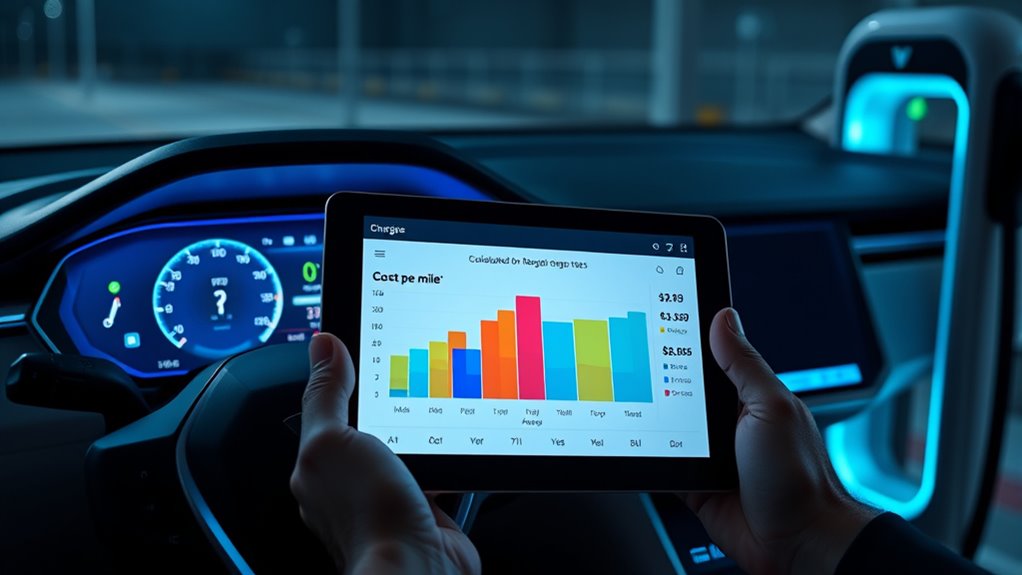
How do you accurately determine your EV’s cost per mile using charging data? First, note your total charging cost and the distance driven on that charge. Then, divide the total cost by miles traveled to get your cost per mile. To guarantee accuracy, consider these factors:
- Record the total energy used during charging, including inefficiencies.
- Use your actual electricity rate per kWh, not just average estimates.
- Include any additional fees or surcharges for public charging.
- Adjust for charging losses, typically around 5-10%.
- Track multiple charges to find an average for better precision.
- Incorporate knowledge of whole‑house water filtration systems to understand the importance of accurate measurement and maintenance in ensuring long-term efficiency.
- Recognize that energy consumption can vary based on factors like ambient temperature and system efficiency, which can impact overall charging costs.
Considering Different Charging Locations and Rates

You’ll find that charging at home generally costs less than public stations, especially fast chargers that can double or triple your per-kWh rate. Public fast chargers are convenient for quick top-ups, but they can substantially increase your overall charging expenses. Comparing these rates helps you budget more accurately and choose the most economical charging options for your needs. Additionally, understanding drone insights can help you optimize your drone operations and avoid costly mistakes.
Home vs. Public Rates
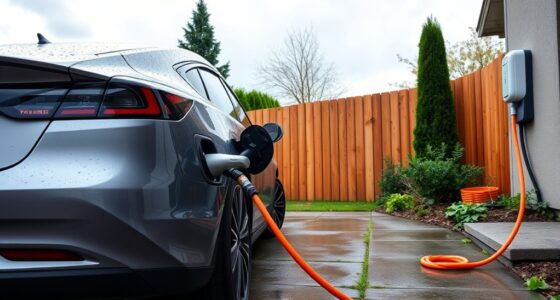
Charging your EV at home typically costs less than using public stations, mainly because residential electricity rates are generally lower and more stable. Home rates often range from 10 to 20 cents per kWh, while public chargers, especially fast chargers, can charge 2-3 times more. This difference impacts your total charging cost per mile considerably. Consider these points:
- Home rates are predictable and steady.
- Public fast chargers often have higher kWh rates.
- Level 2 chargers at public stations may be cheaper than fast chargers.
- Charging efficiency losses are similar across locations.
- Using public chargers for quick top-ups increases costs per mile.
Choosing where to charge depends on convenience and cost considerations. For regular use, home charging offers the most savings, while public stations are better for rapid top-ups.
Fast Charging Costs
Have you noticed that fast charging at different locations can considerably impact your EV’s charging costs? Public fast chargers often charge higher rates—sometimes 2-3 times more per kWh—compared to home charging. Location, provider, and time-of-day rates influence the price. For example, charging at a highway station might cost around $0.50 per kWh, while a retail charging site could be $0.30 per kWh. To visualize this, see the table below:
| Charging Location | Rate per kWh |
|---|---|
| Highway fast charger | $0.50 |
| Retail charging station | $0.30 |
| Airport charging station | $0.45 |
| Rest stop fast charger | $0.40 |
These higher rates increase your cost per mile, especially on long trips. Always check charging prices beforehand.
Estimating Monthly and Trip Charging Expenses
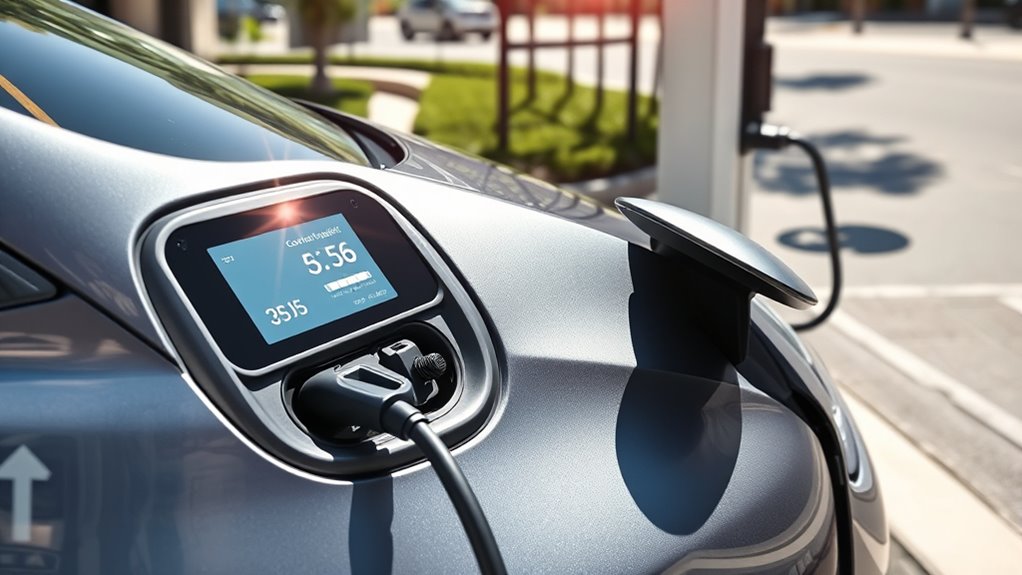
Understanding your monthly and trip charging costs helps you plan your EV expenses more accurately. By calculating how much energy you use based on your driving habits and local electricity rates, you can estimate these expenses effectively. Using simple formulas or tools guarantees you stay within your budget and make informed charging choices.
Calculating Monthly Costs
Calculating your monthly EV charging costs involves estimating how much energy you’ll consume based on your driving habits and the efficiency of your vehicle. To do this, consider:
- Average miles driven per day or month
- Your vehicle’s miles per kWh efficiency
- Local electricity rates
- Charging frequency (home or public charging)
- Variations in driving conditions and seasons
Using these factors, you can estimate your total energy consumption. Multiply your miles by your vehicle’s efficiency to find kWh needed. Then, multiply that by your electricity rate to get monthly costs. For example, driving 1,000 miles at 4 miles/kWh with a $0.14 per kWh rate results in roughly $49 monthly. Adjust estimates based on actual driving patterns and regional rates for accuracy.
Estimating Trip Expenses
Estimating your trip expenses involves determining how much energy you’ll need for each journey and how that translates into cost. First, calculate the miles you plan to drive and your EV’s efficiency (miles per kWh). Then, multiply the energy needed by your local electricity rate. To help visualize, consider this quick reference:
| Trip Distance | Energy Needed (kWh) | Cost to Charge |
|---|---|---|
| 50 miles | 12.5 kWh | $1.73 |
| 100 miles | 25 kWh | $3.47 |
| 200 miles | 50 kWh | $6.94 |
Use these estimates to plan your budget, adjusting for charging efficiency and station type. Tracking actual energy use over time refines your cost predictions.
Using Tools and Strategies for Precise Cost Tracking
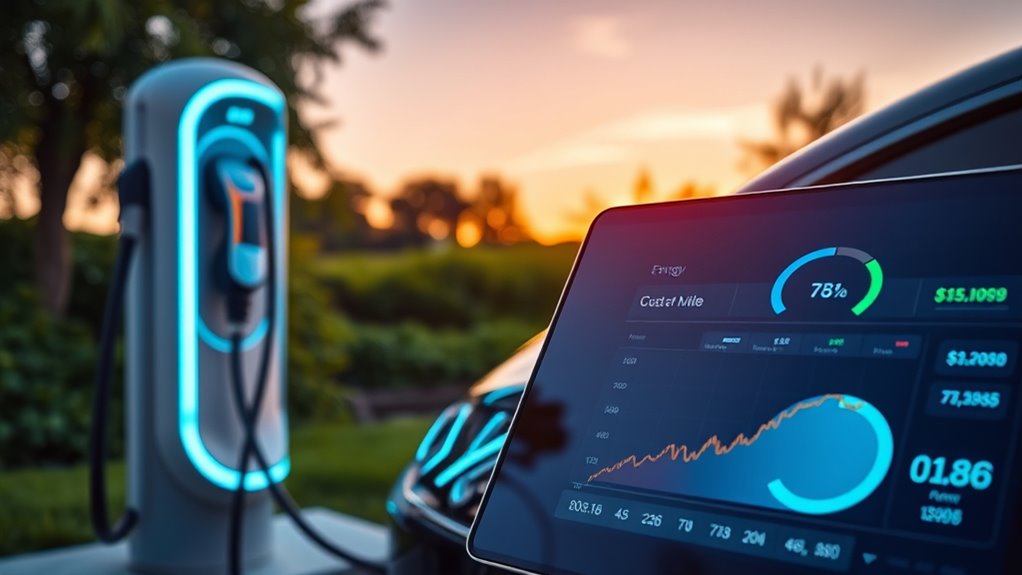
To guarantee you accurately track your EV charging costs, leveraging specialized tools and strategies is essential. These can help you monitor expenses, identify savings, and optimize charging habits. Consider using:
- Mobile apps that connect to your EV or charging stations to log energy consumption automatically.
- Spreadsheets to record charging sessions, costs, and efficiency metrics for detailed analysis.
- Utility rate tracking tools to stay updated on variable electricity prices and time-of-use rates.
- Charging station maps with cost information to find the most affordable options.
- Budgeting software that incorporates charging costs alongside other vehicle expenses for exhaustive financial planning.
Frequently Asked Questions
How Does Temperature Affect My Ev’s Charging Efficiency and Cost?
Temperature impacts your EV’s charging efficiency by affecting battery performance. Cold weather causes the battery to be less efficient, increasing energy use and charging time, which raises costs. Hot weather can also reduce efficiency due to thermal management needs. You’ll notice higher charging costs during extreme temperatures because more energy is needed to charge and maintain battery health. To save, charge in moderate temperatures whenever possible.
Do Fast Chargers Cost More per Kwh Than Home Chargers?
Fast chargers cost more per kWh than home chargers, like buying premium coffee versus making it at home. Public fast chargers often charge between 50-74 cents per kWh, compared to home rates around 13-20 cents. This higher cost reflects faster charging speeds and infrastructure costs. If you’re looking to save money, charging at home is usually much cheaper, but fast chargers are handy for quick top-ups during long trips.
How Do Time-Of-Use Rates Impact My Overall Charging Expenses?
Time-of-use rates can markedly lower your charging expenses by shifting charging to off-peak hours when electricity is cheaper. By scheduling your charging during these times, you save money compared to peak hours when rates are higher. You can set timers or use smart chargers to automate this, ensuring you always charge when costs are minimized. This strategy helps reduce your overall energy costs and makes EV ownership more economical.
What Is the Typical Charging Loss Percentage During Fast Charging?
Charging losses during fast charging can feel like a sneaky thief, stealing up to 10% of your energy. Typically, you’ll see loss percentages around 5-10%, depending on the charger and battery condition. Fast chargers tend to be less efficient than home chargers due to higher power levels and heat generation. To save money and energy, aim for slower, Level 2 charging when possible, reducing those sneaky losses.
How Can I Reduce My EV Charging Costs Long-Term?
You can cut your long-term EV charging costs by charging at home during off-peak hours, where electricity is cheaper. Use a smart charger with timers to optimize charging times, and consider installing solar panels to generate your own clean energy. Maintaining your battery well and avoiding frequent fast charging also helps reduce efficiency losses and prolong battery life, saving you money over time.
Conclusion
Now that you’ve mapped out your EV’s charging journey, you hold the compass to your costs. With each calculated mile, you turn data into a steady drumbeat of savings and awareness. Tracking your expenses is like tuning a finely crafted instrument—every note matters. Stay vigilant, adapt to changing rates, and let your knowledge be the wind beneath your wheels, guiding you smoothly down the road of efficient, cost-conscious driving.