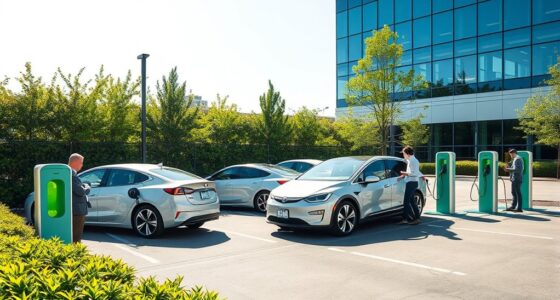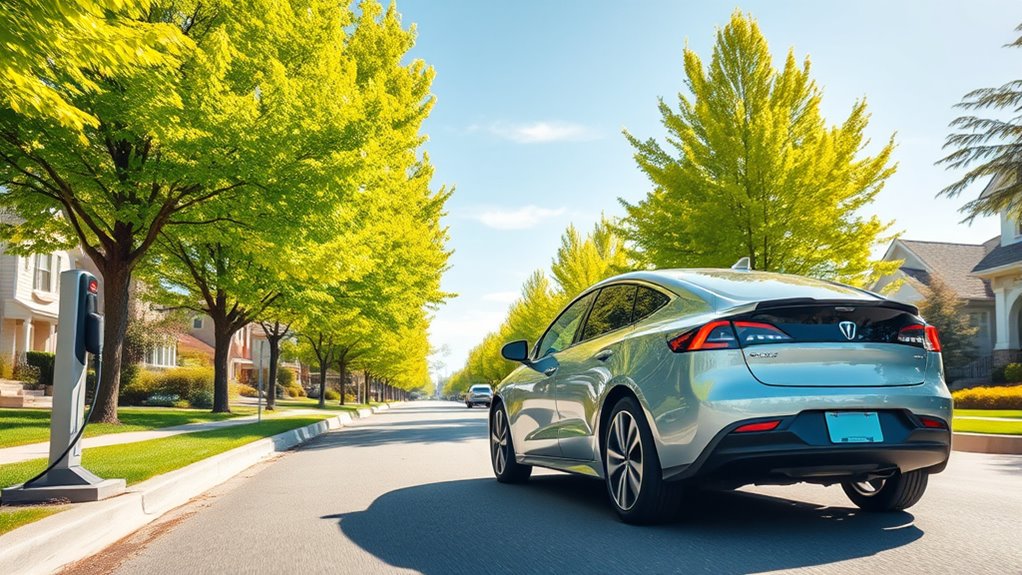

To maximize your EV’s range on daily drives, keep your tires properly inflated, and remove unnecessary cargo to lighten the load. Use eco-climate settings and precondition your vehicle while plugged in. Drive smoothly with gentle acceleration and regenerative braking, and activate Eco Mode for energy savings. Schedule preconditioning and charging beforehand, monitor battery health, and protect it from cold weather. Limit air conditioning and heating, stay at steady speeds, and avoid stop-and-go traffic. Discover more ways to boost efficiency if you keep exploring.
Key Takeaways
- Keep tires properly inflated to the recommended PSI and check regularly to reduce rolling resistance and improve efficiency.
- Remove unnecessary cargo and clutter to lighten the vehicle, enhancing acceleration, braking, and overall range.
- Use eco-mode, plan routes with minimal hills and traffic, and utilize eco-routing features for energy-efficient driving.
- Precondition your EV and battery while plugged in, especially in cold weather, to optimize performance and conserve energy.
- Drive smoothly with gradual acceleration, avoid abrupt braking, and use regenerative braking to recover energy and extend range.

ETENWOLF T300 Digital Tire Pressure Gauge 3-200 PSI, Industrial Tire Gauge Calibrated to ANSI B40.7 Grade 2A(Plus-Minus 0.5%), Replaceable AAA Batteries (Vivid Orange)
PROCESS LEVEL ACCURACY: Each ETENWOLF’s digital tire pressure gauge is calibrated manually to ANSI B40.7 Grade 2A(plus-minus 1…
As an affiliate, we earn on qualifying purchases.
As an affiliate, we earn on qualifying purchases.
Keep Your Tires Properly Inflated for Better Efficiency

Keeping your tires properly inflated is one of the simplest ways to improve your EV’s range. Underinflated tires increase rolling resistance, meaning your vehicle works harder and consumes more energy to move. Regularly check your tire pressure with a reliable gauge, and guarantee it matches the manufacturer’s recommended PSI—usually found on the driver’s door frame or in the owner’s manual. Properly inflated tires not only boost efficiency but also extend tire life and improve handling. Remember, temperature fluctuations can cause pressure changes, so check your tires monthly, especially before long trips or during seasonal shifts. Maintaining ideal tire pressure helps your EV operate more smoothly and conserves battery power, giving you extra miles on each charge. Regular tire maintenance is essential for optimal EV performance and energy conservation. Additionally, understanding how tire pressure impacts rolling resistance can help you better optimize your driving habits for maximum efficiency. Being aware of the relationship between tire pressure and vehicle range can further assist in making informed decisions to maximize your driving distance.
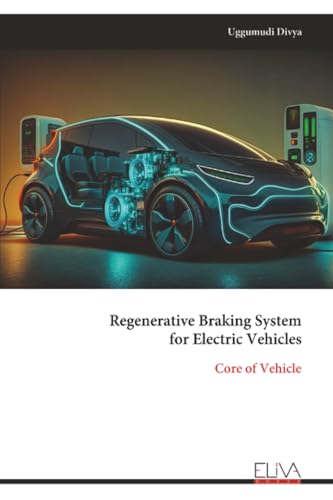
Regenerative Braking System for Electric Vehicles: Core of Vehicle
As an affiliate, we earn on qualifying purchases.
As an affiliate, we earn on qualifying purchases.
Lighten Your Load by Removing Unnecessary Cargo

Removing unnecessary cargo from your EV can substantially boost your range. Every extra item adds weight, making your vehicle work harder and consume more energy. Keep your load light to get the most out of each charge. Additionally, vehicle weight reduction techniques can further enhance efficiency by minimizing non-essential components. Incorporating multi-surface capability in your vehicle’s design can also help optimize energy use across different terrains. Being mindful of aerodynamic improvements can further reduce drag and improve overall efficiency during your drives. Implementing proper weight distribution can also contribute to better handling and energy savings.
Reduce Excess Weight
Since extra cargo adds unnecessary weight, it directly impacts your EV’s range by making the vehicle work harder. Every additional pound requires more energy, reducing efficiency. To visualize, consider this table:
| Item | Weight (lbs) | Effect on Range |
|---|---|---|
| Heavy toolbox | 20 | Cuts 0.2–0.4 miles |
| Extra luggage | 50 | Cuts 0.5–1 mile |
| Unused gym bag | 10 | Cuts 0.1–0.2 miles |
Removing these unnecessary items lightens your load, helping your EV conserve energy. Focus on essentials only, and avoid carrying heavy, unused cargo. This simple step can extend your range and improve overall efficiency on daily drives. Additionally, lightweight materials can further optimize your vehicle’s performance, as reducing weight is a fundamental efficiency strategy. Being aware of vehicle weight and how it affects energy consumption allows you to make smarter choices for your daily driving habits. Incorporating weight reduction techniques can also lead to better handling and safety during your trips. Plus, staying mindful of your vehicle’s total load can help maintain optimal energy use and prolong battery life.
Clear Unnecessary Items
Clearing out unnecessary items from your vehicle is an effective way to boost your EV’s range. Extra cargo adds weight, which means your car needs more energy to move. Even small items can add up; removing anything you don’t need reduces overall load. Aim to keep only essentials like your charger, emergency kit, or a few personal items. Regularly check your trunk and back seats, and remove any unnecessary bags or tools. Lighter vehicles accelerate faster, brake more efficiently, and consume less energy during everyday drives. Additionally, understanding vehicle weight is key to optimizing your EV’s performance and range. By minimizing the weight your EV carries, you’ll improve efficiency and extend your range without changing your driving habits. It’s a simple, cost-free tactic that makes a noticeable difference in maximizing your vehicle’s battery life.

16A Portable Level 1&2 EV Charger-ETL Certified,110V-240V Car Charger with 25FT Charging Cable, NEMA 6-20 Plug & NEMA 5-15 Adapter EV Charging Station, Backup EV Chargers for All SAE EVSE J1772 Cars
✅【Fast and Efficient Charging】 The eTimxon level 2 EV charger is equipped with NEMA 6-20 Plug, supports 240V,…
As an affiliate, we earn on qualifying purchases.
As an affiliate, we earn on qualifying purchases.
Use Eco-Climate Settings and Precondition While Plugged In

Using eco-climate settings and preconditioning your vehicle while plugged in can substantially extend your range. By warming or cooling the cabin before unplugging, you avoid draining the battery during driving. This simple step helps you maximize efficiency without sacrificing comfort. Additionally, vehicle energy management features optimize power use, further boosting your driving range. Incorporating smart charging strategies ensures your battery remains healthy and ready for your daily needs. Implementing integrated automation systems can further streamline these processes and enhance overall energy efficiency.
Precondition While Charging
Preconditioning your EV while it’s still plugged in is one of the most effective ways to maximize range and battery life. When you precondition, you warm or cool the cabin and battery without draining the battery’s charge, saving energy for your drive. Use eco-climate settings to optimize temperature control and avoid excessive energy use. Many EVs allow you to schedule preconditioning through the app or vehicle system, so your car’s at the ideal temperature when you’re ready to leave. This reduces the need for the vehicle to draw power from the battery during your trip, helping you extend your range. Preconditioning while plugged in guarantees your EV is comfortable and efficient, especially in extreme weather conditions, making every mile count. Understanding the heat distribution principles and how different climate settings impact energy consumption can further enhance your preconditioning strategy. Additionally, being aware of battery thermal management can help maintain optimal performance and longevity of your EV’s battery during preconditioning. Proper thermal regulation techniques can further improve energy efficiency and protect your battery from temperature-related degradation. Incorporating smart charging features and monitoring ambient conditions can optimize energy use even further, ensuring your vehicle remains in peak condition for daily drives. Recognizing the importance of energy conservation strategies can help you get the most out of each charge and extend your vehicle’s lifespan.
Use Eco-Climate Settings
To maximize your EV’s range, setting your climate controls to eco-mode helps reduce energy consumption without sacrificing comfort. Eco-climate settings limit the use of the HVAC system, conserving battery power for driving. Additionally, preconditioning your cabin while plugged in keeps the interior comfortable without draining the battery during your trip. To optimize your energy savings, consider these tips:
- Use eco-mode for climate controls to cut auxiliary power use
- Precondition the cabin while still plugged in to avoid battery drain
- Rely on seat heaters instead of full cabin heating in cold weather
- Learn how smartphone tips and accessories can help monitor and manage your EV’s energy use more effectively
- When choosing portable power solutions, selecting a portable inverter generator can provide reliable backup power that complements your EV’s energy management
- Proper load planning ensures your EV operates efficiently, extending its range on daily drives
These strategies help maintain comfort while minimizing energy use, giving you more range on everyday drives. Limiting HVAC use during trips can notably extend your EV’s distance.

ONE PIX Backseat Car Organizer Mats Back Seat Organizers and Storage Bag with Touch Screen Tablet Holder for Kids Toddlers Car Seats, Travel Accessories, Road Trip Essentials Kids
【ULTIMATE SPACE SAVER & KEEP CAR CLEAN】: Tired of a messy backseat? Our car organizer with 8 large…
As an affiliate, we earn on qualifying purchases.
As an affiliate, we earn on qualifying purchases.
Drive Smoothly With Gentle Acceleration and Regenerative Braking

Driving smoothly with gentle acceleration and deceleration is one of the most effective ways to extend your EV’s range. Rapid acceleration uses more energy, while abrupt braking wastes momentum that regenerative braking could recover. Instead, accelerate gradually to maintain steady speed and avoid sudden stops. When approaching a stop or slowing down, ease off the accelerator early and coast whenever possible. This allows regenerative braking to recover energy, boosting your range. Maintaining a consistent speed on highways also helps conserve battery power. By practicing smooth driving habits, you reduce strain on the motor and battery, maximizing efficiency. Remember, gentle driving isn’t just safer—it’s a smart way to get the most out of each charge and enjoy longer trips between charges.
Activate Eco Mode to Limit Power Consumption and Extend Range

Activating Eco Mode is a quick and effective way to limit your vehicle’s power consumption and maximize your EV’s range. When you turn on Eco Mode, your car automatically adjusts settings to reduce energy use without sacrificing essential functions. This helps you extend your driving distance on a single charge. Some key benefits include:
- Limiting throttle response for smoother acceleration
- Reducing power to non-essential features like heated seats or defrosters
- Optimizing climate control to conserve battery life
Plan Routes With Fewer Hills and Less Traffic

Choosing routes with fewer hills and less traffic helps you conserve battery power and extend your range. By selecting flatter roads and avoiding congestion, your EV uses less energy and maintains a steady speed. Use your navigation system to find energy-efficient routes that prioritize smooth traffic flow and minimal elevation changes.
Optimized Route Selection
Planning your route with fewer hills and less traffic can substantially extend your EV’s range. Flat, smooth routes require less energy, helping you go farther on each charge. Use your navigation app to identify alternative paths that avoid steep inclines and congested areas. This not only conserves battery but also reduces stress and travel time.
Keep these strategies in mind:
- Select routes with minimal elevation changes to cut down on energy used for climbing.
- Choose roads with steady traffic flow, avoiding stop-and-go conditions that drain power.
- Use your navigation system’s eco-routing features to prioritize energy-efficient paths.
Traffic Flow Awareness
Reducing traffic congestion and avoiding hilly routes can considerably boost your EV’s range. When you steer clear of stop-and-go traffic, your vehicle maintains a steady speed, reducing energy waste from frequent acceleration and braking. Planning your trip to avoid congested areas helps minimize idling and unnecessary stops, conserving battery power. Opt for routes with fewer hills, as elevation changes demand extra energy to climb and slow down your efficiency. Navigation apps can help identify flatter, less congested paths, saving you time and extending your range. Even slightly longer, flatter routes often use less energy than direct but hilly shortcuts. By being mindful of traffic flow and terrain, you optimize your EV’s performance and get the most out of every charge.
Schedule Preconditioning and Charging Before Your Trip

Preconditioning your EV before a trip guarantees the vehicle is ready to deliver maximum range and efficiency. By scheduling preconditioning, you warm the cabin and battery while still plugged in, reducing energy drain during your drive. This helps maintain ideal battery temperature and minimizes range loss in cold weather. Additionally, plan your charging to be complete just before departure, ensuring your battery is at full capacity and ready to perform.
- Preheat the cabin and battery while plugged in to save range
- Schedule charging to finish right before your trip
- Use smart timers or apps to automate preconditioning and charging
Taking these steps ensures your EV is primed for efficiency, making the most of each mile and avoiding unnecessary energy consumption.
Monitor Battery Health and Protect It From Cold Weather

Monitoring your battery health and shielding it from cold weather can substantially extend your EV’s range and lifespan. Regularly check your battery’s state of health through your vehicle’s dashboard or app. A healthy battery retains more charge and performs more efficiently, especially in cold conditions. To protect it from cold weather, park in a garage or sheltered area whenever possible. Cold temperatures reduce battery capacity and increase energy drain, lowering your range by up to 40%. Preconditioning the battery while plugged in keeps it warm and ready for your drive, minimizing efficiency loss. Avoid deep discharges and unnecessary fast charging, which can accelerate battery degradation. By keeping an eye on your battery’s condition and managing cold exposure, you ensure peak performance and longevity for your EV.
Use Natural Shade and Limit Air Conditioning and Heating

Whenever you park your EV, make sure to use natural shade or covered parking to keep the cabin and battery cooler. This simple step prevents your battery from overheating, which can reduce efficiency and range. To maximize savings, avoid running the air conditioning or heater unnecessarily. Instead, try these tips:
Park in shade or covered spots to keep your EV cooler and boost range.
- Use eco-climate settings to minimize energy use
- Precondition the cabin while still plugged in
- Rely on seat heaters instead of cabin heating
Limiting climate control not only preserves battery power but also extends your driving range. If possible, park in shaded areas or garages, especially during extreme temperatures. These small adjustments help maintain ideal battery temperature and reduce auxiliary load, giving you more miles on every charge.
Maintain Steady Highway Speeds and Avoid Stop-and-Go Traffic

Maintaining a steady highway speed is one of the most effective ways to maximize your EV’s range. Fluctuating speeds, especially accelerating and braking frequently, wastes energy and reduces efficiency. Using cruise control on the highway helps keep a consistent pace, preventing unnecessary acceleration and deceleration. Additionally, avoiding stop-and-go traffic saves battery life by minimizing idle time and repeated acceleration. Plan your routes to steer clear of congested areas whenever possible. Slowdowns caused by traffic jams can cut your range markedly, so using navigation apps to find alternative routes can be beneficial. Staying at a steady speed not only conserves energy but also reduces strain on your vehicle’s components, helping you get the most out of each charge during everyday drives.
Frequently Asked Questions
How Does Tire Pressure Specifically Impact My Ev’s Range?
When your tire pressure is properly maintained, it can boost your EV’s range by up to 3%. Underinflated tires increase rolling resistance, making your motor work harder and consume more energy. By keeping tires inflated to the recommended pressure, you lessen resistance and improve efficiency. Regularly checking and maintaining tire pressure ensures your vehicle uses less energy, helping you go farther on each charge.
What’s the Best Way to Reduce Energy Use From Climate Control?
To reduce energy use from climate control, precondition your EV while it’s plugged in to warm or cool the cabin without draining the battery. Use eco-settings and limit AC or heat, opting for seat heaters instead of full cabin heating. Keep windows closed in extreme temperatures, and park in shaded or sheltered areas. These steps help minimize auxiliary load, conserving battery power and extending your driving range.
How Can I Effectively Use Regenerative Braking to Save Battery?
You can effectively save battery by maximizing regenerative braking whenever you slow down or approach a stop. Ease off the accelerator early to allow the system to recover energy, and apply gentle, steady brakes instead of abrupt stops. Keep an eye on your vehicle’s regen settings if adjustable, and use cruise control on highways to maintain consistent speeds. These habits help reclaim energy and extend your EV’s range with every drive.
When and How Should I Precondition My EV for Maximum Efficiency?
Precondition your EV before driving by turning it on while still plugged in, ideally 15-30 minutes before departure. Use the climate control settings to warm or cool the cabin and battery efficiently without draining the battery during your trip. Schedule preconditioning during off-peak hours if possible, and park in a garage or sheltered area to maintain ideal battery temperature. This maximizes range and preserves battery health.
How Does Route Selection Influence Overall Battery Consumption?
Think of your route as a river’s course—choose the smoothest path for less resistance. You’ll use less battery if you pick routes with fewer hills, less stop-and-go traffic, and natural terrain. Flat, direct routes save energy by avoiding steep inclines and constant acceleration. Navigation that considers terrain and traffic flow helps you glide effortlessly, conserving battery power and extending your driving range with every mile.
Conclusion
By following these simple strategies, you’ll supercharge your EV’s efficiency and extend its everyday endurance. Keep your tires topped off, trim unnecessary trappings, and stay smooth on the streets. Precondition while plugged in, prioritize proper planning, and protect your battery from chilly challenges. With these clever tips, you’ll conquer commutes confidently, conserve charge, and enjoy eco-friendly expeditions every day. Drive smarter, stretch further, and make every mile matter!