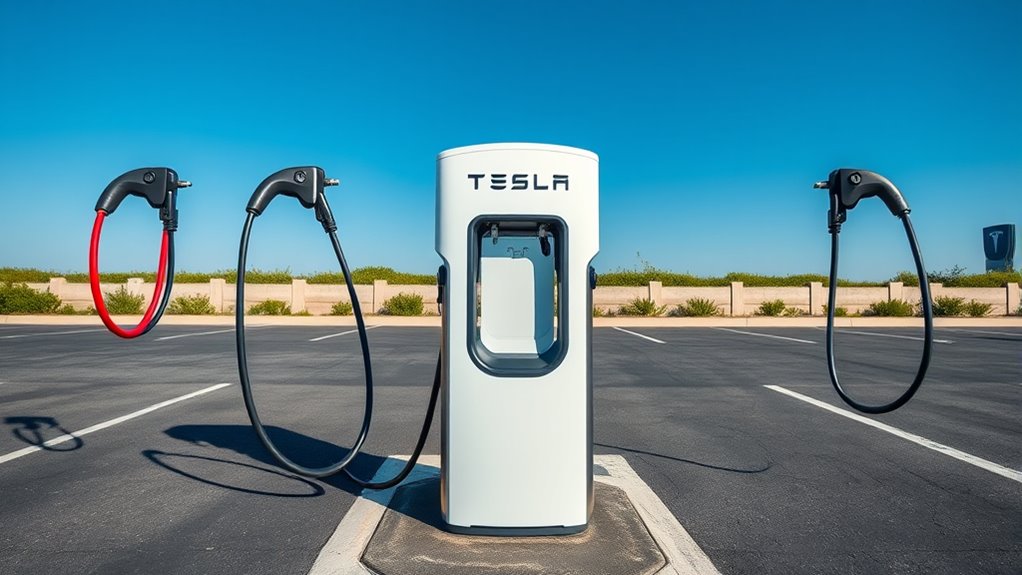

Tesla’s new NACS charging plug combines both AC and DC functions into a smaller, more versatile design that many automakers and charging networks are adopting. It supports faster charging speeds, up to 325 kW, and aims to reduce the need for adapters, making charging easier and more compatible across brands. If you want to understand how this change affects your EV experience and future options, there’s plenty more to discover.
Key Takeaways
- Tesla’s NACS combines AC and DC charging in a smaller, streamlined connector, supporting higher voltages and faster charging than traditional standards.
- Most automakers are adopting NACS starting in 2025, aiming for industry-wide standardization and fewer adapters.
- EVs using NACS can access Tesla’s extensive Supercharger network and other compatible charging stations seamlessly.
- Unlike CCS and J1772 connectors, NACS offers a more compact design with advanced safety and high-current capabilities.
- Future-proofing ensures NACS compatibility with upcoming EV models, simplifying charging infrastructure and improving user experience.
Understanding the NACS Design and Features

The North American Charging Standard (NACS) is Tesla’s proprietary connector engineered to combine both AC and DC charging functions into a single, compact design. You’ll notice it features five pins, with two primary pins handling both Level 2 AC charging and high-power DC fast charging. This design allows for versatile charging options while keeping the connector lightweight and easy to handle. NACS supports voltage configurations up to 500 V for AC and 1000 V for DC fast charging, offering high power delivery. Tesla has tested this connector through over 20 billion miles of use, ensuring safety and reliability. Its streamlined design minimizes complexity and enhances durability, making it a practical choice for fast and home charging. Additionally, the connector’s versatility enables compatibility with various charging networks, further simplifying the charging process for EV owners. The advanced engineering behind NACS also contributes to its high efficiency and robustness, which are crucial for long-term use. The design also incorporates safety features that protect both the vehicle and the user during charging. Furthermore, the compact form factor of NACS helps reduce manufacturing costs and makes it easier to incorporate into a wide range of vehicles. This design innovation exemplifies Tesla’s commitment to improving EV charging infrastructure. Overall, NACS aims to simplify your EV charging experience.
Industry Adoption and Transition to NACS

Are automakers and charging networks truly shifting toward Tesla’s NACS standard? The answer is yes. Major automakers plan to adopt NACS for new EVs starting with 2025 models, aiming to reduce reliance on adapters and improve compatibility. The extensive Tesla Supercharger network, known for reliability, is a key factor in this changeover. Several charging operators are now integrating NACS connectors, broadening access and simplifying charging for non-Tesla owners. Tesla’s “Magic Dock” allows limited CCS1 compatibility during the transition, but all new EVs will soon feature NACS ports. This shift means you’ll benefit from seamless access, faster charging, and fewer accessories. The transition also emphasizes the importance of standardized connectors for streamlined charging experiences industry-wide. As industry adoption accelerates, the move toward unified charging standards will likely lead to a more consistent and convenient charging infrastructure for all EV users.
Tesla Wall Connector and Home Charging Options

Tesla’s Wall Connector offers a reliable and convenient home charging solution tailored for North American EV owners, especially as more vehicles adopt the NACS standard. It delivers up to 11.5 kW at 48 amps, providing about 44 miles of range per hour on Tesla vehicles. The connector features Wi-Fi for over-the-air updates, remote diagnostics, and charging management via the Tesla app. Its 24-foot cable and auto-sensing handle make charging straightforward inside or outside your home. Installation requires a qualified electrician to match your electrical system, with power management features that help reduce costs and optimize charging speeds. Additionally, the Wall Connector is designed with safety features that ensure secure operation during various weather conditions. The device’s connected technology allows for seamless integration with your smart home system, enhancing overall convenience. As part of a broader home automation ecosystem, it can be integrated with other smart devices for enhanced control and monitoring. Understanding charging standards is essential for EV owners to maximize compatibility and efficiency. Moreover, its compatibility with various power management tools helps optimize energy use and reduce costs. Overall, the Wall Connector simplifies overnight charging, giving you a fast, efficient, and integrated solution for daily EV use.
Comparing NACS With Other Charging Standards

Compared to other charging standards like CCS1 and J1772, NACS offers a streamlined, integrated approach that consolidates AC and DC charging into a single, lightweight connector. This design reduces complexity, making it easier to handle and install. Unlike CCS1, which uses separate connectors for AC and DC, NACS combines both in one plug, minimizing space and moving parts. It’s smaller and more efficient, enabling faster charging at higher currents. Tesla’s NACS supports up to 500 V and 1000 V configurations, with continuous operation at currents up to 900 amps. While CCS1 remains prevalent for non-Tesla vehicles, NACS’s simplicity and expanding adoption are making it increasingly attractive for automakers and charging networks, promising a more unified and user-friendly experience for EV owners. Additionally, connector design is a key factor in the overall efficiency and user experience of EV charging systems, especially as the industry moves toward more standardized solutions that benefit consumers and manufacturers alike. A growing number of charging infrastructure providers are adopting NACS, further enhancing its role in the evolving EV landscape.
Charging Speed and Performance Insights

Charging speed and performance are key factors that determine how quickly your EV can be ready for use. With Tesla’s Wall Connector at 48 amps, you get up to 44 miles of range per hour, making home charging efficient and convenient. The mobile connector, offering up to 7.6 kW, charges more slowly but still speeds up daily refills compared to standard household outlets, which provide just 3 miles per hour. Tesla’s Superchargers, utilizing NACS V4 technology, deliver up to 325 kW, allowing rapid charging from 20% to 80% in around 30 minutes. This fast performance minimizes downtime, especially during long trips. Modern charging technology enables faster and more reliable EV recharging experiences, and the integration of advanced charging standards ensures compatibility with a growing range of electric vehicles. Additionally, charging infrastructure continues to expand, and the development of fast-charging networks makes fast charging more accessible in various locations. For EV owners, understanding the differences in charging options can help optimize your charging routine and ensure your vehicle is always ready when needed. Overall, Tesla’s charging solutions combine high power levels with seamless integration, ensuring your vehicle gets charged quickly and reliably whenever you need it.
Benefits and Future Implications for EV Owners

As an EV owner, you’ll benefit from a more seamless charging experience with the new NACS standard, which consolidates AC and DC charging into one easy-to-use plug. Industry-wide compatibility means you’ll have better access to fast chargers across networks, reducing wait times and increasing convenience. Looking ahead, this infrastructure promises to be future-proof, ensuring your vehicle remains compatible as technology continues to evolve. Embracing standardized wiring and safety protocols will further enhance your charging experience and vehicle longevity.
Seamless Charging Experience
The adoption of the North American Charging Standard (NACS) promises a more seamless charging experience for EV owners by simplifying access and reducing the need for adapters. With NACS, you’ll benefit from a single, compact connector that handles both AC and DC charging, making it easier to charge at home and on the go. As more automakers adopt NACS, you’ll encounter fewer compatibility issues, and access to Tesla’s extensive Supercharger network will become more straightforward. This standard eliminates the hassle of carrying multiple adapters and *steering through* different charging ports. Over time, NACS will streamline your charging routine, providing faster, more reliable connections and a unified experience across various charging stations. Additionally, the integration of outdoor technology and smart gear can help you monitor and manage your EV charging more effectively during outdoor adventures and remote trips. Incorporating charging station compatibility features into your outdoor gear can further enhance your charging experience. Future upgrades and widespread industry adoption promise ongoing improvements in charging infrastructure convenience and efficiency. Staying informed about industry standards ensures you’re prepared for upcoming developments and can optimize your EV charging experience.
Industry-Wide Compatibility
Industry-wide compatibility with NACS offers significant benefits for EV owners by creating a more unified and accessible charging ecosystem. With more automakers adopting NACS, you’ll find it easier to charge your vehicle across different brands and networks without needing adapters. This reduces inconvenience and streamlines your charging experience, whether at home or on the road. As more charging stations incorporate NACS, you’ll have better access to fast, reliable charging options. This shift also promotes competition among charging providers, driving innovation and potentially lowering costs. In the future, NACS’s expanding presence promises increased interoperability, making EV ownership more practical and less complicated. Overall, industry-wide compatibility enhances convenience, broadens charging access, and supports the growth of EV adoption. Additionally, understanding the Gold IRA markets can help investors diversify their portfolios, ensuring financial security as the EV industry continues to grow.
Future-Proof Infrastructure
Embracing NACS as the new standard positions your EV infrastructure to be truly future-proof. This shift guarantees compatibility with the expanding network of EVs, including upcoming models from major automakers. NACS’s consolidated design means fewer adapters and simpler installations, reducing long-term costs and complexity. The standard’s high current capacity and fast-charging capabilities prepare you for rapid charging needs as battery technologies improve. As industry adoption accelerates, more charging stations will support NACS, making charging more convenient and universal. Home chargers like Tesla’s Wall Connector are designed to adapt to future upgrades, providing seamless updates and optimal performance. Investing now in NACS-compatible infrastructure guarantees your EV setup remains relevant, reliable, and ready for the evolving landscape of electric mobility.
Frequently Asked Questions
Will All New EVS Automatically Have NACS Ports?
Yes, most new EVs in North America will automatically have NACS ports. Automakers are shifting to this standard, starting with the 2025 model year, to guarantee compatibility with Tesla’s extensive Supercharger network. You won’t need adapters for most new EVs, and as adoption grows, NACS ports will become the norm, making charging more seamless and convenient for you, whether at home or on the road.
How Soon Will Non-Tesla EVS Fully Support NACS Charging?
Non-Tesla EVs are expected to fully support NACS charging by 2025 or shortly after, as many automakers plan to adopt the standard for new vehicles in North America. You’ll likely see built-in NACS ports on upcoming models, reducing reliance on adapters. Meanwhile, existing EVs may need to use adapters, but the industry’s shift towards NACS means compatibility will improve rapidly, making charging more seamless for you.
Can Existing CCS1 Adapters Work With NACS Chargers?
Existing CCS1 adapters won’t work directly with NACS chargers. Only Tesla’s Magic Dock adapters can connect non-Tesla EVs to Tesla’s Supercharger network. Notably, over 75% of North American fast chargers are Tesla Superchargers, highlighting their dominance. As industry shifts toward NACS, more compatible adapters may emerge, but currently, you’ll need a Tesla-specific adapter for non-Tesla vehicles to access Tesla’s charging stations.
Are NACS Chargers Compatible With All EV Models?
NACS chargers are not compatible with all EV models directly, especially those using CCS1 or J1772 connectors. However, many non-Tesla EVs can use adapters to access NACS chargers, though compatibility varies by vehicle and charger. As more automakers adopt NACS, future EVs are likely to come with built-in NACS ports, reducing the need for adapters. For now, check your vehicle’s compatibility before attempting to charge at NACS stations.
What Are the Long-Term Cost Benefits of Switching to NACS?
Switching to NACS saves you money long-term by reducing charging costs and hassle. Imagine charging your EV effortlessly at Tesla’s extensive Supercharger network, avoiding costly adapters or multiple chargers. With industry-wide adoption, you’ll enjoy more competitive rates, fewer compatibility worries, and increased access to fast charging. Over time, these savings add up, making your EV ownership more affordable and convenient—like a smooth, uninterrupted drive toward a greener, more economical future.
Conclusion
Embracing the NACS plug means embracing faster charging, broader access, and future-proofed convenience. It’s about simplifying your daily drives, expanding your charging options, and staying ahead in the evolving EV landscape. By understanding its design, benefits, and industry shift, you empower yourself to make smarter choices. Ultimately, adopting NACS isn’t just about technology; it’s about enhancing your driving experience, ensuring reliability, and embracing innovation. Stay informed, stay connected, and drive confidently into the future.