Knowing your EV’s max charging rate helps you optimize stops during road trips. It shows how quickly your vehicle can accept power from chargers, ensuring you don’t wait longer than necessary or risk damaging the battery. Matching your car’s capacity with the right chargers saves time and maintains battery health. This knowledge guides you in planning efficient routes and stops. Keep exploring to learn more about how this simple info can improve your travel experience.
Key Takeaways
- Your EV’s max charging rate, measured in kW, determines how quickly its battery can be charged.
- Matching your vehicle’s max rate with compatible charging stations optimizes charging speed and reduces wait times.
- Using chargers exceeding your EV’s max rate won’t increase charging speed, preventing unnecessary delays.
- Knowing your max charging rate helps plan efficient stops and manage trip timing effectively.
- Properly understanding charging limits protects battery health and ensures smoother, more reliable road trips.

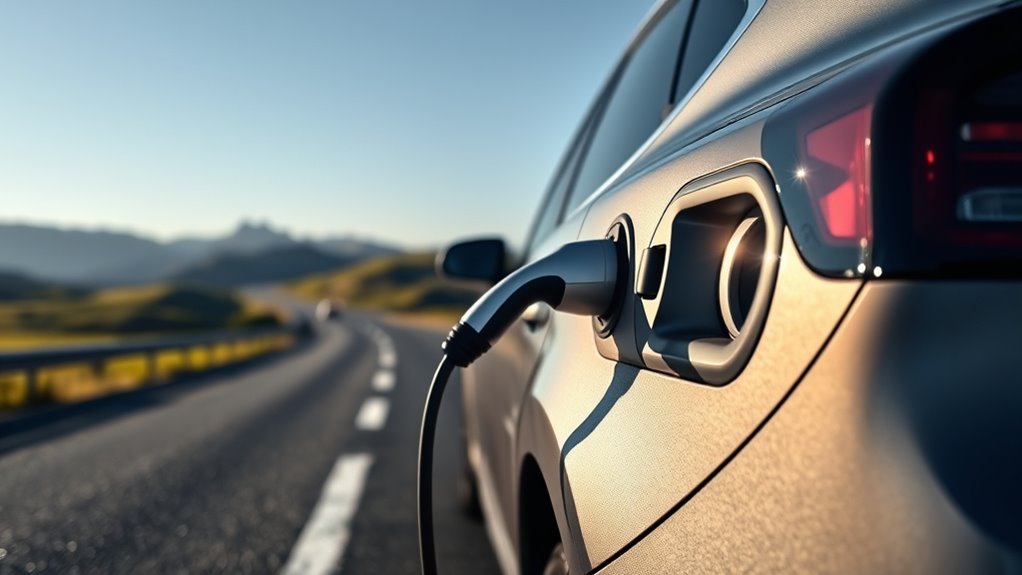
Knowing your electric vehicle’s maximum charging rate is essential for optimizing charging times and maintaining battery health. When you’re planning a road trip or daily commute, understanding how quickly your EV can recharge helps you avoid unnecessary delays and keeps your battery in good shape. Every EV has a specified maximum charging rate, often measured in kilowatts (kW), which indicates the fastest rate at which it can accept power from a charger. This rate is influenced by your vehicle’s battery capacity, which determines how much energy the battery can hold, and the capabilities of the charging infrastructure available along your route. Larger battery capacities generally mean longer ranges but can also affect how quickly your vehicle charges, especially if the charger isn’t powerful enough.
Knowing your EV’s max charging rate helps optimize charging times and battery health.
If you’re using a charger that exceeds your vehicle’s maximum charging rate, your EV won’t take advantage of the additional power. Instead, it will only draw as much power as it’s rated to handle, which means you won’t save time by connecting to faster chargers. That’s why it’s important to know your vehicle’s charging limits and match them with the appropriate charging stations. For instance, if your EV’s max charging rate is 50 kW, plugging into a 150 kW fast charger won’t speed up the charging process. Instead, it will simply supply power at the rate your car can handle, preventing you from wasting time waiting for a quicker charge. This understanding helps you plan more efficient stops, especially during long trips where time becomes critical.
Additionally, the availability and placement of suitable charging infrastructure play a crucial role. Not all charging stations provide the same power levels, so knowing your vehicle’s max charging rate allows you to select the right stations along your route. Many EV owners use apps that map charging infrastructure, showing the types and speeds of chargers available nearby. By focusing on chargers that match or are below your vehicle’s maximum charging rate, you minimize wait times and maximize efficiency. This is especially important when you’re on tight schedules or traveling through areas with limited charging options.
Understanding your EV’s max charging rate and how it interacts with the charging infrastructure ensures you’re not only saving time but also protecting your battery’s longevity. Charging at or below your vehicle’s maximum rate reduces stress on the battery, helping it maintain its capacity over the years. Being aware of the charging rate limits can also inform your choice of charging stations, leading to better overall trip planning. In brief, knowing these details empowers you to optimize your charging strategy, avoid unnecessary delays, and keep your EV running smoothly on all your road trips.

ChargePoint HomeFlex Level 2 EV Charger J1772 – Fast Smart Battery Power Charging at Home for Electric Automobile Vehicles
Charge With Confidence: ChargePoint builds reliable, flexible EV charging stations for home, business, and fleets. Get 24/7 support…
As an affiliate, we earn on qualifying purchases.
As an affiliate, we earn on qualifying purchases.
Frequently Asked Questions
How Is the Maximum Charging Rate Different From the Charging Speed?
Imagine your EV’s charging rate as the engine’s power, while the charging speed is how fast you fill the tank. The maximum charging rate is the highest power your vehicle can handle, but the actual charging speed depends on factors like charger type and battery temperature. Knowing the difference helps you optimize charging times on road trips, ensuring you get back on the road faster, with efficient charging rate terminology guiding your choices.
Can I Upgrade My Ev’s Maximum Charging Rate?
You can’t typically upgrade your EV’s maximum charging rate yourself, as it depends on the vehicle’s design and hardware. Battery aging can reduce charging efficiency, and upgrading often requires new components. To improve charging times, verify you have access to better charging infrastructure, like high-speed chargers, and maintain your battery properly. Consult your manufacturer for options, but most upgrades involve professional service or vehicle replacement.
How Does Temperature Affect My Ev’s Max Charging Rate?
Temperature substantially affects your EV’s max charging rate through battery temperature and thermal management. When your battery is too cold or hot, it slows down charging to protect itself. Thermal management systems regulate temperature, optimizing charging speed. To maximize charging efficiency on road trips, keep your battery within the ideal temperature range, especially before fast charging, to ensure your vehicle charges quickly and safely without damaging the battery.
Is a Higher Max Charging Rate Always Better?
A higher max charging rate isn’t always better, since it depends on your charging station compatibility and your battery’s health. Charging at a rate your vehicle and station support prevents unnecessary battery degradation. If your EV can’t handle ultra-fast charging or you use incompatible stations, pushing for higher speeds won’t improve your trip. Focus on balanced charging to safeguard your battery and ensure reliable performance over time.
How Does My Ev’s Age Impact Its Charging Capabilities?
As your EV ages, its charging capabilities can change unexpectedly. You might notice slower charging times due to battery degradation or wear on the charging port, which can limit power flow. Regular maintenance and monitoring are vital because these factors can silently reduce your vehicle’s max charging rate over time. Stay vigilant—understanding these signs helps you optimize charging and extend your EV’s lifespan on all your adventures.
ChargePoint HomeFlex Level 2 EV Charger J1772 – Fast Smart Battery Power Charging at Home for Electric Automobile Vehicles
Charge With Confidence: ChargePoint builds reliable, flexible EV charging stations for home, business, and fleets. Get 24/7 support…
As an affiliate, we earn on qualifying purchases.
As an affiliate, we earn on qualifying purchases.
Conclusion
Now that you know your EV’s max charging rate, imagine hitting the road with confidence, knowing exactly how fast you can top off your battery. But what if your charger isn’t up to speed, or your destination’s charging station isn’t compatible? The journey’s potential hinges on these details. So, stay prepared, stay curious—your next adventure could depend on understanding just how quickly you can recharge and keep moving forward. The road ahead is waiting.

16A Portable Level 1&2 EV Charger-ETL Certified,110V-240V Car Charger with 25FT Charging Cable, NEMA 6-20 Plug & NEMA 5-15 Adapter EV Charging Station, Backup EV Chargers for All SAE EVSE J1772 Cars
✅【Fast and Efficient Charging】 The eTimxon level 2 EV charger is equipped with NEMA 6-20 Plug, supports 240V,…
As an affiliate, we earn on qualifying purchases.
As an affiliate, we earn on qualifying purchases.

AIMILER Level 2 Electric Vehicle (EV) Charger(WIFI APP/Plug-play), 32A, 25ft Cable ETL Certified, 220V-240V NEMA 14-50P Plug EVSE w/ J1772 Connector, Portable EV Car Charging Stations for Home Level 2
❤ [Equipped with Nema 14-50 plug 240V, Compatible with 110-120V Nema 5-15p to 14-50r EV Adapter(Not packaged) or…
As an affiliate, we earn on qualifying purchases.
As an affiliate, we earn on qualifying purchases.