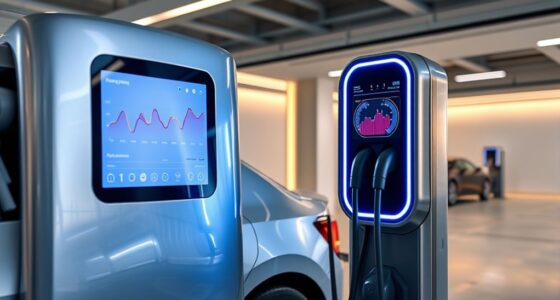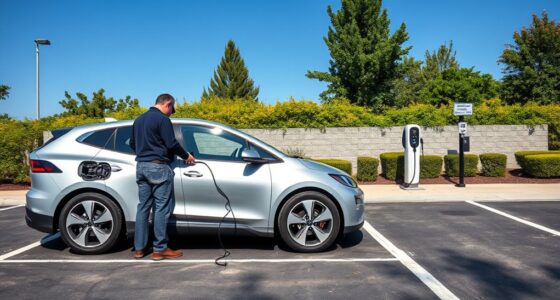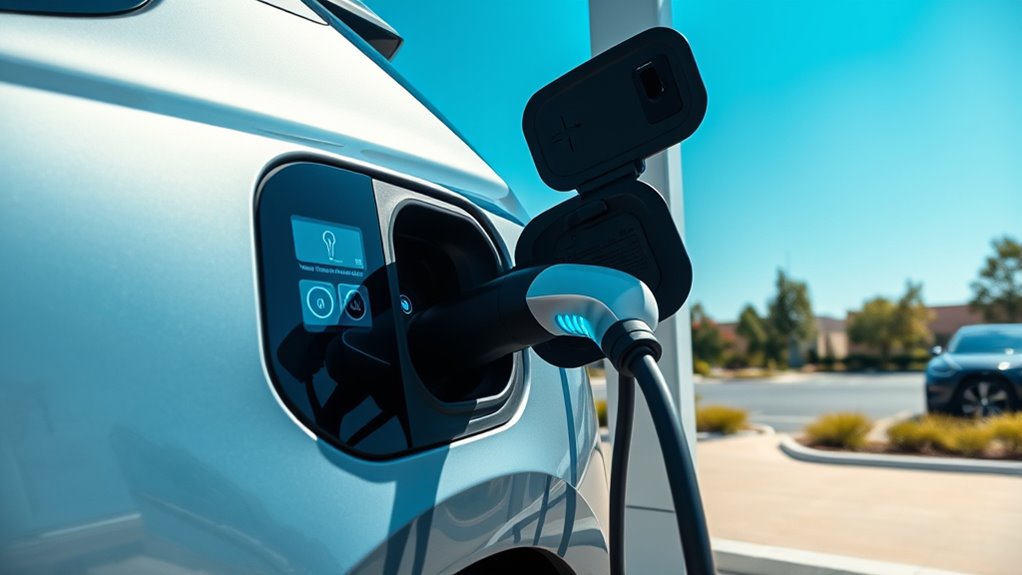

To confidently use EV charging stations, first find a reliable one nearby using apps or navigation tools that show real-time availability and amenities. Know the different charger types—Levels 1, 2, and DC fast chargers—and guarantee compatibility with your vehicle. Connect the charger properly, follow station instructions, and use your preferred payment method. Monitor the charging process, troubleshoot issues if needed, and follow etiquette by unplugging when done. Keep exploring how to make your charging experience smooth and stress-free.

Get backup power and energy gear delivered free with Prime
- Fast, free delivery on millions of items
- Prime Video, Amazon Music and more included
- Member-only deals all year
Key Takeaways
- Familiarize yourself with station locations, types, and compatible connectors before arriving.
- Use apps or RFID cards to access stations, monitor charging status, and handle payments easily.
- Confirm the correct connector is securely attached and follow safety instructions during connection.
- Track charging progress via station displays or vehicle apps to manage time effectively.
- Have a backup plan for stations that may be busy or temporarily out of service during your trip.
As an affiliate, we earn on qualifying purchases.
Finding the Right Charging Stations for Your EV

Finding the right charging stations for your EV can seem intimidating at first, but with a few key tips, it becomes much easier. Start by considering the charging station amenities you need, such as fast chargers, parking availability, or restrooms. These features can make charging more convenient and comfortable. Next, focus on location selection—choose stations near your route, work, or frequent destinations to minimize detours. Use apps or navigation tools that show real-time station availability and amenities, helping you plan ahead. Additionally, be aware of European cloud innovation and the importance of reliable infrastructure to ensure your charging experience is smooth and secure. Staying informed about infrastructure reliability can help you avoid unexpected issues during your charging sessions. You can also leverage AI-powered station data to get more accurate and up-to-date information about station status and features. Recognizing the role of cloud-based data management can further enhance your ability to find dependable charging options. An understanding of technological advancements in EV infrastructure can also guide you toward more future-proof charging choices. By prioritizing the amenities important to you and selecting stations strategically, you’ll save time and avoid frustration. With a little planning, finding suitable charging stations becomes a simple step toward hassle-free EV ownership.
As an affiliate, we earn on qualifying purchases.
Understanding Different Types of Public Chargers

Understanding the different types of public chargers is essential for efficient EV charging. There are various charger types, each suited for different needs and locations. Level 1 chargers are slow and use standard household outlets, ideal for overnight charging. Level 2 chargers are more common in public stations, providing faster charging with higher power levels. Fast chargers, including DC fast chargers, can notably reduce charging time but require specific connector standards like CCS or CHAdeMO. It’s important to recognize the connector standards compatible with your EV. Some vehicles use Type 1 connectors, while others use Type 2 or CCS. Knowing your vehicle’s required charger type helps you select the right station and avoid confusion, ensuring a smoother, more confident charging experience. Additionally, understanding the concept of Free Floating can help you identify flexible charging locations that do not require fixed station setups, which is increasingly relevant as Youngster Choice gains popularity among EV users. As the charging infrastructure continues to evolve, being familiar with charger standard compatibility becomes crucial for making the most of available charging options. Being aware of Environmental considerations can also help you choose more sustainable charging practices and reduce your carbon footprint.
Furthermore, awareness of Piercings-Body considerations can be beneficial when planning for accessible and comfortable charging experiences, especially in public or crowded stations.
As an affiliate, we earn on qualifying purchases.
Preparing Your EV for Charging

Before you plug in, it’s important to prepare your EV for charging to guarantee a safe and efficient process. Start by checking your vehicle’s compatibility with the charging station, especially if you’re using a different type than usual. Confirm that your charging port is clean and free of debris, which can interfere with proper connection. Battery maintenance is also key—make sure your battery isn’t overly hot or cold, as extreme temperatures can affect charging efficiency. If your EV has a pre-conditioning feature, use it to optimize battery temperature before charging. Additionally, verify that your charging cable and connectors are in good condition. Proper preparation minimizes the risk of issues during charging and helps maintain your vehicle’s battery health over time. Being aware of your smartphone and accessory compatibility can also enhance your overall charging experience. Furthermore, considering your smart home automation setup can help you schedule charging during off-peak hours for cost efficiency and energy management. Incorporating electric vehicle charging standards knowledge can ensure you’re following best practices and adhering to safety regulations. To further ensure safety, checking your vehicle’s manual can provide specific guidance tailored to your EV model. Knowing about flat iron bike technologies can also be useful if you’re considering alternative eco-friendly transportation options.
As an affiliate, we earn on qualifying purchases.
How to Use Charging Station Interfaces and Payment Systems

When using a charging station, make sure to familiarize yourself with its interface and payment system to guarantee a smooth experience. The user interface varies between stations but generally includes clear prompts to guide you through the process. Payment methods can include credit/debit cards, mobile apps, or RFID cards, so check which options are available beforehand. To avoid delays, ensure your chosen payment method is ready. Pay attention to on-screen instructions, icons, and prompts to navigate easily. Understanding station hardware can help you troubleshoot common issues quickly. Additionally, being aware of regulatory requirements related to charging stations can prevent potential complications. Familiarizing yourself with electric vehicle charging standards can also ensure compatibility and safety during your charging session. Keep your payment device handy. Watch for confirmation messages before disconnecting. Being aware of proper station usage helps maintain efficiency and safety for all users. Also, understanding smart charging technology can optimize your charging experience and save energy.
Connecting Your Vehicle Safely and Correctly

To connect your vehicle safely and correctly, start by positioning your car close enough to the charging station so the connector can reach the charging port without stretching or forcing it. Confirm the connector’s safety features are engaged; many chargers have locking mechanisms that secure the connector during charging. When plugging in, handle the cable carefully to avoid damaging the connector or the cable itself. Practice proper cable management by coiling excess cable neatly to prevent tripping hazards or strain on the connector. Keep the connector aligned straight with the port to avoid damaging pins or contacts. Always double-check that the connection is secure before starting the charging process. Proper connector safety and cable management help ensure a safe, efficient, and damage-free charging experience. Additionally, taking a moment to understand the ergonomics of cable handling can improve your overall safety and comfort during the process, especially when considering proper lifting techniques for heavy or cumbersome cables. Being mindful of load calculations can also help prevent overloading circuits and ensure safe charging practices.
Monitoring Charging Progress and Estimated Completion Time

You can easily keep track of your charging status through the station’s display or your vehicle’s app. Reading the estimated completion time helps you plan your departure wisely. If needed, you can adjust charging settings to optimize the process and avoid overcharging.
Tracking Charging Status
Monitoring your vehicle’s charging progress is essential to guarantee your car is ready when you need it. It helps you track battery health and understand how charging speed affects your timeline. Most charging stations and apps display real-time data, so you can see the percentage charged and estimated completion time. Staying aware prevents overcharging or underestimating your needs. Keep in mind that charging speed varies depending on station type and battery condition, impacting your overall charging time.
To optimize your experience, pay attention to:
- Charging station compatibility with your EV
- Variability in charging speed at different stations
- Battery health and its effect on charging efficiency
- Notifications for when your vehicle reaches desired charge levels
Reading Estimated Time
Ever wonder how to accurately gauge your vehicle’s charging progress? Monitoring the estimated time helps you plan your departure smoothly, respecting charging etiquette and station accessibility. Most chargers display an estimated completion time, but it can fluctuate based on your vehicle’s state and charger strength. Keep an eye on the display to avoid overstaying your welcome. To better understand, here’s a quick comparison:
| Charging Station Type | Estimated Time Accuracy |
|---|---|
| Fast Chargers | Usually precise but variable |
| Level 2 Chargers | Slightly flexible estimates |
| Standard Chargers | Less accurate, more estimation |
Knowing how to interpret these times ensures you use stations efficiently and courteously, ensuring everyone benefits from accessible charging.
Adjusting Charging Settings
Adjusting your charging settings allows you to keep a close eye on your vehicle’s charging progress and estimated completion time. By fine-tuning these settings, you can optimize power delivery and guarantee your EV charges efficiently. Monitoring these details helps you plan your departure and avoid unnecessary wait times. Many charging stations let you adjust parameters like charging speed or limit the maximum charge level, giving you control over the process.
- Set a desired charging limit to preserve battery health
- Select faster or slower charging modes based on your schedule
- Check real-time updates on charging progress through the station’s display or app
- Adjust settings remotely for convenience and better control
Troubleshooting Common Charging Issues

When your charger isn’t working properly, you need to identify what’s causing the problem. You might encounter charging errors, connection issues, or power supply troubles that halt the process. Troubleshooting these common issues quickly can get you back on the road without delay.
Identifying Charging Errors
Are you experiencing issues with your electric vehicle not charging properly? Sometimes, errors happen at charging stations, and recognizing them quickly saves time. First, check if you’ve followed proper charging station etiquette—like not monopolizing multiple chargers or interrupting others. Confirm your payment methods are correctly processed; failed transactions can halt charging. Look for error messages on the station’s display or indicator lights, which often signal specific problems, such as connection issues or incompatible chargers. Also, inspect the charging cable for damage or improper connection. If the station shows a status error, try unplugging and reconnecting, or locating nearby station instructions. Being attentive to these signs helps you troubleshoot efficiently, ensuring a smoother charging experience.
Resolving Connection Problems
Connection issues are a common hurdle when charging your electric vehicle, but they can often be resolved with some straightforward troubleshooting. First, check the signal strength between your vehicle and the charging station. Weak signals can cause connection instability, so ensure you’re close enough to the station and that there are no obstructions. If the connection feels unstable, try reconnecting the charging cable, ensuring it’s securely plugged in. Sometimes, restarting your vehicle’s charging system or turning the station off and on again can help reset the connection. Ensure that your vehicle’s software is up to date, as outdated software can impact connection stability. If problems persist, consult the station’s user guide or contact support for further assistance. Resolving these issues quickly keeps your charging experience smooth and stress-free.
Addressing Power Supply Issues
Power supply issues are a common cause of charging problems and often require quick troubleshooting. Sometimes, the power grid experiences supply constraints, leading to inconsistent power delivery. This can cause chargers to malfunction or not start at all. To troubleshoot, check if other nearby devices are experiencing power issues, indicating a broader grid problem. Ensure the charging station’s circuit breaker hasn’t tripped. Confirm that your vehicle’s charging port and connector are clean and secure. If problems persist, try using a different station or wait until off-peak hours when demand on the power grid is lower. Recognizing signs of a supply constraint can help you decide whether to wait or seek alternative charging options.
- Check nearby power usage for signs of supply constraints
- Reset the charging station or circuit breaker
- Inspect your vehicle’s charging port and connector
- Consider charging during off-peak hours
Best Practices for Charging Etiquette and Efficiency

To guarantee a smooth charging experience for everyone, practicing good etiquette and efficiency at public charging stations is essential. You should be mindful of charging etiquette by not occupying a charger longer than necessary and moving your vehicle once it’s fully charged. Avoid occupying multiple ports if your car doesn’t need that much power, and be considerate of other EV drivers waiting. Efficient practices include unplugging promptly when your vehicle reaches the desired charge and positioning your car correctly to maximize space. Always follow posted instructions and respect the station’s rules. By being courteous and mindful of time, you help ensure charging stations are accessible and convenient for all users. Good etiquette fosters a positive charging environment and speeds up the process for everyone involved.
Tips for Planning Longer Trips With Public Charging

Planning longer trips with an electric vehicle requires careful preparation to guarantee you can recharge efficiently along the way. Start by mapping your route and identifying charging station networks along your path. Use reliable apps or GPS features to locate stations compatible with your vehicle and note their open hours. Consider the charging speed at each station to minimize downtime. Always plan for buffer time in case stations are busy or out of service. Checking reviews or user feedback can help avoid problematic sites. Additionally, plan your stops around amenities for comfort and convenience. This proactive approach ensures you won’t be caught off guard, making your journey smoother and stress-free. Proper route planning and awareness of charging station networks are key to successful longer trips.
Frequently Asked Questions
Can I Leave My EV Charging Station Unattended Overnight?
Yes, you can leave your EV charging station unattended overnight if you guarantee proper charging station security and follow unattended charging safety protocols. Make sure the station is in a secure location, well-lit, and monitored if possible. Avoid leaving your vehicle charging in isolated areas. Regularly check for updates or alerts from the station provider. This way, you can confidently leave your EV charging station unattended overnight without concerns.
What Should I Do if My EV Doesn’t Start Charging?
Feeling like a knight facing a dragon? When your EV doesn’t start charging, start with basic troubleshooting. Check that your charging station’s power is on and your connector is properly secured. If issues persist, try a different station or reset your vehicle’s charging port. Sometimes, it’s just a minor glitch—consult your owner’s manual or contact support. Staying calm and systematic helps you conquer charging issues with confidence.
Are There Any Safety Precautions During Lightning Storms?
During lightning storms, prioritize lightning safety and storm precautions by staying indoors and avoiding contact with charging stations or electrical equipment. If you’re outside, seek shelter immediately, ideally in a sturdy building or vehicle. Remember, lightning can strike even if it’s not raining. Avoid using EV chargers during storms to prevent electrical hazards. Stay informed by listening to weather alerts and wait until the storm passes before resuming charging activities.
How Do I Update the Charging Station’s Firmware or Software?
To update the charging station’s firmware or software, start by checking the station’s display or app for any notifications about available updates. Follow the manufacturer’s instructions, which often involve connecting to a Wi-Fi network or using a USB drive. Make sure your station is powered on during the process. Regular software upgrades and firmware updates help guarantee your charging station runs smoothly and securely.
Can I Use Multiple Charging Stations Simultaneously?
Imagine pulling up to a busy charging hub, surrounded by multiple connectors and stations. Yes, you can use multiple charging stations simultaneously if your vehicle and the stations are compatible. Check station compatibility first, and confirm your vehicle supports multi-charging. Some stations may allow multiple connectors, but always verify your vehicle’s capacity. This way, you can charge efficiently without any hiccups, even in crowded charging spots.
Conclusion
Now that you’re equipped with the knowledge to navigate public charging stations, you’re like a seasoned sailor steering through unfamiliar waters with confidence. With each charge, you’ll build a map of reliable spots and smooth routines, turning what once felt like uncharted territory into a familiar trail. Embrace these tips, and charging your EV will become as effortless as a gentle breeze guiding you forward on your journey. Happy charging and happy driving!
Halloween Picks
halloween
As an affiliate, we earn on qualifying purchases.