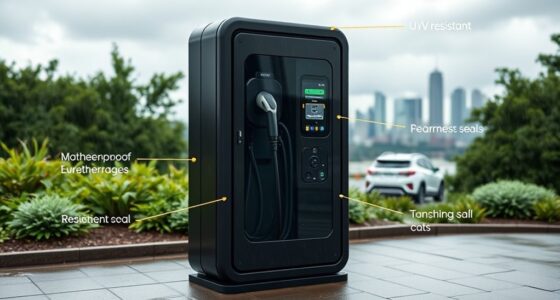
Level 1 charging uses a standard 120V outlet, offering slow charging suited for overnight top-ups at home. Level 2, at 240V, charges faster and is common in homes, workplaces, and public stations, typically taking 4-8 hours. Level 3 provides rapid charging at high voltages, giving 80% charge in about 20-30 minutes, ideal for quick stops or long trips. Understanding these differences helps you pick the right option; more details await below.

Get backup power and energy gear delivered free with Prime
- Fast, free delivery on millions of items
- Prime Video, Amazon Music and more included
- Member-only deals all year
Key Takeaways
- Level 1 uses standard household outlets (120V) for slow charging, suitable for overnight top-ups at home.
- Level 2 employs 240V power, offering faster charging typically completed within 4-8 hours.
- Level 3 provides rapid charging at 600-800V, delivering 80% charge in about 20-30 minutes.
- Installation costs and infrastructure needs increase from Level 1 to Level 3, with Level 3 requiring advanced, high-power setups.
- Choice depends on usage pattern, infrastructure availability, and desired charging speed, balancing convenience with cost.
Products Worth Considering

Autel Home EV Charger up to 50A J1772 Hardwired Level 2 Charger with 25 ft Cable

Autel MaxiCharger Level 2 EV Charger, 40A, 240V, Indoor/Outdoor, 25‑Foot Flexible Cable, NEMA 14‑50 Plug (White)

Autel 40A Level 2 EV Charger, 240V NEMA 14-50 J1772, WiFi, 25ft Cable
As an affiliate, we earn on qualifying purchases.
Overview of Charging Levels and Their Uses

Understanding the different charging levels is essential for choosing the right option for your electric vehicle. Level 1 charging uses a standard household outlet, providing a slow charge that’s ideal for overnight use or daily top-ups. This method is gentle on your battery, helping to preserve battery longevity over time, and has a minimal environmental impact since it relies on standard power sources. Level 2 chargers are more powerful, often found in homes and public stations, offering faster charging while still maintaining good battery health. They’re suitable for daily use and longer trips. Each level’s use depends on your driving habits, available infrastructure, and priorities like battery lifespan and environmental considerations. Choosing the right level guarantees efficient, eco-friendly charging without compromising your vehicle’s performance. Additionally, understanding home theatre projectors and their features can enhance your overall entertainment setup. Recognizing charging infrastructure options can further help you plan for various driving needs and locations.
Technical Differences in Power Delivery and Speed

The primary difference in power delivery among Level 1, Level 2, and Level 3 chargers lies in their voltage, current, and resulting charging speeds. Level 1 chargers deliver low voltage (120V) with minimal current, resulting in slow power flow. Level 2 chargers increase voltage (240V) and current, boosting charging speed. Level 3 chargers use high voltage (up to 800V) and rapid current, enabling fast power flow for quick charging. The table below highlights these differences:
| Charger Level | Voltage Levels | Power Flow Speed |
|---|---|---|
| Level 1 | 120V | Slow |
| Level 2 | 240V | Moderate |
| Level 3 | 600-800V | Fast |
Understanding these technical differences helps you choose the right charger based on your charging needs. Knowing these technical details can assist you in making an informed decision about which charging level best suits your vehicle and lifestyle. Additionally, power delivery varies depending on the charging infrastructure and vehicle compatibility, which are important factors in selecting the appropriate charging level. Proper infrastructure is essential for ensuring efficient and safe rapid charging experiences, and considering charger compatibility can prevent connection issues and optimize charging efficiency. Being aware of charging standards ensures compatibility across different vehicles and charging stations, facilitating smoother charging experiences.
Typical Charging Locations and Accessibility

Charging stations are strategically placed in various locations to guarantee convenient access for electric vehicle owners. You’ll find options for home charging, where you can plug in overnight, providing daily convenience. Public stations are spread across cities, shopping centers, and highways, making long trips easier. Some common locations include:
- Residential garages for home charging
- Malls and shopping centers with accessible public stations
- Highway rest stops for quick top-ups
- Workplace parking lots offering charging options
Public stations enhance accessibility, especially when away from home, while home charging provides the convenience of charging overnight. The availability of public stations varies by area, so planning your routes around accessible charging locations ensures a smooth driving experience. Whether at home or on the go, understanding typical charging locations helps you stay connected to your EV’s needs. Charging infrastructure plays a crucial role in supporting EV adoption and ensuring reliable power access. Additionally, advancements in charging network technology continue to expand the reach and reliability of public charging options, making EV ownership increasingly practical. As the deployment of charging stations grows, drivers can enjoy greater flexibility and peace of mind during their journeys, especially as more areas develop comprehensive public charging options to meet expanding demand.
Cost Considerations and Installation Requirements

When considering where to charge your electric vehicle, it’s important to factor in both the costs involved and the installation process. Installation costs vary markedly between levels. Level 1 chargers typically require minimal setup, often just plugging into a standard outlet, with little to no extra installation costs. Level 2 chargers usually need a dedicated circuit, increasing installation expenses. Level 3 chargers involve high-power setups, demanding professional installation and significant infrastructure investment. Maintenance requirements also differ; Level 1 and 2 chargers generally need minimal upkeep, whereas Level 3 chargers may require regular inspections due to their complexity. Additionally, power supply requirements can influence the feasibility and cost of installation for higher-level chargers. The Electrical Infrastructure of your property may also impact the overall installation process and expenses. Ensuring proper Electrical Capacity is essential for safely supporting higher-powered chargers and avoiding costly upgrades. The compatibility with existing wiring should also be assessed to prevent potential electrical issues. Proper site assessment and planning can help identify potential challenges early on. Here’s a quick overview:
| Level | Installation Costs | Maintenance Requirements |
|---|---|---|
| 1 | Low | Minimal |
| 2 | Moderate | Low to Moderate |
| 3 | High | Regular, specialized |
Practical Advantages and Limitations of Each Level

Each level of EV charging offers distinct practical advantages and limitations that can influence your choice based on your driving habits and infrastructure. Level 1 chargers are simple and require minimal installation, making them accessible but slow, ideal for overnight charging at home. Level 2 chargers increase user convenience with faster charging times and broader charging infrastructure but may need professional installation. Level 3 chargers deliver rapid charging, perfect for quick top-ups during travel, yet they’re limited by high costs and availability. Consider how often you need to charge and your access to charging stations. Your decision impacts daily convenience and how well your setup fits into your lifestyle. Charging infrastructure plays a crucial role in your overall EV experience.
Choosing the Right Charging Option for Your Needs

When selecting a charging option, consider how quickly you need your vehicle to recharge and what fits your budget. Level 1 chargers are slow but affordable and accessible, while Level 3 chargers offer rapid charging at a higher cost. Balancing your charging speed needs with cost and convenience helps you pick the best option for your lifestyle.
Charging Speed Comparison
Understanding the differences in charging speeds is essential for choosing the right option for your needs. Level 1 chargers are slow, taking up to 20 hours to fully charge, suitable for overnight use but less ideal if you need quick top-ups. Level 2 chargers are faster, typically providing a full charge in 4-8 hours, suitable for daily use at home or work. Level 3 chargers are rapid, delivering 80% charge in 20-30 minutes, perfect for quick stops or long trips. Keep in mind that faster charging can impact battery longevity over time, and the environmental impact varies depending on the energy source. Choosing the right speed balances convenience with preserving your battery and reducing environmental footprint. charging speeds can influence the overall efficiency and longevity of your vehicle’s battery.
Cost and Accessibility
Choosing the right charging option depends largely on your budget and access to charging infrastructure. Level 1 chargers are the most affordable and widely accessible, often using standard outlets. Level 2 chargers require a dedicated charging station, which can be installed at home or found at public locations, but may involve higher costs. Level 3 chargers are fast but less common and usually available at commercial charging stations, often requiring specific infrastructure and compatibility considerations. Battery compatibility also influences your choice, as not all chargers suit every EV model. Here’s a quick comparison:
| Charging Level | Cost to Install/Use | Accessibility |
|---|---|---|
| Level 1 | Low | Very accessible, home use |
| Level 2 | Moderate | Widely available, public & home |
| Level 3 | High | Limited, mainly commercial |
Additionally, understanding charger compatibility can help you make an informed decision based on your specific vehicle and charging needs.
Frequently Asked Questions
How Do Charging Levels Impact Vehicle Battery Longevity?
Charging levels impact your vehicle’s battery longevity by influencing battery degradation and charging speed. Faster charging, like Level 3, can accelerate battery degradation over time because it stresses the battery more. Slower charging, such as Level 1 or Level 2, minimizes wear and tear, preserving battery health longer. To extend your battery’s life, avoid frequent rapid charging and opt for slower, moderate charging whenever possible.
Are There Compatibility Issues Between Charging Levels and Different EV Models?
You might think all EVs play nicely with every charger, but surprise—charging compatibility varies wildly. Model variance means some vehicles only accept specific levels, especially with fast chargers. You’ll need to double-check your EV’s charging specifications before plugging in, or risk damage or slower charging. So, yes, compatibility issues exist, and ignoring them could leave you stranded or wasting time. Always verify your car’s charging needs first!
What Safety Precautions Are Necessary When Using Various Charging Levels?
You should always prioritize charger safety by inspecting cords and connectors for damage before use. Follow proper charging protocols, like avoiding extension cords with Level 1 chargers, and make certain the charging station is properly grounded. Use the correct charger for your EV and avoid overcharging. Stay attentive to any warning lights or alerts on your vehicle, and never unplug or disconnect during charging to prevent safety hazards.
How Does Charging Infrastructure Vary Internationally Across Levels?
You’ll find that international charging infrastructure varies widely across levels, often due to differing standards and regulations. Countries may adopt specific international standards like IEC or CCS, affecting compatibility and charging speeds. For example, some regions prioritize Level 2 infrastructure, while others focus on fast Level 3 chargers. This variation encourages you to check local standards and adapt your charging options to guarantee safe, efficient, and compatible charging wherever you go.
Can Public Charging Stations Automatically Detect and Switch Between Levels?
Public charging stations often feature automatic detection and switching capabilities, allowing them to identify your vehicle’s charging level and adjust accordingly. When you connect your EV, these stations can seamlessly switch between charging modes, ensuring ideal power transfer without manual input. This technology simplifies the charging process, making it more convenient for you to charge at different levels without needing to select settings or worry about compatibility issues.
Conclusion
Choosing the right charging level is like picking the perfect tool for a job—you want efficiency, convenience, and fit. Level 1, Level 2, and Level 3 each serve different needs, from slow overnight charging to rapid top-ups. Consider your daily driving habits and access points. By understanding their differences, you can make smarter choices, ensuring your EV stays ready to roll—like a well-oiled engine firing on all cylinders.