If you’re looking to save money and manage power smarter in 2025, I recommend choosing energy monitors that offer real-time data, high accuracy, and smart home integration. Devices like the Emporia Vue 3 or the Haoguo Monitor provide detailed insights into your EV charging, household appliances, and solar systems. Portable, reliable, and compatible with platforms like Alexa or Google, these monitors help optimize energy use. Keep exploring to find the best options tailored to your needs.
Key Takeaways
- Choose energy monitors with real-time, high-accuracy data to optimize EV charging efficiency and reduce electricity costs.
- Prioritize models with smart home integration (Alexa, Google Home, Home Assistant) for automated energy management.
- Select monitors that support bi-directional power tracking for better management of solar and grid energy use.
- Ensure compatibility with your home’s electrical system (single-phase, three-phase) for accurate EV charging monitoring.
- Opt for devices with easy installation, robust data storage, and remote control features to maximize savings and convenience.
Haoguo Home Energy Monitor with IP65 Waterproof for Indoor/Outdoor Use
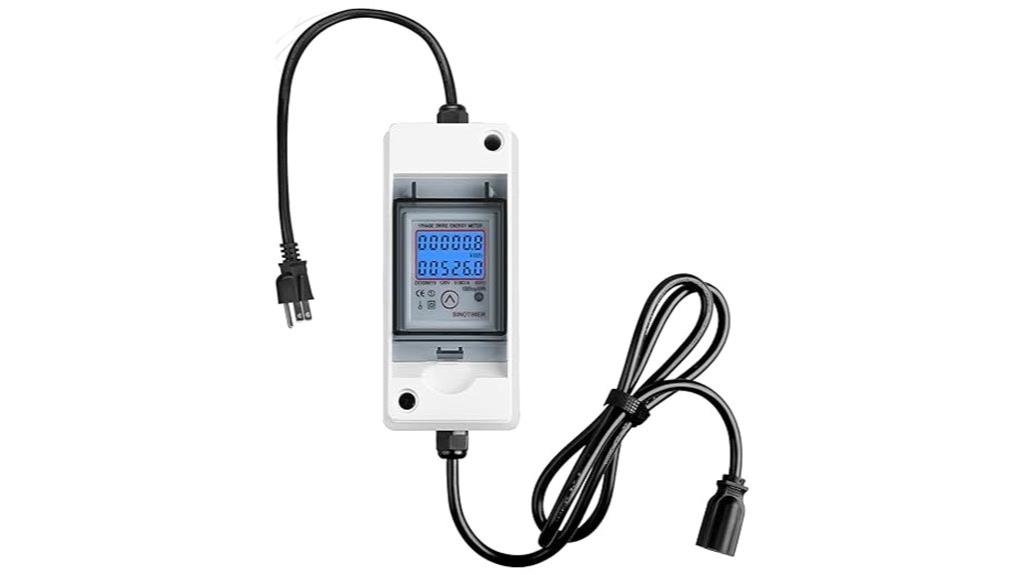
If you’re looking for a versatile energy monitor that can handle outdoor conditions, the Haoguo Home Energy Monitor with IP65 waterproof rating is an excellent choice. It’s designed for both indoor and outdoor use, perfect for tracking power consumption of EV chargers, generators, RVs, and household appliances. Its IP65 rating protects against weather, moisture, and environmental factors, ensuring reliable performance anywhere. Compact and lightweight, it’s easy to carry and set up. With a built-in MCU chip for quick, accurate readings and durable copper connectors, this monitor delivers safety, precision, and durability in a single, portable device.
Best For: homeowners, outdoor enthusiasts, and professionals needing reliable, portable energy monitoring for indoor and outdoor devices including EV chargers, generators, RVs, and household appliances.
Pros:
- Waterproof IP65 rating ensures durability and reliable performance in various weather conditions.
- Compact, lightweight, and portable for easy setup and mobility.
- Accurate and fast measurements with a built-in MCU chip and high-quality copper connectors.
Cons:
- May require some technical familiarity to interpret detailed energy data.
- Limited to 110V applications; not suitable for higher voltage setups without additional adapters.
- The 4.9ft power cord might be restrictive for certain outdoor configurations.
Emporia Vue 3 Home Energy Monitor

Looking for a reliable energy monitor that offers precise, real-time data to optimize your EV charging and home energy use? The Emporia Vue 3 Home Energy Monitor is UL Listed for safety and works with most home electrical systems, including split-phase and 2-wire setups. It provides 24/7 monitoring via Wi-Fi, with sensors that deliver ±2% accuracy. You can easily track energy consumption, solar production, and appliance loads through its app on your phone or web browser. Plus, it supports automation for peak demand and solar excess, helping you save money and manage power smarter. A solid choice for detailed, real-time home energy management.
Best For: homeowners and energy enthusiasts seeking precise, real-time monitoring and automation to optimize home energy use and EV charging.
Pros:
- Provides highly accurate energy data with ±2% precision for detailed insights.
- Supports a wide range of electrical systems including split-phase and 2-wire setups.
- Offers comprehensive automation features for peak demand, solar excess, and cost savings.
Cons:
- Requires Wi-Fi and internet connection for full functionality, which may be a limitation in some areas.
- Additional sensors may be needed for 3-phase or 4-wire Wye systems, increasing overall cost.
- The device and sensors are covered by only a 1-year warranty, which is shorter than some competitors.
Smart Home Energy Monitor with Circuit Sensors and Real-Time Tracking

The Refoss Smart Home Energy Monitor stands out for homeowners who want precise, real-time insights into their energy consumption. It supports multiple circuit sensors, up to 200A for main circuits and 60A for branches, with easy clamp-on installation. Compatible with various single-phase and three-phase systems, it offers accurate tracking of power, voltage, current, and power factor. The device stores up to three years of detailed data, helping you analyze patterns and identify inefficiencies. With Wi-Fi connectivity, firmware updates, and integration with Home Assistant, it’s perfect for optimizing energy use, reducing bills, and enhancing smart home automation.
Best For: homeowners seeking precise, real-time energy monitoring and smart automation to optimize household energy use and reduce utility bills.
Pros:
- Supports multiple circuit sensors up to 200A and 60A, enabling comprehensive household energy tracking.
- Stores up to three years of detailed data for thorough analysis and pattern recognition.
- Compatible with various system types and integrates with Home Assistant for advanced automation.
Cons:
- Requires careful handling of current transformers during installation to ensure safety and accuracy.
- Some features depend on firmware updates and app compatibility, which may require regular updates.
- No support for Delta (delta-wye) systems, limiting compatibility with certain setups.
Upgraded Watt Meter Power Meter with Backlight and Overload Protection

For those seeking a reliable energy monitor that combines all-encompassing tracking with safety features, the Upgraded Watt Meter Power Meter with Backlight and Overload Protection stands out. It tracks power (W), electricity (kWh), voltage (V), frequency (Hz), current (A), and power factor (PF), offering eight display modes for easy parameter access. The device features overload protection that flashes “OVERLOAD” if power exceeds 1800W, ensuring safety. Its durable ABS construction is fireproof and drop-resistant. The white backlit LCD improves readability day or night, while data is automatically saved during power outages. Resetting and adjusting settings are straightforward, making it a versatile tool for smarter energy management.
Upgraded Watt Power Meter Plug for Home Electrical Usage Monitoring
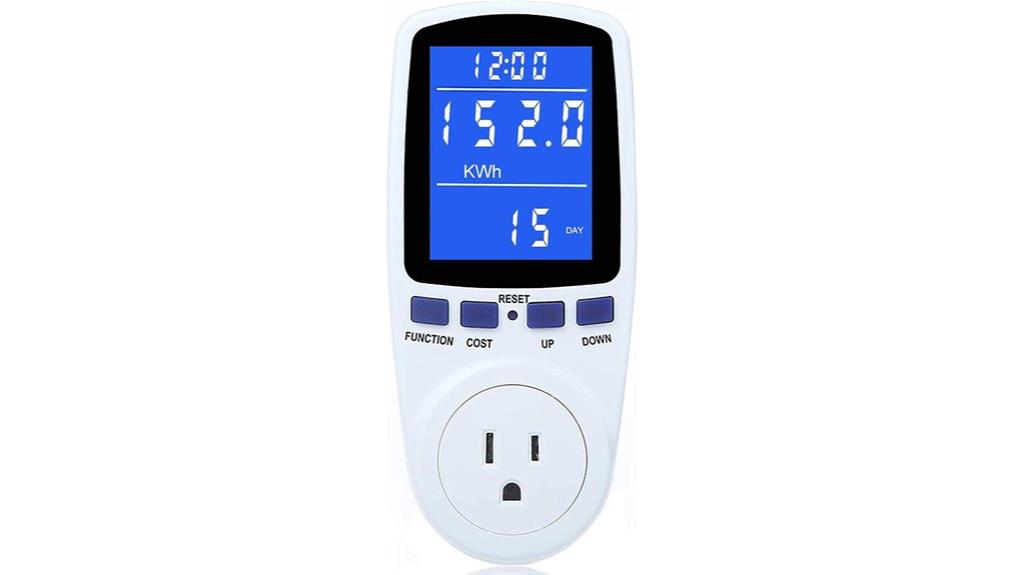
If you want precise control over your home’s energy consumption, the upgraded watt power meter plug is a game-changer. It monitors essential parameters like power, energy, volts, amps, and power factor, displaying them clearly on a large backlit LCD screen with 180° viewing angles. You can choose from seven display modes for quick access to data, and the adjustable backlight helps at night. With overload protection and a default threshold of 3680W—adjustable to 0-3680W—it ensures safety. Plus, it records energy usage even when unplugged, making it easier to track and manage your electricity costs effectively.
Best For: homeowners and energy-conscious users seeking precise, real-time monitoring of their electrical consumption to reduce costs and enhance safety.
Pros:
- Provides comprehensive monitoring of multiple parameters including power, energy, volts, amps, and more on a clear, large LCD display.
- Features adjustable backlight with multiple timing options for convenient viewing day and night.
- Equipped with overload protection and data memory that records usage even when unplugged, ensuring safety and accurate tracking.
Cons:
- Default overload threshold may need to be manually adjusted for different appliances, which could be complex for some users.
- The device’s complexity might be overwhelming for users unfamiliar with electrical monitoring tools.
- Limited to a maximum overload setting of 3680W, which might not accommodate very high-power appliances.
Emporia Vue 3 Home Energy Monitor

Emporia Vue 3 Home Energy Monitor stands out for homeowners seeking an all-encompassing, safety-certified solution to track their energy usage in real-time. It’s UL and CE Listed, ensuring safety and reliability while preventing hazards like overheating or fires. Easy to install in most home panels using clamp-on sensors, it supports various wiring and system types, including single-phase and 3-phase setups. With Wi-Fi connectivity, it delivers ±2% accurate data updates every second, stored locally and in the cloud. You can customize energy management, monitor solar power, and expand with sensors for major appliances—making it a thorough tool to save money and power smarter.
Best For: homeowners seeking a safe, reliable, and comprehensive home energy monitoring solution to optimize energy use and reduce costs.
Pros:
- UL and CE Listed for safety, ensuring compliance and peace of mind
- Supports real-time data updates with ±2% accuracy via Wi-Fi connectivity
- Expandable with multiple branch sensors for detailed appliance monitoring
Cons:
- Requires separate purchase of additional sensors for expanded monitoring needs
- Installation may be complex for some users unfamiliar with electrical panels
- Data retention limited to 3 hours locally, requiring cloud storage for longer periods
Govee Smart Plug with Energy Monitoring
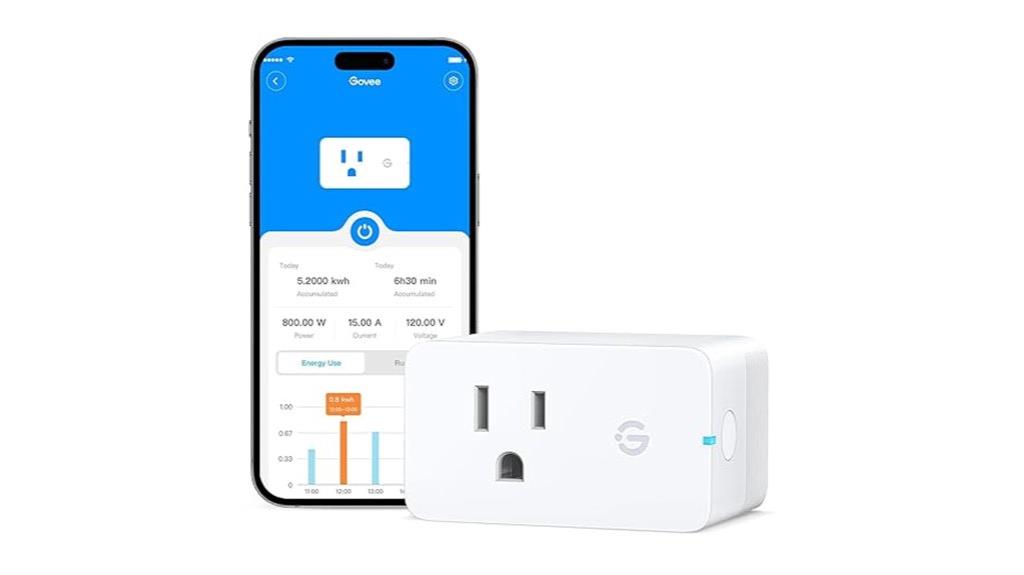
The Govee Smart Plug with Energy Monitoring stands out for its seamless integration with popular voice assistants like Alexa and Google Assistant, making it ideal for anyone seeking hands-free control over their EV charger. It offers real-time data tracking of power, current, and voltage via the Govee Home App, helping you monitor energy use daily, weekly, or monthly. With stable WiFi and Bluetooth, you can control it remotely, even without a hub. Plus, its scheduling features and voice commands make managing your EV charging simple and efficient. Built with safety in mind, it’s FCC and ETL certified and handles high-power devices safely.
Best For: homeowners and EV owners seeking a reliable, energy-efficient smart plug with voice control and detailed usage monitoring.
Pros:
- Seamless compatibility with Alexa and Google Assistant for hands-free operation
- Real-time energy data tracking via the Govee Home App for effective monitoring
- Safe, high-power device support with fire-resistant materials and certifications
Cons:
- Does not support 5G Wi-Fi networks, potentially limiting some connectivity options
- Requires stable WiFi and Bluetooth for remote control; may face issues with network disruptions
- Limited to 15A 120V capacity, which may not suit very high-power appliances
EMPORIA Level 2 EV Charger with J1772 Connector

For those seeking a reliable and fast home charging solution, the EMPORIA Level 2 EV Charger with J1772 Connector stands out with its impressive charging speeds of up to 46 miles per hour. It offers flexible power options, supporting up to 48 amps with a hardwired connection or 40 amps via a NEMA plug, and includes a 25-foot cable. Compatible with all North American EVs, it’s UL listed, ENERGY STAR certified, and meets rigorous safety standards. Its WiFi connectivity enables remote management, real-time energy monitoring, and scheduling, helping me optimize utility rates and charging efficiency effortlessly. This charger combines speed, safety, and smart features for a seamless EV charging experience.
Best For: EV owners seeking a fast, reliable, and smart home charging solution compatible with all North American electric vehicles.
Pros:
- Delivers up to 46 miles of range per hour for quick charging
- WiFi-enabled for remote management, scheduling, and energy monitoring
- Supports up to 48 amps with flexible installation options and safety certifications
Cons:
- Requires WiFi connection for full smart features, which may not be ideal in areas with poor connectivity
- Hardwired installation may require professional setup for some users
- Higher upfront cost compared to basic chargers without smart features
SIEMENS Inhab Smart Home Energy Monitor

If you’re seeking precise, real-time energy monitoring directly at your electrical panel, the Siemens Inhab Smart Home Energy Monitor stands out as an excellent choice. It measures energy use and production at the circuit level, connecting directly to your panels without relying on assumptions or guesses. Capable of monitoring up to 16 circuits with high accuracy, it provides continuous data via a mobile app, letting you track current and historical consumption. Its advanced features include Peak Demand Management, solar excess tracking, load shedding, and personalized alerts. Compatible with smart home systems, it helps you optimize energy use and save money, all while ensuring safety and compliance.
Best For: homeowners seeking precise, real-time energy monitoring and management at their electrical panel to optimize consumption and reduce costs.
Pros:
- Direct measurement at circuit level for high accuracy without reliance on assumptions
- Advanced features like Peak Demand Management, load shedding, and personalized alerts
- Compatible with smart home systems and provides continuous mobile app monitoring
Cons:
- Installation may require electrical expertise, especially in existing panels
- Limited to monitoring up to 16 circuits, which may be insufficient for very large or complex systems
- No batteries required; dependent on wired connection, which might complicate some installations
Sense Energy Monitor – Real-Time Electricity Usage Tracking

Sense Energy Monitor stands out for its real-time electricity tracking, making it an ideal choice for homeowners who want immediate insight into their energy consumption. With its ability to provide live data through iOS, Android, and web apps, I can monitor my household’s energy use from anywhere. It detects patterns like kids returning home or lights left on, helping me optimize efficiency and security. The device also offers customizable alerts for critical appliances, preventing issues before they escalate. Certified for safe installation inside electrical panels and available only in the US and Canada, the Sense monitor combines safety, convenience, and actionable data to save money and power smarter.
Best For: homeowners seeking real-time energy monitoring, safety alerts, and insights to optimize their household energy use from anywhere in the US or Canada.
Pros:
- Provides real-time energy tracking through intuitive iOS, Android, and web apps.
- Helps identify usage patterns to improve efficiency and security.
- Certified for safe installation inside electrical panels, ensuring reliable and safe operation.
Cons:
- Available exclusively in the US and Canada, limiting regional accessibility.
- Requires installation inside an electrical panel, which may need professional assistance.
- Does not offer compatibility outside North America, restricting international use.
EMPORIA Level 2 EV Charger with NEMA 14-50 and NACS Compatibility

The EMPORIA Level 2 EV Charger stands out for its NEMA 14-50 and NACS compatibility, making it an ideal choice for EV owners who want seamless integration with Tesla and other NACS vehicles without needing adapters. It supports Tesla’s NACS connector, functioning like a Tesla charger, and allows remote port opening with the press of a button. With up to 46 miles per hour charging (48A) via hardwired connection and 38 miles per hour (40A) through NEMA, it offers fast, efficient charging. Certified UL and ENERGY STAR, it’s safe, reliable, and supports smart features like WiFi connectivity, energy data tracking, and remote management.
Best For: EV owners seeking a versatile, fast-charging Level 2 charger compatible with Tesla and NACS vehicles without adapters, featuring smart remote management.
Pros:
- Supports both Tesla and NACS connections, no adapters required
- Fast charging up to 46 miles/hour at 48A for quick top-ups
- Smart features include WiFi connectivity, remote control, and energy tracking
Cons:
- Professional installation recommended for safety and optimal performance
- Limited to 40A via NEMA connection unless converted to hardwired 48A
- May be more expensive than basic chargers due to advanced features and certifications
Smart Home Energy Monitor with 2 CTs and Wi-Fi
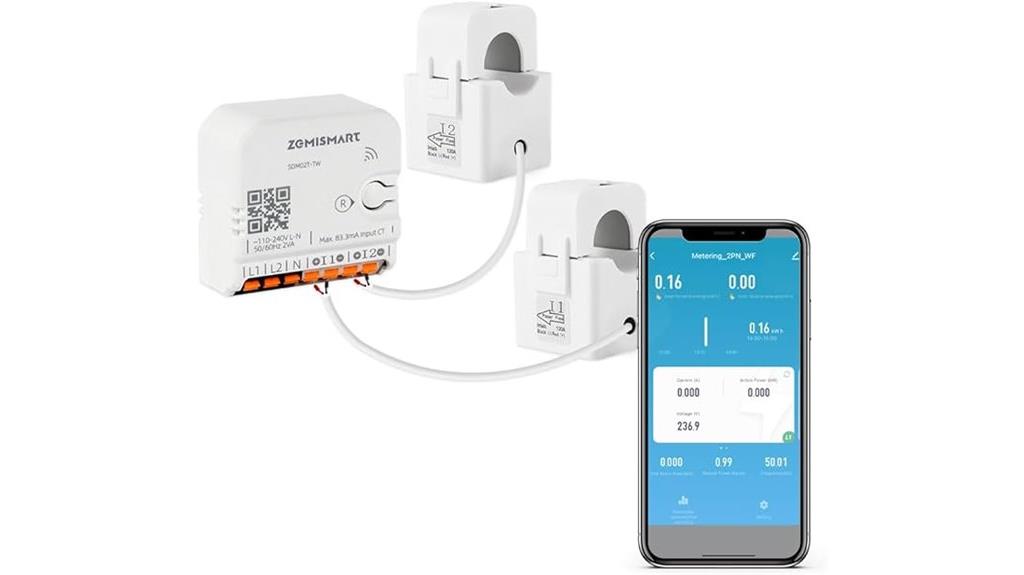
For those seeking precise, real-time energy tracking that seamlessly integrates into their smart home, the Smart Home Energy Monitor with 2 CTs and Wi-Fi stands out. It provides accurate measurements of voltage, current, power, and total energy consumption, supporting Class 1 accuracy for reliable data. Designed for solar and battery systems, it enables bi-directional power monitoring. Its quick installation with pluggable terminals and split-core CTs makes setup easy. Compatible with 2.4GHz Wi-Fi and the Smart Life app, it offers real-time analysis, alerts, and automation. This monitor helps maximize home energy efficiency, reduce costs, and optimize renewable energy use effortlessly.
Best For: homeowners and renewable energy enthusiasts seeking precise, real-time energy monitoring and smart home integration for improved efficiency and cost savings.
Pros:
- Supports Class 1 accuracy for highly reliable energy data
- Compatible with solar systems and bi-directional power tracking
- Easy installation with pluggable terminals and split-core CTs
Cons:
- Limited to 2.4GHz Wi-Fi, not suitable for 5GHz networks
- Requires compatible smart home app (Smart Life) for full functionality
- May involve initial setup and configuration for optimal automation integration
Emporia Energy Monitoring Smart Plug (4 Pack)

If you’re looking to manage multiple devices effortlessly, the Emporia Energy Monitoring Smart Plug (4 Pack) offers a versatile solution with its compatibility with Alexa and Google Home, allowing voice control and seamless automation. It supports controlling lights, fans, lamps, and other appliances plugged into 120V outlets. The plug features a 10A continuous load and a 15A peak load capacity for up to an hour daily. It provides real-time energy monitoring, helping you identify waste and cut costs. With built-in scheduling and remote access via the Emporia App, you can automate and manage your devices anytime, anywhere, as long as you’re connected to a 2.4GHz WiFi network.
Best For: Homeowners and renters seeking easy, remote control and energy monitoring of multiple household appliances through voice commands and automation.
Pros:
- Compatible with Alexa and Google Home for voice control and seamless automation
- Real-time energy monitoring helps identify wasteful power usage and reduce costs
- Built-in scheduling allows for automatic device operation and convenience
Cons:
- Requires a stable 2.4GHz WiFi network; does not support 5GHz networks
- Limited to a 10A continuous load, which may not suit high-power appliances
- Sold as a 4-pack, which may be more than needed for some users’ needs
Smart Home Energy Monitor with 16 Circuit Sensors

With 16 circuit-level sensors, the Smart Home Energy Monitor stands out for homeowners seeking extensive energy tracking across multiple circuits, making it ideal for those managing complex electrical systems or multiple high-power appliances. It installs easily via clamp-on sensors in most circuit panels and supports various electrical systems, including single-phase, split-phase, and three-phase setups. The monitor provides real-time, 1% accurate data on power usage for devices like HVAC units, water heaters, and appliances. With WiFi connectivity, you can monitor energy consumption anytime, anywhere, and export historical data to identify savings opportunities and optimize your energy use effectively.
Best For: Homeowners with complex electrical systems or multiple high-power appliances seeking comprehensive, real-time energy monitoring and savings insights.
Pros:
- Supports a wide range of electrical systems including single-phase, split-phase, and three-phase setups for versatile installation.
- Offers high-accuracy (1%) real-time energy data for multiple circuits, ideal for detailed energy management.
- Supports local control via MQTT and Home Assistant without internet, ensuring privacy and secure operation.
Cons:
- Installation may be challenging for those unfamiliar with electrical work or circuit panels.
- Requires WiFi connectivity for full functionality, which may be a limitation in some environments.
- Limited to 16 circuits, which might not cover extremely complex or larger electrical systems without additional solutions.
ChargePoint HomeFlex Level 2 EV Charger for Electric Vehicles

The ChargePoint HomeFlex Level 2 EV Charger stands out for its fast charging capabilities, making it an excellent choice for electric vehicle owners who need quick, reliable power at home. It delivers up to 37 miles of range per hour, charging nine times faster than standard outlets. Compatible with all non-Tesla EVs via the J1772 connector, it supports circuits of 20A or 80A for flexible installation. The charger connects seamlessly through WiFi, allowing me to control charging remotely using the ChargePoint app. UL-certified and weather-resistant, it’s built for durability indoors or outdoors. Plus, ChargePoint’s extensive network ensures I can find charging stations whenever I’m on the go.
Best For: EV owners seeking fast, reliable home charging with extensive network access and smart control features.
Pros:
- Delivers up to 37 miles of range per hour, significantly reducing charging time
- Compatible with all non-Tesla EVs via J1772 connector and supports circuits of 20A or 80A
- WiFi-enabled for remote control, monitoring, and integration with smart home devices
Cons:
- Requires a qualified electrician for proper installation indoors or outdoors
- Adapter needed for Tesla vehicles, which may add to setup complexity and cost
- WiFi connectivity is necessary for full features, which could limit use in areas with poor internet access
Factors to Consider When Choosing an Energy Monitor for Ev Charging

When choosing an energy monitor for EV charging, I focus on key factors like compatibility with my EV, measurement accuracy, and how easily I can access and interpret data. Connectivity options and installation ease also matter, making setup and monitoring straightforward. Considering these points helps guarantee I pick the right monitor to fit my needs.
Compatibility With EVS
Choosing an energy monitor that works seamlessly with your EV charging setup requires careful attention to compatibility factors. First, make certain the monitor supports your EV’s specific connector type, like J1772 or NACS. It’s also important that the device can handle your charger’s power levels, whether 40A or 48A, for accurate monitoring. If your setup uses single-phase or three-phase electricity, verify that the monitor is compatible with both systems. Additionally, check if it can track and analyze power consumption in real-time, giving you detailed insights. Finally, confirm if the monitor supports the communication protocols and smart home integrations you need, so it can connect smoothly with your EV charger hardware. Compatibility is key to effective, hassle-free energy management.
Power Measurement Accuracy
Accurate power measurement is essential for effectively tracking your EV charging energy, as even small errors can lead to misjudging consumption and efficiency. When choosing an energy monitor, look for at least ±2% measurement accuracy to ensure reliable data. True RMS measurement capability is critical, especially for EV chargers with non-sinusoidal loads and variable power factors, as it provides correct readings regardless of waveform distortions. Multi-parameter measurements, including voltage, current, power factor, and real power, can enhance overall accuracy and give a thorough view of your energy use. Regular calibration and high-quality sensors, such as clamp-on current transformers (CTs), help maintain measurement precision over time. Prioritizing these factors ensures you’ll have dependable data to optimize your EV charging and save money.
Connectivity Options
Connectivity options play a vital role in guaranteeing your energy monitor can deliver real-time, reliable data on your EV charging. I look for devices supporting Wi-Fi, Bluetooth, or Ethernet to enable seamless data transmission and remote access. Compatibility with smart home systems like Alexa, Google Assistant, or Home Assistant is also essential, as it allows integrated control and automation. I check if the monitor provides real-time updates, ideally with a 1-second refresh rate, for accurate monitoring. Privacy is important, so I verify support for local data storage or MQTT protocols to avoid reliance on cloud services. Additionally, firmware updates over-the-air (OTA) are valuable for enhancing connectivity features and security over time. These factors guarantee a dependable, flexible, and secure monitoring experience.
Installation Ease
When selecting an energy monitor for EV charging, ease of installation should be a top consideration. I recommend checking that the device supports your home’s electrical system, whether it’s single-phase or three-phase, to guarantee compatibility. Look for models with straightforward wiring instructions and features like plug-and-play or clamp-on sensors, which make setup much simpler. It’s also helpful if the monitor includes all necessary components, such as circuit sensors and connectors, so you don’t need extra purchases or complex wiring. Safety certifications and detailed installation guides are essential for a smooth, secure process. Additionally, some monitors offer remote or app-based setup assistance, which can further streamline installation and troubleshooting, especially for those less experienced with electrical work.
Data Accessibility
To make the most of your EV energy monitor, you should prioritize how easily you can access and interpret your data. Look for monitors that offer real-time updates through mobile apps or web portals so you can get timely insights. Check if you can export historical usage data in formats like CSV or PDF—this helps you analyze trends in detail. Compatibility with your smart home systems is also key, allowing seamless integration with your automation setup. Make sure the monitor provides notifications or alerts for abnormal energy use or device issues, so you’re always informed. Lastly, consider how often the data updates—whether every second, minute, or hour—depending on how precise your monitoring needs are. Clear, accessible data helps you make smarter energy decisions.
Safety Certifications
Ensuring your energy monitor has proper safety certifications is essential for safe and reliable EV charging. Certifications like UL, ETL, or CE verify that the device meets rigorous safety standards, reducing risks of electrical hazards such as overheating, short circuits, or fires. Devices with these certifications have been tested for electrical safety and are suitable for both residential and commercial installations without risking safety violations or voiding warranties. The certification labels provide important details about the safety standards met and testing processes, giving you confidence in their reliability. Always check that these certifications are current and applicable to your region’s regulations. Choosing a certified energy monitor guarantees peace of mind, safety, and compliance, making your EV charging experience safer and more dependable.
Monitoring Range
Choosing an energy monitor that matches your EV charger’s specifications is key to accurate and reliable data. You need to verify it supports your charger’s voltage and current ratings, typically 110V or 240V and up to 50A or more. The monitor should accurately track the full range of your EV’s charging power, from low-power home chargers to fast chargers. Real-time data is essential, so confirm it shows peak and minimum power levels during charging sessions. Additionally, it must measure both energy consumption and power output across the entire spectrum. Finally, check if the monitor’s data logging and reporting features thoroughly cover your charging activities, enabling you to analyze and optimize your energy use effectively.
Cost and Budget
Budget plays a crucial role in selecting an energy monitor for your EV charger, as prices can range from affordable options around $20 to high-end systems exceeding $300. It’s important to weigh the total cost of ownership, including installation, accessories, and any subscription or data plan fees. While a lower-priced monitor may save you money upfront, it might lack features like accurate data, connectivity, or smart home integration. Balancing initial investment with long-term savings is key—look for monitors that offer essential features such as real-time tracking or automation within your budget. Remember, investing in a slightly more expensive model with better accuracy and connectivity can lead to greater savings and convenience over time.
Frequently Asked Questions
How Accurate Are These Energy Monitors for EV Charging?
These energy monitors are generally quite accurate, often within 1-3% of actual energy consumption. I’ve found that quality models with proper installation give reliable readings, helping me track my EV charging costs precisely. Of course, accuracy can vary based on the device and setup, so I recommend choosing reputable brands and ensuring correct installation for the best results. This way, I save money and better manage my energy use.
Can These Monitors Differentiate Between Various Household Appliances?
Yes, many energy monitors can differentiate between household appliances, especially those with advanced features. I’ve found that models with multiple sensors or smart capabilities can identify specific devices based on their unique energy signatures. However, simpler monitors may just show overall consumption. So, if you want detailed insights, look for monitors that support appliance detection or offer customizable settings to distinguish between different devices.
Are Compatible Energy Monitors Suitable for All EV Charger Brands?
Ever wonder if compatible energy monitors work with all EV charger brands? Yes, most compatible monitors are designed to be versatile and support various brands, making them a great choice for many households. But, it’s smart to double-check the specs before buying to confirm your specific charger is supported. After all, who doesn’t want to streamline energy tracking without compatibility concerns?
How Easy Is Installation for Non-Technical Users?
Installation is pretty straightforward for non-technical users like me. Most energy monitors come with clear instructions and simple setup steps. I just had to turn off the main power, connect the monitor to the breaker box or charger, and follow the prompts. If you’re comfortable with basic electrical work, you’ll find it manageable. For those unsure, a quick professional install can make it even easier and worry-free.
Do These Monitors Support Remote Monitoring via Smartphones?
Yes, many of these energy monitors support remote monitoring via smartphones. I love how I can check my EV charging status and energy usage from anywhere using an app. It makes managing my energy more convenient and keeps me informed in real-time. Just verify the model you choose has Wi-Fi or Bluetooth connectivity, and you’ll enjoy hassle-free remote access, helping you save money and optimize power use effortlessly.
Conclusion
Choosing the right energy monitor can transform your EV charging experience, saving you a fortune and making you feel like a power-saving superhero. With so many options, you’ll find one that fits your needs perfectly—no more guesswork or wasted energy. Investing in the right monitor means you’ll be smarter with your power usage and keep your wallet happy. Trust me, once you start monitoring, you’ll wonder how you ever lived without it—it’s a game-changer!