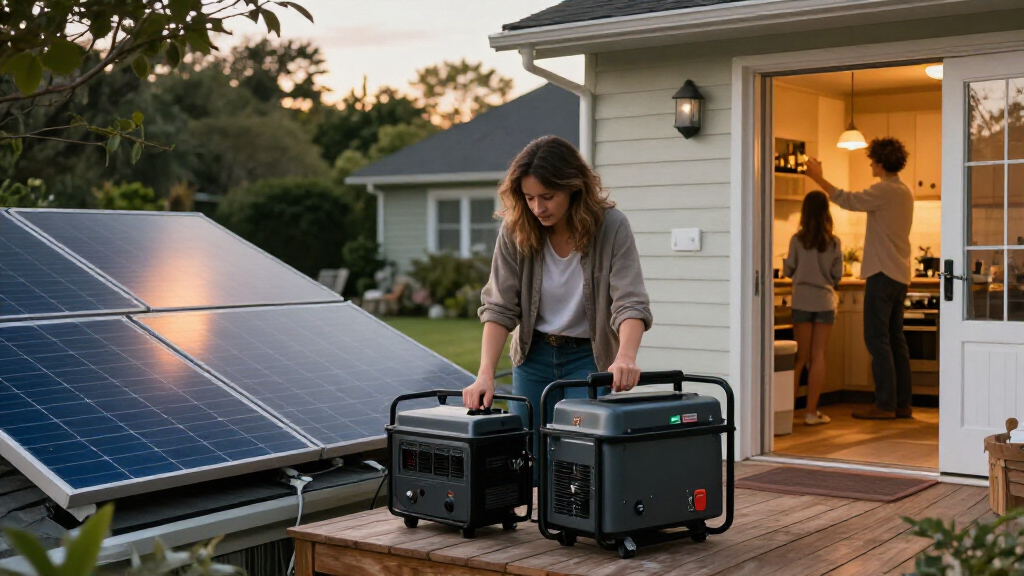

Choosing a solar-powered backup generator means deciding how much of your home needs power during an outage—and how much you are willing to spend to get it. A portable solar generator combines a battery, inverter, and charging inputs in a movable unit; a whole-home solar-plus-battery system uses permanently installed equipment wired into a home’s electrical system. The portable option is easier to buy, move, and use for essentials, while the installed system can cover more circuits and work with less manual setup. Choose portable backup for occasional outages, camping, or a modest budget. Choose a whole-home system if outages are frequent, essential loads are substantial, and the installation cost fits your plans.

Get backup power and energy gear delivered free with Prime
- Fast, free delivery on millions of items
- Prime Video, Amazon Music and more included
- Member-only deals all year

Jackery Solar Generator 1000 V2 with 200W Solar Panel – 1024 Wh LiFePO₄ Battery
- ✔ Battery capacity: 1,024Wh
- ✔ Battery chemistry: LiFePO₄
- ✔ AC output: 1,500W continuous; 3,000W surge

Portable Solar Generator 300W Power Station with 60W Solar Panel
- ✔ Rated output: 300W
- ✔ Solar panel: 60W monocrystalline, included
- ✔ AC outlets: 2, up to 300W max

Jackery Explorer 300 Portable Power Station, 292Wh
- ✔ Battery capacity: 292Wh
- ✔ Battery chemistry: LiFePO₄
- ✔ Rated output: 300W; 600W peak surge
At a Glance
| Criteria | Portable solar generator | Whole-home solar-plus-battery system | Winner |
|---|---|---|---|
| Upfront cost and installation | Usually lower initial cost; generally no electrical installation required. | Higher initial cost, including equipment and professional electrical installation. | A |
| Power capacity and coverage | Best for selected devices and appliances within the unit’s output and capacity limits. | Can serve selected home circuits or, if designed and sized for it, much of the house. | B |
| Solar recharging | Can recharge from compatible solar panels, with charge speed affected by sunlight, panel input limits, and battery size. | Roof solar may recharge batteries, subject to system design, weather, seasonal production, and household use. | Depends |
| Setup and operation | Manual: connect devices or circuits supported by the unit, and manage loads. | Can switch to backup automatically when configured with appropriate equipment. | B |
| Portability and other uses | Easy to move; useful for camping, travel, or backup in different locations. | Designed to stay at the property; less useful away from home. | A |
| Outage duration and expansion | Runtime depends on battery capacity and load; some models allow extra batteries or panels. | Capacity can be designed or expanded for longer backup, though added capacity raises cost and does not remove weather limits. | B |
| Maintenance and ownership | Few routine tasks, though battery care, storage, and compatibility checks still matter. | Requires installed-system upkeep and attention to battery, inverter, and solar equipment over time. | A |
Jackery Solar Generator 1000 V2 with 200W Solar Panel – 1024 Wh LiFePO₄ Battery
For buyers who need more than phone and laptop charging, the Jackery Solar Generator 1000 V2 is the clear lead in this group. Its 1,024Wh LiFePO₄ battery stores over three times the stated energy of the Explorer 300, while 1,500W continuous output gives it far more appliance headroom than either 300W model. That distinction matters when an outage plan includes several small devices or an appliance whose running draw exceeds 300W. Check the actual wattage and startup surge of each device before connecting it.The 10ms UPS switchover is the most backup-specific feature here: it can help keep compatible connected equipment powered through a brief interruption. It does not turn the station into a whole-home backup system, and the supplied details do not establish automatic transfer for household circuits. Its 50-minute full-charge claim is also tied to supported charging conditions and app functionality, so it should not be read as a solar recharge time. Solar panel configuration matters: the listing describes a 200W panel pairing, but the product notes say the panel ships separately. Buyers should confirm exactly what the bundle includes.Compared with the smaller Jackery, this is the pick when capacity and output outweigh a 15.9-pound weight difference. Compared with ZeroKor, it offers much more rated AC power but lacks the same clear included-panel advantage. We would skip it if the plan is only to top up phones on occasional trips: that is where the lighter Explorer 300 is easier to justify. The 1000 V2 makes most sense for buyers who will use its additional output and can arrange compatible solar charging.
Pros:
- Largest stated battery capacity in this comparison at 1,024Wh.
- 1,500W continuous output and 3,000W surge rating provide more appliance headroom than the 300W options.
- 10ms UPS switchover is useful for compatible devices that should stay powered through brief interruptions.
- Two 100W USB-C PD ports and a five-year warranty are listed.
Cons:
- At 23.4 pounds, it is considerably heavier than the 7.5-pound Explorer 300.
- The product details say the solar panel ships separately, so verify the bundle contents before purchase.
- Super-charging functionality depends on the app, and solar recharge duration is not specified here.
Best for: Households or campers who want a portable station for a wider range of outage loads and value a fast UPS switchover, while understanding that solar panel inclusion must be confirmed.
Not ideal for: Buyers who only need to charge phones and small electronics, want the lightest carry, or expect a complete whole-home backup system.
Bottom line: Choose the 1000 V2 when greater stored energy, higher AC output and UPS switching matter more than low carry weight or an included panel.
“Choose the 1000 V2 when greater stored energy, higher AC output and UPS switching matter more than low carry weight or an included panel.”
Portable Solar Generator 300W Power Station with 60W Solar Panel
The ZeroKor’s strongest differentiator is simple: a 60W monocrystalline solar panel is included. For a buyer assembling a compact camping or emergency kit, that removes the separate panel decision required by both Jackery options as described here. It supports AC, DC and USB charging, and the listed SOS flashlight and reading mode add practical utility when the station is used outdoors. Its multiple recharge routes—wall, car and solar—also make it flexible for topping up between trips.Its central limitation is the 300W maximum output. That places it alongside the Explorer 300 for small-device duty, well below the 1000 V2’s 1,500W continuous rating. The listing does not provide a battery capacity in watt-hours, so we cannot compare its stored energy or estimate runtime against the two Jackery units. A 60W panel is a modest input source; it can help replenish energy when conditions cooperate, but it is not a promise of rapid recovery after substantial use. The panel junction box is not waterproof, which calls for careful handling around rain or damp ground.We would pick this over the Explorer 300 when a bundled panel and a set of small charging needs matter more than knowing a clearly stated battery capacity or carrying the lightest unit. Choose the Explorer instead if its 292Wh capacity and 7.5-pound weight are more important and you already have compatible solar charging arranged. For stronger appliances or a more substantial outage reserve, move up to the 1000 V2. Keep the ZeroKor maintained as directed; the supplied guidance calls for regular charging and a 60–80% storage charge.
Pros:
- Includes a 60W monocrystalline solar panel, unlike the Jackery bundles as described.
- Offers AC, DC and USB charging plus wall, car and solar recharge options.
- Built-in safety protections cover short circuit, over-current, over-voltage, overload and overheating.
- SOS flashlight and reading mode suit outdoor and emergency-kit use.
Cons:
- The 300W output limit rules out many higher-power appliances.
- Battery capacity in watt-hours is not stated in the supplied specifications, making runtime comparison difficult.
- Panel junction box is not waterproof and requires care around moisture.
Best for: Campers and emergency-kit buyers who want a small-load station with a panel included and can work within a 300W output ceiling.
Not ideal for: Anyone who needs to run high-draw appliances, compare runtime precisely from published watt-hour capacity, or leave the solar panel exposed to wet weather.
Bottom line: The ZeroKor is the most convenient entry point for modest loads if having a solar panel in the box matters more than appliance headroom or published capacity clarity.
“The ZeroKor is the most convenient entry point for modest loads if having a solar panel in the box matters more than appliance headroom or published capacity clarity.”
Jackery Explorer 300 Portable Power Station, 292Wh
If carrying convenience is the priority, the Jackery Explorer 300 is the easiest of these three to take along. At 7.5 pounds, it is less than a third of the 1000 V2’s listed weight, with an integrated handle and a 292Wh LiFePO₄ battery. Its 300W rated output and two AC outlets serve small electronics and modest loads; USB-C PD, USB-A and a 120W car port add useful ways to charge multiple device types. The listed 4,000-plus cycle rating before reaching 70% capacity may also appeal to buyers planning frequent use over time.That portability comes with a firm capacity and output tradeoff. Its 292Wh is much less stored energy than the 1000 V2’s 1,024Wh, and the 300W limit puts it in the same output class as ZeroKor rather than near the top pick. It suits keeping smaller devices topped up or supporting selected low-draw needs, not running a broad set of household appliances. Solar charging is supported, but the panel is sold separately; the listed charging estimates use compatible panels and should not be treated as guaranteed results under every condition.Compared with ZeroKor, the Explorer gives us a published capacity, lighter stated weight and a clear battery-cycle claim, while ZeroKor supplies a 60W panel and outdoor light modes in its described package. Compared with the 1000 V2, this is a much more packable travel companion but a weaker outage reserve. Pick it when moving the station frequently is part of the plan and the connected loads are small. If the priority is a panel-ready kit without separate panel sourcing, ZeroKor has the advantage; if it is longer backup for more demanding loads, choose the 1000 V2.
Pros:
- Lightest listed unit at 7.5 pounds with an integrated handle.
- 292Wh LiFePO₄ battery and a stated rating of over 4,000 cycles to 70% capacity.
- Ports include two AC outlets, USB-A, 100W USB-C PD and a 120W car port.
- Solar charging is supported with compatible panels.
Cons:
- 300W rated output limits appliance choices.
- 292Wh capacity is far below the 1000 V2’s 1,024Wh.
- Solar panel is not included, so solar charging requires a separate compatible purchase.
Best for: Travelers and campers who need a lightweight power station for phones, laptops and other small loads, and are willing to source a compatible solar panel separately.
Not ideal for: Buyers who need to run appliances above 300W, want longer backup from one charge, or expect a solar panel in the package.
Bottom line: Choose the Explorer 300 when a light carry and small-device charging matter more than long runtime or an included solar panel.
“Choose the Explorer 300 when a light carry and small-device charging matter more than long runtime or an included solar panel.”
As an Amazon Associate we earn from qualifying purchases.
Key Differences
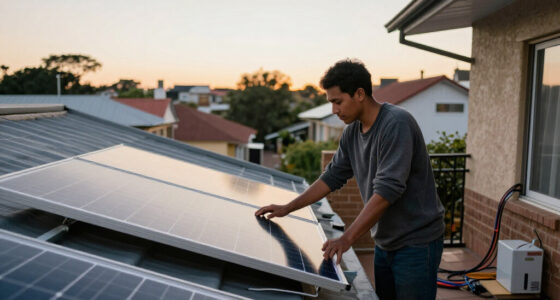
The primary gap is coverage. A portable unit is a battery-powered source for a limited set of loads: for example, phones, lights, a router, or a refrigerator if its starting demand and continuous draw fit the inverter. A whole-home installation connects storage to the home’s electrical system and can support selected circuits or broader coverage, depending on its capacity and wiring. That distinction matters more than the label “generator”: neither option should be assumed to run every appliance indefinitely.
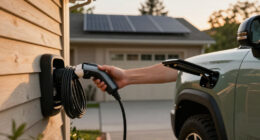
Convenience and cost move in opposite directions. Portable backup usually costs less and avoids permanent electrical work, but the owner must position it, connect equipment, and watch the load. A permanently installed system costs substantially more and needs qualified installation, yet can take over backup duties with less intervention. Solar charging helps replenish either setup when conditions and equipment allow, but panels do not guarantee uninterrupted power through cloudy weather or heavy demand.
Value depends on the outage problem. A portable unit is a strong value when the goal is a few hours of power for essentials or occasional use beyond the home. The installed system’s premium is more defensible for households facing repeated or prolonged outages, or those who need backup across selected home circuits. Before spending, compare usable battery capacity, inverter output, surge handling, solar input limits, and the loads you actually plan to run.
Detailed Comparison
Upfront cost and installation (Portable solar generator wins — major)
Portable units usually win on initial cost and simplicity: buyers can choose a capacity, add compatible panels, and start using the unit without installing a home transfer system. Whole-home systems require equipment, electrical work, and often permitting, so the bill is much higher. This is a major difference for budget-sensitive buyers. The installed system may justify the premium when home-wide or automatic backup is a real need; buying it for occasional phone charging is poor value.
Power capacity and coverage (Whole-home solar-plus-battery system wins — major)
Whole-home systems win on potential coverage because they can connect batteries to home circuits and be sized for larger loads. The result depends on system design: some installations back up a few critical circuits, while others support much broader use. Portable units have defined inverter and battery limits, so users must prioritize devices and check startup surges. This is a major practical difference for households relying on medical equipment, refrigeration, or heating controls. Neither option should be assumed to run every high-demand appliance without checking specifications.
Solar recharging (moderate difference)
There is no universal winner. Portable units can pair with portable panels, which gives flexibility to reposition them in sun, but their solar input limit may make recharging a large battery slow. Whole-home systems can use roof panels and an integrated battery setup, which can make daily generation more convenient when the system is designed for backup charging. Clouds, shade, season, and household consumption affect both. This difference is moderate and depends on the actual panels, battery, and charging configuration, not the solar label.
Setup and operation (Whole-home solar-plus-battery system wins — moderate)
Whole-home systems win for convenience when configured for automatic backup: they can switch over without requiring the owner to unplug and reconnect each device. Portable units require more hands-on decisions about placement, cords, load limits, and recharging. For occasional, small-scale outages, that work is manageable; during a long outage, monitoring loads can become tedious. This is a moderate difference for most households and a major one for people who need backup to work with minimal intervention.
Portability and other uses (Portable solar generator wins — major)
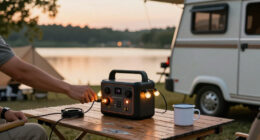
Portable units win clearly. They can serve at home, at a campsite, or at another location, provided transport and local rules permit. Permanently installed equipment is designed to serve the property and cannot be taken along. The advantage is major for people who camp, work remotely from different places, or want backup for more than one setting. If the only concern is keeping a home’s circuits running, portability may matter less than capacity and automatic operation.
Outage duration and expansion (Whole-home solar-plus-battery system wins — moderate)
Whole-home systems generally offer a more practical path to larger storage and integration with household solar, but extra batteries and panels add cost. A portable setup can also be expanded on compatible models, yet the combined capacity and output still have to meet the planned load. In either case, runtime is determined by usable battery energy divided by demand, while solar replenishment varies with conditions. This is a moderate advantage for installed systems when long outages are common; it is not a guarantee of indefinite power.
Maintenance and ownership (Portable solar generator wins — minor)
Portable systems tend to win modestly because they involve fewer installed components and no permanent electrical connection to maintain. Owners still need to follow battery storage and charging guidance and check panel and cable compatibility. Whole-home systems add an inverter, fixed wiring, and roof or ground-mounted solar equipment, which may call for professional service. This difference is minor for many buyers, but the installed system’s long-term ownership costs belong in its value calculation.
Portable solar generator: Pros and Cons
Pros:
- Lower initial cost and little or no installation work
- Easy to move and useful outside the home
- Suitable for selected devices and essential loads
Cons:
- Limited output and stored energy compared with many home installations
- Requires manual setup and load management
- Solar recharge can be slow if panel input is limited or sunlight is poor
Whole-home solar-plus-battery system: Pros and Cons
Pros:
- Can support selected home circuits or broader coverage when properly sized
- Can provide automatic backup with compatible installation
- Can integrate with household solar and added battery capacity
Cons:
- Higher upfront cost and professional installation
- Fixed to the property and less useful for travel
- Runtime and solar charging remain limited by capacity, load, and weather
Who Should Choose What
Choose Portable solar generator if:
- You need backup for a few essentials rather than the entire house.
- You want a lower-cost system that can also travel to campsites or other locations.
- Outages are occasional and you are comfortable connecting devices and managing power use.
Choose Whole-home solar-plus-battery system if:
- Your household experiences frequent outages and needs backup across multiple circuits.
- You value automatic switchover and have room in your budget for installation.
- You already have, or plan to install, household solar and want an integrated battery system.
Skip both if: Skip both if your required loads exceed available solar-battery capacity and you need dependable power through extended low-sun periods; compare other backup sources and a properly sized hybrid plan.
Value for Money
Portable backup is usually the better value for targeted, occasional use because it avoids installation expense and can serve outside the home. Pay more for a whole-home system when broader coverage, automatic operation, or frequent outages make those benefits useful in daily life. The premium buys installed capacity and convenience, not immunity from depleted batteries or poor solar conditions. Compare total installed cost, usable storage, output, and the circuits covered before deciding whether the added coverage is worth the price.
Final Verdict
For most buyers seeking an affordable way to keep a few essentials running, choose a portable solar generator. It offers useful backup at a lower cost and doubles as portable power, as long as you accept manual setup and limited capacity. Choose a whole-home solar-plus-battery system if outages are frequent, you need multiple home circuits backed up, and automatic operation is worth the installation premium. The deciding factor is how much of the home you need powered: a portable unit suits prioritized devices; a properly designed home system suits broader, more convenient coverage.
Frequently Asked Questions
Can a portable solar generator power a refrigerator?
Often, if its inverter can handle the refrigerator’s startup surge and its battery can support the expected runtime. Check the appliance’s power requirements and the generator’s continuous and surge ratings before relying on it.
Will either option keep working during several cloudy days?
Both depend on stored energy and available solar charging. A larger battery can extend runtime, but prolonged low sunlight and high demand can still drain it. Estimate your daily load and expected charging conditions rather than assuming panels will replace all consumed energy.
Does a whole-home battery run every appliance in the house?
Not automatically. Coverage depends on the system’s inverter output, battery capacity, wiring, and which circuits the installer connects. Ask for a written list of backed-up circuits and confirm that high-demand appliances fit the design.
Is a portable solar generator a better deal than a home battery?
For occasional backup of a few devices, usually. For frequent outages where automatic support across multiple circuits matters, an installed battery can justify its higher cost. The better value follows from the loads and outage pattern, not the product category alone.
Black Friday Picks

Ninja Foodi DualZone Smart XL Air Fryer, 10-Quart, 6-in-1, Black, DZ550
As an affiliate, we earn on qualifying purchases.