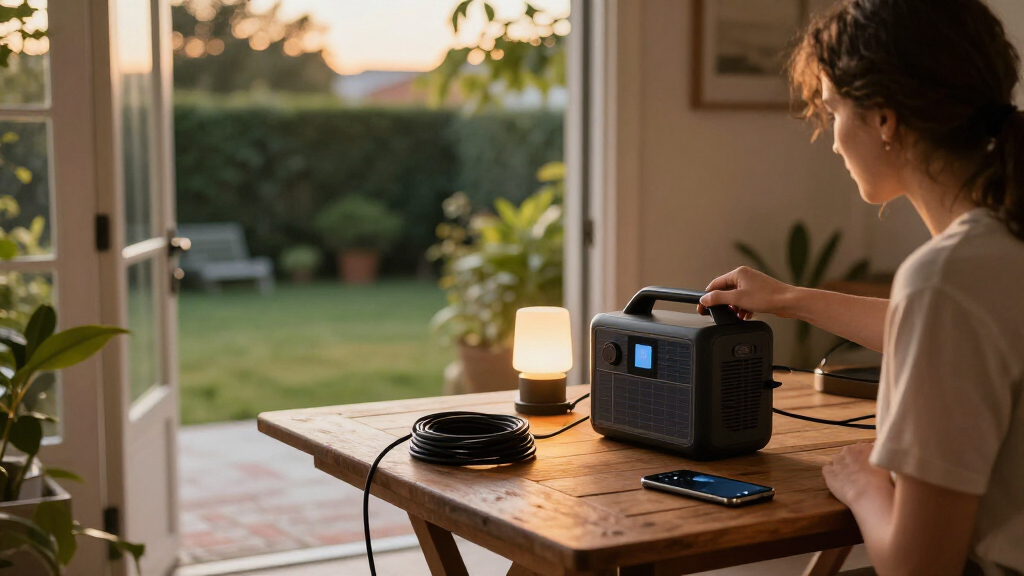
Choosing a solar backup power station means deciding whether you need a movable source of electricity for a few essentials or a larger system that can carry more of your home through an outage. Portable stations are lighter, simpler to place, and usually less expensive to buy up front. Expandable home stations add battery capacity, higher output, and, on some models, home integration, but they cost more and can require more planning.

Get backup power and energy gear delivered free — and shop member deals
- Fast, free delivery on millions of items
- Access to Prime Big Deal Days deals on October 6–7
- Prime Video, Amazon Music and more included

GRECELL Portable Power Station 500W, 519Wh Solar Generator
- ✔ Capacity: 519Wh
- ✔ AC output: 500W pure sine wave
- ✔ USB-C: 1 port, up to 60W PD

Jackery Explorer 300 Portable Power Station, 292Wh
- ✔ Capacity: 292Wh
- ✔ Output: 300W continuous, 600W surge
- ✔ Battery: LiFePO4, rated for 4,000-plus cycles to 70% capacity

ZeroKor 300W Portable Power Station with 60W Foldable Solar Panel
- ✔ Maximum output: 300W
- ✔ Battery capacity: Not stated in supplied product details
- ✔ Solar panel: Included 60W foldable monocrystalline panel
The practical divide is how much power you need at once and for how long. A portable unit can keep phones, lights, a router, and selected small appliances running, and it can travel with you. A home system is a better fit when you want to run several larger loads or stretch backup across longer outages. Choose portable for occasional, targeted backup and flexibility; choose expandable home backup when household coverage matters more than carrying the unit elsewhere.
At a Glance
| Criteria | Portable solar backup power stations | Expandable home solar backup power stations | Winner |
|---|---|---|---|
| Upfront cost | Usually lower; small models can cover basic needs | Higher; battery expansion and home connections add cost | A |
| Capacity and runtime | Typically limited; runtime depends heavily on the loads connected | Typically expandable for longer backup, within system limits | B |
| Power output | Suited to selected appliances and electronics, subject to model limits | Often higher output, but capacity and surge limits vary by model | B |
| Portability | Strong; designed to move between rooms, vehicles, or campsites | Limited; larger batteries and installation reduce easy movement | A |
| Solar charging | Can recharge from compatible panels; charging speed depends on input limits and sunlight | Can support larger solar input on some models; actual recharge depends on panels, conditions, and system design | Depends |
| Home integration | Usually standalone, with appliances plugged directly into the unit | May support transfer equipment or selected home circuits, depending on model and installation | B |
| Best outage use | Short outages, essential devices, and mobile use | Longer outages and broader household backup | Depends |
GRECELL Portable Power Station 500W, 519Wh Solar Generator
The GRECELL’s 519Wh capacity gives it the strongest starting point for backup in this group: it stores substantially more energy than either 300W station, so a phone, router, or laptop can draw power longer before the battery needs recharging. Its 500W pure sine wave AC output also provides more room for compatible small appliances than the Jackery or ZeroKor, both limited to 300W. That makes it the most flexible pick here, though it remains a compact station rather than a solution for high-wattage household equipment.For sensitive electronics, the pure sine wave output is a useful distinction, and the stated ports cover a broad mix of devices: USB-C PD up to 60W, three QC3.0 USB-A ports, DC outputs, a car port, and wireless charging. The product description also lists CPAP machines among possible uses, but buyers should check their specific machine’s wattage, startup needs, and required runtime before relying on it overnight. The 500W ceiling still rules out many heaters, kettles, and kitchen appliances.The tradeoff is that GRECELL does not include a solar panel. It supports up to 200W solar input, but the listed full recharge estimate is six to nine hours with a 100W panel, under full sun. Compared with ZeroKor, we get greater capacity and output but must source the panel separately; compared with Jackery, we get more stored energy but a larger, less portability-focused format. Its lithium battery is not specified as LiFePO4, and the guidance to recharge at least every three months calls for some upkeep.
Pros:
- 519Wh capacity is the largest in this comparison.
- 500W pure sine wave AC output supports more compatible devices than the 300W alternatives.
- Many charging ports, including 60W USB-C PD and wireless charging.
- Accepts up to 200W solar input and can also recharge from a wall outlet or car.
Cons:
- Solar panel is not included.
- The 500W limit excludes many high-draw appliances.
- Requires recharge at least every three months to maintain battery health.
Best for: Buyers who want the longest runtimes and widest load flexibility here for small backup devices, and can supply a compatible solar panel separately.
Not ideal for: People seeking a lightweight carry-first station, an all-in-one solar bundle, or backup for appliances above 500W.
Bottom line: We recommend the GRECELL first when backup runtime and a higher output limit matter more than a lightweight design or included panel.
“We recommend the GRECELL first when backup runtime and a higher output limit matter more than a lightweight design or included panel.”
Jackery Explorer 300 Portable Power Station, 292Wh
When we expect to carry a station between a car, campsite, or emergency kit, the Jackery Explorer 300’s compact 292Wh design is easier to justify than the larger GRECELL. Its product information gives a weight of 7.1 pounds in the specs and 7.5 pounds in the description, so we should treat it as a very portable unit without relying on one exact figure. Two AC outlets, a 100W USB-C PD port, USB-A, and a 120W car port let us handle common personal electronics across several connection types.Its standout feature for long-term ownership is LiFePO4 chemistry rated for more than 4,000 cycles to 70% capacity. That rating is a meaningful differentiator against the GRECELL’s unspecified lithium battery and the ZeroKor’s unspecified battery chemistry. It does not increase the amount of energy available per charge, however: at 292Wh and 300W output, the Jackery is best reserved for modest loads and shorter backup windows. The GRECELL stores nearly twice as much energy and allows a higher load, while Jackery prioritizes manageable size and stated cycle life.Solar charging is supported, and the provided estimate reaches 80% in about 2.8 hours with a 100W panel, but the panel is sold separately. That makes it less immediately solar-ready than the ZeroKor bundle. A 300W output limit also means we should leave high-draw appliances off the plan. This is the better fit for keeping phones, a laptop, lights, or other small essentials charged while staying easy to move; it is not the choice for long runtimes or broad household backup.
Pros:
- Compact format and a listed weight around 7 pounds make it easy to transport.
- LiFePO4 battery is rated for 4,000-plus cycles to 70% capacity.
- 100W USB-C PD, AC outlets, USB-A, and a car port support varied small devices.
- Solar charging is supported, with a stated 80% estimate of about 2.8 hours using a 100W panel.
Cons:
- Solar panel is sold separately.
- 292Wh capacity and 300W output limit backup duration and appliance choice.
- Supplied product details give two slightly different weights: 7.1 and 7.5 pounds.
Best for: Campers and outage planners who prioritize low carry weight, small-device charging, and a stated long cycle-life rating.
Not ideal for: Buyers who need more than 292Wh of stored energy, want a solar panel included, or plan to power high-draw appliances.
Bottom line: We choose the Jackery when portability and LiFePO4 cycle life outweigh the GRECELL’s extra capacity or ZeroKor’s included panel.
“We choose the Jackery when portability and LiFePO4 cycle life outweigh the GRECELL’s extra capacity or ZeroKor’s included panel.”
ZeroKor 300W Portable Power Station with 60W Foldable Solar Panel
For buyers who want to begin charging from sunlight without choosing a panel separately, the ZeroKor’s included 60W foldable panel gives it the most straightforward starting setup in this group. It also supports wall and car charging, with MPPT solar charging listed, so the kit has several ways back to a full battery. That bundled convenience is its central advantage over the Jackery and GRECELL, which both require a separately purchased panel.The station is still limited to 300W maximum output, putting it in the same basic load class as the Jackery and below the GRECELL’s 500W ceiling. The supplied details do not state battery capacity, so we cannot compare its likely runtime directly with the 292Wh Jackery or 519Wh GRECELL. We should therefore judge it mainly as an entry-level solar kit for phones, lights, and other compatible modest loads, not assume that the included panel or output rating guarantees extended outage coverage.Its port mix and built-in BMS protection add practical flexibility, and an automatic cooling fan is specified. However, the panel junction box is not waterproof, so solar setup needs protection from rain and splashes. The listing also advises regular charging and discharging to avoid a protection state, which asks for more attention than the Jackery’s stated long cycle-life story. Choose ZeroKor when panel inclusion and multi-source recharging matter most; skip it if capacity transparency, weather exposure, or higher-wattage loads are central to the plan.
Pros:
- Includes a 60W foldable monocrystalline solar panel.
- Supports AC, solar, and 12V car recharging, with MPPT solar charging listed.
- Multiple AC, DC, and USB outputs accommodate several small devices.
- BMS protection and an automatic cooling fan are specified.
Cons:
- Maximum output is 300W, excluding many common high-draw appliances.
- Battery capacity is not provided in the supplied specifications, making runtime comparisons difficult.
- Solar panel junction box is not waterproof, and regular charging and discharging is advised.
Best for: First-time solar-station buyers who want a panel and the basic charging accessories bundled for modest electronics and outdoor use in dry conditions.
Not ideal for: Buyers who need a clearly stated large capacity, weatherproof panel connections, or enough output for high-draw appliances.
Bottom line: We pick ZeroKor for the simplest included-panel entry point, while its unstated capacity and 300W ceiling keep it behind the GRECELL for backup depth.
“We pick ZeroKor for the simplest included-panel entry point, while its unstated capacity and 300W ceiling keep it behind the GRECELL for backup depth.”
As an Amazon Associate we earn from qualifying purchases.
Key Differences
The central tradeoff is coverage versus flexibility. A portable station is useful when you can choose which devices to run and accept that heavy loads may quickly drain its battery. Its compact form also makes it easier to take outdoors or move to a different room. An expandable home station can store more energy and serve a wider set of needs, but the larger system is less convenient to relocate and costs more to build.
Neither category guarantees that solar panels will keep every load running indefinitely. Charging depends on sunlight, panel capacity, the station’s solar input limits, and how much power the household uses. A home setup may accept more panels or battery expansion, but buyers should check the exact model’s limits and whether it can connect to household circuits. Portable systems are simpler to use as plug-in backup; they generally provide less whole-home convenience.
For most people who only need backup for communications, lighting, and a few small devices, a portable station is the more sensible starting point. Pay for an expandable home system when outages are long or frequent, several people depend on powered equipment, or you have specific circuits and appliances you need to support. The larger purchase makes sense only when its capacity and integration solve those needs.
Detailed Comparison
Upfront cost (Portable solar backup power stations wins — major)
Portable stations win on the initial bill because they offer a lower-cost way to cover a defined list of essentials. Expandable home systems require more investment, especially when extra batteries, panels, or home connection equipment are part of the plan. This is a major difference for buyers with a limited budget. A smaller system is better value if it covers your actual loads; paying more for unused capacity does not improve backup in a meaningful way.
Capacity and runtime (Expandable home solar backup power stations wins — major)
Expandable home stations win for stored energy and the option to add batteries, although expansion is model-specific and increases cost. Portable stations can run essential devices, but several hours of appliance use may consume their available charge quickly. The gap is major for multi-day outages and moderate for a brief interruption. List the devices you need, their wattage, and expected hours of use before buying; rated capacity alone does not say how long a real setup will last.
Power output (Expandable home solar backup power stations wins — moderate)
Home systems often offer higher continuous and surge output, which can make them more suitable for larger appliances or multiple loads. Portable models are generally aimed at selected electronics and smaller appliances, though ratings vary widely. This is a moderate-to-major advantage for B if a required device has high starting demand. Check both continuous output and surge rating against the appliance, and remember that a higher output rating does not mean the battery can sustain that load for long.
Portability (Portable solar backup power stations wins — major)
Portable stations clearly win: their smaller size and handles make them easier to move, store, or take on a trip. Home systems can be heavy and may be placed near a transfer connection or selected circuits, reducing their usefulness away from that location. This is a major difference if you want one unit for outages and recreation. Choose B only if leaving the system in one place is an acceptable trade for capacity.
Solar charging (moderate difference)
Neither format automatically wins. Portable units are convenient to pair with a modest panel setup, but their solar input limits can constrain recharge speed. Larger home systems may accept more solar input or support a broader panel array, but only when the specific model allows it and the installation suits the available sunlight. The difference is moderate and depends on equipment. Compare solar input limits, compatible panel voltage, and expected daily energy use rather than relying on a category label.
Home integration (Expandable home solar backup power stations wins — moderate)
Expandable home stations win when they support a transfer switch or selected circuit connection, since that can reduce the need to move individual plugs during an outage. Not every product has this feature, and proper connection may require compatible equipment and qualified installation. Portable models usually operate as standalone units with devices plugged into them. The gap is moderate for a few essentials and major when convenient circuit backup is a priority.
Best outage use (major difference)
This criterion depends on the outage and household. Portable stations suit short interruptions, apartments, camping, and targeted backup for phones, lighting, and a router. Expandable home systems suit longer outages and households that need more stored energy or broader coverage. Neither is automatically the right choice for every home. The difference is major when outage duration or critical equipment raises the cost of running out of power.
Portable solar backup power stations: Pros and Cons
Pros:
- Lower upfront cost for basic backup
- Easy to move and store
- Useful for both home outages and mobile activities
- Simple plug-in operation for selected devices
Cons:
- Less stored energy and typically shorter runtime
- May not support high-demand appliances
- Usually requires connecting devices directly
- Solar recharge speed is limited by model input and conditions
Expandable home solar backup power stations: Pros and Cons
Pros:
- More stored energy, with expansion available on some models
- Often higher output for multiple or larger loads
- Some systems support selected home circuits
- Better fit for longer outages when planned around actual loads
Cons:
- Higher purchase cost, with added batteries and installation raising it further
- Heavier and less convenient to move
- Features and expansion vary by model
- Solar input and home connection still have equipment-specific limits
Who Should Choose What
Choose Portable solar backup power stations if:
- You mainly need to run phones, lights, a router, and a few small devices.
- You want a unit that can also go camping or move between locations.
- You have a modest budget and can prioritize which loads receive backup.
Choose Expandable home solar backup power stations if:
- You face longer outages and need more stored energy.
- You have several household loads to support and have checked their power requirements.
- You want selected circuits connected and are prepared for the additional equipment or installation cost.
Skip both if: You need guaranteed whole-home or multi-day backup for high-demand equipment but have not sized the system, confirmed circuit compatibility, or planned enough generation and stored energy. First define the loads and outage duration, then compare suitable systems.
Value for Money
Portable stations are better value for buyers with a short, specific list of essential devices. Their lower entry price buys useful backup without committing to batteries or home connections that may go unused. Expandable systems justify their premium when extra capacity, higher output, or circuit integration will be used regularly. Adding batteries and panels can raise the total substantially, so pay more only after checking runtime for your real loads and confirming the exact system supports the expansion you want.
Final Verdict
For most households seeking occasional backup for communications, lighting, and small electronics, choose a portable solar power station. It costs less, moves easily, and covers those needs without the complexity of a larger setup. Choose an expandable home station when longer outages, high-demand equipment, or selected-circuit backup make capacity and integration worth the extra cost. The deciding factor is not the category name: it is whether the system’s usable energy and output match the devices you need to keep running.
Frequently Asked Questions
Can a portable solar power station run a refrigerator?
Some can, but suitability depends on the refrigerator’s starting surge, average energy use, and the station’s output and battery capacity. Check both ratings and estimate runtime; a unit that can start the compressor may still run out of energy sooner than expected.
Will solar panels keep either station running during a long outage?
They can help replenish the battery, but continuous operation is not guaranteed. Sunlight, panel placement, charging limits, weather, and the energy used by connected devices all affect the balance. Size the panels and battery around realistic daily use.
Is an expandable home station always better for a house?
No. It makes sense when you need longer runtime, greater output, or compatible circuit backup. For a few small devices during occasional outages, a portable unit may cover the need at a lower cost.
Is a solar power station the same as a home generator?
Both can provide backup electricity, but solar stations store energy in batteries and recharge from compatible panels or other supported sources. Their runtime depends on stored energy and recharge conditions. Compare the specific system’s output, capacity, and connection options with the loads you need to support.
Fall Picks
fall essentials
As an affiliate, we earn on qualifying purchases.