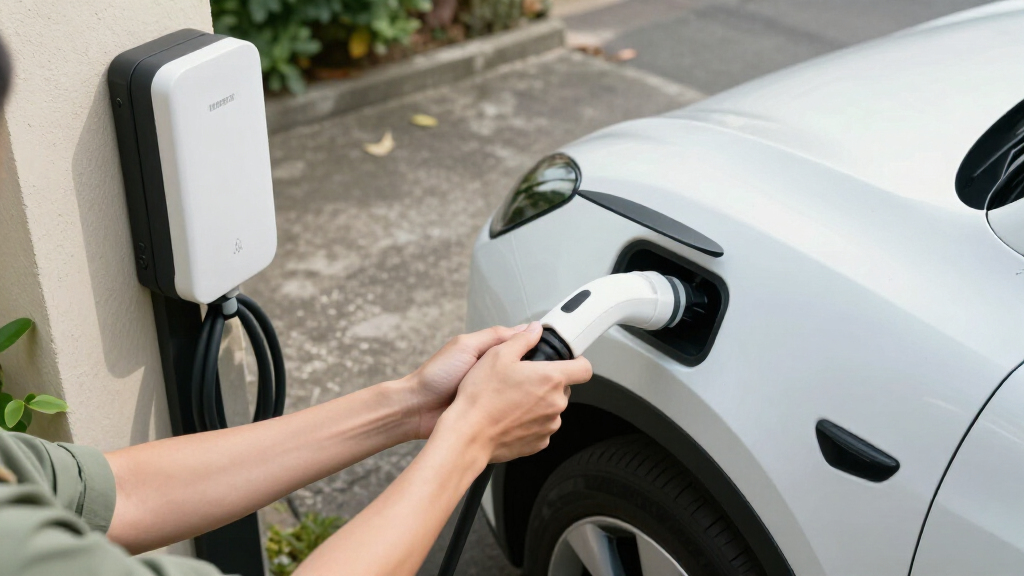

The best EV charging equipment for most drivers in 2026 is the Emporia Level 2 EV Charger, which pairs 48-amp hardwired speed with a polished app and energy-monitoring tools at a mid-tier price. For drivers who want Tesla-style NACS convenience, the EVIQO EVIPOWER-2 stands out with its native NACS plug and 40-amp output, while budget-minded buyers get a genuinely capable option in the AIMILER 40A Level 2 charger, which covers app control and ETL certification without the premium price. The main tradeoffs in this category come down to amperage versus electrical capacity — a 48-amp unit charges faster but demands hardwiring and a 60-amp circuit, whereas 40-amp plug-in models work with an existing NEMA 14-50 outlet. Smart features, cable length, and connector type (J1772 versus NACS) further separate the field. Continue reading for the full breakdown of all 15 picks and which one fits your garage.

Get backup power and energy gear delivered free — and shop member deals
- Fast, free delivery on millions of items
- Access to Prime Big Deal Days deals on October 6–7
- Prime Video, Amazon Music and more included
Key Takeaways
- Hardwired 48-50A models (Emporia, DEWALT, Autel) charge roughly 20% faster than 40A plug-in units, but only if your panel supports a 60-amp dedicated circuit — several picks in this lineup are wasted on undersized electrical service.
- App quality separated the top tier more than raw hardware: Emporia and Autel offer robust scheduling and energy tracking, while several generic 40A chargers bundle apps that feel like afterthoughts.
- The EVIQO EVIPOWER-2 was the only pick with a native NACS (Tesla-style) connector, making it the standout choice as more non-Tesla EVs adopt the standard in 2026.
- Portable units like the MACH 3 and eTimxon trade charging speed for flexibility — they make sense as a travel backup or rental-friendly option, not a primary home charger.
- ETL or UL certification appeared on most but not all budget picks; skipping certification to save money is the riskiest corner to cut in this category.




| EV charging equipment | Connector | Cable Length | Warranty | Certifications |
|---|---|---|---|---|
| Emporia Pro Level 2 EV Charger | J1772 | 25 ft | — | Energy Star, NEMA, UL |
| DEWALT Level 2 Hardwired EV Ch | SAE J1772 | 25 ft (UL-certified) | 3-year limited | — |
| EVIQO EVIPOWER-2 Level 2 EV Ch | NACS (Tesla-style) | 25 ft | 3 years | UL, ETL, FCC, Energy Star |
| MACH 3 Fast 40 Amp Portable Le | SAE J1772 (NACS/Tesla adapter included) | 25 ft | 5 years | — |
| AIMILER Level 2 EV Charger | J1772 | 25 ft | — | ETL, FCC; meets UL2231, UL2594 and related standards |
| ChargePoint HomeFlex Level 2 E | J1772 | — | — | — |
| Level 2 EV Charger | J1772 | 25 ft | 3 years | — |
| Level 2 EV Charger with WiFi A | J1772 | 25 ft | 3 years | ETL, FCC (UL2231, UL2251, UL2594, SAE J1772) |
| eTimxon 16A Portable Level 1 a | SAE J1772 | — | — | CE, ETL, FCC |
| Lectron Nexus Level 2 J1772 EV | J1772 | 23 ft | 3-year limited | UL 2594, UL 2231, UL 2251, UL 817; ETL; Energy Star; FCC |
| Autel MaxiCharger AC Home Leve | J1772 | 25 feet | 3 years | — |
| Autel MaxiCharger AC Home Leve | — | 25 feet | 3 years | — |
| IYILO Level 2 EV Charger | SAE J1772 | 25 feet | 3 years | ETL, Energy Star, CSA |
| Emporia Level 2 EV Charger wit | SAE J1772 | 25 feet | — | UL Listed, ENERGY STAR, NEC 625, UL 2594 |
| EVIQO Level 2 EV Charger | J1772 | 25 feet | 3 years | UL, ETL, FCC, Energy Star |
More Details on Our Top Picks
Emporia Pro Level 2 EV Charger with PowerSmart
The Emporia Pro earns the top spot because it solves the single biggest barrier to fast home charging: panel capacity. Its PowerSmart load balancing shares available power with the rest of your house in real time, so many homeowners can charge at high amperage without paying thousands for an electrical service upgrade. Compared with the DEWALT 48A, which delivers similar peak output but ignores what else is running in the house, the Emporia Pro is smarter about living within your electrical means. The included Emporia Vue energy monitor ties charging into whole-home usage data, which is more useful for utility-bill management than the standalone app tracking on the AIMILER. The tradeoff: this is a permanent installation requiring an electrician, so renters and anyone wanting a plug-in travel charger should look at the MACH 3 instead.
Pros:- PowerSmart load balancing enables fast charging without costly panel upgrades
- Included Vue energy monitor provides whole-home usage insight alongside charging data
- Flexible hardwired or NEMA 14-50 plug installation options
- Weather-resistant build with US-based customer support
Cons:- Installation almost always requires an electrician, adding cost and lead time
- 48A output is wasted if your electrical service can’t support it
Best for: Homeowners with limited panel capacity who want maximum charging speed without a service upgrade
Not ideal for: Renters or apartment dwellers — the hardwired or NEMA 14-50 installation makes it impractical to relocate
- Amperage:48 A
- Input Voltage:240V AC
- Connector:J1772
- Cable Length:25 ft
- Installation:Hardwired or NEMA 14-50 plug
- Connectivity:Wi-Fi, Bluetooth
- Certifications:Energy Star, NEMA, UL
Our verdict“The smartest permanent home charger here for homeowners whose panels can’t spare a full 48 amps on their own.”
DEWALT Level 2 Hardwired EV Charger, 48A
Built in the USA with a NEMA 4X/IP66 enclosure, the DEWALT 48A is the most rugged permanent installation in this lineup, adding up to 46 miles of range per hour. Where the Emporia Pro focuses on energy intelligence, this model focuses on raw, durable performance — think garage workshops and driveways exposed to weather year-round. Its 12-48A adjustable range is wider than the EVIQO EVIPOWER-2’s 6-40A ceiling at the top end, giving high-service homes a genuine speed advantage. The LCD screen and Bluetooth/Wi-Fi app cover scheduling and energy tracking competently, though the software feels less polished than Emporia’s ecosystem. The main compromises are the mandatory hardwired installation and the missing Tesla adapter, which EVIQO includes natively with its NACS connector.
Pros:- 11.5 kW output adds up to 46 miles of range per hour
- NEMA 4X/IP66 weatherproofing for harsh indoor or outdoor mounting
- Wide 12-48A adjustable amperage range
- Comprehensive safety protections against overcurrent, overheating, and surges
Cons:- Hardwired installation requires an electrician
- Tesla vehicles need a separately sold adapter
- Only a 3-year limited warranty despite the premium positioning
Best for: Owners of long-range EVs with 100A+ electrical service who want maximum daily charging speed and jobsite-grade durability
Not ideal for: Tesla owners — the J1772 connector requires a separately purchased adapter, adding cost and friction
- Max Current:48 A (adjustable 12-48A)
- Max Power:11.5 kW at 240V
- Charging Speed:Up to 46 miles of range per hour
- Cable Length:25 ft (UL-certified)
- Connector:SAE J1772
- Connectivity:Bluetooth & Wi-Fi
- Certification:CSA Certified, NEMA 4X/IP66
- Warranty:3-year limited
Our verdict“The pick for drivers who prioritize charging speed and build toughness over smart-home integration.”
EVIQO EVIPOWER-2 Level 2 EV Charger, NACS Plug
While most chargers here require an adapter to serve Tesla vehicles, the EVIQO EVIPOWER-2 plugs directly into any Tesla with its native NACS connector — including a button that pops the charge port open, a small convenience adapters can’t replicate. Its 6-40A adjustable amperage is the lowest floor in this lineup, making it unusually forgiving on older wiring or shared circuits compared with the AIMILER’s 16A minimum. The glow-in-the-dark holster is a thoughtful touch for dark garages, and the UL/ETL certification plus IP66 housing match the DEWALT’s outdoor credibility at a plug-in form factor. Compared with the MACH 3, which includes a NACS adapter rather than a native connector, the EVIQO avoids adapter fumbling entirely. Non-Tesla J1772 owners, though, face the reverse problem: they’ll need to buy their own adapter.
Pros:- Native NACS connector charges Teslas directly with charge-port opening button
- Very wide 6-40A adjustable range suits older or shared circuits
- UL/ETL certified with fully sealed IP66 housing
- 25 ft cable and glow-in-the-dark holster for nighttime use
Cons:- Requires a dedicated 50A NEMA 14-50 circuit — not compatible with dryer outlets
- Non-Tesla vehicles need a separately purchased adapter
- Only supports 2.4 GHz WiFi
Best for: Tesla Model S/3/X/Y owners who want a plug-in charger with no adapter hassle and fine-grained amperage control
Not ideal for: J1772 EV owners like most Hyundai, Ford, and Toyota drivers — they’d need a separately purchased adapter
- Connector:NACS (Tesla-style)
- Amperage:40 A (adjustable 6-40A)
- Voltage:240V
- Plug Type:NEMA 14-50
- Cable Length:25 ft
- Certifications:UL, ETL, FCC, Energy Star
- Connectivity:2.4 GHz Wi-Fi app control
- Warranty:3 years
Our verdict“The obvious choice for Tesla households; everyone else should weigh the adapter cost before buying.”
MACH 3 Fast 40 Amp Portable Level 1 & 2 EV Charger
The MACH 3 stands out as the travel-first option: it works on both 120V and 240V, ships with a 5-15 adapter for standard wall outlets, and includes a NACS adapter for Teslas — the broadest vehicle and outlet compatibility in this batch. That dual-voltage flexibility is something the EVIQO and AIMILER can’t match, since both assume a 240V NEMA 14-50 outlet is available. As a plug-in unit, it needs no electrician, making it the fastest path from box to charging for anyone with an existing 14-50 outlet, and the 5-year warranty is the longest here — two years beyond the DEWALT and EVIQO. The compromises are predictable: 120V charging crawls at 1.44kW for emergency use only, and the portable build means no hardwired weatherproofing like the DEWALT’s sealed enclosure.
Pros:- Dual Level 1/Level 2 operation with included 5-15 wall outlet adapter
- NACS/Tesla adapter included, covering all US EVs out of the box
- Longest warranty in this lineup at 5 years
- 25 ft cable with holder and true plug-and-play setup
Cons:- Level 1 charging at 1.44kW is too slow for daily reliance
- Needs an existing NEMA 14-50 outlet for full 40A speed
- Portable enclosure is less rugged than hardwired weatherproof units
Best for: EV owners who split time between homes, rentals, or road trips and need one charger that works anywhere
Not ideal for: Anyone without an existing NEMA 14-50 outlet — full-speed charging requires dedicated 240V wiring anyway
- Max Current:40 A
- Max Power:9.6 kW (240V), 1.44 kW (120V)
- Voltage:120-240V
- Plug Types:NEMA 14-50, NEMA 5-15 adapter
- Connector:SAE J1772 (NACS/Tesla adapter included)
- Cable Length:25 ft
- Connectivity:Bluetooth, Wi-Fi
- Warranty:5 years
Our verdict“The most flexible charger here for multi-location lifestyles, provided a 240V outlet is waiting at each stop.”
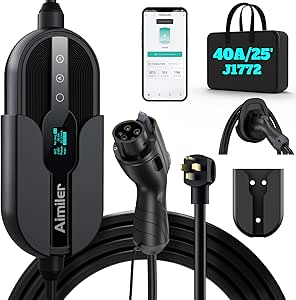
AIMILER Level 2 EV Charger, 40A with WiFi App Control
For straightforward home charging on a budget, the AIMILER covers the essentials: 9.6kW peak output, a 25ft IP66-rated cable tested beyond 10,000 charge cycles, and app scheduling with cost tracking that helps shift charging to off-peak rates. Its 16-40A adjustable range lets it dial down for smaller circuits, though the EVIQO’s 6A floor is more forgiving still. Compared with the MACH 3, the AIMILER drops the dual-voltage flexibility and the included Tesla adapter, which is where the savings come from — J1772-only compatibility means Tesla owners must supply their own adapter. The Wi-Fi setup can also be finicky and only connects to 2.4GHz networks, so mesh-router households may need to fiddle with settings. ETL certification to multiple UL standards keeps the safety story credible despite the lower price.
Pros:- Adjustable 16-40A output to match circuit capacity
- WiFi app with scheduling, cost tracking, and notifications
- IP66-rated 25ft cable rated for over 10,000 charges
- ETL certified to multiple UL safety standards
Cons:- No Tesla adapter included — J1772 vehicles only out of the box
- 2.4GHz-only WiFi with a setup process that can be finicky
- Charging drops to roughly 1.3-1.8kW if using a 120V adapter
Best for: Budget-conscious J1772 EV owners with a NEMA 14-50 outlet who want smart scheduling without premium pricing
Not ideal for: Tesla owners and anyone on a 5GHz-only network — both require workarounds the box doesn’t provide
- Connector:J1772
- Max Amperage:40 A (adjustable 16-40A)
- Max Power:9.6 kW at 220-240V
- Plug:NEMA 14-50P
- Cable Length:25 ft
- Smart Features:WiFi app, touch screen, scheduling, charging history
- Certifications:ETL, FCC; meets UL2231, UL2594 and related standards
Our verdict“A dependable, cert-backed smart charger for J1772 drivers who don’t need dual-voltage portability or native Tesla support.”
ChargePoint HomeFlex Level 2 EV Charger with J1772 Connector and NEMA 14-50 Plug
The ChargePoint HomeFlex earns its place for the most polished smart-charging experience in this batch. Compared with the NexCyber or AIMILER units, whose apps feel like afterthoughts, the ChargePoint app offers genuinely useful scheduling, reminders, and smart-home integrations that translate into lower electricity bills if your utility offers time-of-use rates. Its UL certification and cold-resistant cable also make it a safer bet for harsh climates than generic imports. The tradeoff is real, though: at 40A on a NEMA 14-50 plug, it delivers less peak power than hardwired 48A options like the Emporia Level 2, and Tesla owners will need a separate adapter. This pick makes the most sense for buyers who prioritize software maturity and long-term reliability over raw charging speed.
Pros:- Mature app with scheduling, reminders, and smart-home connections
- UL-certified for safe indoor or outdoor installation
- Cold-resistant cable suits harsh winter climates
- Up to 45 miles of range per hour, roughly 9x faster than a 120V outlet
Cons:- Requires a 240V NEMA 14-50 outlet on a 40A or 50A circuit
- Tesla vehicles require a separately purchased adapter
- Actual charging speed depends on the vehicle’s onboard charger
Best for: EV owners on time-of-use utility rates who want mature app scheduling and smart-home integration
Not ideal for: Tesla owners who want a native connector, and anyone chasing maximum 48A charging speed
- Output Voltage:240 volts
- Connector:J1772
- Plug Type:NEMA 14-50
- Charging Speed:Up to 45 miles of range per hour
- Installation:Indoor or outdoor; electrician required
- Certification:UL
- Weight:13.8 pounds
Our verdict“Buy this if software and reliability matter more to you than raw wattage; skip it if you drive a Tesla without an adapter.”
Level 2 EV Charger, 40A NEMA 14-50P, 25FT Cable, J1772 Wall Charger, 9.6kW
This unbranded-looking 40A unit punches above its price class by bundling features that the ChargePoint HomeFlex charges a premium for: WiFi app control, RFID card authentication, and adjustable amperage from 10A to 40A. That adjustability matters more than it sounds — dialing down current lets you charge safely on a shared circuit or exploit cheap overnight rates. The 25-foot cable matches the longest in this roundup, and the IP65 metal housing is sturdier than the plastic shells on the NexCyber. Compared with the similarly featured NexCyber, this model is the stronger outdoor choice thanks to its weatherproof metal build and RFID access control for shared driveways. The compromise is the 2.4GHz-only WiFi, which can be finicky on modern mesh networks, and the same Tesla adapter caveat as every J1772 unit here.
Pros:- Full smart feature set: app control, RFID card, and plug-and-charge modes
- Adjustable 10-40A current for off-peak cost optimization
- IP65 waterproof metal housing for indoor or outdoor mounting
- Extra-long 25-foot cable for flexible parking positions
Cons:- WiFi limited to 2.4GHz networks only
- Requires a 50A circuit breaker and NEMA 14-50 outlet
- Tesla vehicles require a separately purchased J1772 adapter
Best for: Budget-conscious buyers who want app control and RFID access without paying brand-name prices
Not ideal for: Households with 5GHz-only WiFi networks, and buyers who want a recognized brand behind the warranty
- Max Current:40A (adjustable 10-40A)
- Power Output:9.6kW
- Connector:J1772
- Plug Type:NEMA 14-50P
- Cable Length:25 ft
- Certification:ETL listed to UL-2594 / CSA-C22.2 No. 280
- Circuit Breaker Requirement:50A
- Warranty:3 years
Our verdict“The most feature-per-dollar pick here — choose it when you want smart charging on a budget and can live with 2.4GHz WiFi.”
Level 2 EV Charger with WiFi App, 40A NEMA 14-50 Plug, 25ft Cable, ETL Certified, J1772 Connector
The NexCyber stands out for one thing its competitors don’t do as well: charging cost tracking built directly into the app, plus a touch screen on the unit itself — something neither the ChargePoint HomeFlex nor the Lectron Nexus offers. That screen makes checking status or adjusting amperage (16A to 40A) possible without pulling out your phone. Its 25-foot cable is rated for 10,000+ charge cycles, which speaks to durability. However, this model is not recommended for direct sunlight or rain exposure, making it the weakest outdoor option in this lineup — the Lectron Nexus with its IP66 rating is the better pick if your charger lives on an exterior wall. Occasional E-Stop Fault errors requiring a manual reset are another frustration the better-established brands largely avoid.
Pros:- App-based cost tracking shows exactly what each session costs
- On-unit touch screen for status and settings without the phone
- Long 25-foot cable rated for 10,000+ charge cycles
- Broad safety certifications (ETL, FCC, UL2231, UL2594) with 3-year warranty
Cons:- Not recommended for direct sunlight or rain exposure
- Reported E-Stop Fault errors that require reset procedures
- Needs professional installation with 6-8AWG wiring
Best for: Drivers who want to see exactly what each charging session costs and prefer on-unit controls over app-only operation
Not ideal for: Outdoor or uncovered driveway installations — it isn’t rated for direct sun or rain
- Charging Level:Level 2
- Max Current:40A (adjustable 16A-40A)
- Plug Type:NEMA 14-50
- Connector:J1772
- Cable Length:25 ft
- Voltage:240 volts
- Certifications:ETL, FCC (UL2231, UL2251, UL2594, SAE J1772)
- Warranty:3 years
Our verdict“A solid indoor-garage choice for data-obsessed EV owners; pick the Lectron Nexus instead for outdoor mounting.”
eTimxon 16A Portable Level 1 and Level 2 EV Charger
The eTimxon plays a completely different role from everything else here: it’s the charger you throw in the trunk, not the one you bolt to a garage wall. Its dual-level design — Level 2 at 240V/16A via a NEMA 6-20 plug, Level 1 at 120V/12A with the included 5-15 adapter — means it can sip from almost any outlet you’ll encounter, whether that’s a friend’s dryer outlet or a standard wall socket. Compared with the MACH 3 portable unit elsewhere in this roundup, the eTimxon trades charging speed for flexibility, adding adjustable current and delayed charging. The honest tradeoff: at 3.84kW maximum, it charges roughly 2.5x slower than the 9.6kW wall units like the Lectron Nexus, and Level 1 mode can take over 60 hours for a large battery. It’s a safety net, not a primary charger.
Pros:- Dual Level 1 and Level 2 support from a single compact unit
- Works with common NEMA 6-20 and 5-15 outlets — no electrician needed
- Adjustable current and delayed charging settings
- Temperature protection that automatically pauses and resumes charging
Cons:- Only 3.84kW maximum output, far slower than 40A wall chargers
- Level 1 charging can take over 60 hours for an 87 kWh battery
- Tesla vehicles require a separate adapter
Best for: EV owners who want a travel and emergency backup charger that works with nearly any outlet
Not ideal for: Daily primary charging — 16A Level 2 and slow Level 1 speeds won’t keep up with high-mileage drivers
- Charging Levels:Level 1 and Level 2
- Level 2 Output:240V, 16A / 3.84kW
- Level 1 Output:120V, 12A / 1.44kW
- Plugs:NEMA 6-20 (Level 2); NEMA 5-15 adapter (Level 1)
- Connector:SAE J1772
- Certifications:CE, ETL, FCC
- Dimensions:12 × 16 × 5 in
Our verdict“Buy it as a trunk-mounted insurance policy for road trips and emergencies, never as your main home charger.”
Lectron Nexus Level 2 J1772 EV Charger, 40A, 240V, 23-Foot Cable, NEMA 14-50 Plug
The Lectron Nexus is the pick for buyers who want a dependable dumb charger — no app, no account, no WiFi setup headaches. While the NexCyber and the 9.6kW smart unit demand network configuration, the Nexus works the moment it’s plugged into a NEMA 14-50 outlet. What elevates it above basic wall units is its IP66 weather rating — the highest in this batch — plus an unusually deep safety certification stack (UL 2594, UL 2231, UL 2251, UL 817, Energy Star) and built-in protections against overheating, overcurrent, voltage faults, and ground faults. The included charger holder is a small but thoughtful touch the eTimxon and NexCyber omit. Its 23-foot cable is two feet shorter than the longest here, and at 20.4 pounds it’s the heaviest portable-style unit, but for a set-it-and-forget-it exterior wall install, it’s the strongest choice in this group.
Pros:- Highest weather rating in this batch (IP66) for indoor or outdoor use
- Extensive certification stack including UL 2594, UL 2231, and Energy Star
- Built-in protection against overheating, overcurrent, voltage, and ground faults
- Includes charger holder for tidy cable management
Cons:- No app, scheduling, or smart charging features
- Tesla vehicles need a separately purchased NACS adapter
- Requires a NEMA 14-50 outlet and is heavier than comparable units at 20.4 lb
Best for: Buyers who want a no-app, no-setup outdoor charger with maximum weather protection and safety certifications
Not ideal for: Tech-focused buyers who want scheduling, cost tracking, or app-based amperage control
- Connector:J1772
- Current:40A
- Voltage:240V
- Power:9.6 kW
- Outlet:NEMA 14-50
- Cable Length:23 ft
- Weather Resistance:IP66
- Certifications:UL 2594, UL 2231, UL 2251, UL 817; ETL; Energy Star; FCC
- Warranty:3-year limited
Our verdict“The best choice if you value rugged simplicity and outdoor durability over smart features; skip it if you want app-based scheduling.”
Autel MaxiCharger AC Home Level 2 EV Charger, 50A/240V, Hardwired with 25-Foot Cable, Wi-Fi & Bluetooth
This option stands out for buyers who want full-time connectivity: unlike most competitors that rely on a single 2.4 GHz Wi-Fi link, this unit adds Bluetooth and Ethernet, so scheduling and off-peak optimization keep working even when home Wi-Fi flakes out. At 50A it matches the fastest home chargers in this roundup, delivering roughly 37 miles of range per hour — enough to refill most EVs overnight. Compared with the Emporia 48A hardwired model, the Autel trades a couple of theoretical miles per hour for a broader feature set and OTA firmware updates that keep the charger current. The tradeoff is real, though: hardwired installation means an electrician visit and a permanent wall commitment, unlike the plug-in EVIQO or IYILO units below.
Pros:- Triple connectivity (Wi-Fi, Bluetooth, Ethernet) keeps app control reliable
- 50A/12kW output matches the fastest home chargers available
- NEMA Type 4 housing and -40°C-rated cable handle harsh outdoor installs
- OTA firmware updates and off-peak scheduling reduce long-term electricity costs
Cons:- Hardwired installation adds cost and eliminates portability
- No plug-in option for households wanting flexibility
Best for: Homeowners with a dedicated garage wall who want the most robust smart features and maximum 50A charging speed
Not ideal for: Renters or anyone without a hardwired 240V circuit — installation requires a licensed electrician and permanent mounting
- Max Current:50A
- Max Power:12kW at 240V
- Charging Speed:Up to 37 miles per hour
- Connector:J1772
- Cable Length:25 feet
- Connectivity:Wi-Fi, Bluetooth, Ethernet
- Installation:Hardwired
- Warranty:3 years
Our verdict“This pick makes the most sense for committed homeowners who want maximum speed and the most resilient smart platform in one unit.”
Autel MaxiCharger AC Home Level 2 EV Charger, 50A, 240V, Hardwired, 25-Foot Cable
Where the smarter Autel sibling leads with connectivity, this version earns its place through rugged dependability. The -40°C rated cable stays flexible in deep-freeze conditions that turn cheaper cables into stiff, unmanageable cords — a genuine daily annoyance for buyers in northern states and Canada. Adjustable amperage from 6A to 50A gives it flexibility the IYILO matches only in finer 1A steps, letting owners dial output down to share a circuit or accommodate older wiring. At 12kW it sits near the top of the roundup for speed, ahead of the 40A EVIQO and IYILO. The compromise is a leaner smart feature set — the app handles schedules and charge management, but there’s no Ethernet backup or OTA update pipeline like the connected Autel model offers.
Pros:- Cable rated to -40°C stays flexible where standard cables stiffen
- 6–50A adjustable amperage adapts to any panel capacity
- 12kW output is faster than 40A competitors
- NEMA 4 protection for indoor or outdoor mounting
Cons:- Hardwired only — no plug-in installation path
- Simpler app ecosystem than the Wi-Fi/Bluetooth/Ethernet Autel variant
Best for: Drivers in severe-winter regions who prioritize cold-weather build quality and maximum adjustable amperage over app extras
Not ideal for: Tech-forward buyers who want energy tracking, RFID access, or power sharing — the IYILO covers those bases better
- Charging Level:Level 2
- Max Current:50A (adjustable 6–50A)
- Max Power:12kW at 240V
- Cable Length:25 feet
- Installation:Hardwired
- Operating Temperature:Down to -40°C
- Compatibility:All electric cars (J1772)
- Warranty:3 years
Our verdict“This model is better suited to cold-climate homeowners who value bulletproof hardware over an elaborate smart platform.”
IYILO Level 2 EV Charger, 40A/9.6kW/240V, NEMA 14-50P, Wi-Fi Smart Charging Station
Two-car families are the clear winner here. The IYILO’s power-sharing capability lets two chargers run off a single circuit breaker — something none of the other picks in this batch can do without extra hardware — which matters enormously when a 200A panel is already stretched thin. The NTC temperature sensor with automatic cutoff at 221°F is a safety layer most budget chargers skip, and the app goes deep: TOU rate settings, energy and cost tracking, and RFID access control. Its 1A-increment current adjustment is finer than the Autel’s range, useful for precise load management. Tradeoffs exist: dynamic load balancing needs an optional Energy Meter, Tesla owners must buy a separate NACS adapter, and 2.4 GHz-only Wi-Fi plus limited customer service hours mean less hand-holding than Autel or Emporia provide.
Pros:- Power sharing lets two chargers run on one breaker
- 1A-increment amperage adjustment for precise load management
- Connector overheat protection with real-time temperature sensing
- Full app suite: scheduling, TOU rates, cost tracking, RFID
Cons:- Dynamic load balancing requires an optional Energy Meter
- Tesla compatibility needs a separately purchased NACS adapter
- 2.4 GHz-only Wi-Fi and limited customer service hours
Best for: Two-EV households needing to share one circuit, or detail-oriented owners who want granular current control and usage analytics
Not ideal for: Tesla/NACS drivers who want native connector fit — an adapter purchase is required — or buyers wanting responsive round-the-clock support
- Max Current:40A (adjustable 6–40A in 1A steps)
- Max Power:9.6kW at 240V
- Plug Type:NEMA 14-50P
- Connector:SAE J1772
- Cable Length:25 feet
- Safety Features:GFCI breaker, NTC overheat sensor (cutoff at 221°F)
- Certifications:ETL, Energy Star, CSA
- Wi-Fi:2.4 GHz only
- Warranty:3 years
Our verdict“The strongest choice in this lineup when a second EV is on the driveway and panel capacity is tight.”
Emporia Level 2 EV Charger with J1772 Connector — 48 Amp, 240V, WiFi Enabled, 25ft Cable, Hardwired, White
Emporia’s real advantage lives in its ecosystem. For households that already track whole-home energy use, this charger’s real-time energy monitoring slots into a unified picture of consumption that competitors like the EVIQO or Lectron Nexus can’t replicate — their apps stop at the charger itself. At 48A hardwired, it delivers up to 46 miles of range per hour, faster than the 40A plug-in options and just shy of the Autel’s 50A ceiling, though the hardwired requirement means an electrician visit and a whip connection. The certification list is unusually deep — UL Listed plus a stack of UL sub-standards and ENERGY STAR — which matters for insurance and inspection-sensitive installations. Drawbacks mirror other hardwired units: no portability, and Tesla owners need an adapter since there’s no native NACS version here.
Pros:- Up to 46 miles of range per hour at 48A
- Real-time energy data integrates with whole-home energy tracking
- Extensive UL and ENERGY STAR certifications
- 25ft cable with broad J1772 compatibility
Cons:- Hardwired installation with professional install recommended
- Not natively Tesla/NACS compatible without an adapter
Best for: Energy-conscious homeowners, especially those using Emporia’s monitoring ecosystem, who want near-maximum 48A speed
Not ideal for: Renters or Tesla/NACS drivers without an adapter — and anyone wanting to move the charger later
- Amperage:48A
- Voltage:240V
- Charging Speed:Up to 46 miles per hour
- Connector:SAE J1772
- Cable Length:25 feet
- Installation:Hardwired with whip
- Wi-Fi:2.4 GHz
- Certifications:UL Listed, ENERGY STAR, NEC 625, UL 2594
Our verdict“The clear pick for owners building a monitored, efficient home-energy setup around serious charging speed.”
EVIQO Level 2 EV Charger, J1772, 40A, NEMA 14-50, 240V
This is the pick for buyers who want no electrician beyond the outlet itself. Its NEMA 14-50 plug means anyone with an existing 240V outlet — common in garages and RV setups — can be charging within minutes of unboxing, a flexibility the hardwired Autel and Emporia units simply don’t offer. Compared with the IYILO, which shares the same plug type and 40A output, the EVIQO counters with a slim 1.97-inch-deep housing and an IP66/NEMA 4 rating, plus native Tesla support through the adapter Tesla already includes with its cars — no separate purchase needed, unlike the IYILO. The app covers remote control, energy tracking, and off-peak scheduling. The tradeoffs: it caps at 9.6kW, noticeably slower than the 48–50A hardwired picks, and it demands a dedicated 50A circuit with 2.4 GHz Wi-Fi for smart features.
Pros:- Plug-in NEMA 14-50 connection avoids hardwiring
- Tesla vehicles work with the adapter Tesla includes
- Slim weatherproof IP66/NEMA 4 housing for indoor or outdoor use
- App with remote controls, energy tracking, and off-peak scheduling
Cons:- Requires a dedicated 50A circuit and 14-50 outlet
- 9.6kW ceiling is slower than 48–50A hardwired picks
- Smart features need 2.4 GHz Wi-Fi
Best for: Drivers with an existing NEMA 14-50 outlet — including renters with landlord permission — who want a fast, movable install
Not ideal for: Owners of long-range EVs wanting the fastest possible overnight refill — 40A trails the 48–50A hardwired options
- Connector:J1772
- Amperage:Up to 40A
- Voltage:240V
- Outlet:NEMA 14-50
- Cable Length:25 feet
- Wi-Fi:2.4 GHz
- Certifications:UL, ETL, FCC, Energy Star
- Warranty:3 years
Our verdict“The most sensible choice when a 14-50 outlet already exists and portability or a landlord-friendly install matters.”
How We Picked
I evaluated each charger against the factors that actually shape daily ownership: charging speed relative to its power class, installation flexibility (plug-in versus hardwired), smart features and app reliability, connector compatibility, cable length and manageability, and safety certification. A 40-amp charger that delivers a dependable 9.6 kW with clean scheduling ranks higher than a 48-amp unit with a buggy app, because the hardware only matters if the whole package works every day. I also weighted build quality and weatherproofing, since most of these units live outside for a decade.
The ranking logic follows a simple principle: the best pick is the one whose tradeoffs match the most buyers. Emporia’s 48-amp model earned the top spot for combining near-maximum home charging speed with an excellent app and hardwired durability. Value picks like AIMILER and Lectron ranked high for delivering 90% of the experience at a lower tier. Portable and low-amp units were ranked for the specific niches they serve rather than head-to-head against wall-mounted stations, because comparing a 16A travel charger to a 50A hardwired unit would be misleading.
| EV charging equipment | Connector |
|---|---|
| Emporia Pro Level 2 EV Charger | J1772 |
| DEWALT Level 2 Hardwired EV Ch | SAE J1772 |
| EVIQO EVIPOWER-2 Level 2 EV Ch | NACS (Tesla-style) |
| MACH 3 Fast 40 Amp Portable Le | SAE J1772 (NACS/Tesla adapter included) |
| AIMILER Level 2 EV Charger | J1772 |
| ChargePoint HomeFlex Level 2 E | J1772 |
| Level 2 EV Charger | J1772 |
| Level 2 EV Charger with WiFi A | J1772 |
| eTimxon 16A Portable Level 1 a | SAE J1772 |
| Lectron Nexus Level 2 J1772 EV | J1772 |
| Autel MaxiCharger AC Home Leve | J1772 |
| Autel MaxiCharger AC Home Leve | — |
| IYILO Level 2 EV Charger | SAE J1772 |
| Emporia Level 2 EV Charger wit | SAE J1772 |
| EVIQO Level 2 EV Charger | J1772 |
Factors to Consider When Choosing Best EV Charging Equipment
Before settling on a specific model, it helps to understand how the bigger decisions shape your experience. The charger you buy is only half the equation — your home’s electrical capacity, your vehicle’s onboard limits, and your daily driving distance determine which features are worth paying for and which are wasted money.Match the Charger to Your Electrical Panel, Not Your Ambitions
The most common and expensive mistake in this category is buying a 48-amp charger before checking whether the home’s panel can support it. A 48A unit requires a 60-amp dedicated circuit and hardwired installation, which often means an electrician visit and sometimes a panel upgrade that costs more than the charger itself. A 40A charger on a NEMA 14-50 outlet is the practical ceiling for most homes, especially those with existing 50-amp circuits from a previous dryer or RV hookup. Before ordering anything, have an electrician confirm your available capacity — the model you can actually install beats the model you wish you could. Drivers charging one car overnight rarely need more than 32 amps anyway; a 40-amp charger replenishes 200+ miles in a single night for most EVs. Paying for amperage you cannot deliver, or do not need, is money spent on a spec sheet rather than your daily life.
Smart Features Are Where Cheap Chargers Cut Corners
Every mid-range charger now advertises Wi-Fi and app control, but the quality gap between apps is enormous and rarely visible before purchase. A good app lets you schedule charging around off-peak utility rates, track energy costs, and set charging limits — features that can save real money over a year of ownership. A bad app means dropped connections, forced account sign-ups, and firmware updates that break more than they fix. Established brands tend to maintain their software for years, while generic models frequently ship with apps that receive no updates after launch. My advice: treat the app as part of the product, not a bonus. If a charger’s software reputation is unclear, expect the dumb-charger experience regardless of what the box promises. For renters or anyone who wants zero complexity, skipping app control entirely and using the car’s own scheduling features is a legitimate strategy that opens up cheaper options.
J1772 Versus NACS: The Connector Question in 2026
Connector choice matters more now than it did two years ago. Most chargers in this lineup use J1772, the long-standing standard that works with nearly every non-Tesla EV, and Tesla vehicles via a simple adapter. But the industry is shifting toward NACS (the Tesla-style plug), and most new EVs sold in 2026 include or plan NACS ports. If your next car will have a native NACS port, buying a NACS charger like the EVIQO EVIPOWER-2 future-proofs your garage; if you plan to keep a J1772 vehicle for years, an adapter strategy works fine and keeps your options open. There is no wrong answer yet, but there is a wrong time to decide: at purchase. Check your current vehicle’s port, your likely next vehicle, and whether the charger includes an adapter before committing. The cheapest path is usually a J1772 charger plus a quality adapter, since adapters cost far less than replacing a wall unit.
Plug-In Versus Hardwired: Flexibility Versus Permanence
Installation type shapes both cost and long-term flexibility. Plug-in chargers (typically NEMA 14-50) can be unplugged and moved — ideal for renters, people who move frequently, or anyone who wants a portable backup option. Hardwired chargers require professional installation but eliminate the plug as a failure point, satisfy some local electrical codes that prohibit outdoor outlets, and are generally required for units above 40 amps. Hardwired installs also tend to look cleaner on a garage wall. The hidden tradeoff: hardwiring locks you into that mounting location, so think about where the cable will reach both your current driveway position and any future one. A 25-foot cable covers most setups, but a car parked on the street or a driveway that wraps the house may need careful measurement. Measure twice, install once — relocation costs are real.
Don’t Overlook Certification and Cable Management
Safety certification is the least glamorous factor and the one where cutting corners carries actual risk. An ETL or UL listing means the charger passed independent testing for overheating, weather sealing, and fault protection; uncertified units may work fine, but they shift all the risk onto you and can complicate home insurance claims after an electrical fire. Cable management deserves more attention than buyers give it: a 25-foot cable left coiled on the ground frays, trips people, and cracks in cold climates. Look for a holstered connector and either an integrated cable hanger or a simple wall hook. Also check the operating temperature range if your charger lives outside — cheaper units are rated for milder climates and can slow or fault in extreme cold. These details rarely appear in marketing copy but define whether the charger still works well in year five.
Frequently Asked Questions
Is a 48-amp charger worth it over a 40-amp model?
Only if two conditions are met: your panel supports a 60-amp dedicated circuit, and your vehicle’s onboard charger can accept 11.5 kW. Many EVs cap at 9.6 or 11 kW, which means a 48-amp charger delivers little to no real-world speed gain over a 40-amp unit on those cars. Check your vehicle’s specs before paying extra. If you do qualify on both counts, the practical benefit is roughly 15-20% faster charging — meaningful if you routinely arrive home with a low battery and need range back quickly. For overnight charging of 60-100 miles per day, the difference is invisible by morning, and the money is better spent elsewhere.
Can I install a plug-in NEMA 14-50 charger myself?
Physically plugging in the charger is trivial, but installing the 14-50 outlet itself is not a beginner electrical job and is illegal to DIY in some jurisdictions. A 240-volt, 50-amp circuit involves a double-pole breaker, heavy-gauge wiring, and correct grounding — mistakes carry fire risk, not just inconvenience. Hiring a licensed electrician typically costs a few hundred dollars if your panel has spare capacity, and more if it does not. One tip worth the electrician visit alone: have them verify the outlet is properly torqued and rated for continuous load, because EV charging runs at high amperage for hours, unlike a dryer. Skipping the professional to save money on a 240V circuit is the one corner I would never cut.
Do I need Wi-Fi and app control, or is a dumb charger fine?
A basic charger without connectivity works perfectly well if your utility charges a flat rate and your car handles its own charge scheduling — which most modern EVs do through their native apps. Smart chargers earn their keep when your utility uses time-of-use pricing, since scheduling charging into cheap overnight windows can cut your charging costs dramatically. App control also enables energy monitoring, which helps verify that off-peak scheduling is actually happening. The middle path many buyers miss: buy a smart-capable charger but ignore the app if you do not need it yet. What I would avoid is paying a premium for connectivity features from a brand with a poorly maintained app, because a broken app sometimes blocks charging settings you have already configured.
Will a J1772 charger work if my next EV has a NACS port?
Yes, in almost every case. NACS-port vehicles sold in recent years ship with a NACS-to-J1772 adapter precisely because the public and home charging installed base is overwhelmingly J1772. The adapter lives on the cable end or in the car, and charging speed is unaffected for Level 2 rates. The reverse also works: Tesla and NACS-port cars can use J1772 chargers, and J1772 cars can use NACS chargers with the appropriate adapter, like the one EVIQO supports. The practical guidance is to buy whichever connector matches your current car and keep an adapter on hand. Only buy a native NACS wall unit today if your current vehicle already has the port, so you are not adapting twice daily.
What’s a reasonable charger for an apartment or rental situation?
Renters should prioritize plug-in, portable, or low-amperage options that leave no permanent marks and work with existing outlets. A portable 40A unit like the MACH 3 works if your building offers an NEMA 14-50 outlet, and it doubles as a travel charger if you move. If only standard 120V outlets are available, a modest Level 1 unit like the eTimxon 16A will add 30-40 miles of range overnight — slow, but genuinely adequate for low-mileage drivers. The bigger hurdle in apartments is usually permission and billing rather than hardware, so talk to your landlord or property manager about outlet access and submetering before buying anything. Never run a charger through an extension cord or an outlet not rated for continuous high-amperage loads.
Conclusion
The right pick depends less on the leaderboard and more on your garage. For best overall, the Emporia Level 2 48A hardwired charger delivers the strongest combination of charging speed, app quality, and long-term durability. The AIMILER 40A takes best value, covering app control, ETL certification, and a 25-foot cable at a price that undercuts the smart-charger field. For best premium, the Autel MaxiCharger 50A and DEWALT 48A offer the most refined hardware and software ecosystems for buyers who want a set-and-forget setup for a decade. Beginners should start with the Lectron Nexus or EVIQO J1772 40A — simple, plug-in units with fewer settings to misconfigure. For specific needs: the EVIQO EVIPOWER-2 for native NACS charging, the MACH 3 or eTimxon for portability and rentals, and the Emporia Pro for homeowners who want whole-home energy management tied into their charging. Whatever you choose, verify your panel capacity and connector needs first — the best EV charging equipment is the model that matches your electrical reality, not just the spec sheet.
Fall Picks
fall essentials
As an affiliate, we earn on qualifying purchases.