Solar backup power kits range from small stations for phones and lights to high-capacity systems for extended outages and home circuits. I’d choose the BLUETTI Elite 300 as the best overall fit in this lineup for its 3,014Wh LiFePO4 battery and included solar panels, while the UDPOWER S1200 with a 210W panel stands out as a more approachable mid-capacity option and the ECO-WORTHY 10 kW system suits buyers planning a substantial off-grid installation. The main tradeoffs are capacity versus portability, included solar input versus room to expand, and plug-and-play convenience versus installation demands. A portable station can cover selected essentials, but it is not automatically a whole-home backup system. Read on for how each kit fits different backup plans and what to check before choosing.

Get backup power and energy gear delivered free with Prime
- Fast, free delivery on millions of items
- Prime Video, Amazon Music and more included
- Member-only deals all year
Complete the kit


Key Takeaways
- The lineup splits into three different jobs: compact portable stations, larger battery stations for essential loads, and fixed off-grid systems that need more planning and installation.
- Included panel wattage changes how practical recharging may be: the BLUETTI Elite 300 arrives with two 200W panels, while the Dabbsson 3000L includes a single 210W panel despite its much larger 3,072Wh battery.
- Battery capacity alone does not establish what a kit can run: inverter output and the power demands of connected appliances matter just as much, especially for motor-driven or heat-producing equipment.
- LiFePO4 appears across several larger portable picks, including the Powkey 200W, BLUETTI Elite 300, and OUPES Mega 1, but their capacities and output make them suited to very different loads.
- The ECO-WORTHY 10 kW kits are not direct substitutes for portable stations: their larger panels, batteries, and hybrid inverter target fixed off-grid power planning, not quick grab-and-go outage use.
| Powkey 200W Portable Power Station, 192Wh LiFePO4 Battery |  | Best Compact Backup Kit Starter | Battery capacity: 192Wh / 60,000mAh | Battery type: LiFePO4 | Maximum output: 200W | VIEW LATEST PRICE | See Our Full Breakdown |
| ZeroKor 300W Portable Power Station with 60W Solar Panel |  | Best Entry-Level Kit with Solar Included | Maximum power station output: 300W | Included solar panel: 60W monocrystalline | Solar panel conversion efficiency: 20.5% | VIEW LATEST PRICE | See Our Full Breakdown |
| BLAVOR 20,000mAh Solar Power Bank with Wireless Charging |  | Best Personal Emergency Charger | Battery capacity: 20,000mAh | USB-C charging: 20W fast charging | Maximum output power: 18W | VIEW LATEST PRICE | See Our Full Breakdown |
| EF ECOFLOW DELTA Pro 3600Wh Portable Power Station with Two 220W Solar Panels |  | Best Premium Home-Backup Kit | Battery capacity: 3,600Wh | Battery type: LFP | Expandable capacity: Up to 25kWh with compatible equipment | VIEW LATEST PRICE | See Our Full Breakdown |
| UDPOWER S1200 1190Wh Portable Power Station with 210W Solar Panel |  | Best Mid-Size Power and Port Selection | Capacity: 1,190Wh | Peak output: 1,800W | Battery type: LiFePO4 | VIEW LATEST PRICE | See Our Full Breakdown |
| ECO-WORTHY Solar Backup System with 6 Solar Panels, 2 LiFePO4 Batteries, and 10 kW Hybrid Inverter |  | Best for High-Capacity Home Backup | Solar panels: 6 × 590 W N-type monocrystalline panels | Battery: 2 × 48 V, 314 Ah LiFePO4 | Usable energy: 30 kWh+ | VIEW LATEST PRICE | See Our Full Breakdown |
| 3000W 24V Off-Grid Solar Power System Kit with 1440W Solar Panels, 5.12kWh Battery, MPPT Controller and Pure Sine Wave Inverter |  | Best for Cabin-Scale Off-Grid Power | Solar array: 1,440 W from 12 × 120 W monocrystalline panels | Battery capacity: 5.12 kWh | Battery configuration: 4 × 12.8 V, 100 Ah LiFePO4 batteries | VIEW LATEST PRICE | See Our Full Breakdown |
| BLUETTI Elite 200 V2 Solar Generator with Two 200W Solar Panels, 2073.6Wh |  | Best Portable Solar Backup Kit | Battery capacity: 2,073.6 Wh LiFePO4 | Continuous AC output: 2,600 W | Power-lifting output: Up to 3,900 W | VIEW LATEST PRICE | See Our Full Breakdown |
| ZeroKor 100W Portable Power Station with 40W Foldable Solar Panel |  | Best Compact Kit for Small Electronics | Power station output: 100 W | Solar panel: 40 W foldable monocrystalline | Weight: About 3.3 lb | VIEW LATEST PRICE | See Our Full Breakdown |
| ECO-WORTHY 10 kW Off-Grid Solar System Kit with 2,340 W Panels and 10.24 kWh Battery Storage |  | Best Expandable Off-Grid System | Solar array: 12 × 195 W panels; 2,340 W total | Panel type: N-type bifacial monocrystalline | Panel efficiency: 25% | VIEW LATEST PRICE | See Our Full Breakdown |
| UDPOWER S1200 Portable Power Station with 120W Solar Panel |  | Best for Fast-Switching Home Backup | Battery capacity: 1,190Wh | Battery chemistry: LiFePO4 | Continuous / peak output: 1,200W / 1,800W | VIEW LATEST PRICE | See Our Full Breakdown |
| BLUETTI Elite 300 Solar Generator with Two 200W Solar Panels, 3014Wh LiFePO4 Battery |  | Best for RV-Ready High-Capacity Backup | Battery capacity: 3,014Wh | Battery chemistry: LiFePO4 | AC output / surge: 2,400W / 4,800W | VIEW LATEST PRICE | See Our Full Breakdown |
| Dabbsson 3000L Portable Power Station, 3072Wh, 3000W, with 210W Solar Panel |  | Best for High-Output Appliance Loads | Battery capacity: 3,072Wh | Battery chemistry: Semi-solid LiFePO4 | Included solar panel: 210W | VIEW LATEST PRICE | See Our Full Breakdown |
| OUPES Mega 1 Solar Generator with 100W Solar Panel, 2000W, 1024Wh LiFePO4 |  | Best for Expandable Mid-Size Backup | Battery capacity: 1,024Wh | Expandable capacity: Up to 5,120Wh with two compatible B2 Extra Batteries | Battery chemistry: LiFePO4 | VIEW LATEST PRICE | See Our Full Breakdown |
| solar backup power kit | Battery capacity |
|---|---|
| Powkey 200W Portable Power Sta | 192Wh / 60,000mAh |
| ZeroKor 300W Portable Power St | — |
| BLAVOR 20,000mAh Solar Power B | 20,000mAh |
| EF ECOFLOW DELTA Pro 3600Wh Po | 3,600Wh |
| UDPOWER S1200 1190Wh Portable | — |
| ECO-WORTHY Solar Backup System | — |
| 3000W 24V Off-Grid Solar Power | 5.12 kWh |
| BLUETTI Elite 200 V2 Solar Gen | 2,073.6 Wh LiFePO4 |
| ZeroKor 100W Portable Power St | — |
| ECO-WORTHY 10 kW Off-Grid Sola | — |
| UDPOWER S1200 Portable Power S | 1,190Wh |
| BLUETTI Elite 300 Solar Genera | 3,014Wh |
| Dabbsson 3000L Portable Power | 3,072Wh |
| OUPES Mega 1 Solar Generator w | 1,024Wh |
More Details on Our Top Picks
Powkey 200W Portable Power Station, 192Wh LiFePO4 Battery
For a small solar backup setup that needs to stay easy to carry, the Powkey 200W pairs a 192Wh LiFePO4 battery with a light 4.7-pound body and several charging options. It can keep phones, small lights, and other modest loads powered, while its flashlight adds a useful emergency feature. Compared with the ZeroKor 300W, it is lighter but offers less output and does not include a solar panel, so buyers must source one separately. Its 200W AC limit rules out many kitchen appliances and other high-draw equipment; the capacity is also better suited to short outages than extended backup. The long stated cycle life makes it a more sensible repeat-use choice than a disposable-feeling emergency pack, but this is a compact device-charging station, not a home backup system.
Pros:- Light 4.7-pound build and foldable handle make it easier to carry than larger stations.
- LiFePO4 battery is rated for over 3,000 charge and discharge cycles.
- Can recharge from a wall outlet, 12V car socket, or a solar panel.
- Built-in flashlight offers multiple brightness levels and lighting modes.
Cons:- Solar panel is not included, so a solar-ready kit requires an additional compatible panel.
- The 192Wh capacity and 200W AC limit restrict it to small loads and short backup periods.
Best for: Campers and apartment dwellers who want a lightweight station for phones, lights, and other devices, and are willing to buy a compatible solar panel separately.
Not ideal for: Households seeking multi-day backup or anyone who needs to run appliances drawing more than 200W.
- Battery capacity:192Wh / 60,000mAh
- Battery type:LiFePO4
- Maximum output:200W
- AC output:120V, 200W
- Charging ports:2 USB, 1 USB-C, 2 DC outputs
- Recharge methods:Wall outlet, 12V car socket, or solar panel (not included)
- Weight:4.7 lbs
- Dimensions:7.1 × 5.3 × 5.5 in
- Battery cycle life:Over 3,000 charge and discharge cycles
Our verdict“Choose the Powkey for portable, low-wattage backup when easy carrying matters more than included solar hardware or longer runtimes.”
ZeroKor 300W Portable Power Station with 60W Solar Panel
The ZeroKor 300W is the more ready-to-go small kit in this group: it includes a 60W monocrystalline panel, unlike the Powkey 200W, which needs a separately sourced panel. That pairing suits buyers who want to recharge modest devices from sunlight without piecing together the basic kit themselves. Its 300W ceiling and mix of AC, DC, and USB outputs cover phones, tablets, and some small electronics, but it is not built for appliances that exceed its output limit. Solar input is also modest, so replenishing the battery can take time, especially when sunlight is limited. The panel’s junction box must stay dry, adding a handling caveat for outdoor use. Compared with the Powkey, this is the more complete solar package; the tradeoff is a larger, lower-powered panel setup rather than a substantial backup system.
Pros:- Includes a foldable 60W monocrystalline solar panel.
- Provides AC, DC, USB, and quick-charge USB output options.
- Can recharge from an AC outlet, compatible solar panel, or 12V car outlet.
- Includes short-circuit, over-current, over-voltage, overload, and overheating protection.
Cons:- Devices drawing more than 300W may damage the station.
- The solar panel junction box is not waterproof and must be kept dry.
- The 60W panel offers limited solar input for replenishing the station quickly.
Best for: First-time solar backup buyers who want an included panel for charging phones, tablets, and small electronics during camping trips or brief outages.
Not ideal for: Buyers who need to power appliances above 300W, want fast solar replenishment, or need a panel with weatherproof junction-box protection.
- Maximum power station output:300W
- Included solar panel:60W monocrystalline
- Solar panel conversion efficiency:20.5%
- AC outlets:2, 300W maximum
- DC output:9V–12.6V, 10A maximum
- USB outputs:3 × 5V/3A maximum, plus one quick-charge USB port
- Recharge methods:AC outlet, compatible 13V–23V solar panel, or 12V car outlet
- Solar panel DC output:18V/3.3A, 60W maximum
Our verdict“Pick the ZeroKor when an included solar panel and simple small-device backup matter more than high output or rapid recharging.”
BLAVOR 20,000mAh Solar Power Bank with Wireless Charging
The BLAVOR 20,000mAh is the pocket-scale choice here, aimed at keeping personal devices charged rather than serving as a conventional solar power station. Four built-in cables, wireless charging, a compass, and several lights make it handy for travel and emergency bags, while its stated protective construction suits outdoor use. Compared with the Powkey 200W, it is more focused on direct phone charging and is far smaller in scope: it has no AC outlet and cannot run household electronics. Its solar-powered description does not include a solar input rating or recharge time, so I would treat solar as a supplementary feature rather than count on it to refill the battery during an outage. The product data also gives both a 20W USB-C charging rate and an 18W maximum output figure, which makes power expectations less clear.
Pros:- 20,000mAh capacity with stated 20W USB-C fast charging.
- Built-in cables, USB ports, and Qi wireless charging reduce the need to pack separate leads.
- Outdoor-oriented additions include a flashlight, camping light, compass, thermometer, and carabiner.
- Product data lists overcharge, over-discharge, over-current, and short-circuit protection.
Cons:- No AC outlet or substantial power output for appliances and larger electronics.
- Solar charging performance and recharge time are not specified.
- Listed 20W USB-C charging and 18W maximum output figures create uncertainty about output limits.
Best for: Hikers, travelers, and emergency-kit owners who primarily need to recharge phones, an Apple Watch, and other small personal devices.
Not ideal for: Anyone seeking AC power, backup for household equipment, or predictable solar recharging based on a stated panel input and recharge time.
- Battery capacity:20,000mAh
- USB-C charging:20W fast charging
- Maximum output power:18W
- Charging ports:3: USB-C, USB-A, and iOS
- Built-in cables:4: two USB-C, one iOS, and one USB-A
- Wireless charging:Qi compatible; supports phones and Apple Watch
- Dimensions:7.28 × 3.85 × 1.5 in
- Protection:Overcharge, over-discharge, over-current, and short-circuit protection
Our verdict“Choose the BLAVOR as a personal-device emergency charger, not as a replacement for a solar backup power station.”
EF ECOFLOW DELTA Pro 3600Wh Portable Power Station with Two 220W Solar Panels
For buyers planning backup beyond phones and small devices, the EcoFlow DELTA Pro makes a different proposition from the compact Powkey and ZeroKor: its 3,600Wh LFP battery is sized for much larger loads and longer use. The included pair of 220W solar panels gives this kit far more solar capacity than the ZeroKor’s 60W panel, though the panels and station ship separately. Its stated expansion path up to 25kWh can support a more substantial setup as needs grow. Home circuit backup requires the separate EcoFlow Smart Home Panel, so the station alone is not a ready-made connection to household wiring. This is also a large, heavy format compared with portable entry-level stations. I would rank it highest for expandable home backup, but not for buyers who want a light grab-and-go unit or a simple low-cost charging kit.
Pros:- Large 3,600Wh LFP battery capacity is suited to more demanding backup needs than the Powkey or ZeroKor.
- Includes two 220W solar panels, offering much more stated panel output than the ZeroKor’s 60W panel.
- Expandable to a stated 25kWh with compatible extra batteries or Smart Generators.
- Can support backup for up to six home circuits when integrated with the EcoFlow Smart Home Panel.
Cons:- Power station and solar panels ship in separate packages.
- Home circuit backup requires the separately specified Smart Home Panel.
- Its large format is less suited to frequent carrying than compact stations such as the Powkey.
Best for: Homeowners who need substantial outage capacity, want to add compatible battery or generator equipment later, and are prepared to use the Smart Home Panel for circuit integration.
Not ideal for: Campers seeking a lightweight station, or buyers wanting a simple all-in-one unit that connects to household circuits without additional equipment.
- Battery capacity:3,600Wh
- Battery type:LFP
- Expandable capacity:Up to 25kWh with compatible equipment
- Included solar panels:Two 220W panels
- Wattage:3,600 watts
- Output wattage:4,500 watts
- Voltage:120 volts
- Total power outlets:6
- Dimensions:11.2 × 16.4 × 25 in
Our verdict“Choose the DELTA Pro for expandable, high-capacity home backup if you can accommodate separate components and the added circuit-integration equipment.”
UDPOWER S1200 1190Wh Portable Power Station with 210W Solar Panel
The UDPOWER S1200 fills the middle ground between the 192Wh Powkey and the much larger EcoFlow DELTA Pro: its 1,190Wh capacity and 1,200W rated output suit a wider range of household electronics without reaching the size and expansion focus of the EcoFlow. A foldable 210W solar panel is included, and the five AC outlets plus high-output USB-C ports make it practical when several devices need power at once. Its LiFePO4 battery is rated for over 4,000 cycles, while the claimed under-10ms UPS switchover may appeal to buyers seeking backup for sensitive equipment. The 25.8-pound weight makes it less convenient to carry than the Powkey, and the station and panel ship separately. The listed one-hour runtime is not enough to judge performance across different loads, so buyers should plan around their devices’ actual draw.
Pros:- 1,190Wh capacity and 1,200W rated output cover more than the Powkey’s small-device use case.
- Includes a foldable 210W solar panel for charging without sourcing a panel separately.
- Five AC outlets and a broad mix of USB-C, USB-A, DC, and car outputs support several devices at once.
- LiFePO4 battery is rated for over 4,000 cycles, with a stated UPS switchover under 10ms.
Cons:- At 25.8 pounds, it is much less portable than compact options such as the Powkey.
- The power station and solar panel ship separately.
- The listed one-hour runtime gives little guidance without a specified load.
Best for: Households and remote workers who need mid-size backup, multiple AC connections, and solar charging in a package smaller than a large home-backup station.
Not ideal for: Buyers who prioritize a lightweight travel unit, need multi-day high-load backup, or require a clearly specified runtime for a particular device.
- Capacity:1,190Wh
- Peak output:1,800W
- Battery type:LiFePO4
- Battery cycle life:Over 4,000 cycles with 80% capacity retention
- Included solar panel:210W
- AC outlets:5
- USB-C ports:2, 100W each
- Weight:25.8 lbs
Our verdict“Pick the UDPOWER S1200 for a balance of household-capable output, multiple connections, and included solar, provided its weight and separate shipments suit your setup.”
ECO-WORTHY Solar Backup System with 6 Solar Panels, 2 LiFePO4 Batteries, and 10 kW Hybrid Inverter
This is the strongest fit here for buyers who want a substantial home backup system in one package rather than a portable power station. Its 30 kWh+ of usable storage and 10 kW hybrid inverter give it much more reserve and output capacity than the BLUETTI Elite 200 V2, which is easier to move but holds about 2.07 kWh. The six 590 W panels, batteries, inverter, and cables make the kit unusually complete, while 120 V or 240 V output broadens the circuits it may support. App monitoring and several battery protection features add useful system oversight. The tradeoff is scale: this ships on a pallet by truck and calls for space and serious installation planning. I’d choose the ECO-WORTHY 10 kW Off-Grid kit instead if I wanted a smaller battery bank and more panels.
Pros:- Complete package includes six panels, two batteries, inverter, and cables.
- More than 30 kWh of stated usable storage supports longer backup periods than the portable stations in this roundup.
- 120 V and 240 V output suits a broader range of home backup needs.
- Monitoring options and multiple battery protection features support system oversight.
Cons:- Pallet delivery and heavy components require substantial receiving and installation planning.
- The shipped inverter version may differ in exterior appearance.
- A large fixed system is less practical for buyers who need portability or a simple plug-in setup.
Best for: Homeowners or off-grid property owners seeking a large stored-energy reserve, 120/240 V output, and a bundled panel, battery, and inverter system.
Not ideal for: Apartment dwellers, renters, or buyers who need a portable backup unit; its pallet delivery, large components, and installation demands are a poor fit.
- Solar panels:6 × 590 W N-type monocrystalline panels
- Battery:2 × 48 V, 314 Ah LiFePO4
- Usable energy:30 kWh+
- Inverter:10 kW hybrid inverter
- Output voltage:120 V or 240 V
- Monitoring:Bluetooth, Wi-Fi, and LCD screen
- Battery cycle life:9,000+ cycles at 80% DoD
- Battery protection:Active balancing BMS, circuit breaker, aerosol fire suppression, and buzzer alarm
Our verdict“Choose this kit for high-capacity home or off-grid backup when you can accommodate pallet-scale equipment and installation.”
3000W 24V Off-Grid Solar Power System Kit with 1440W Solar Panels, 5.12kWh Battery, MPPT Controller and Pure Sine Wave Inverter
This kit sits between the small portable stations and the house-scale ECO-WORTHY systems: it pairs 1,440 W of panels with a 5.12 kWh LiFePO4 battery and a 3,000 W inverter. That combination is better suited to a cabin, RV, or essential-load setup than the ZeroKor 100W, which is limited to small electronics, but it does not offer the storage reserve or 240 V output of the larger ECO-WORTHY kits. The pure sine wave output is a practical match for sensitive electronics and many motor-driven appliances, and the 60 A MPPT controller handles solar charging. Its 24 V design uses four 12.8 V batteries, so buyers should be comfortable with the system’s battery configuration and setup. Solar output also depends on available sun; this is not a guaranteed all-weather supply.
Pros:- Bundles panels, LiFePO4 storage, MPPT controller, inverter, combiner box, and cables.
- 3,000 W pure sine wave inverter provides clean 120 V AC for electronics and compatible appliances.
- Battery bank includes a built-in BMS and charge-balancing technology.
- MPPT controller includes an LCD and protective functions.
Cons:- The 24 V bank is assembled from four 12.8 V batteries, adding configuration complexity.
- 5.12 kWh of storage is substantially less than the 10.24 kWh or 30 kWh+ ECO-WORTHY systems.
- Solar generation can fall in shade, poor weather, or limited-sun locations.
Best for: Cabin owners, RV users, and off-grid households building a 120 V system for essential appliances and electronics.
Not ideal for: Buyers who need 240 V home backup, a large multi-day reserve, or a portable all-in-one station; this kit has a 24 V battery system and 5.12 kWh capacity.
- Solar array:1,440 W from 12 × 120 W monocrystalline panels
- Battery capacity:5.12 kWh
- Battery configuration:4 × 12.8 V, 100 Ah LiFePO4 batteries
- Charge controller:60 A MPPT; tracking efficiency above 99%
- Inverter:3,000 W pure sine wave
- AC output:120 V
- Peak inverter power:6,000 W for 1 second
- Included components:PV combiner box, battery cables, and extension cables
Our verdict“Pick this kit for a moderate-capacity 120 V cabin or RV setup when you want a bundled solar system rather than a small portable station.”
BLUETTI Elite 200 V2 Solar Generator with Two 200W Solar Panels, 2073.6Wh
For buyers who want backup power they can move between rooms, vehicles, or a campsite, the Elite 200 V2 offers a more approachable format than the fixed ECO-WORTHY systems. Its 2,073.6 Wh LiFePO4 battery and 2,600 W continuous output can support a wider range of portable loads than the ZeroKor 100W, while the included pair of 200 W panels provides a meaningful solar-charging option. UPS backup with a transfer time of 15 ms or less can help keep selected equipment running through a brief outage. The tradeoff is stored energy: this is not a substitute for the 10.24 kWh ECO-WORTHY kit, much less its 30 kWh+ counterpart. At 53.4 lb, it is portable in the sense of being movable, not especially light, and the panels ship separately.
Pros:- 2,600 W continuous output exceeds the ZeroKor 100W’s small-device limit.
- Includes two 200 W solar panels and supports several other charging sources.
- LiFePO4 battery is rated for over 6,000 cycles.
- UPS function has a stated transfer time of 15 ms or less.
Cons:- At 2,073.6 Wh, storage is far below the large ECO-WORTHY home backup kits.
- The 53.4 lb unit is cumbersome for frequent carrying.
- Solar panels ship separately.
Best for: Campers, remote workers, and homeowners who need a movable backup source for electronics and moderate-power devices, with solar charging included.
Not ideal for: Households seeking multi-day whole-home backup or a lightweight pack for frequent long-distance carrying; its capacity is limited beside the fixed ECO-WORTHY systems, and the unit weighs 53.4 lb.
- Battery capacity:2,073.6 Wh LiFePO4
- Continuous AC output:2,600 W
- Power-lifting output:Up to 3,900 W
- Solar panels:2 × 200 W
- AC outlets:4
- UPS transfer time:≤15 ms
- Cycle life:Over 6,000 cycles
- Weight:53.4 lb
Our verdict“Choose the Elite 200 V2 when you need a movable, high-output power station with included solar panels rather than a fixed home-scale system.”
ZeroKor 100W Portable Power Station with 40W Foldable Solar Panel
The ZeroKor is the smallest-scale option in this group: it pairs a 100 W power station with a 40 W foldable panel for phones, small electronics, and compatible devices below its output limit. That makes it easier to carry and simpler to use for modest needs than the BLUETTI Elite 200 V2, but the gap in capability is substantial: the BLUETTI can deliver 2,600 W continuously, while this unit is not intended for appliances with heating elements or built-in air compressors. Multiple USB, DC, and AC outputs help with small-device charging, and it can recharge from a wall outlet, car outlet, or solar panel. The panel’s junction box must stay dry, and its 40 W rating means solar replenishment will be gradual. I’d treat this as a compact electronics kit, not household outage backup.
Pros:- Compact power station weighs about 3.3 lb and includes a foldable 40 W panel.
- AC, DC, USB-A, QC USB, and USB-C outputs support several small-device types.
- Can recharge from AC, solar, or a 12 V car outlet.
- Built-in protections cover short circuit, over-current, over-voltage, overload, and overheating.
Cons:- The 100 W output limit excludes many appliances and higher-demand devices.
- A 40 W panel is suited to modest charging needs rather than rapid replenishment.
- The solar panel junction box is not waterproof and must be kept dry.
Best for: Day hikers, campers, and emergency-kit owners who want a light source for phones, small USB devices, and other compatible loads under 100 W.
Not ideal for: Anyone who needs to run household appliances, heating devices, air compressors, or larger equipment; its 100 W output ceiling rules out those loads.
- Power station output:100 W
- Solar panel:40 W foldable monocrystalline
- Weight:About 3.3 lb
- Dimensions:7.6 × 3.7 × 6.1 in
- AC outlets:2 × 100 W maximum
- USB outputs:2 USB-A, 1 QC USB, and 1 USB-C
- Recharging methods:AC wall outlet, solar panel, or 12 V car outlet
- Protection features:Short circuit, over-current, over-voltage, overload, and overheating protection
Our verdict“Choose this compact kit for small electronics and light outdoor use, not for running appliances or backing up household circuits.”
ECO-WORTHY 10 kW Off-Grid Solar System Kit with 2,340 W Panels and 10.24 kWh Battery Storage
This ECO-WORTHY kit targets buyers who want a substantial 10 kW inverter and 120/240 V output, but do not need the 30 kWh+ storage of the other ECO-WORTHY system in this batch. Its 10.24 kWh battery bank and 2,340 W bifacial array make it a more balanced fit for cabins, farms, and off-grid homes than the 5.12 kWh 24 V kit, while inverter paralleling up to six units offers room to expand output capacity. Multiple charging modes and app-based monitoring add flexibility, and the stated daily generation figure assumes four hours of full sunshine, not every location or season. This is not a plug-and-play portable choice: professional installation is recommended. Buyers who prioritize longer stored backup should compare it with the 30 kWh+ ECO-WORTHY package; those seeking mobility should look at the BLUETTI instead.
Pros:- Combines 2,340 W of bifacial panels, 10.24 kWh of batteries, and a 10,000 W inverter.
- 120 V/240 V output supports a broader range of off-grid loads than 120 V-only kits.
- Can parallel up to six inverters for expanded inverter capacity.
- Offers multiple charging and output modes with Bluetooth and Wi-Fi app monitoring.
Cons:- Professional installation is recommended, making it a poor fit for buyers seeking a simple portable setup.
- The stated 9.36 kWh daily output depends on four hours of full sunshine.
- Its 10.24 kWh battery reserve is substantially smaller than the other ECO-WORTHY system’s 30 kWh+ usable energy.
Best for: Owners of cabins, farms, sheds, or off-grid homes who need 120/240 V output, a high-power inverter, and the option to expand inverter capacity.
Not ideal for: DIY beginners without electrical-system experience, renters, or buyers prioritizing long-duration storage; professional installation is recommended and its 10.24 kWh reserve is much smaller than the other ECO-WORTHY kit’s.
- Solar array:12 × 195 W panels; 2,340 W total
- Panel type:N-type bifacial monocrystalline
- Panel efficiency:25%
- Battery storage:2 × 48 V, 100 Ah lithium batteries; 10.24 kWh total
- Inverter output:10,000 W maximum continuous
- Output voltage:120 V / 240 V AC
- Daily energy output:9.36 kWh under four hours of full sunshine, as stated
- Inverter parallel support:Up to 6 units
Our verdict“Choose this kit for an expandable 120/240 V off-grid installation when inverter capacity matters more than having the largest battery reserve.”
UDPOWER S1200 Portable Power Station with 120W Solar Panel
The UDPOWER S1200 suits buyers who want a mid-capacity battery with a rapid backup handoff, rather than a large off-grid system. Its under-0.01-second UPS switching is the standout for devices that need uninterrupted power, while 1,200W continuous output and five AC outlets cover several everyday loads. The 1,190Wh LiFePO4 battery is rated for 4,000+ cycles, giving it a longer-use profile than small portable stations such as the Powkey 192Wh model.
The tradeoff is solar replenishment: the included 120W panel is modest for a 1,190Wh battery, so replacing substantial use from sunlight can take time. The BLUETTI Elite 300 includes twice the solar panel wattage and far more stored energy, but is also a much larger-capacity choice. The S1200 is the more manageable fit for essential devices, though the station and panel ship separately.
Pros:- UPS switching under 0.01 seconds supports sensitive devices that need a quick handoff.
- LiFePO4 battery is rated for more than 4,000 cycles.
- Five AC outlets plus USB-C, USB-A, car, and DC ports support several devices at once.
- Foldable, IP65-rated 120W panel has an adjustable stand for outdoor placement.
Cons:- The included 120W panel is limited relative to the 1,190Wh battery capacity.
- The station and solar panel ship separately.
- Its 1,200W continuous output and capacity are below larger kits such as the BLUETTI Elite 300.
Best for: Households seeking a portable backup for routers, laptops, lights, and other essential devices that benefit from rapid UPS switching.
Not ideal for: Buyers who need to run high-draw appliances for long periods or recharge a large battery quickly from the included panel.
- Battery capacity:1,190Wh
- Battery chemistry:LiFePO4
- Continuous / peak output:1,200W / 1,800W
- Included solar panel:120W foldable, IP65-rated
- UPS switching time:Under 0.01 seconds
- Ports:5 AC outlets, 2 × 100W USB-C, 4 USB-A, 1 car port, 2 DC5521
- Weight:25.8 lb
- Warranty:5 years for power station; 1 year for solar panel
Our verdict“Choose the S1200 for portable essential-load backup and fast UPS switching, but not for rapid solar recovery or extended high-power use.”
BLUETTI Elite 300 Solar Generator with Two 200W Solar Panels, 3014Wh LiFePO4 Battery
Among these portable kits, the BLUETTI Elite 300 is the clearest choice for buyers who need substantial stored energy and RV connections in one package. Its 3,014Wh LiFePO4 battery and 2,400W output give it more room for appliance use than the UDPOWER S1200, while 4,800W surge capacity can accommodate some demanding startup loads. A TT-30 outlet and 12V/30A DC port also make it better suited to RV hookups than models that offer only standard AC and vehicle outlets.
The included two 200W panels provide more solar capacity than the smaller panels bundled with the OUPES Mega 1 or Dabbsson 3000L, but the stated solar recharge time is still about 7–15 hours from empty. That makes sunlight a replenishment option, not a quick refill. Its large battery favors longer outings and backup sessions, while buyers seeking a lighter, easier-to-carry kit should look at the S1200 instead.
Pros:- 3,014Wh LiFePO4 battery is rated for more than 6,000 cycles.
- 2,400W output and 4,800W surge capacity support a broader range of appliances than the UDPOWER S1200.
- Two included 200W panels offer 400W total rated solar capacity.
- TT-30 outlet and 12V/30A DC port provide dedicated RV connections.
Cons:- The stated solar recharge time is approximately 7–15 hours from empty to full.
- The solar panels ship separately from the power station.
- Its larger capacity makes it less suited to buyers who want a compact, frequently carried kit.
Best for: RV owners and households who want a high-capacity portable station, dedicated RV ports, and included solar panels for replenishment.
Not ideal for: Buyers prioritizing a light carry, short solar recharge times, or a smaller station for occasional phone and laptop charging.
- Battery capacity:3,014Wh
- Battery chemistry:LiFePO4
- AC output / surge:2,400W / 4,800W
- Included solar panels:2 × 200W
- RV connections:TT-30 outlet and 12V/30A DC port
- Solar charging time:Approximately 7–15 hours from 0–100% using included panels
- AC voltage:120V
Our verdict“Pick the Elite 300 for RV-ready ports and substantial portable storage, provided its long solar refill window and larger format fit your plans.”
Dabbsson 3000L Portable Power Station, 3072Wh, 3000W, with 210W Solar Panel
The Dabbsson 3000L is a strong fit when output headroom matters as much as battery capacity. It pairs a 3,072Wh semi-solid LiFePO4 battery with 3,000W rated output and up to 3,600W P-Boost, exceeding the BLUETTI Elite 300’s 2,400W rated output. That extra wattage gives buyers more latitude with demanding loads, while six AC outlets and a TT-30 outlet serve home and RV setups. AC charging can reach 80% in a stated 1.5 hours, a useful way to refill faster than waiting on the included panel.
The solar kit is less balanced: its 210W panel is small beside the station’s 1,200W maximum solar input, so buyers who want to make fuller use of solar charging may need additional panels. At 56 pounds, it is also much harder to move than the OUPES Mega 1 or UDPOWER S1200. I’d favor it for a mostly stationary backup spot or RV setup, not frequent carrying.
Pros:- 3,000W rated output and up to 3,600W P-Boost provide more output headroom than the BLUETTI Elite 300.
- 3,072Wh battery capacity supports longer use between recharges.
- Supports AC, solar, car, and combined AC-plus-solar charging.
- Includes six AC outlets, a TT-30 outlet, app control, LED light, and EPS switching under 15ms.
Cons:- At 56 pounds, it is less convenient to carry than the OUPES Mega 1 or UDPOWER S1200.
- The included 210W panel is far below the 1,200W maximum solar input.
- A high-capacity battery makes solar replenishment a lengthy prospect with the included panel alone.
Best for: Buyers running higher-wattage appliances or RV equipment who want a large battery, strong AC output, and multiple charging options.
Not ideal for: Campers who move their power station often or buyers expecting the included 210W panel to recharge the battery quickly.
- Battery capacity:3,072Wh
- Battery chemistry:Semi-solid LiFePO4
- Included solar panel:210W
- Maximum solar input:1,200W
- AC recharge time:80% in 1.5 hours
- Ports:6 AC outlets, TT-30, 2 USB-C, 2 USB-A, car port, DC5521
- Weight:56 lb
- Warranty:5 years
Our verdict“Choose the Dabbsson 3000L when high AC output and large storage matter more than easy carrying or strong solar input from the included panel.”
OUPES Mega 1 Solar Generator with 100W Solar Panel, 2000W, 1024Wh LiFePO4
The OUPES Mega 1 stands apart from the larger BLUETTI Elite 300 and Dabbsson 3000L by starting with a more manageable 1,024Wh battery, then offering a path to up to 5,120Wh with two compatible B2 Extra Batteries. That modular approach can suit buyers who want a smaller initial setup but may later need longer backup sessions. Its 2,000W pure sine wave output and 4,500W surge rating provide meaningful appliance headroom, and AC charging is stated to reach 80% in 36 minutes.
Its main compromise is the solar bundle: the included 100W panel is modest, even though the unit accepts up to 800W of solar input. The UDPOWER S1200 comes with a slightly larger 120W panel, while the Dabbsson includes 210W; neither matches OUPES’s expansion potential, but the included panel alone won’t showcase it. Extra capacity also requires buying compatible batteries separately, so this is less straightforward than choosing a larger all-in-one kit.
Pros:- Expandable from 1,024Wh to as much as 5,120Wh with two compatible B2 Extra Batteries.
- 2,000W pure sine wave output and 4,500W surge capacity support substantial appliance loads.
- Supports up to 800W solar input and simultaneous AC-plus-solar charging.
- AC charging is stated to reach 80% in 36 minutes; combined AC and solar reaches 80% in 26 minutes.
Cons:- The included 100W panel is far below the station’s 800W maximum solar input.
- Expansion requires purchasing two compatible B2 Extra Batteries.
- Its 1,024Wh base capacity is much smaller than the BLUETTI Elite 300 and Dabbsson 3000L.
Best for: Households wanting a mid-size portable backup now with the option to add compatible battery capacity for longer outages later.
Not ideal for: Buyers who need several days of capacity immediately, want stronger solar charging from the included panel, or prefer a self-contained kit without add-on batteries.
- Battery capacity:1,024Wh
- Expandable capacity:Up to 5,120Wh with two compatible B2 Extra Batteries
- Battery chemistry:LiFePO4
- AC output / surge:2,000W pure sine wave / 4,500W
- Included solar panel:100W
- Maximum solar input:800W
- Charging time to 80%:36 minutes on AC; 26 minutes with AC and solar
- Ports:4 AC, 2 USB-C PD, 4 USB-A QC3.0, 2 DC5521, 1 car socket
- UPS transfer time:Under 20ms
Our verdict“Choose the Mega 1 if you want a capable mid-size station with a clear expansion route, but budget for extra batteries and stronger solar input if longer off-grid use is the goal.”
How We Picked
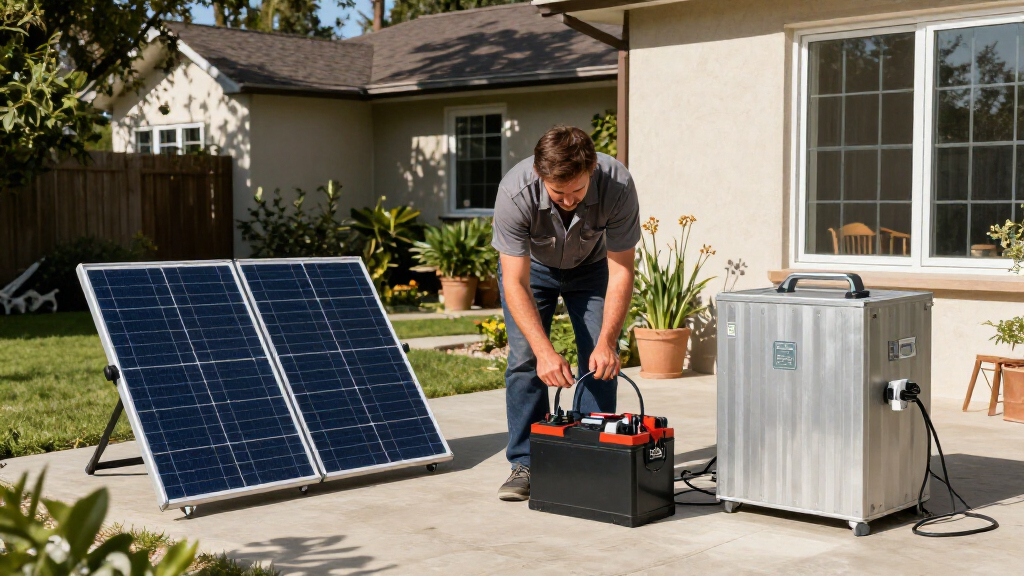
I ranked these solar backup power kits by how well their stated components match a plausible backup job: small-device charging, essential household loads, or a larger off-grid setup. I compared battery capacity, inverter output where listed, solar panel wattage included, battery chemistry when specified, and the practical gap between stored energy and the solar input provided. I also weighed whether a kit reads as portable and ready to use or calls for more extensive system planning.
The order favors options with a clearer balance of usable storage, power delivery, and solar replenishment for common backup needs. Larger capacity did not automatically put a product first: a big battery paired with limited included panel wattage may take longer to recharge, while a small portable unit cannot stand in for a fixed home system. Product details supplied for this roundup do not establish every compatibility or installation requirement, so buyers should verify specifications and local electrical requirements before purchase.
Factors to Consider When Choosing Solar Backup Power Kits
Before choosing a kit, I’d start with the outage plan rather than the largest capacity number. The right setup depends on which devices need power, how long they need to run, whether sunlight is available during the outage, and how much installation you can take on.
Match inverter output to the devices you need to run
Battery capacity tells you how much energy a system stores, while inverter output limits how much power it can deliver at one time. List the wattage of the loads you expect to run together, then check both their running demand and any startup surge listed by the manufacturer. Refrigerators, pumps, and other motors can briefly draw more power when they start, so a kit that handles steady loads may still struggle with startup. Avoid planning around a headline wattage without checking whether it is continuous or peak output. For multiple appliances, stagger use when possible rather than assuming every load can run at once. If the product listing does not clearly state output limits, confirm them before treating the kit as backup for that equipment.
Estimate runtime from usable energy, not battery capacity alone
Write down the devices you need and estimate their watt-hours over the intended backup period; a device’s watts multiplied by hours gives a useful starting estimate. Actual runtime can be shorter because inverters and connected equipment use some energy, and many appliances cycle rather than draw a steady load. A large battery is valuable for longer outages, but it may be unnecessary if your plan is to charge phones and run a few lights. For essential household loads, prioritize a realistic daily energy budget over a single impressive capacity figure. Leave a buffer for cold conditions, changing appliance use, and energy you may want in reserve. Do not assume a battery’s full rated capacity will reach every device as usable AC energy.
Compare panel wattage with the energy you need to replace
Solar panels are the replenishment side of the kit, and a small panel can make a large battery slow to refill in real-world conditions. Panel wattage is a rated figure, not a promise of constant output; shade, angle, weather, and daylight hours all affect collection. Compare the included panel capacity with your expected daily use and the battery size, then check whether the system accepts additional panels if you may expand later. A bigger panel array can help restore energy during a short sunny window, but it also takes more space and can be harder to transport. Buyers who expect cloudy weather should not base an outage plan on solar alone. Confirm the supported solar input range and connector compatibility before buying separate panels.
Choose portable backup or a fixed off-grid system
Portable power stations are designed around moving the unit and plugging devices into its outlets, while larger hybrid-inverter kits are aimed at planned, more permanent power systems. A fixed system can serve a different scale of need, but it may require electrical work, suitable battery placement, and careful integration with panels and household circuits. Do not assume a portable station can connect directly to home wiring; the required transfer equipment and installation rules depend on the setup. Check local codes and use a qualified electrician for household circuit connections. Buyers who need a mobile outage kit should favor manageable weight and simple controls over a panel count intended for a permanent array. Match the system type to where and how you expect to use it.
Check expansion, connections, and charging paths before purchase
A backup kit is easier to adapt when its solar input, outlets, and battery system match the devices and panels you already own or plan to add. Verify connector types, supported input limits, and whether extra batteries or panels are explicitly compatible; similar-looking plugs do not guarantee safe operation. Check whether the unit can charge from an AC outlet or vehicle as well as solar, since sunlight may be unavailable during a storm. Also review the outlet mix and any limits on simultaneous charging and power delivery. A system with more expansion options may cost more in complexity even if you never use them. Keep the purchase focused on documented compatibility rather than assumptions based on brand or product-family names.
Account for setup, storage, and maintenance
Portability includes more than whether a product has a handle: panel size, cable length, total kit weight, and the space needed to operate it all affect usability. A foldable panel may be easy to store but still need clear outdoor space and regular repositioning for useful sunlight. Fixed systems have a different burden, including installation planning and safe battery storage. Read the manufacturer’s guidance for charging, storage state, temperature limits, and periodic checks so the kit is ready when an outage arrives. Think through where the battery and panels will live between emergencies, not just where they will sit on a sunny day. Paying for more capacity makes sense only if you can store, recharge, and safely use it.
Frequently Asked Questions
Can a portable solar power station run my whole house during an outage?
Usually, a portable station is best treated as backup for selected devices rather than a whole-house supply. Its battery capacity limits how long it can deliver energy, while inverter output limits the load it can run at one time. Connecting a station to household circuits may require compatible transfer equipment and professional installation; plugging it into a wall outlet is not a safe substitute. Make a short list of priority loads and check their starting and running power against the station’s documented limits. For broader household coverage, compare a properly designed fixed system with a portable unit before deciding.
How much solar panel capacity do I need to recharge a backup battery during an outage?
There is no single panel wattage that fits every battery: the answer depends on how much energy you use, how much sunlight reaches the panels, and how quickly you need to restore the battery. Start with your daily watt-hour needs, then compare that figure with the system’s supported solar input and the panel capacity you can deploy. Rated panel output is a best-condition figure, so shade, clouds, orientation, and short winter days can reduce collection. A large battery paired with modest panel input may take longer to recharge than you expect. Check the manufacturer’s charging specifications and plan for alternate charging or reduced use when sunlight is poor.
Is a bigger battery always a better choice for solar backup?
No. A larger battery provides more stored energy, but it can add weight, storage demands, and charging time without helping if your loads are small. A system also needs enough inverter output for the devices you plan to run, so capacity alone does not establish compatibility. If your priority is phones, lights, or a small set of electronics, a compact station may be easier to handle. For longer outages or higher energy use, additional capacity can matter, provided you have a practical way to recharge it. Compare storage, output, solar input, and portability as a group.
Should I buy a kit with panels included or choose the power station separately?
An included-panel kit is convenient when its panel wattage, connectors, and supported input match your recharging plan. A station sold without enough solar capacity may look like a simpler purchase but leave you to source compatible panels later. Separately chosen components can give you more control over panel size and placement, yet require you to verify electrical limits and connectors yourself. Compare the complete setup rather than focusing only on the battery unit. Ask whether the included panels can realistically replenish the energy you expect to use each day, and check the manufacturer’s guidance before adding third-party equipment.
When does a fixed off-grid system make more sense than a portable solar generator?
A fixed system may make sense when you need a planned, higher-capacity supply for a building or off-grid site and have space for a larger panel array and batteries. Portable generators are generally easier to deploy for selected appliances, temporary needs, and users who value movement and simpler setup. Fixed hybrid-inverter systems bring added planning, wiring, safety, and installation requirements that should not be treated as plug-and-play. Before choosing one, define the loads, review local electrical rules, and get qualified help for household integration. If your need is occasional backup for a few essentials, a portable station may be the more manageable fit.
Conclusion
For most readers comparing different types of solar backup power kits, I’d start with the BLUETTI Elite 300 as the best overall balance in this lineup: substantial LiFePO4 storage with two included 200W panels. My best value pick for a more modest portable setup is the UDPOWER S1200 with a 120W panel, while the 210W-panel S1200 is a stronger choice if faster solar input matters more than keeping the setup simple. For a premium, high-capacity portable option, consider the EF ECOFLOW DELTA Pro, but verify the exact system configuration and household connection requirements. Beginners should look at a compact, clearly portable kit such as the ZeroKor 300W with a 60W panel for modest loads, not whole-home coverage. For fixed off-grid needs, compare the ECO-WORTHY 10 kW systems against your load plan and installation capacity; for lightweight personal charging, the BLAVOR power bank serves a different job altogether. Choose by the devices you must keep running, then confirm output, charging compatibility, and setup demands before buying.