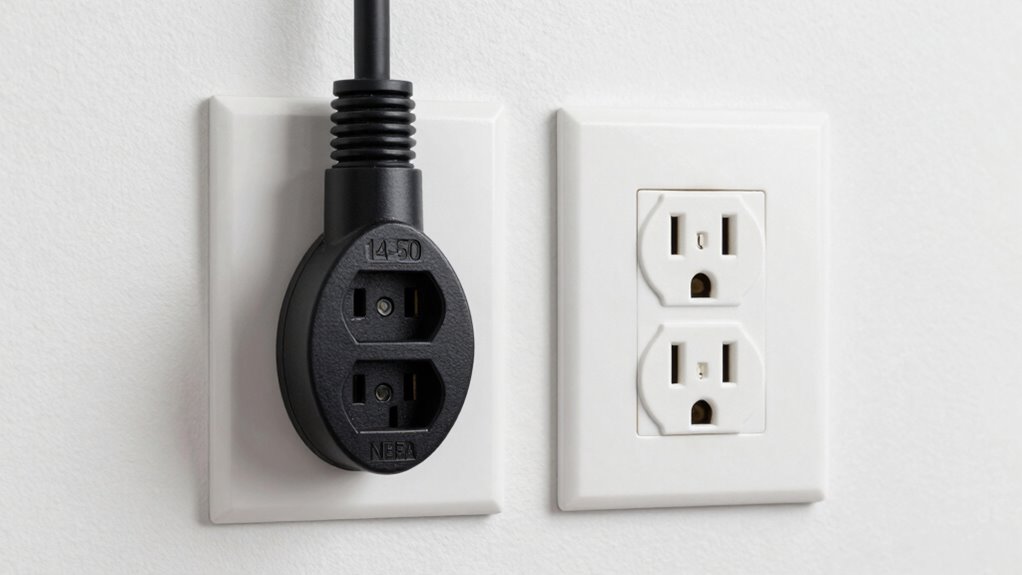

To understand NEMA outlets before buying an EV charger, start by checking the existing outlets in your home. Look at the number of prongs and their arrangement to identify the outlet type, such as NEMA 5-15 or 14-50. Matching your charger to the correct outlet guarantees safety and proper function. It’s also wise to consult a professional electrician to verify compatibility and safety standards—continue exploring to uncover key tips for a secure setup.

Get backup power and energy gear delivered free with Prime
- Fast, free delivery on millions of items
- Prime Video, Amazon Music and more included
- Member-only deals all year
Key Takeaways
- Examine the outlet’s prong configuration to identify its NEMA type and power capacity.
- Match your vehicle’s charging requirements with the correct NEMA outlet (e.g., NEMA 14-50 for Level 2).
- Ensure your existing outlets meet safety standards like UL and NEC before purchasing a charger.
- Consult a licensed electrician to verify wiring, grounding, and load capacity for compatibility.
- Confirm that the charger and outlet comply with local electrical codes for safe installation.
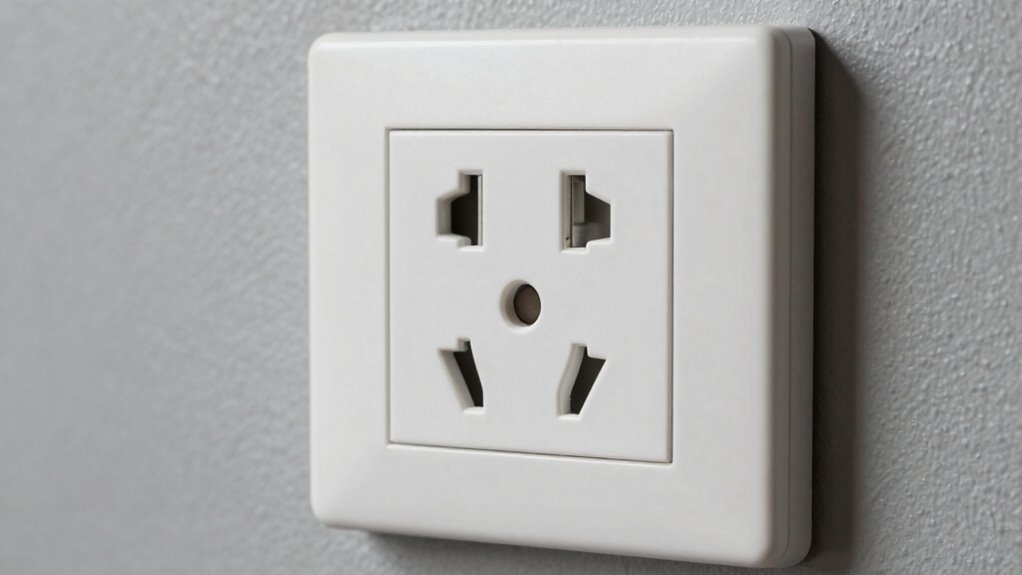
Ever wondered how to choose the right EV charger for your home? It all begins with understanding NEMA outlets, which are common in residential settings and determine what kind of charging station you can install. NEMA outlets come in various configurations, each designed for specific electrical capacities and safety standards. Knowing which outlet type you have is essential because it directly impacts your options for charging station compatibility. Without the right outlet, your charger may not fit or might not deliver the power your vehicle needs. So, before you buy, take a close look at your existing outlets and verify they match the specifications of the charger you’re considering.
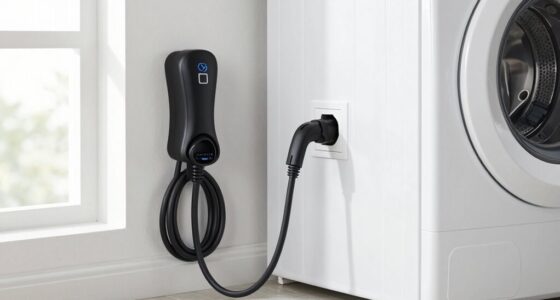
Your first step should be to identify the NEMA outlet type in your home, which involves checking the number of prongs and their arrangement. For example, a NEMA 14-50 outlet is a common choice for Level 2 charging and provides a higher power capacity, making it suitable for faster charging. Conversely, a NEMA 5-15 outlet is a standard household outlet that supports Level 1 charging, but it’s often insufficient for quick charging needs. Confirming your outlet matches the charging station you want is essential because incompatible outlets won’t work, and forcing an incompatible plug can be dangerous. When evaluating your options, always keep in mind the Charging station compatibility—selecting an outlet that aligns with your vehicle’s charging requirements makes the process smoother and safer. Additionally, understanding electrical safety standards ensures your installation remains secure and compliant with local regulations.
Identify your NEMA outlet type to ensure compatibility and safe, efficient EV charging at home.
It’s also helpful to recognize that installation requirements vary depending on the outlet type and the electrical load, so consulting a professional can save you from potential complications later. Electrical safety standards play an important role in this decision-making process. You need to confirm that your outlets and potential chargers meet local electrical safety standards to prevent hazards like short circuits, overheating, or electrical fires. Standards set by organizations like UL or NEC specify how outlets and chargers should be installed and maintained. If your outlets don’t meet these standards, you risk damaging your vehicle’s charging system or creating unsafe conditions in your home. It’s wise to have a licensed electrician inspect your outlets before installing any new charger. They can verify that your wiring is grounded properly and can handle the load, guaranteeing both safety and performance. Moreover, understanding electrical capacity helps determine if your current wiring can support the increased load without upgrades, which is crucial for a safe installation. Being aware of outlet compatibility and ensuring they meet safety standards can prevent costly modifications later on.
NEMA 14-50 outlet for EV charger
As an affiliate, we earn on qualifying purchases.
As an affiliate, we earn on qualifying purchases.
Frequently Asked Questions
Are NEMA Outlets Compatible With All Electric Vehicle Chargers?
NEMA outlets aren’t compatible with all electric vehicle chargers because outlet compatibility depends on the NEMA standards and the charger’s plug type. You need to check if your EV charger’s plug matches the NEMA outlet in your location. Different NEMA configurations support various power levels, so make certain your outlet meets your charger’s requirements for safe, efficient charging. Always verify compatibility before installation to avoid issues.
How Do NEMA Outlet Types Affect Charging Speed?
NEMA outlet types directly impact your charging speed because different types provide varying voltage levels. Higher voltage outlets, like NEMA 14-50, offer faster charging, but you need to confirm voltage compatibility with your EV charger. Your outlet installation must match the NEMA type supported by your vehicle and charger. Choosing the right outlet type ensures efficient charging and safe installation, so always verify compatibility before purchase.
Can I Replace a Standard Outlet With a NEMA Outlet?
Yes, you can replace a standard outlet with a NEMA outlet, but you need to check outlet compatibility and installation requirements first. Make sure your electrical system supports the NEMA outlet type you’re installing, and consider whether your home’s wiring can handle the increased power demand. It’s best to hire a licensed electrician to safely perform the upgrade, ensuring proper installation and compliance with local electrical codes.
Do Different NEMA Outlets Require Different Circuit Breakers?
Did you know that using the wrong circuit breaker can cause electrical hazards? Different NEMA outlets, like NEMA 14-50 or NEMA 6-50, do require specific circuit breakers to guarantee safe outlet installation. For electrical safety, always match the NEMA outlet with the correct breaker size and type. This prevents overheating, shorts, and fires. Consult a professional to verify your setup and keep your home safe when installing or upgrading outlets.
Are NEMA Outlets Suitable for Outdoor EV Charging Stations?
Yes, NEMA outlets are suitable for outdoor EV charging stations when they’re designed for outdoor safety. Look for weather-resistant NEMA outlets, which protect against moisture, dust, and temperature changes. These features guarantee safe, reliable charging in various weather conditions. Proper installation and regular maintenance also help maintain weather resistance, so your outdoor station remains safe and functional, no matter the weather.
home EV charging station compatible with NEMA outlets
As an affiliate, we earn on qualifying purchases.
As an affiliate, we earn on qualifying purchases.
Conclusion
Understanding NEMA outlets is like learning the language of your home’s electrical system—you’ll speak confidently and avoid surprises. When I first switched to electric, I thought all outlets were the same until I realized my NEMA 14-50 was like a secret handshake, enabling faster charging for my EV. Knowing these details isn’t just technical—it’s about powering your journey smoothly and safely. Get familiar with NEMA outlets, and your electric future will feel like a well-tuned engine ready to go.
electrical outlet tester for NEMA types
As an affiliate, we earn on qualifying purchases.
As an affiliate, we earn on qualifying purchases.
As an affiliate, we earn on qualifying purchases.
Halloween Picks
halloween
As an affiliate, we earn on qualifying purchases.