
Your EV’s charging slows down after 80% to protect the battery’s health and extend its lifespan. As the battery approaches full capacity, the charging system reduces current—this is called tapering—preventing overheating, electrode stress, and degradation. The battery’s chemistry and the management system work together to balance fast charging with safety. If you want to understand how this process keeps your battery safe and efficient, keep exploring the details behind the charge curve.
Open a free Amazon Business account
Business pricing, bulk buying and tax-exempt orders.
As an affiliate, we earn on qualifying purchases.
Key Takeaways
- Charging slows after 80% to prevent electrode stress and battery degradation during high voltage buildup.
- The battery’s chemistry causes a natural tapering of current as it approaches full capacity.
- The Battery Management System (BMS) reduces current to avoid overheating and overcharging risks.
- Thermal management becomes critical; slowing charging helps prevent overheating and extends battery life.
- The charging curve reflects lithium-ion behavior, deliberately tapering to balance speed and longevity.
As an affiliate, we earn on qualifying purchases.
Understanding the Basics of EV Batteries

Electric vehicle batteries are the heart of any EV, storing the energy that powers your car. Understanding how they work helps you appreciate their importance. EV batteries are typically lithium-ion, designed for longevity and efficiency. As batteries age or reach the end of their life, battery recycling becomes essential to recover valuable materials and reduce environmental impact. The development of a robust charging infrastructure supports the widespread adoption of EVs and ensures your battery stays charged efficiently. Knowing about these basics helps you make informed decisions about charging habits and sustainability. Proper recycling practices and accessible charging stations are key to maintaining the health of both your vehicle and the environment, ensuring EVs remain a reliable and eco-friendly transportation option. Biology of Batteries Additionally, advancements in battery chemistry are continuously improving performance and safety standards. Understanding battery performance also helps consumers optimize their charging routines to prolong battery life and efficiency. Recognizing the battery lifespan and planning for eventual replacement can also help you manage costs and maintenance more effectively.
As an affiliate, we earn on qualifying purchases.
The Charging Process: From Empty to Full

When you start charging your EV from empty, you’ll notice a rapid increase in power during the fast charging phase. As the battery approaches full, the charging slows down through tapering and top-off stages. Understanding these phases helps you optimize your charging routine and avoid unnecessary delays. Precious metal investments can also be a strategic way to hedge against economic fluctuations during long-term planning.
Fast Charging Phase
Fast charging accelerates the process of replenishing your vehicle’s battery from empty to full, letting you get back on the road faster. During this phase, your EV’s charger delivers high power, rapidly increasing the battery’s state of charge. This phase relies heavily on your vehicle’s battery chemistry to handle fast energy inflow without damage. The quality of the charging infrastructure also matters, as it determines how much power your charger can supply safely. Additionally, the battery’s ability to manage heat during rapid charging is crucial to maintain performance and longevity.
Tapering and Top-off
As your vehicle’s battery approaches full capacity, the charging process slows down considerably through tapering and top-off stages. During tapering, the charger reduces current to prevent overcharging, which can accelerate battery degradation over time. This slowdown helps preserve battery health but extends charging time. The top-off stage fine-tunes the charge to reach 100%, requiring careful management by the charging infrastructure to avoid stress on the battery. Because charging slows near full capacity, using fast chargers repeatedly can impact long-term battery health. Understanding this process helps you optimize your charging habits, balancing convenience with battery longevity. Keep in mind, the slowdown isn’t just about speed—it’s a protective measure to ensure your EV’s battery remains durable over its lifespan.
As an affiliate, we earn on qualifying purchases.
The Charging Curve Explained

Understanding the charging curve helps you see how your battery behaves during charging, especially with lithium-ion cells. You’ll notice the charging rate slows in different phases to protect the battery’s safety and longevity. Recognizing these patterns can help you optimize charging and extend your battery’s life. Additionally, modern battery management systems monitor the charging profile to ensure optimal performance and durability. These systems often incorporate thermal management to prevent overheating during fast charging, further safeguarding the battery’s health.
Lithium-Ion Battery Behavior
The charging behavior of lithium-ion batteries follows a predictable pattern known as the charging curve, which describes how voltage and current change during the process. As you charge your EV, the battery’s voltage steadily increases, but this pattern shifts after about 80%. This slowdown occurs because charging speeds are limited to prevent battery degradation, especially affecting electrode materials. When you push the battery too quickly, it can cause stress and reduce its lifespan. To preserve battery health, the charging system adjusts current flow, leading to a natural tapering effect. This behavior guarantees the electrodes don’t overheat or deteriorate prematurely, balancing fast charging needs with longevity. Understanding this behavior helps you appreciate why your EV slows down near full capacity, and recognizing the importance of battery management systems can help extend your battery’s overall lifespan.
Charging Rate Phases
Charging your EV follows a specific pattern known as the charging curve, which maps out how voltage and current change over time. During the initial phase, the charger supplies high current to quickly raise the battery’s voltage, enabling rapid charging. As the battery approaches higher states of charge, the charging rate slows down to protect against battery degradation. This slowdown occurs in distinct phases: a fast charge phase, then a tapering stage, and finally a stabilization near full capacity. Your charging infrastructure influences how smoothly these phases occur, especially since some chargers can sustain higher rates longer. Understanding these phases helps you recognize why charging slows after 80%, as the vehicle’s system reduces current to preserve battery health and extend its lifespan. Recognizing the battery management system helps drivers understand how safety features regulate charging rates to prevent damage. Additionally, the charge rate is affected by factors such as ambient temperature and battery age, which can further influence charging speed. A comprehensive understanding of the battery chemistry can also shed light on why these charging behaviors occur.
Safety and Longevity
Since the charging curve naturally slows as your battery approaches full capacity, it’s designed to safeguard the battery’s safety and extend its lifespan. This slowdown helps prevent overheating, minimizes stress on battery cells, and reduces the risk of damage. By following safety protocols, manufacturers ensure that your EV’s battery remains reliable over time. Additionally, implementing proper piercing care and hygiene during maintenance can help maintain optimal performance and prolong battery life. Regularly monitoring and maintaining battery health can further enhance your vehicle’s longevity and efficiency. Understanding battery management systems can also provide insights into how these controls optimize charging and protect your battery.
As an affiliate, we earn on qualifying purchases.
Why Charging Speed Drops After 80
As your electric vehicle approaches 80% capacity, you’ll notice the charging speed often slows down considerably. This slowdown happens because the battery’s temperature rises during charging, especially in fast-charging sessions. To protect the battery’s health, the vehicle’s management system reduces charging current once it detects high temperature levels. Additionally, as you go through multiple charge cycles, the battery’s chemistry changes slightly, making it less receptive to rapid charging at higher levels. The system prioritizes safety and longevity over speed, deliberately tapering the charge rate to prevent overheating and undue wear. This controlled reduction guarantees your battery remains healthy over the long term, even if it means a longer charge time once you hit around 80%. Understanding battery chemistry can help explain why these protective measures are necessary for maintaining optimal performance over time, especially considering thermal management plays a critical role in battery longevity. Moreover, charge rate modulation is an essential feature that adapts charging behavior based on real-time battery conditions to optimize lifespan.
The Role of Battery Management Systems
Your battery management system (BMS) plays a vital role in controlling charging speeds to protect your battery. It adjusts charge flow to prevent damage and extend battery life, especially during fast charging. Understanding how your BMS works helps you optimize charging and avoid unnecessary slowdowns. For example, it monitors various battery parameters to ensure safe operation battery parameters.
BMS and Charging Control
Battery Management Systems (BMS) play a critical role in controlling how your electric vehicle charges and protects its battery. They monitor key factors like temperature, voltage, and state of charge to guarantee safe and efficient charging. Your BMS actively manages charging speed, especially as the battery approaches 80%, to prevent damage from overloading or overheating. It also adapts to different battery chemistries, maximizing performance and longevity. Additionally, the BMS interacts with the charging infrastructure to coordinate charging rates, making sure your EV charges efficiently without risking battery health. You’ll find that the BMS: – Adjusts charging based on battery chemistry and condition – Coordinates with charging infrastructure for ideal speed – Prevents overheating and overcharging during high-rate charging sessions and maintains user privacy and data security.
Preventing Battery Damage
Battery Management Systems actively protect your EV’s battery from damage during charging by continuously monitoring critical parameters like temperature, voltage, and state of charge. This precise oversight helps prevent overcharging or overheating, which can harm the battery’s lifespan. To further safeguard your battery, manufacturers emphasize proper charging infrastructure, ensuring chargers deliver consistent, compatible power levels. Additionally, efficient battery recycling programs help reduce the environmental impact of battery degradation and disposal, supporting sustainability. By managing charging rates and protecting against stress, BMS systems extend battery life and maintain safety. Proper wave and wind energy sources are also considered to reduce strain on the battery during charging. Together with robust charging infrastructure and responsible recycling, your EV’s battery remains healthier longer, reducing the risk of damage and ensuring reliable performance over time.
Safety Considerations During Charging
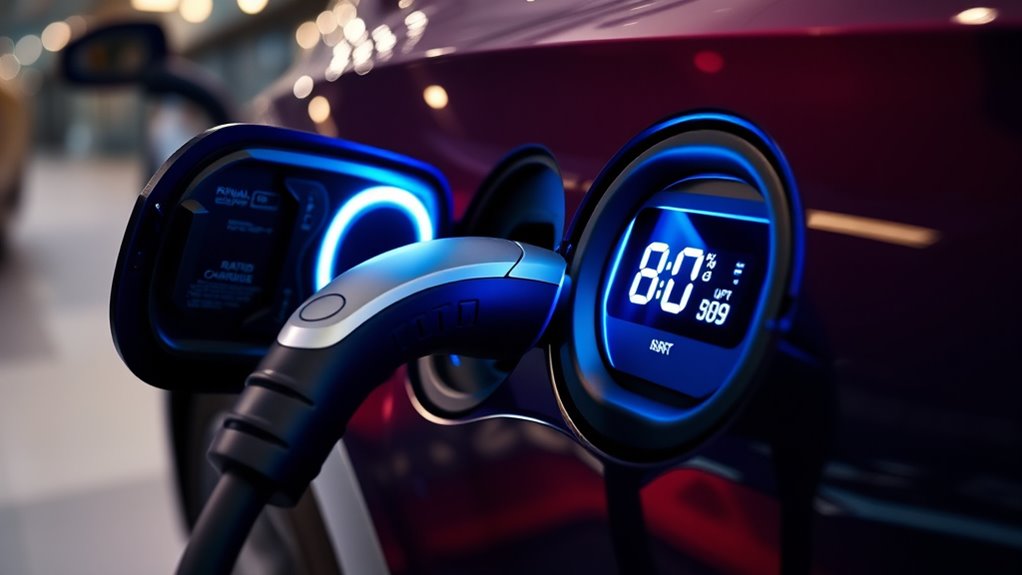
While charging your electric vehicle, safety should always be a top priority to prevent accidents or damage. Proper thermal management is essential to avert overheating, which can lead to battery degradation or safety hazards. Always monitor the charging environment and avoid extreme temperatures. To guarantee user safety, follow these guidelines:
- Use compatible chargers and avoid makeshift setups
- Keep an eye on the charging station for any signs of damage or malfunction
- Disconnect the charger if you notice excessive heat or unusual smells
The Impact of Temperature on Charging Rates
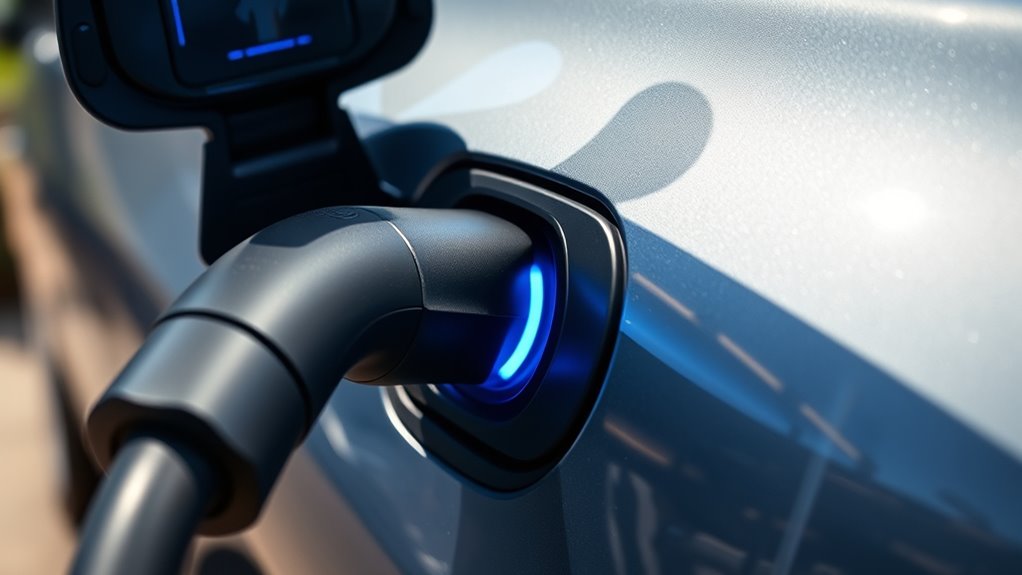
Temperature plays a significant role in how quickly your EV charges, directly affecting the efficiency of the process. When your battery is too hot or cold, thermal management systems activate to protect its health, which can slow down charging rates. In cold ambient temperatures, the battery’s internal resistance increases, making it harder for electrons to flow and reducing charging speed. Conversely, high temperatures can cause overheating, prompting the thermal management system to slow or pause charging to prevent damage. Maintaining ideal temperature ranges is vital for fast charging; your vehicle’s thermal management actively works to keep the battery within these limits. Understanding how ambient temperature impacts charging helps you anticipate delays and guarantees better overall charging performance.
Strategies to Maximize Charging Efficiency

To maximize your EV’s charging efficiency, start by planning your charging sessions during periods of moderate ambient temperatures, such as late morning or early evening, when thermal conditions are more favorable. Understanding your battery chemistry helps you avoid unnecessary stress during charging, prolonging battery life. Additionally, choosing the right charging infrastructure ensures ideal speed and safety. To improve efficiency, consider these strategies:
- Use Level 2 chargers for steady, efficient charging without stressing the battery chemistry.
- Avoid frequent fast charging above 80%, as it can generate heat and reduce overall battery health.
- Schedule charging sessions during off-peak hours to benefit from better grid performance and reduced congestion.
Implementing these tactics helps you get the most out of your charging sessions while preserving your battery’s longevity.
Future Technologies Improving Fast Charging

Advancements in battery chemistry and cooling technologies are paving the way for faster, more reliable charging solutions. These innovations aim to reduce battery degradation caused by high current loads, extending battery life and maintaining performance. Future charging infrastructure will incorporate ultra-fast chargers with increased power capacity, minimizing wait times. Solid-state batteries promise higher energy density and faster charging, while advanced cooling systems prevent overheating during rapid charge cycles. These developments will make fast charging more efficient and accessible.
| Technology | Benefit | Impact on Charging Experience |
|---|---|---|
| Solid-State Batteries | Faster charging, less battery degradation | Longer-lasting, quicker top-ups |
| Enhanced Cooling Systems | Keeps batteries cool during rapid charge | Reduces downtime, improves safety |
| High-Power Charging Stations | Significantly faster charging speeds | Less time at charging stations |
| Upgraded Charging Infrastructure | Supports widespread fast-charging networks | Convenience and reliability for users |
Practical Tips for EV Charging Efficiency
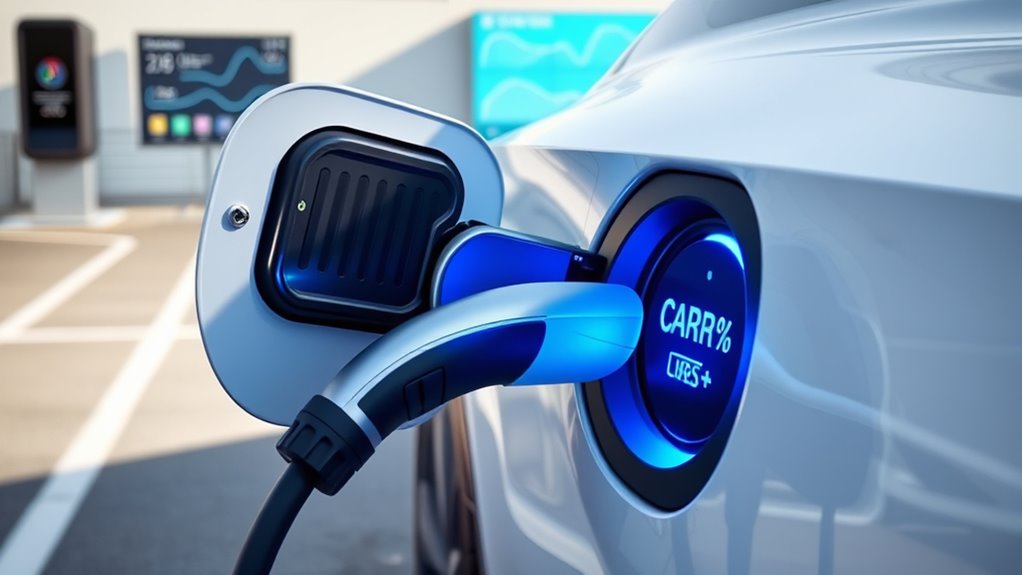
Maximizing your EV’s charging efficiency requires a few simple, practical steps. First, avoid charging to 100% unless necessary, as it stresses the battery chemistry and slows charging. Second, charge during moderate temperatures; thermal management helps keep your battery cool, preventing heat-related slowdowns. Third, use fast chargers only when needed—frequent rapid charging can impact long-term battery health. Additionally, preconditioning your battery before charging can optimize thermal management, maintaining ideal temperatures for efficient charging. Keeping your EV in a shaded or garage environment helps regulate temperature, ensuring consistent charging speeds. By understanding battery chemistry and managing thermal conditions, you can improve charging efficiency, extend your battery’s life, and reduce overall charging time.
Frequently Asked Questions
How Does Battery Age Affect Charging Speed Curves?
Battery age impacts your charging speed due to changes in battery chemistry and increased charging cycles. As your EV battery ages, its chemistry becomes less efficient, causing the charging speed curve to slow earlier and more prominently. Repeated charging cycles also wear down the battery, reducing its ability to accept high currents. This results in longer charging times, especially after reaching 80%, as the battery’s capacity to handle rapid charging diminishes over time.
Can Using Different Chargers Influence the Charging Curve?
Using different chargers can profoundly influence your EV’s charging curve. While faster chargers like CCS or CHAdeMO deliver quick power, compatibility issues may cause slower charging or voltage limitations. Conversely, standard charging stations follow specific standards that ensure consistent performance. So, if your charger isn’t compatible with your vehicle or doesn’t meet the station’s standards, expect slower charging speeds. Always check charger compatibility to optimize your charging experience.
What Are the Signs of Battery Degradation Affecting Charging?
If your EV’s battery capacity decreases, you’ll notice it takes longer to charge and your range drops. You might also see inconsistent charging speeds, especially if the charging temperature isn’t ideal. When the battery degrades, it struggles to hold charge, leading to slower charging times and reduced efficiency. Keep an eye on these signs to catch early signs of battery degradation and maintain your EV’s performance.
Does Charging at Higher Voltages Impact Battery Longevity?
Charging at higher voltages is like pushing your battery through a storm; it can accelerate voltage stress and strain the delicate battery chemistry. While it may seem quick, over time, this stress wears down your battery’s health, reducing longevity. You might enjoy faster charges now, but long-term, it’s like burning a candle at both ends—shortening your EV’s lifespan and risking costly replacements. Play it safe to keep your battery thriving.
Are There Specific EV Models With Faster Charging Capabilities?
You’ll find that some EV models, like Tesla’s Supercharger-enabled vehicles or Porsche’s Taycan, offer faster charging capabilities thanks to advanced fast charging standards. These vehicles use sophisticated battery thermal management systems to keep the battery cool, enabling quick charging without damage. If fast charging matters to you, look for models with high charging wattage ratings and robust thermal management, ensuring shorter charging times and better battery health.
Conclusion
Understanding your EV battery, the charging process, and the reasons behind slowing down after 80% helps you charge smarter. By knowing the battery curve, managing temperature, and using practical strategies, you can maximize efficiency and reduce charging time. Embrace the future of fast-charging technology, stay informed about battery management systems, and apply these tips. With awareness, patience, and proper care, you’ll enjoy faster, safer, and more efficient charging every time you plug in.
Flea & tick season Picks
flea and tick prevention
As an affiliate, we earn on qualifying purchases.