
The best home electricity monitor for most households is the Emporia Vue 3, which pairs whole-panel tracking with sensors for individual circuits. For broader circuit coverage and smart-home flexibility, the Meross 18-Circuit Monitor stands out, while Tapo P115 smart plugs are a simpler way to track individual appliances without opening an electrical panel. The main choice is between detailed whole-home insight, lower-effort plug-level monitoring, and the installation and compatibility demands that come with each. I compare all 15 options by monitoring scope, usability, setup, and fit for different homes. Read on for the full breakdown and guidance on which type makes sense for your energy questions.

Get backup power and energy gear delivered free with Prime
- Fast, free delivery on millions of items
- Prime Video, Amazon Music and more included
- Member-only deals all year
Key Takeaways
- Whole-panel monitors offer the broadest picture: The Emporia Vue 3, Emporia 16-sensor kit, Refoss, Meross, SEM-Meter, Siemens Inhab, Nestool, and Eyedro options track circuits or incoming power, unlike plug-in meters that only see connected devices.
- Circuit count is not the same as useful coverage: A monitor’s sensors may not map neatly to every circuit or appliance, so check your panel layout and which loads you want to isolate before choosing a multi-sensor kit.
- Plug-in monitors lower the setup barrier: Tapo P115 and Emporia smart plugs suit renters or appliance-focused tracking, but they cannot account for hardwired equipment or provide a whole-home view.
- Connectivity changes who each monitor suits: Meross models with Home Assistant support and the Refoss model with local control appeal to buyers prioritizing integrations or reduced cloud dependence; check exact model capabilities before purchase.
- Installation and data access separate the leading picks: Circuit-level detail can answer more questions, but it often requires panel access and compatible sensors, while standalone watt meters trade convenience for narrower, device-by-device readings.
| Emporia Whole-Home Energy Monitor with 16 Sensors and 4 Smart Plugs |  | Best Overall | Sensors: 16 | Circuit monitoring: Main panel and up to 16 individual circuits | Included smart plugs: 4 Wi-Fi smart plugs | VIEW LATEST PRICE | See Our Full Breakdown |
| Refoss EM16P Smart Home Energy Monitor |  | Best for Home Assistant and Local Data | Model: EM16P | Main circuit sensors: 2 × 200A | Branch circuit sensors: 16 × 60A | VIEW LATEST PRICE | See Our Full Breakdown |
| Tapo P115 Smart Wi-Fi Plug with Energy Monitoring, 4-Pack, 15A |  | Best for Beginners | Model: P115 | Pack size: 4 | Operating voltage: 110 V AC | VIEW LATEST PRICE | See Our Full Breakdown |
| Plug-In Watt Meter and Home Energy Monitor |  | Best for Simple Appliance Checks | Power source: Corded electric | Minimum operating voltage: 120 V | Overload threshold: 1800 W | VIEW LATEST PRICE | See Our Full Breakdown |
| Watt Meter Plug for Home Electricity Usage Monitoring |  | Best Adjustable Plug-In Meter | Display: 2.36 × 1.85-inch backlit LCD | Display modes: 7 | Monitored parameters: Power, energy, voltage, current, frequency, power factor, cost, minimum and maximum power, cumulative days and time | VIEW LATEST PRICE | See Our Full Breakdown |
| Meross Smart Home Energy Monitor with 18-Circuit Monitoring and Home Assistant Support |  | Best for Home Assistant Automation | Brand: Meross | Model: EM16 | Circuit monitoring: Up to 18 circuits | VIEW LATEST PRICE | See Our Full Breakdown |
| Meross Smart Home Energy Monitor with 18 Circuit Sensors | | Best for Detailed Circuit Coverage | Model: EM16 | Main circuit support: 2 circuits, 200A | Branch circuit support: 16 circuits, 60A | VIEW LATEST PRICE | See Our Full Breakdown |
| SEM-Meter Smart Home Energy Monitor with 16 Circuit Sensors |  | Best for Solar and Electricity-Cost Tracking | Model: SEM-Meter | Circuit sensors: 16 × 50A | Voltage support: Single-phase up to 240VAC line-neutral; split-phase 120/240VAC; three-phase up to 415Y/240VAC; no Delta | VIEW LATEST PRICE | See Our Full Breakdown |
| MECHEER Power Meter Plug, 2-Pack |  | Best for Plug-In Appliance Checks | Model: JK-PM07-2P-US | Pack size: 2 | Measurements: Power, energy, voltage, current, frequency, power factor, and estimated cost | VIEW LATEST PRICE | See Our Full Breakdown |
| Siemens Inhab Smart Home Energy Monitor with Circuit-Level Sensors |  | Best for Solar and Load Management | Model: INHEM1216 | Main sensors: 2 × 200A CTs | Circuit sensors: 16 × 50A CTs | VIEW LATEST PRICE | See Our Full Breakdown |
| Emporia Energy Monitoring Smart Plugs with Wi-Fi, Alexa and Google Home Compatibility, 4 Pack |  | Best for Plug-In Appliance Tracking | Pack size: 4 plugs | Operating voltage: 120 V | Continuous load: 10 A | VIEW LATEST PRICE | See Our Full Breakdown |
| Emporia Vue 3 Home Energy Monitor with 16 Circuit Sensors |  | Best for Solar and Circuit-Level Monitoring | Model: EMV3A-2P-16 | Circuit sensors: 16 branch sensors, 50A | Sensor accuracy: ±2% | VIEW LATEST PRICE | See Our Full Breakdown |
| Refoss Smart Home Energy Monitor with 16 Circuit Sensors and Local Control |  | Best for Local Data and Home Assistant | Model: EM16P | Main sensors: 2, up to 200A | Branch sensors: 16, up to 60A | VIEW LATEST PRICE | See Our Full Breakdown |
| Nestool WiFi Home Energy Monitor with Three 80A CT Clamps |  | Best for Monitoring a Few Selected Circuits | Model: PW03 | Monitored circuits: Up to 3 | Included sensors: 3 CT clamps, 80A | VIEW LATEST PRICE | See Our Full Breakdown |
| Eyedro Smart Home Energy Monitor with 200A Sensors, WiFi and Ethernet |  | Best for Flexible Network Connections | Model: EYEDRO-HOME | Sensors: 2 × 200A directional current sensors | Connectivity: 2.4 GHz Wi-Fi or Ethernet | VIEW LATEST PRICE | See Our Full Breakdown |
| home electricity monitor | Model |
|---|---|
| Emporia Whole-Home Energy Moni | — |
| Refoss EM16P Smart Home Energy | EM16P |
| Tapo P115 Smart Wi-Fi Plug wit | P115 |
| Plug-In Watt Meter and Home En | — |
| Watt Meter Plug for Home Elect | — |
| Meross Smart Home Energy Monit | EM16 |
| Meross Smart Home Energy Monit | EM16 |
| SEM-Meter Smart Home Energy Mo | SEM-Meter |
| MECHEER Power Meter Plug | JK-PM07-2P-US |
| Siemens Inhab Smart Home Energ | INHEM1216 |
| Emporia Energy Monitoring Smar | — |
| Emporia Vue 3 Home Energy Moni | EMV3A-2P-16 |
| Refoss Smart Home Energy Monit | EM16P |
| Nestool WiFi Home Energy Monit | PW03 |
| Eyedro Smart Home Energy Monit | EYEDRO-HOME |
More Details on Our Top Picks
Emporia Whole-Home Energy Monitor with 16 Sensors and 4 Smart Plugs
I rank the Emporia as the most versatile pick here because it combines whole-home and circuit-level monitoring with four plugs that measure usage at individual outlets. That gives buyers a way to compare large loads in the electrical panel with everyday appliances, then schedule or control plugged-in devices from the app. It also supports solar systems and Alexa-enabled devices, making it a better fit for a mixed setup than the Tapo P115 four-pack, which focuses on plug-in monitoring rather than the breaker panel.
The tradeoff is that its wider coverage depends on installing sensors in the panel, so it is not as simple to set up as the standalone Plug-In Watt Meter. The listed details also do not specify local data access or long-term export options, which may matter to buyers who want open integrations or detailed archival data.
Pros:- Tracks the main panel and up to 16 individual circuits.
- Includes four smart plugs with outlet-level energy tracking.
- App schedules and automations can control connected devices.
- Supports solar systems and Alexa-enabled devices.
Cons:- Panel installation makes setup more involved than using a plug-in meter.
- The provided specifications do not state whether data can be accessed locally or exported.
Best for: Homeowners who want circuit-level visibility, outlet-level tracking, and smart-plug control in one system, especially those with solar.
Not ideal for: Renters or buyers who only need to measure one appliance and do not want to install sensors in an electrical panel.
- Sensors:16
- Circuit monitoring:Main panel and up to 16 individual circuits
- Included smart plugs:4 Wi-Fi smart plugs
- App compatibility:iOS and Android
- Voice assistant compatibility:Alexa-enabled devices
- Compatible systems:Solar systems
Our verdict“Choose the Emporia if you want one system for panel circuits and four smart-plug loads, and skip it if a simple appliance-only meter will do.”
Refoss EM16P Smart Home Energy Monitor
The Refoss EM16P is the strongest choice in this group for buyers who want local access and open integrations, rather than an app-first system. Native Home Assistant support, an Open API, and MQTT make it easier to bring energy readings into a custom smart-home setup. Its clamp-on sensors cover two main circuits and up to 16 branch circuits, while exportable data can be retained for up to five years—a more explicit data path than the Emporia Whole-Home Energy Monitor provides in its listed specifications.
That control comes with a setup and compatibility burden: the unit must fit a suitable electrical panel, and installation is not as straightforward as plugging in the Tapo P115 or a watt meter. The stated accuracy also drops from ±1% to ±2% at low current, a limitation worth weighing if you are tracking small loads.
Pros:- Local access through a web interface, Open API, and MQTT.
- Native Home Assistant integration supports custom automations.
- Monitors two main circuits and up to 16 branch circuits.
- Stores exportable data for up to five years and supports solar-use automation.
Cons:- Requires installation in a compatible electrical panel.
- Accuracy is specified as ±2% at low current, rather than ±1%.
Best for: Home Assistant users and technically confident homeowners who want local energy data, automation options, and long-term exports.
Not ideal for: Buyers seeking a quick, no-panel-installation monitor or those who need the stated ±1% accuracy at low current.
- Model:EM16P
- Main circuit sensors:2 × 200A
- Branch circuit sensors:16 × 60A
- Accuracy:±1%; ±2% at low current
- Data storage:Up to 5 years
- Connectivity:Wi-Fi, Open API, MQTT
- Integration:Home Assistant
- Installation:Clamp-on
- Warranty:2 years
Our verdict“Pick the Refoss EM16P for local-first monitoring and Home Assistant control, but choose a plug-in meter if you want to avoid panel installation.”
Tapo P115 Smart Wi-Fi Plug with Energy Monitoring, 4-Pack, 15A
The Tapo P115 four-pack is the approachable pick for someone who wants to start measuring appliance use without opening an electrical panel. Plug one into an outlet, connect it over 2.4 GHz Wi-Fi, and use the app’s energy statistics, schedules, and automatic shutoff for the connected device. Its compact shape is designed to leave neighboring outlets accessible, a practical advantage when adding several monitors around the home.
Compared with the Emporia Whole-Home Energy Monitor, the Tapo is easier to add room by room but cannot show circuit or whole-home consumption. It also supports Alexa, Google Assistant, and SmartThings, giving it broader listed voice-assistant compatibility than the Emporia bundle. Cost estimates rely on billing information, though, and this is still a plug-level tool—not a way to find which breaker or circuit is driving household use.
Pros:- Four plugs let buyers track several appliances separately.
- Energy statistics and charts help compare connected devices.
- Works with Alexa, Google Assistant, and SmartThings.
- Compact design helps keep adjacent outlets available.
Cons:- Requires a 2.4 GHz Wi-Fi network.
- Does not monitor whole-home or circuit-level electricity use.
- Energy cost estimates depend on entered billing information.
Best for: Beginners and renters who want to track and schedule a handful of plug-in appliances without installing panel sensors.
Not ideal for: Homeowners who need whole-home or breaker-level readings, or buyers whose Wi-Fi network does not support 2.4 GHz.
- Model:P115
- Pack size:4
- Operating voltage:110 V AC
- Maximum wattage:1800 W
- Connectivity:2.4 GHz Wi-Fi
- Control methods:App and voice control
- Compatible assistants:Amazon Alexa, Google Assistant, SmartThings
- Certifications:ETL, FCC, RoHS
Our verdict“Choose the Tapo P115 if you want easy outlet-level tracking and controls across several appliances, not a view of your home’s circuits.”
Plug-In Watt Meter and Home Energy Monitor
This plug-in meter is the no-network option for checking what a single appliance draws. Its eight display modes cover power, accumulated energy, voltage, frequency, current, power factor, and cost, so it gives more immediate electrical detail than a smart plug such as the Tapo P115. A backlit LCD makes readings visible at the outlet, while memory preserves settings and cumulative usage through power interruptions.
The tradeoff is scope: unlike the Emporia Whole-Home Energy Monitor, this unit cannot identify usage across circuits or show several loads in an app. It also lacks the Tapo’s remote control, voice commands, and scheduling. The 1800 W overload alert adds a clear warning point, but the backlight turns off after ten minutes without button presses, and several instantaneous readings are not retained in memory.
Pros:- Displays several electrical measurements, including power factor and cumulative cost.
- Eight modes provide more measurement detail than a basic smart plug.
- Memory retains settings and cumulative usage through power interruptions.
- Backlit LCD and an overload alert above 1800 W support at-outlet checks.
Cons:- Measures a single plugged-in appliance rather than circuits or the whole home.
- Backlight switches off after ten minutes without button presses.
- Current, voltage, power, and power factor readings are not retained in memory.
Best for: People who want a direct, screen-based reading of one standard-plug appliance without Wi-Fi or a companion app.
Not ideal for: Buyers who need whole-home trends, remote access, smart-home automations, or saved voltage and power readings.
- Power source:Corded electric
- Minimum operating voltage:120 V
- Overload threshold:1800 W
- Measurements:Power, energy, voltage, frequency, current, power factor, and cost
- Display modes:8
- Dimensions:5.5 × 3.5 × 2.5 inches
- Compatibility:Appliances with standard US plugs
- Certification:CE
Our verdict“Choose this meter for direct, detailed readings from one appliance; choose the Tapo P115 for remote control or the Emporia for panel-wide coverage.”
Watt Meter Plug for Home Electricity Usage Monitoring
This watt meter suits buyers who want a stand-alone appliance monitor with more control over its display and alert settings. It records power, energy, voltage, current, frequency, power factor, and cost, along with minimum and maximum power and cumulative time. The adjustable backlight can stay on for up to eight hours or continuously, giving it an advantage over the Plug-In Watt Meter and Home Energy Monitor, whose backlight switches off after ten minutes without input.
It remains a single-outlet instrument, not a substitute for the Refoss EM16P or Emporia panel monitors. Its overload threshold is configurable up to 3680 W, but the product description recommends lowering the default limit to 1800 W before use. That extra configuration makes it less ready-to-use than the Tapo P115 smart plugs, and it does not offer app monitoring or remote control.
Pros:- Tracks a broad set of electrical readings, including minimum and maximum power.
- Backlight duration is adjustable, including an always-on setting.
- Overload warning can be configured from 0 to 3680 W.
- Retains usage data after unplugging or a power failure.
Cons:- Measures only the appliance connected to its outlet, not household circuits.
- The default overload limit is 3680 W; the description recommends setting it to 1800 W before use.
- Does not provide app access, remote control, or smart-home integrations.
Best for: Buyers who want detailed readings for one appliance and prefer adjustable overload and display settings over app-based controls.
Not ideal for: People who need circuit-level tracking, multi-device dashboards, smart-home integrations, or a set-and-forget setup.
- Display:2.36 × 1.85-inch backlit LCD
- Display modes:7
- Monitored parameters:Power, energy, voltage, current, frequency, power factor, cost, minimum and maximum power, cumulative days and time
- Overload protection:Adjustable from 0 to 3680 W
- Backlight options:10 minutes, 1 hour, 4 hours, 8 hours, or always on
- Data memory:Retains data after unplugging or sudden power failure
Our verdict“Pick this watt meter for configurable, screen-based appliance monitoring, but choose a smart plug or panel monitor if you need connected or whole-home data.”
Meross Smart Home Energy Monitor with 18-Circuit Monitoring and Home Assistant Support
I’d choose this Meross for a smart home built around local Home Assistant control, especially when circuit readings need to trigger actions rather than just appear in an app. It tracks power, voltage, current, and power factor across up to 18 circuits, and its solar-surplus integration can help automate high-draw appliances. Compared with the Siemens Inhab, the emphasis here is on local integration and avoiding cloud subscriptions, while Siemens adds named energy-management features such as load shedding. Meross also offers up to five years of data storage, useful for spotting longer-term changes in consumption. The tradeoff is that panel installation and wiring compatibility call for care: this model is aimed at compatible US systems, not every home or three-phase setup.
Pros:- Tracks power, voltage, current, and power factor across up to 18 circuits.
- Local Home Assistant integration supports solar-surplus detection and appliance automation.
- Stores data locally for up to five years without subscription fees.
- Clamp-on design is intended for common compatible US wiring configurations.
Cons:- Panel installation may be difficult for people unfamiliar with electrical work.
- Compatibility is limited to specified US single-phase or certain three-phase systems.
Best for: Home Assistant users with a compatible US electrical panel who want local circuit data to drive solar-aware automations.
Not ideal for: Buyers who want a simple plug-in monitor, lack confidence working around an electrical panel, or have an unsupported wiring configuration.
- Brand:Meross
- Model:EM16
- Circuit monitoring:Up to 18 circuits
- Measurements:Power, voltage, current, and power factor
- Data storage:Up to five years
- Integration:Home Assistant
- Installation:Clamp-on sensors
- Warranty:2 years
Our verdict“Choose this Meross if local Home Assistant automations matter more to you than a simple app-only setup.”
Meross Smart Home Energy Monitor with 18 Circuit Sensors
This Meross stands out for buyers who want to see both whole-home demand and a broad set of branch circuits in one system: it supports two 200A mains and 16 branch circuits. Its claimed ±1% accuracy, usage alerts, and up to five years of locally stored data make it a more detailed panel-level option than the MECHEER plug meters, which track one connected appliance at a time. Home Assistant and Open API support also give technically confident owners room to build custom dashboards or automations. The tradeoff is installation fit: the monitor supports several specified grounded-neutral configurations, but not Delta systems, so wiring must be checked before purchase. It is also more involved to install than a plug-in meter, and its strongest advantages may be wasted if you only need to check one appliance.
Pros:- Monitors two 200A main circuits and up to 16 branch circuits.
- Claims ±1% accuracy and provides real-time electrical readings.
- Offers local storage for up to five years, alerts, Home Assistant, and Open API support.
- ETL-certified and supplied with a two-year warranty.
Cons:- Does not support Delta electrical systems.
- Panel wiring determines compatibility and installation may require professional help.
- More equipment and setup than needed for monitoring a single appliance.
Best for: Homeowners with a compatible panel who want main-circuit and branch-circuit readings, local history, and options for custom integrations.
Not ideal for: Renters, appliance-only monitoring shoppers, or households with a Delta three-phase system or wiring configuration outside the listed compatibility.
- Model:EM16
- Main circuit support:2 circuits, 200A
- Branch circuit support:16 circuits, 60A
- Claimed accuracy:±1%
- Data storage:Up to five years
- Compatibility:Single-phase 2-wire, split-phase 3-wire, and 3-phase 4-wire Wye with earthed neutral; no Delta
- Integration:Home Assistant and Open API
- Certification:ETL-certified; compliant with UL 61010 testing standard
- Warranty:2 years
Our verdict“Pick this Meross when broad circuit coverage and local data matter, after confirming your panel is compatible.”
SEM-Meter Smart Home Energy Monitor with 16 Circuit Sensors
I’d shortlist the SEM-Meter for households that need to connect circuit-level use with electricity costs, solar, or net metering. Its app supports customizable time-of-use rates, turning usage readings into estimates that better reflect a changing utility schedule. It monitors up to 16 circuits and also offers local MQTT operation with Home Assistant. Compared with the Meross EM16 models, this unit gives cost schedules and solar/net-metering support a more explicit place in the feature set; the Meross options instead emphasize long local data retention and broader integration features. The SEM-Meter’s 90-day hourly export window is less generous for fine-grained history than Meross’s stated five-year storage, although day, month, and year exports are permanent. Local mode also requires Home Assistant with MQTT, and Delta systems are unsupported.
Pros:- Monitors up to 16 circuits with real-time usage and cost estimates.
- Customizable time-of-use rates can make cost tracking more relevant to the household’s tariff.
- Supports solar, net metering, and local MQTT operation.
- Lists 1% accuracy and permanent day, month, and year exports.
Cons:- Hourly exports are available for only 90 days.
- Local operation requires Home Assistant with MQTT.
- Requires panel installation and does not support Delta three-phase systems.
Best for: Solar households or utility customers with time-of-use rates who want circuit-level readings and cost estimates, with Home Assistant available for local MQTT.
Not ideal for: Buyers seeking long-term hourly exports, a plug-in appliance meter, or compatibility with Delta three-phase wiring.
- Model:SEM-Meter
- Circuit sensors:16 × 50A
- Voltage support:Single-phase up to 240VAC line-neutral; split-phase 120/240VAC; three-phase up to 415Y/240VAC; no Delta
- Connectivity:2.4 GHz Wi-Fi; local MQTT mode
- Accuracy:1%
- Data history:Hourly exports for 90 days; day, month, and year exports permanent
- Compatibility:Android, Apple, and Home Assistant with MQTT
- Warranty:1 year
Our verdict“Choose the SEM-Meter if solar or time-of-use cost tracking is a priority and its export limits fit your needs.”
MECHEER Power Meter Plug, 2-Pack
For checking what an individual appliance draws, I’d favor these MECHEER plug meters over a panel monitor such as the Siemens Inhab. They show power, energy, voltage, current, frequency, power factor, and estimated cost on a backlit LCD, without requiring access to the breaker panel. Adjustable overload and energy-use alarms can flag a device that crosses a chosen threshold, while saved cumulative readings help preserve energy totals through a disconnection or outage. The two-meter pack also lets you compare separate appliances directly. The boundary is just as clear: these are plug-level meters, not whole-home monitors, and current, voltage, power, and power-factor readings are not saved. The backlight also needs AC power, so this is a practical diagnostic tool rather than a long-term, app-based circuit-monitoring system.
Pros:- Displays several electrical measurements and estimated electricity cost.
- Adjustable overload and energy-use alarms help flag selected thresholds.
- Saves cumulative readings and settings during disconnection or power failure.
- Includes two plug meters with configurable backlight duration.
Cons:- Measures connected plug-in loads rather than whole-home or individual breaker circuits.
- Current, voltage, power, and power-factor readings are not saved.
- The backlight operates only while the meter is connected to AC power.
Best for: Renters and homeowners who want to check the consumption and estimated operating cost of plug-in appliances without panel installation.
Not ideal for: Buyers who need whole-home or breaker-level tracking, remote app access, or saved histories for every electrical reading.
- Model:JK-PM07-2P-US
- Pack size:2
- Measurements:Power, energy, voltage, current, frequency, power factor, and estimated cost
- Adjustable overload range:0–3680 W
- Default overload setting:3680 W
- Backlight options:10 minutes, 1 hour, 4 hours, 8 hours, or always on
- Dimensions:5.2 × 2.7 × 2.4 inches
- Weight:13 oz
Our verdict“Choose this two-pack for straightforward appliance checks, not for a full-home energy picture.”
Siemens Inhab Smart Home Energy Monitor with Circuit-Level Sensors
The Siemens Inhab is the strongest fit here for households that want a panel monitor tied to broader energy management, solar, and net-metering features. It tracks electricity use and production at the mains and up to 16 branch circuits, with app notifications and tools that include time-of-use management and load shedding for compatible devices. Compared with the SEM-Meter, which highlights customizable rate schedules and local MQTT, Siemens presents a wider set of named management functions without listing MQTT support. Its supplied two 200A sensors and 16 branch sensors give buyers a complete set for main and circuit-level monitoring. The tradeoffs are panel installation and app availability limited to the USA and Canada. Buyers outside those markets, or anyone wanting a simple plug-in check like the MECHEER, should look elsewhere.
Pros:- Tracks electricity use and production at the mains and up to 16 branch circuits.
- Includes two 200A main sensors and 16 50A circuit sensors.
- Supports notifications, time-of-use management, solar management, net metering, and compatible load shedding.
- CE marked and UL Listed.
Cons:- Installation requires access to the electrical panel.
- App availability is limited to the USA and Canada.
- Advanced management features depend on compatible devices and household setup.
Best for: Homeowners in the USA or Canada who want main-panel and branch-circuit monitoring with solar, net-metering, and compatible load-management features.
Not ideal for: Buyers outside the USA and Canada, renters without panel access, or shoppers who only need to measure a single plug-in appliance.
- Model:INHEM1216
- Main sensors:2 × 200A CTs
- Circuit sensors:16 × 50A CTs
- Connectivity:Wi-Fi
- Compatibility:USA and Canada
- Energy features:Time-of-use management, solar management, net metering, and compatible load shedding
- Certification:CE marked and UL Listed
- Dimensions:1.1 × 5.71 × 2.76 inches
Our verdict“Choose the Inhab if you are in the USA or Canada and want panel monitoring that also supports solar and compatible load management.”
Emporia Energy Monitoring Smart Plugs with Wi-Fi, Alexa and Google Home Compatibility, 4 Pack
For buyers who want to measure and control appliances without opening an electrical panel, these four Emporia smart plugs are the simplest fit in this group. Each plug reports the connected device’s energy use and supports app, voice, and scheduled control, so I’d use them to spot the draw from individual lamps, fans, or other compatible 120V appliances. Compared with the Emporia Vue 3, they are easier to add but cannot show whole-home or circuit-level consumption. Their 10A continuous limit also rules out some higher-draw equipment, and setup depends on 2.4 GHz Wi-Fi; 5 GHz networks are not supported. This is a focused appliance-monitoring option, not a substitute for a panel monitor.
Pros:- Tracks energy use for each connected device
- Four plugs let buyers monitor several appliances
- App, remote, touch, push-button, and voice control
- Supports Alexa, Google Assistant, and scheduling
Cons:- Requires 2.4 GHz Wi-Fi and does not support 5 GHz
- 10A continuous load limit excludes some high-draw appliances
- Provides no whole-home or breaker-circuit monitoring
Best for: Renters and homeowners who want to track and schedule several compatible, lower-draw 120V appliances without installing sensors in a breaker panel.
Not ideal for: Buyers who need whole-home or circuit-level data, use only 5 GHz Wi-Fi, or want to monitor appliances that exceed the 10A continuous limit.
- Pack size:4 plugs
- Operating voltage:120 V
- Continuous load:10 A
- Peak load:15 A for up to 1 hour per day
- Wattage:1200 W
- Connectivity:2.4 GHz Wi-Fi
- Compatible assistants:Amazon Alexa and Google Assistant
- Certifications:ETL and FCC
- Warranty:1 year
Our verdict“Choose these plugs for accessible, device-by-device monitoring and control, but pick the Emporia Vue 3 if you need a view of your home’s circuits.”
Emporia Vue 3 Home Energy Monitor with 16 Circuit Sensors
The Emporia Vue 3 earns its place for buyers who want whole-home readings alongside a closer look at individual circuits, including solar and net metering. Its 16 included branch sensors make it more useful for locating where energy goes than a plug-in monitor such as the Emporia smart plugs, which only track connected appliances. The app also supports energy-management automations, adding a practical way to act on the data. The tradeoff is installation: this unit goes in the circuit panel, so buyers need a compatible setup and may want a qualified electrician. It also depends on 2.4 GHz Wi-Fi and internet access. Some three-wire and three-phase configurations need an additional sensor, so I’d check system compatibility before choosing it.
Pros:- Monitors whole-home use and individual circuits
- Includes 16 branch sensors rated at 50A
- Supports solar and net-metering monitoring
- App-based energy management and automation
Cons:- Requires installation in the circuit panel
- Needs 2.4 GHz Wi-Fi and an internet connection
- Some system configurations require an additional sensor
Best for: Homeowners with a compatible electrical panel who want whole-home, circuit-by-circuit, and solar or net-metering data in one app.
Not ideal for: Renters, buyers seeking a no-panel-install option, or households whose electrical configuration requires extra sensors they do not plan to add.
- Model:EMV3A-2P-16
- Circuit sensors:16 branch sensors, 50A
- Sensor accuracy:±2%
- System compatibility:Single phase, single-split phase, and 2-wire systems; some 3-wire and 3-phase systems supported with an additional sensor
- Wi-Fi requirement:2.4 GHz Wi-Fi with internet connection
- Certifications:UL and CE listed
- Dimensions:10 x 5 x 5 inches
- Included components:Energy monitor, current transformers, wire harness, Wi-Fi antenna assembly, wire nuts, and splicing wires
- Warranty:1 year
Our verdict“Choose the Vue 3 for app-based whole-home and circuit data with solar support, provided your panel is compatible and you are comfortable with panel installation.”
Refoss Smart Home Energy Monitor with 16 Circuit Sensors and Local Control
For technically confident buyers who want control over their energy data, the Refoss EM16P offers a different priority from the app-centered Emporia Vue 3: local web access, an Open API, MQTT, WebSocket, and Home Assistant integration. It monitors up to 18 circuits, with stated ±1% measurement precision, and keeps daily data for as long as five years with CSV export. That makes it a stronger fit for custom dashboards and long-term analysis than the Vue 3, whose listed accuracy is ±2%. The tradeoff is a more hands-on setup involving sensors in the breaker box; wireless use also needs compatible Wi-Fi. Its supported system types include three-phase 4-wire Wye, but buyers should still verify their wiring and installation needs before purchase.
Pros:- Local web UI, Open API, MQTT, WebSocket, and Home Assistant support
- Monitors up to 18 circuits with stated ±1% precision
- Stores five years of daily data and supports CSV export
- Includes two 200A main sensors and 16 branch sensors rated up to 60A
Cons:- Installation involves fitting sensors in the breaker box
- Wireless use requires a compatible Wi-Fi connection
- Integration options may be unnecessary complexity for app-only users
Best for: Home Assistant users and technically capable homeowners who want local integrations, exportable history, and monitoring across many circuits.
Not ideal for: Buyers who want a simple plug-in monitor, prefer a guided cloud-only app, or do not want to deal with breaker-panel sensor installation.
- Model:EM16P
- Main sensors:2, up to 200A
- Branch sensors:16, up to 60A
- Measurement precision:±1%
- Supported systems:Single-phase, split-phase, and 3-phase 4-wire Wye
- Connectivity and integrations:Local Web UI, Open API, MQTT, WebSocket, and Home Assistant
- Daily data storage:Up to 5 years
- Data export:CSV
- Warranty:2 years
Our verdict“Choose the Refoss EM16P if local data access and home-automation integrations matter more to you than a simpler, app-led setup.”
Nestool WiFi Home Energy Monitor with Three 80A CT Clamps
The Nestool PW03 is a compact option for buyers who want readings from a few chosen circuits rather than a full panel overview. Its three CT clamps track up to three circuits, while the Smart Life or Tuya app displays voltage, current, power, and energy use with historical data. A temperature alert above 50°C adds a warning feature, and a relay can remotely control one connected circuit up to 15A. Compared with the 16-sensor Emporia Vue 3, Nestool covers fewer circuits and offers a narrower view of household use; its advantage is a smaller, targeted setup. Panel wiring may call for a qualified electrician, and the single relay limits remote switching to one circuit. I’d choose it for focused monitoring, not whole-home analysis.
Pros:- Monitors up to three selected circuits
- Shows real-time and historical readings in Smart Life or Tuya
- Provides temperature alerts above 50°C
- Includes remote relay control for one connected circuit up to 15A
Cons:- Limited to three monitored circuits
- Remote on/off control applies to only one connected circuit
- Panel wiring may require installation by a qualified electrician
Best for: Homeowners who need app-based data for up to three selected circuits and want temperature alerts or remote control for one connected circuit.
Not ideal for: Buyers who want whole-home coverage, monitoring across many breaker circuits, or remote control of multiple circuits.
- Model:PW03
- Monitored circuits:Up to 3
- Included sensors:3 CT clamps, 80A
- Input voltage:AC 100–240V
- Wi-Fi:2.4 GHz
- App support:Smart Life or Tuya
- Temperature alert threshold:Above 50°C
- Remote relay control:One connected circuit, up to 15A
- Dimensions:4.2 x 2.5 x 1.2 inches
Our verdict“Choose the Nestool PW03 for targeted monitoring of a few circuits, but opt for the Emporia Vue 3 if you need broader circuit coverage.”
Eyedro Smart Home Energy Monitor with 200A Sensors, WiFi and Ethernet
The Eyedro EYEDRO-HOME suits buyers who want whole-home electricity or solar-generation readings and the choice of wired Ethernet instead of Wi-Fi. Its two directional 200A sensors feed real-time consumption, production, and net-metering data to the MyEyedro cloud, with access listed as having no subscription. That wired option distinguishes it from the Emporia Vue 3, which requires 2.4 GHz Wi-Fi and internet access. The main limitation is how solar is measured: one meter can monitor grid energy, solar, or net metering, but tracking grid use and solar generation separately requires two meters. It also does not offer the circuit-by-circuit coverage of the Vue 3 or Refoss EM16P. I’d pick Eyedro for whole-home readings and connection flexibility, not detailed breaker analysis.
Pros:- Reports real-time power consumption, production, and net metering
- Supports 2.4 GHz Wi-Fi or wired Ethernet
- Includes two directional 200A sensors
- MyEyedro cloud access is listed without a subscription
Cons:- One meter cannot track grid energy and solar generation separately
- Separate grid and solar tracking requires two meters
- Does not provide the individual circuit coverage offered by the Vue 3 or Refoss EM16P
Best for: Homeowners who want whole-home or solar monitoring through a cloud service and value Ethernet as an alternative to 2.4 GHz Wi-Fi.
Not ideal for: Buyers who need separate grid-use and solar-generation tracking from one meter, or want readings for individual breaker circuits.
- Model:EYEDRO-HOME
- Sensors:2 × 200A directional current sensors
- Connectivity:2.4 GHz Wi-Fi or Ethernet
- Power source:AC
- Cloud service:MyEyedro cloud access, no subscription
- Use:Indoor electricity monitoring
- Included components:Sensor module, two 200A sensors, 6VAC power adapter, Ethernet cable, and Quick Start Guide
- Dimensions:8 × 8 × 3 inches
Our verdict“Choose Eyedro for whole-home or solar readings with Ethernet flexibility, but plan on two meters if you need separate grid-use and solar-generation tracking.”
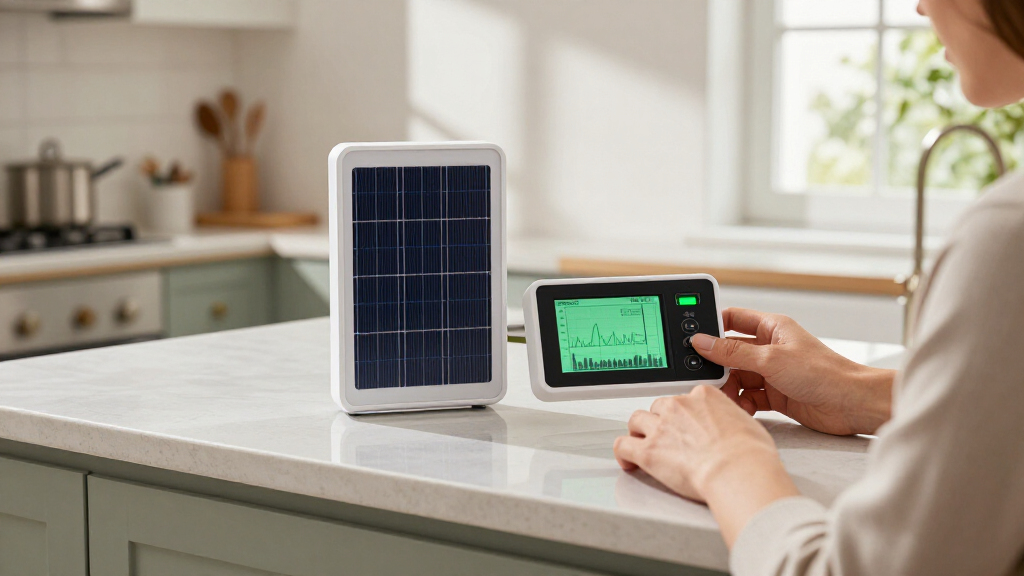
How We Picked
I ranked these monitors by how well they answer common household energy questions: what the whole home is using, which circuits or appliances account for it, and whether the readings are practical to access. I weighed monitoring scope, sensor and clamp setup, smart-home or local-control options, ease of use, and the limitations created by the product’s form factor. A multi-circuit monitor generally ranks above a single-outlet meter for whole-home insight, but a plug-based option can be the better fit for someone who needs a quick appliance check without panel work.
The ordering reflects those differences rather than treating every product as a substitute. The Emporia Vue 3 leads as a balanced whole-panel choice; the Meross 18-circuit options stand out for buyers who value broader sensor coverage or smart-home integration. Plug-in products rank lower for whole-home diagnosis, not because they are poor tools, but because their readings cover only devices connected through them. Before buying any panel monitor, verify panel compatibility, sensor count, installation requirements, and app or network needs.
Factors to Consider When Choosing Best Home Electricity Monitors
Start with the question you want the monitor to answer, not the largest sensor count on the box. A monitor that tracks every major circuit can help explain household patterns, while an outlet meter is better for checking one appliance at a time. These decisions affect installation, data quality, and how useful the readings will be after setup.
Choose Whole-Panel Tracking or Outlet-Level Readings
Whole-panel monitors measure incoming power or selected circuits, making them useful for seeing patterns across heating, cooling, cooking, and other hardwired loads. Outlet monitors measure only what passes through the plug, so they are well suited to a fridge, computer, or portable heater but cannot account for a built-in oven or central air system. A common mistake is buying a plug meter expecting it to explain the whole utility bill. If you mainly want to find which portable appliance runs often, a plug-in device can give a more direct answer with less setup. If you need a household-wide picture, panel sensing is the more suitable class. Some buyers may use both: panel monitoring for patterns and a plug meter for closer checks on individual devices.
Match Sensor Coverage to Your Electrical Panel
Sensor count alone does not tell you how much useful information a monitor will provide. Homes differ in panel layout, circuit assignments, and whether a major appliance has a dedicated circuit, so first list the loads you want to track and identify their breakers. Some monitoring kits use sensors for selected circuits while also measuring the service feed; those readings are not interchangeable. Leave room for changes if you expect to add a heat pump, electric vehicle charger, or other large load. Avoid assuming that every circuit can be monitored individually just because a product includes many sensors. Check the installation guide and confirm the sensor type and count suit your panel before ordering.
Plan for Panel Access and Installation
Many circuit monitors require access inside the electrical panel, which can involve working near hazardous equipment. A panel sensor installation is not the right project for every homeowner, and local rules or the product instructions may call for a qualified electrician. That can add time and complexity compared with placing a meter between an appliance and an outlet. Check whether the system needs a powered gateway, available panel space, or a suitable network connection nearby. If you rent or cannot arrange panel access, focus on plug-in options and accept that their coverage is limited. Do not choose a monitor based only on its app if its physical installation does not fit your home.
Check Smart-Home, Network, and Local-Control Needs
Energy data is most useful when you can access it in the way you prefer, whether through a manufacturer app, a voice assistant, or a home-automation platform. Support varies by model, even within a brand, so verify the exact product’s integrations rather than relying on a family name. Home Assistant users may prioritize explicit compatibility, while buyers who want basic readings may care more about a simple app. Local-control options can reduce reliance on cloud services, but they may require more configuration or limit certain app features. Also check Wi-Fi band and signal requirements near the panel; a weak connection can make an otherwise capable system frustrating. Decide how much setup you are willing to handle before choosing advanced integrations.
Understand What the Readings Can and Cannot Tell You
A monitor can show energy use and patterns, but it cannot automatically explain every change in a bill. Billing periods, utility rates, solar production, and time-of-use charges may require separate configuration or data sources. Some systems estimate circuit readings from sensors, while others focus on service-level measurements, so check how the product reports power and energy. A sudden spike can point you toward a load to investigate, but it does not by itself diagnose a faulty appliance. If your main goal is cost tracking, confirm that the app can use your tariff and distinguish imported power from solar generation where relevant. Treat readings as a guide for follow-up, not a substitute for an electrical inspection or utility statement.
Pay for Useful Coverage, Not Unused Features
More sensors, integrations, and data views can be worthwhile when they answer a specific question, but extra capability adds little if you only want to check one appliance. A beginner may get more practical value from straightforward plug-in monitoring than from a panel system they do not want to configure. Buyers investigating recurring household loads may benefit from circuit-level detail, especially when hardwired equipment is central to the question. Premium features make the most sense when they add needed coverage, local control, or integration with an existing smart home. Before choosing, write down the two or three decisions you hope the monitor will help you make. That short list can prevent paying for monitoring scope you will not use.
Frequently Asked Questions
Can I monitor my whole home without opening the electrical panel?
Not with a standard plug-in watt meter or smart plug alone. Those devices measure only the appliances connected through them, so they cannot capture hardwired equipment or provide a complete household total. A service-level monitor may offer broader coverage, but its sensors still need to be installed at the electrical service or panel. If panel access is not available to you, use plug-in monitors for the loads you can reach and treat the result as a partial view. Renters should also check their lease and get permission before installing any equipment near fixed wiring.
Do I need an electrician to install a circuit-level energy monitor?
It depends on the monitor, your electrical panel, your comfort with electrical work, and local requirements. Circuit sensors often sit inside or near the panel, where hazardous components may be present even when a breaker is off. Read the manufacturer’s installation instructions before purchase and check whether the company recommends a licensed electrician. If the panel is unfamiliar, crowded, damaged, or difficult to access, professional installation is the safer route. Plug-in meters avoid panel work, but they provide readings only for connected devices.
Will a home electricity monitor tell me exactly what my next bill will be?
It can help estimate energy costs when the app supports your utility rates and the data covers the same billing period as your bill. The estimate may differ if rates vary by time, taxes and fixed charges are included, or the monitor does not account for solar exports and other credits. Check whether the system lets you enter a tariff and whether its readings are reported in a way that matches your utility statement. A monitor is most useful for comparing usage patterns and spotting changes, rather than promising an exact final amount. Keep using your utility bill as the authoritative record.
Should I pick a monitor with more circuit sensors if I have a large home?
Not automatically. The right sensor count depends on your panel arrangement and the circuits you want to distinguish, not just the home’s square footage. Large loads may already have dedicated breakers, while several everyday outlets or lights may share one circuit. Map your priorities to your breaker labels and verify the product’s supported sensor configuration before buying. If your goal is a broad total rather than separate readings for many circuits, a smaller setup may answer your question with less installation work.
Is local control worth prioritizing over a manufacturer app?
Local control is useful if you want readings or automations to keep working with less dependence on an internet connection or a vendor’s cloud service. It can also matter to buyers already using a platform such as Home Assistant. The tradeoff is that setup may require more technical effort, and local access may not include every feature found in the manufacturer’s app. If you mainly want occasional energy checks, a clear app may be simpler. Confirm the exact model’s local features, integrations, and network requirements before treating local control as a deciding factor.
Conclusion
For the best overall balance, I recommend the Emporia Vue 3 for buyers who want circuit-level household insight. The best value depends on the scope you need: Tapo P115 plugs are a practical starting point for appliance tracking, while a multi-circuit system is the better fit when you need panel-wide context. For a premium, integration-focused choice, consider the Meross 18-circuit model with Home Assistant support, after confirming its setup suits your home. Beginners who want a low-effort first step should start with a plug-in meter or smart plug rather than panel sensors. For specific needs, look at Refoss for local-control options, Eyedro for Wi-Fi and Ethernet connectivity, and whole-panel models such as Siemens Inhab or Nestool when their sensor setup matches your panel. Choose by the loads you need to understand, then verify installation and compatibility before you buy.
Fall Picks
fall essentials
As an affiliate, we earn on qualifying purchases.