The best electric car accessories solve practical problems, from charging compatibility to keeping cables tidy and handling a low tire. My best overall pick is the Lectron Tesla-to-J1772 adapter for owners who need to connect compatible J1772 charging equipment to a Tesla. For a more organized home setup, the EV Hover cable holder manages cable reach, while the OlarHike tire inflator adds roadside flexibility. The main tradeoffs are whether an accessory fits your vehicle and charging setup, how much space it takes, and whether it solves a problem you actually have. Read on for the full breakdown and guidance on matching each pick to your needs.

Get backup power and energy gear delivered free — and shop member deals
- Fast, free delivery on millions of items
- Access to Prime Big Deal Days deals on October 6–7
- Prime Video, Amazon Music and more included
Key Takeaways
- Compatibility matters more than accessory count: the Lectron adapter and ESSGAER fast-charging adapter serve different connector and charging contexts, so buyers need to check vehicle, charger, and network compatibility before choosing.
- Home cable management has several distinct approaches: the EV Hover supports cable reach, while the Nexoroot, Anina, Joinfworld, and Wallbox Berlin products focus on holding or organizing a connector and cable.
- The ULTRA EVSE is the roundup’s charging-equipment pick: its 32A Level 2 station and 18-foot cable make it a different kind of purchase from the passive wall hooks and holsters.
- Portable utility extends beyond charging: the OlarHike inflator addresses tire upkeep, and the LISEN retractable charger and SCUARI screen cleaner focus on everyday cabin convenience.
- The strongest choice depends on a specific pain point: buyers should prioritize charging compatibility, cable storage, or roadside readiness rather than treating every accessory as a must-have.
| Nexoroot EV Charger Holder Wall Mount – Heavy-Duty J-Hook for Cable Retractor |  | Best for Heavy-Duty Cable Storage | Mounting type: Wall mount | Material: Heavy-duty carbon steel with rubber coating | Maximum weight capacity: 40 pounds | VIEW LATEST PRICE | See Our Full Breakdown |
| OlarHike Portable Tire Inflator with Rechargeable Battery and 12V Power |  | Best for Roadside Readiness | Power sources: Built-in rechargeable battery and 12V DC | Battery capacity: Three 2000mAh batteries | Maximum tire pressure: 51 PSI | VIEW LATEST PRICE | See Our Full Breakdown |
| Lectron Tesla-to-J1772 EV Charging Adapter, 48 A, 240 V |  | Best for J1772 Drivers Using Tesla AC Chargers | Connector type: Tesla to J1772 | Compatible equipment: Tesla wall connectors, destination chargers, and mobile connectors | Maximum current: 48 A | VIEW LATEST PRICE | See Our Full Breakdown |
| Anina SAE J1772 EV Charger Holder and Cable Organizer |  | Best Covered J1772 Wall Holster | Connector compatibility: SAE J1772 | Material: PA | Mounting type: Wall mount | VIEW LATEST PRICE | See Our Full Breakdown |
| ESSGAER NACS to CCS1 EV Fast-Charging Adapter |  | Best for CCS1 Drivers Seeking NACS DC Fast Charging | Input connector: NACS | Output connector: CCS1 | Maximum power: 250 kW | VIEW LATEST PRICE | See Our Full Breakdown |
| Joinfworld EV Charger Holder Wall Mount Kit |  | Best Complete Wall-Organization Kit | Brand: Joinfworld | Model number: CHD-J1772+MH | Compatibility: J1772 charger plugs | VIEW LATEST PRICE | See Our Full Breakdown |
| Wallbox Berlin J1772 EV Charger Connector and Cable Holster |  | Best Simple J1772 Holster | Brand: Wallbox | Connector compatibility: J1772 | Item weight: 11.7 ounces | VIEW LATEST PRICE | See Our Full Breakdown |
| ULTRA EVSE 32A Level 2 EV Charging Station with 18-Foot Cable |  | Best Home Charging Upgrade | Brand: ULTRA EVSE | Model: FSEV-32A | Input voltage: 240V | VIEW LATEST PRICE | See Our Full Breakdown |
| EV Hover Extendable EV Charging Cable Holder, 9.25 ft, Black |  | Best for Long-Reach Cable Management | Brand: EV Hover | Arm length: 9.25 feet | Swivel: 180 degrees | VIEW LATEST PRICE | See Our Full Breakdown |
| LISEN 84W 4-in-1 Retractable Car Charger |  | Best for Charging Devices on the Road | Maximum output: 84W | USB-C PD output: Up to 45W; up to 36W with 12V vehicle power | USB-A output: 12W | VIEW LATEST PRICE | See Our Full Breakdown |
| SCUARI Car Screen Cleaner Microfiber Pad |  | Best for Keeping the Cabin Screen-Clean | Brand: SCUARI | Model: 2260QJB001 | Material: Microfiber | VIEW LATEST PRICE | See Our Full Breakdown |
More Details on Our Top Picks
Nexoroot EV Charger Holder Wall Mount – Heavy-Duty J-Hook for Cable Retractor
The Nexoroot J-hook is a straightforward way to keep a charging cable and plug off the garage floor, with a 40-pound capacity and rubber coating that helps protect the cable from scuffs. Its wide hook and elastic strap provide more cable-and-plug security than the Anina SAE J1772 holder, which focuses on storing a compatible connector and shielding it with a cap. That makes the Nexoroot a better fit for owners who want an open, flexible hook rather than a shaped holster. The tradeoff is installation: it needs screws drilled into a suitable wall, so it is less convenient for renters or anyone avoiding holes. It also does not offer the Anina holder’s protective cap against dust and rain.
Pros:- Wide J-hook holds the cable and plug together.
- Rubber coating helps prevent cable abrasion and slipping.
- Rust-resistant carbon steel supports indoor or outdoor mounting.
- Elastic strap helps keep the plug secured.
Cons:- Requires drilling into wood, brick, or concrete.
- The 40-pound maximum capacity may not suit unusually heavy cable setups.
- Open-hook design does not shield the plug from dust or rain.
Best for: EV owners with a fixed garage or outdoor charging spot who want to hang a cable and plug together.
Not ideal for: Renters or drivers seeking a covered J1772 plug holder, since this hook requires screw mounting and leaves the plug exposed.
- Mounting type:Wall mount
- Material:Heavy-duty carbon steel with rubber coating
- Maximum weight capacity:40 pounds
- Hooks:1
- Dimensions:4.09 × 1.57 × 5.7 inches
- Weight:0.22 kg
- Color:Black
Our verdict“Choose the Nexoroot if you need a sturdy, open wall hook for organizing a cable and plug at a permanent charging spot.”
OlarHike Portable Tire Inflator with Rechargeable Battery and 12V Power
The OlarHike portable inflator earns a place here as a practical tire-care accessory for EV drivers who want a compact tool in the trunk, rather than a charging-specific storage product like the Nexoroot wall hook. Its two power options let you use the built-in battery away from the car or connect to a 12V outlet, while preset modes and auto shut-off reduce guesswork when topping up a tire. The dual LED display makes pressure readings easy to track, and the flashlight adds utility after dark. At 1.2 pounds, it is easier to stow than bulkier emergency equipment. Its limits matter: 51 PSI and the stated suitability for cars and light pickups rule out many heavy-duty truck and RV needs, and repeated inflation may call for a 12V power source.
Pros:- Runs from its rechargeable battery or a 12V DC outlet.
- Auto shut-off and presets simplify routine tire top-ups.
- Compact 1.2-pound body comes with a storage bag.
- USB output and flashlight add roadside utility.
Cons:- Maximum pressure of 51 PSI limits use with some heavier vehicles and applications.
- Not intended for heavy-duty pickup trucks or RV tires.
- Battery use may be less practical for repeated inflation than a 12V connection.
Best for: EV drivers who want a lightweight trunk inflator for passenger-car tires, bikes, or sports gear.
Not ideal for: RV owners and drivers of heavy-duty pickups who need higher pressure capability or sustained heavy-use inflation.
- Power sources:Built-in rechargeable battery and 12V DC
- Battery capacity:Three 2000mAh batteries
- Maximum tire pressure:51 PSI
- Inflation rate:195/65 R15 tire from 30 to 35 PSI in 55 seconds
- Pressure units:PSI, BAR, KPA, and KG/CM²
- Display:Dual LED screen
- Weight:1.2 pounds
- Dimensions:6.5 × 2.76 × 2.17 inches
- Additional features:Auto shut-off, USB output, and LED flashlight
Our verdict“Pick the OlarHike for a compact, dual-powered inflator suited to passenger cars and light roadside needs.”
Lectron Tesla-to-J1772 EV Charging Adapter, 48 A, 240 V
The Lectron Tesla-to-J1772 adapter solves a specific access problem: it lets a J1772 vehicle connect to compatible Tesla wall connectors, destination chargers, and mobile connectors. Its 48 A, 240 V rating suits AC charging setups, while SGS certification to UL 2251 provides a documented safety standard. Unlike the ESSGAER NACS-to-CCS1 adapter, which is designed for DC fast charging, this Lectron model is for the listed Tesla AC equipment and should not be treated as a Supercharger adapter. Its compact form is useful for travel, but compatibility is narrow: both the car’s J1772 inlet and the charger type must match. Buyers who only charge at J1772 stations may have little reason to carry an adapter at all.
Pros:- Supports charging up to 48 A and 240 V.
- Works with several specified Tesla AC charger types.
- Compact format is convenient for carrying in the vehicle.
- SGS certified to UL 2251 and backed by a two-year warranty.
Cons:- Only supports J1772 vehicles and the listed Tesla charger types.
- Does not provide the NACS-to-CCS1 DC fast-charging function of the ESSGAER adapter.
Best for: J1772 EV owners who regularly encounter compatible Tesla wall connectors, destination chargers, or mobile connectors.
Not ideal for: Drivers seeking access to Tesla Superchargers or those whose charging routine already relies on J1772 stations.
- Connector type:Tesla to J1772
- Compatible equipment:Tesla wall connectors, destination chargers, and mobile connectors
- Maximum current:48 A
- Maximum voltage:240 V
- Ports:1
- Certification:SGS certified to UL 2251
- Weight:0.51 kg
- Warranty:2 years
Our verdict“Choose this Lectron adapter if your J1772 EV needs access to compatible Tesla AC charging equipment, not DC fast chargers.”
Anina SAE J1772 EV Charger Holder and Cable Organizer
The Anina J1772 holder is the more protective wall-storage choice compared with the open Nexoroot J-hook. Its shaped holder stores an SAE J1772 connector, while a protective cap helps keep rain and dust away when the plug is parked. That makes it a better match for an outdoor charging point where the connector needs more shelter, and its wall-mounted design also keeps the cable off the ground. The tradeoff is compatibility: this holder is specified for J1772 connectors, whereas the Nexoroot’s open hook is less connector-specific and can hold a cable and plug together. Anina also requires a flat mounting surface, so it is not a no-install accessory. Buyers with a different connector standard should check fit before choosing it.
Pros:- Designed for SAE J1772 connectors.
- Protective cap helps keep rain and dust away from the plug.
- Wall mounting keeps the cable off the ground.
- PA construction is described as durable and temperature resistant.
Cons:- Compatibility is limited to SAE J1772 connectors.
- Requires installation on a flat surface.
- Unlike the Nexoroot open hook, it is not presented as a general cable-and-plug hanger.
Best for: J1772 EV owners who park outdoors and want a wall-mounted holder that covers the stored connector.
Not ideal for: Drivers with non-J1772 connectors or anyone unable to mount the holder on a flat surface.
- Connector compatibility:SAE J1772
- Material:PA
- Mounting type:Wall mount
- Use:Indoor and outdoor
- Weight:7 ounces
- Package dimensions:11.81 × 3.31 × 3.23 inches
- Model number:PJ-2401
Our verdict“Pick the Anina if you have a J1772 connector and want a capped wall holder for an outdoor charging area.”
ESSGAER NACS to CCS1 EV Fast-Charging Adapter
The ESSGAER NACS-to-CCS1 adapter targets a different job from the Lectron: it connects compatible CCS1 vehicles to NACS DC fast-charging equipment, including supported Tesla Supercharger stations. Its stated rating of up to 250 kW, 500 A, and 1000 V is aimed at fast-charging use, while temperature cutoff, dual locking, and an IP66 housing address heat, secure connection, and weather exposure. That makes it a more specialized and higher-power accessory than the Lectron Tesla-to-J1772 adapter, which is for specified AC chargers. The main drawback is vehicle-dependent access: connector fit alone does not guarantee DC fast-charging support, and some plug-in hybrids or pre-2016 models may not qualify. Check vehicle and station compatibility before relying on it for a trip.
Pros:- Rated for DC charging up to 250 kW, 500 A, and 1000 V.
- Temperature cutoff and dual-locking mechanism add protection and connection security.
- IP66-rated housing is designed to resist dust and water ingress.
- UL94 V-0 flame-retardant housing and stated 20,000-plus plug-unplug cycle rating.
Cons:- Vehicle compatibility varies; connector type alone does not confirm charging support.
- Some plug-in hybrids and models released before 2016 may not support DC fast charging.
- It serves a different use from the Lectron AC adapter and will not replace a J1772 charging adapter.
Best for: Owners of compatible CCS1 EVs who want to use supported NACS DC fast-charging stations.
Not ideal for: Drivers whose vehicles lack DC fast-charging support, including some plug-in hybrids and certain older models.
- Input connector:NACS
- Output connector:CCS1
- Maximum power:250 kW
- Maximum current:500 A
- Maximum voltage:1000 V
- Temperature cutoff:85°C (185°F)
- Ingress protection:IP66
- Housing:UL94 V-0 flame-retardant
- Warranty:2 years
Our verdict“Choose the ESSGAER only after confirming your CCS1 EV and intended NACS station support DC fast charging through this adapter.”
Joinfworld EV Charger Holder Wall Mount Kit
The Joinfworld kit is my pick for drivers who want one wall-mounted setup for the plug, cable, and charging box rather than a hook alone. Its three included pieces divide those jobs: the plastic holster protects the J1772 connector, while the metal holders support the cable and charger box. That makes it a more complete organizer than the Wallbox Berlin holster, which focuses on the connector and cable. The tradeoff is that compatibility is specified for J1772 plugs, so buyers with other connector types should check fit before choosing it. The charger and charging box are not included, and installation requires a suitable wall location. I’d choose this when tidy, dedicated storage matters more than a flexible cable reach system like the EV Hover.
Pros:- Includes separate holders for the connector, cable, and charging box
- Metal holders support and organize charging equipment
- Insulated plastic holster helps protect the plug
- Designed for indoor or outdoor use
Cons:- Compatibility is specified only for J1772 charger plugs
- Charger and charging box are not included
- Requires a wall location and installation
Best for: J1772 EV owners who want dedicated wall storage for the connector, cable, and charging box in a garage or sheltered outdoor charging area
Not ideal for: Drivers with non-J1772 connectors or anyone seeking a cable arm that reaches across a wide parking area
- Brand:Joinfworld
- Model number:CHD-J1772+MH
- Compatibility:J1772 charger plugs
- Holster inner dimensions:4.9 x 3.4 inches (L x W)
- Materials:Metal holders; plastic holster
- Mounting type:Wall mount
- Set contents:Charger holster, cable holder, charging box holder
Our verdict“Choose the Joinfworld kit if you want a coordinated J1772 wall setup for the plug, cable, and charging box rather than a single-purpose holster.”
Wallbox Berlin J1772 EV Charger Connector and Cable Holster
The Wallbox Berlin holster suits drivers who need a straightforward place to park a J1772 connector and keep its cable orderly. Its weather-resistant construction supports indoor or outdoor installation, and included hardware avoids a separate search for mounting pieces. Compared with the Joinfworld kit, this is the more focused option: it organizes the connector and cable but does not include a holder for the charging box. That simpler setup may be preferable when the charger already has a home, though it offers less complete storage. The wall-mounted design also means it cannot help renters or drivers without an available mounting surface. Tesla owners need an adapter for connector compatibility, so I’d favor the EV Hover cable holder if flexible cable reach and broader connector compatibility matter more than a dedicated J1772 holster.
Pros:- Designed for J1772 connectors
- Keeps the connector and cable organized
- Weather-resistant construction suits indoor or outdoor use
- Mounting hardware is included
Cons:- Does not include a holder for the charging box
- Requires a wall-mounted installation
- Tesla compatibility requires an adapter
Best for: J1772 drivers who already have a place for their charging unit and want a weather-resistant wall holster with installation hardware included
Not ideal for: Renters or Tesla owners without a suitable adapter who need a no-mount solution or a complete charger-box storage kit
- Brand:Wallbox
- Connector compatibility:J1772
- Item weight:11.7 ounces
- Product dimensions:8.11 x 6.1 x 5.91 inches
- Model number:HOLSTER-T1-BRLN-B
- Installation:Wall-mounted; hardware included
- Use:Indoor and outdoor
Our verdict“Pick the Wallbox Berlin when you need a simple, weather-resistant J1772 connector and cable holster, not a full equipment-storage kit.”
ULTRA EVSE 32A Level 2 EV Charging Station with 18-Foot Cable
Unlike the wall organizers in this roundup, the ULTRA EVSE is the charging station itself: a 240V, 32A Level 2 unit with an 18-foot J1772 cable. Under suitable conditions, it can add up to 25 miles of range per hour, making it a more direct home-charging upgrade than the Joinfworld or Wallbox Berlin accessories, which only store charging equipment. Its delay-start feature, adjustable up to eight hours, gives owners a way to schedule charging around off-peak periods. The tradeoff is infrastructure: it requires a 240V supply and a NEMA 14-50 connection, so it is not a simple add-on for every garage. The stated range gain also depends on charging conditions, and the fixed 18-foot cable may not suit every parking layout.
Pros:- Level 2 charging with up to 25 miles of range per hour under suitable conditions
- Delay-start feature can schedule charging up to eight hours ahead
- 18-foot J1772 cable supports a range of residential and commercial setups
- CSA safety certified
Cons:- Requires a 240V power supply and NEMA 14-50 plug
- Advertised range added per hour depends on charging conditions
- 18-foot cable may not reach every parking position
Best for: EV owners with a 240V NEMA 14-50 outlet who want a dedicated Level 2 home or commercial charging station with scheduled-start capability
Not ideal for: Drivers without 240V power, those seeking a portable 12V accessory, or households whose parking setup needs a longer cable
- Brand:ULTRA EVSE
- Model:FSEV-32A
- Input voltage:240V
- Charging level:Level 2
- Current:32A
- Connector:J1772
- Cable length:18 feet
- Plug type:NEMA 14-50
- Safety certification:CSA
Our verdict“Choose this station if you have a compatible 240V outlet and need actual Level 2 charging, rather than cable storage like the Joinfworld kit.”
EV Hover Extendable EV Charging Cable Holder, 9.25 ft, Black
The EV Hover is built for a different garage problem than the holsters: keeping a long charging cable suspended as it runs from the wall to the car. Its 180-degree swivel arm extends up to 9.25 feet and folds flat when idle, helping keep the cable away from the floor and foot traffic. That reach makes it more adaptable to changing parking positions than the fixed storage points on the Joinfworld kit or Wallbox Berlin holster. It also lists compatibility with Tesla, J1772, and other common connectors. The cost of that reach is a substantial wall-mounted arm, and the product does not include a cable holster. I’d choose it for cable routing across a garage, but not when compact storage of the charging plug is the main need.
Pros:- Arm extends up to 9.25 feet to manage cable reach
- 180-degree swivel supports varied cable routes
- Folds flat against the wall when not in use
- Compatibility includes Tesla, J1772, and other common connectors
Cons:- Requires wall mounting and a suitable installation location
- Does not include a cable holster
- Large arm may be more hardware than needed for a compact charging area
Best for: Drivers who park in different positions or need to route a long charging cable overhead and away from garage traffic
Not ideal for: People seeking a compact connector holster, a complete charger-storage kit, or an accessory that avoids wall installation
- Brand:EV Hover
- Arm length:9.25 feet
- Swivel:180 degrees
- Mounting type:Wall mount
- Materials:Alloy steel and aluminum
- Finish and color:Powder-coated; black
- Compatibility:Tesla, J1772, and other common EV connectors
- Included components:9.25 ft arm, fasteners, mounting plate, straps
Our verdict“Choose the EV Hover if cable reach and keeping the cord off the floor matter more than having a dedicated connector holster.”
LISEN 84W 4-in-1 Retractable Car Charger
The LISEN 84W car charger is the only pick here aimed at the cabin rather than the home charging setup. It plugs into a 12V socket and combines two retractable cables with USB-C and USB-A ports, allowing up to four devices to charge at once. That makes it more useful for phones and tablets during a drive than the ULTRA EVSE, which charges the vehicle from a 240V supply rather than small electronics from the cabin. The adjustable 180-degree design can help position the unit around a console, while retractable cables reduce loose cord clutter. Its limits are clear: USB-C output can fall to 36W with 12V vehicle power, and it supports charging only—not CarPlay, Bluetooth, or data transfer. It also lacks Micro-USB support.
Pros:- Can charge up to four devices at once
- Retractable USB-C and iPhone charging cables help reduce cabin clutter
- USB-C PD output reaches up to 45W
- 180-degree adjustable design can suit different console layouts
Cons:- Requires a 12V cigarette lighter socket
- Does not support CarPlay, Bluetooth, or data transfer
- Not compatible with Micro-USB devices
Best for: Drivers and passengers who regularly charge several USB-C or iPhone-compatible devices from a 12V vehicle socket
Not ideal for: People who need CarPlay, Bluetooth, data transfer, Micro-USB charging, or a charger for vehicles without a 12V socket
- Maximum output:84W
- USB-C PD output:Up to 45W; up to 36W with 12V vehicle power
- USB-A output:12W
- Retractable cables:USB-C and iPhone charging cable
- Cable length:Up to 31.5 inches
- Simultaneous charging:Up to 4 devices
- Input:12V cigarette lighter socket
- Adjustable angle:180 degrees
- Warranty:24-month replacement promise
Our verdict“Pick the LISEN for multi-device cabin charging from a 12V socket, not for vehicle charging or infotainment connectivity.”
SCUARI Car Screen Cleaner Microfiber Pad
Among these accessories, the SCUARI pad is the small, maintenance-focused pick: it helps remove fingerprints and dust from a car’s central screen without adding a bulky tool to the glove box. Its two-sided microfiber design separates wiping from drying, while the glove-style shape gives you a simple way to hold the 4.13-inch square pad as you clean. Unlike the OlarHike tire inflator or the LISEN retractable charger, it does not solve a roadside or charging need; its value is keeping frequently touched interior surfaces tidy. The tradeoff is reach: a small pad may take several passes across a larger display, and cleaning liquid is not included. It is washable and reusable, but buyers who want a spray-and-cloth kit or a dedicated screen-cleaning solution will need to supply that separately.
Pros:- Two sides divide wiping from drying
- Reusable, washable microfiber construction
- Compact 4.13-inch square size is easy to store in a glove box
- Designed for screens, dashboards, and other surfaces
Cons:- Cleaning liquid is not included
- Small pad can require repeated passes on larger screens
Best for: Drivers who regularly clean fingerprints from a central touchscreen and want a compact, washable pad to keep in the cabin.
Not ideal for: Drivers seeking a complete screen-cleaning kit, a large cloth for wide displays, or an accessory that helps with charging or roadside readiness.
- Brand:SCUARI
- Model:2260QJB001
- Material:Microfiber
- Size:4.13 × 4.13 inches
- Design:Two-color, glove-style pad
- Weight:0.634 ounces
- Quantity:1 cleaning cloth
- Use:Car dashboards, central screens, and other surfaces
Our verdict“Choose this compact pad if screen fingerprints are your main cabin-cleaning nuisance and you are comfortable supplying any cleaning liquid separately.”
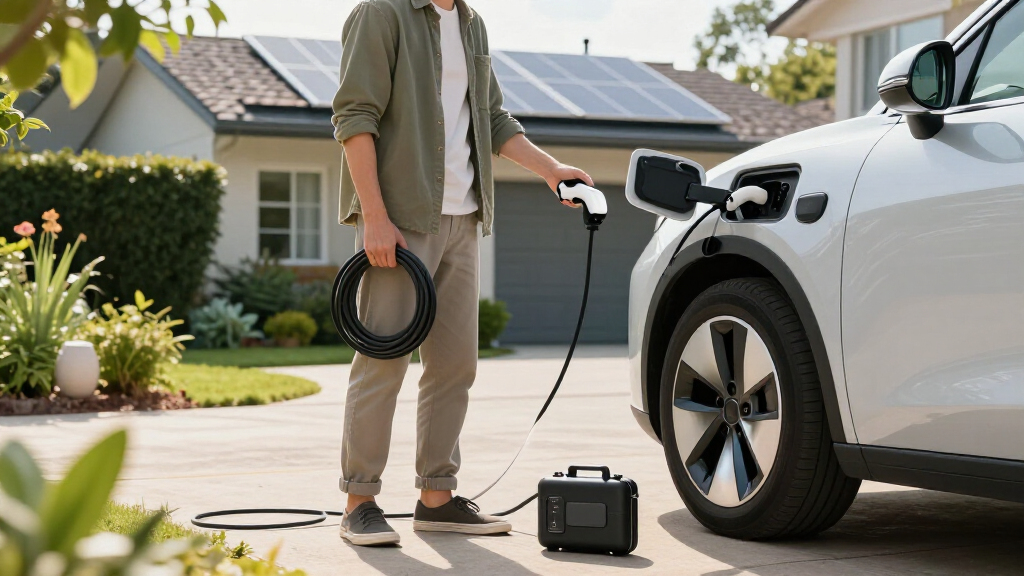
How We Picked
I compared the 11 products by the job they do for an EV owner: charging access, home cable management, tire care, or cabin upkeep. For charging-related picks, I focused on connector type, stated electrical capacity, cable length, and the buyer’s need to verify vehicle and equipment compatibility. For organizers and everyday accessories, I weighed fit, space needs, usability, and whether the item addresses a recurring inconvenience rather than adding clutter.
The ranking gives priority to accessories with a clear, broadly useful role, then distinguishes specialized options by the owner or setup they suit. The Lectron adapter leads for its focused compatibility use; the EV Hover and ULTRA EVSE serve different home-charging needs, while the OlarHike inflator adds practical non-charging utility. The several cable holders are not interchangeable by default, and compact items like the LISEN charger and SCUARI cleaner rank as convenience add-ons rather than core EV equipment. Product fit, electrical requirements, and manufacturer guidance should be checked before purchase.
Factors to Consider When Choosing Best Electric Car Accessories
I’d start by identifying the inconvenience you want to fix, then check the vehicle and equipment details that determine whether an accessory will work. These choices often look similar at a glance, but connector standards, installation needs, and the difference between storage and charging equipment can change the decision.
Match Connector Standards Before Buying an Adapter
Connector adapters are not universal, even when two plugs appear suited to the same charging session. Confirm the inlet on your vehicle, the connector on the charging equipment, and the adapter’s stated direction of use; an adapter designed for one pairing may not support the reverse. Check the charging level and power limits for every part of the connection, not just the adapter’s headline rating. Also review vehicle-maker and charging-network guidance, since access rules and compatibility can vary. A common mistake is treating physical fit as proof that charging will work. If your charging routine is already well served by compatible equipment, an adapter may add cost and another item to store without adding useful access.
Separate Home Charging Equipment From Cable Storage
A charging station supplies power; a wall hook, holster, or cable holder only supports storage or cable handling. Decide whether you need charging equipment at all before comparing organizers, because buying a holder will not add a charging circuit or improve charging speed. For a home station, check electrical requirements, installation conditions, cable reach, and local rules with a qualified installer where appropriate. For a holder, think about where the connector should sit, whether the cable can hang without dragging, and how much wall space is available. Avoid choosing by appearance alone: a tidy-looking mount may still be poorly placed for your parking position. Planning the parking path first can prevent a cable from crossing a walkway or being stretched around the vehicle.
Choose a Cable Organizer for Your Parking Layout
Wall hooks and holsters suit different habits: some mainly keep a connector off the ground, while broader cable-management setups can help guide or support a longer lead. Measure the distance from the planned mounting spot to the vehicle’s charge port with the car parked as it normally would be. Include slack for routing, but avoid a layout that leaves cable loops where people walk or tires can run over them. Check the mount’s installation method and the surface it is meant to attach to before drilling or fastening anything. Owners who park in more than one position may value reach and flexibility over a fixed, compact holder. Those with a stable parking spot may prefer a simpler organizer that takes less wall space.
Treat Electrical Ratings and Installation as Safety Questions
For any powered charger or high-capacity accessory, check voltage, amperage, connector type, and the electrical supply it requires. A stated rating does not mean every home circuit or vehicle can use that capacity; the complete setup must be compatible. Review installation instructions and seek qualified electrical advice when a unit connects to household wiring or requires a dedicated circuit. Do not rely on an extension cord or improvised adapter unless the manufacturer explicitly permits that configuration. Consider cable length alongside the location of the outlet and vehicle, since a longer cable can help reach but may also be harder to store. When requirements are unclear, pause the purchase and confirm them with the manufacturer or installer.
Pick Portable Accessories for the Problems You Actually Face
A tire inflator, multi-device car charger, and screen-cleaning pad address different routines, so their value depends on what you keep in the vehicle. For an inflator, check how it receives power, whether its connectors suit your tires, and whether its operating instructions match the task you expect it to handle. For a car charger, confirm the vehicle’s available power connection and the devices you intend to charge; a multi-port design is only useful if it fits that mix. A screen cleaner should be suited to delicate displays and kept free of grit that could mark a surface. Avoid buying several small items simply because each seems handy: storage space and the likelihood of regular use matter. Prioritize the accessory that solves a repeated inconvenience or fills a gap in your roadside plan.
Frequently Asked Questions
Can I use a Tesla-to-J1772 adapter with any J1772 charging station?
Not automatically. The adapter is intended to bridge specific connector types, but the vehicle, adapter, charging equipment, and charging network all need to support the intended use. Check the adapter’s stated direction, power limits, and compatibility notes, then confirm whether the charging station permits that setup. A connector that physically fits does not guarantee communication or charging. If you are unsure, confirm the exact pairing with the adapter maker and your vehicle manufacturer.
Should I buy an EV cable holder or a cable extender?
Choose a holder when your existing cable reaches the car but needs a safe, tidy place to rest between sessions. Consider a reach-focused cable support only if your parking layout makes routing or supporting the cable difficult. Neither type should be assumed to add electrical length or change the charger’s capabilities unless the product is specifically designed and rated to do so. Measure the parking position and cable path before deciding. If reach is the problem, verify your charging equipment’s permitted cable arrangement rather than stretching a lead or adding an unapproved extension.
Do I need a Level 2 charging station if I already have a portable charger?
That depends on your driving routine, available electrical supply, and how long your vehicle is parked at home. A dedicated Level 2 station may suit owners who want a fixed home setup and whose vehicle and electrical installation support it. A portable charger may be sufficient for a different pattern of use, but charging speed and outlet requirements vary by equipment. Compare your daily driving needs with the charging time your current setup provides before replacing it. Ask a qualified electrician to review the circuit and installation requirements for a hardwired or higher-capacity option.
What should I check before buying an EV fast-charging adapter?
Start with the vehicle’s charging inlet, the station’s connector, and the adapter’s stated supported pairing. Then check vehicle and charger compatibility, charging-network policies, and the adapter’s voltage and current limits. Fast-charging support is not guaranteed just because an adapter is described for a particular connector pair. Read the manufacturer’s instructions for use, temperature limits, and any restrictions on charging sessions. If the maker does not clearly document your exact vehicle and station combination, contact them before relying on the adapter for a trip.
Which accessory should a new EV owner buy first?
Start with a practical need, not a fixed accessory checklist. If you already have dependable charging access, a cable holder may improve a cluttered home setup; if tire checks are a concern, a portable inflator may be more useful. Owners who use charging equipment with a different supported connector may need an adapter, but should verify compatibility before purchase. A new charging station is a larger decision because it involves electrical capacity and installation planning. I’d first identify the issue you face most often, then buy only the item that directly addresses it.
Conclusion
For a broad mix of owners, my best overall pick is the Lectron Tesla-to-J1772 adapter, provided its connector pairing matches your vehicle and charging plans. The best value for a tidy home setup depends on the layout: the Nexoroot or Anina offers a focused holder, while the EV Hover is the better fit when cable reach and routing are the main concerns. The best premium-style home upgrade is the ULTRA EVSE for buyers who need a Level 2 station and have confirmed their electrical and vehicle requirements. For beginners, I’d start with a simple organizer or the OlarHike inflator before taking on a charging-equipment purchase. For specific needs, choose ESSGAER only after verifying fast-charging compatibility, LISEN for in-car device charging, and SCUARI for screen upkeep; skip accessories that do not solve a real problem in your routine.
Fall Picks
fall essentials
As an affiliate, we earn on qualifying purchases.