The best solar-powered laptop charger overall is the Portable Solar Generator 300W with 60W Solar Panel, because it pairs enough battery capacity to run a full-size laptop for a working day with a panel large enough to actually recharge it with sunlight. If portability matters more, the FlexSolar 60W Foldable Panel turns any power bank into a solar rig and packs flat into a backpack. Budget buyers get the most from the Takki 88.8Wh Solar Generator, which costs far less while still charging most laptops. The main tradeoff in this category is simple: genuine solar panels that recharge a laptop are bulky, while pocketable “solar power banks” mostly rely on wall charging with solar as an emergency trickle. Keep reading for the full breakdown of where each of the 15 options lands on that spectrum.
Complete the kit


Key Takeaways
- Small solar power banks like the YELOMIN 10000mAh and SOARAISE 48000mAh cannot realistically recharge a laptop from the sun alone — their tiny panels deliver a trickle at best, so I ranked them as backup chargers rather than true solar laptop solutions.
- The dividing line in this roundup is roughly 60W of panel output: only the 60W kits (the Portable Solar Generator 300W and FlexSolar panel) can restore meaningful laptop battery capacity within a single sunny afternoon.
- Capacity claims are wildly inflated across the category — several 40000mAh+ power banks output less usable laptop energy than the 146Wh–220Wh power stations, which is why watt-hours, not milliamp-hours, drove my rankings.
- AC outlets with low watt ratings (65W–100W) handle ultrabooks fine but fail or throttle with gaming laptops and 16-inch machines — buyers with power-hungry laptops need the 300W-class stations.
- Integrated cables (Selore, SOARAISE, YELOMIN) added real convenience value, but every one of those picks sacrificed solar input to get there — no product in the lineup does both well.




More Details on Our Top Picks
SinKeu 24000mAh Portable Power Bank with AC Outlet and Solar Generator
The SinKeu 24000mAh hits the sweet spot most buyers actually need: enough capacity for roughly one to two full laptop charges, a real 110V AC outlet, and a sub-4-hour recharge that won’t leave you waiting overnight. The OLED display is more useful than it sounds — it tells you exactly how much runtime is left, which the Selore & S-Global model also offers but with far less total energy on tap.
Compared with the 32000mAh 100W PD bank below, this one trades raw capacity for the flexibility of an AC outlet, which matters if your laptop uses a barrel charger rather than USB-C. The tradeoff is real, though: at 65W, the outlet won’t run gaming laptops or power-hungry workstations, and the unit is noticeably heavier than a simple power bank. Still, for general travel and emergency backup, this is the most balanced package in the lineup.
Pros:- 24000mAh capacity delivers one to two full laptop charges
- 110V AC outlet handles non-USB-C laptop chargers
- Fast recharge time of under 4 hours
- OLED display shows precise remaining battery and output status
Cons:- Heavier and bulkier than standard USB-only power banks
- 65W AC limit rules out high-wattage devices
- Needs specific recharging accessories for best results
Best for: Travelers and remote workers who want laptop-class backup power with both AC and USB options in one device
Not ideal for: Owners of gaming laptops or high-wattage machines — the 65W AC ceiling will not keep them charged
- Capacity:24000mAh / 88.8Wh
- AC Outlet:110V / 65W
- USB Outputs:QC3.0 9V/2A, 5V/3A
- Additional Outputs:DC 9-12.6V / 10A
- Recharge Time:Under 4 hours
- Display:OLED
- Safety:Built-in BMS
Our verdict“If you want one do-everything laptop charger for travel and emergencies without buying a full power station, this is the most sensible pick.”
Portable Laptop Charger 32000mAh 100W PD Power Bank with Multiple Ports
If your laptop charges over USB-C — a MacBook, a Dell XPS, most modern thin-and-lights — 100W Power Delivery is the number that matters, and this bank delivers it in full. That’s a meaningful step up from the SinKeu 24000mAh, whose 65W AC outlet will slow-charge or refuse many USB-C laptops entirely. With 118Wh on tap, this option can roughly double the runtime of a 14-inch laptop before it needs a wall outlet itself.
The adjustable DC outputs (12V through 24V) with included connectors make it a quiet workhorse for photographers and drone pilots too. The catch: you’ll need to supply your own USB-C wall plug for fast recharging, and it carries more cables than a simple travel setup demands. For pure USB-C households, though, nothing else in this batch matches its wattage.
Pros:- Full 100W USB-C PD charges even power-hungry laptops at native speed
- 118Wh capacity offers roughly two laptop charges
- Adjustable DC outputs cover 12V-24V devices with included tips
- Supports pass-through charging so you can top up bank and laptop together
Cons:- USB-C wall charger not included in the box
- Larger and heavier than streamlined travel chargers
- Multiple cables needed to use every output
Best for: USB-C laptop owners, photographers, and drone pilots who need 100W charging and barrel-plug flexibility
Not ideal for: Minimalist travelers who want a single built-in cable — this bank requires carrying multiple cables and connectors
- Capacity:32000mAh / 118Wh
- Max Output:100W
- USB-C:PD3.0 100W
- DC Output 1:12V / 6A
- DC Output 2:16V/20V 6A, 24V 5A
- USB Ports:2x USB QC3.0
Our verdict“This is the pick for anyone whose laptop charges at or near 100W over USB-C and who refuses to accept slow charging on the road.”
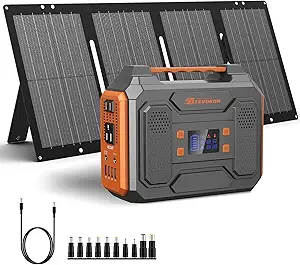
Portable Solar Generator 300W with 60W Solar Panel
Most products in this roundup make you buy the solar panel separately — the 146Wh power station later in this list is a good example — but this kit bundles a 300W generator with a 60W foldable panel, so you’re genuinely off-grid capable on day one. That panel can meaningfully recharge the station over a sunny afternoon, which is the entire point of a solar laptop charger if you’ll be away from outlets for days rather than hours.
Compared with the SinKeu 24000mAh, this trades pocketability for a true generator form factor: more outlets, 300W of headroom for running a laptop plus peripherals, and safety cutoffs for overload. Two honest weaknesses: the junction box is not waterproof, so rain management is on you, and the battery degrades if it sits uncharged for long stretches. For campers and RV users, though, it’s the most complete package here.
Pros:- 60W foldable solar panel included, so no separate panel purchase
- 300W output runs a laptop plus phone, lights, or small accessories simultaneously
- Multiple outlets with overload and short-circuit protection
- Recharges via solar, AC, or DC for flexibility
Cons:- Cannot run devices above 300W
- Solar panel junction box is not waterproof
- Battery health declines if left uncharged for extended periods
Best for: Campers, RV travelers, and off-grid workers who want a matched generator and panel in one purchase
Not ideal for: Day-trippers and commuters — this is a camp-sized kit, not something you toss in a laptop bag
- Output Wattage:300W
- Voltage:110V
- Included Panel:60W foldable solar
- Power Sources:Solar, AC, DC
- Fuel Type:Electric (battery)
- Safety:Overload and short-circuit protection
Our verdict“Buy this if your plan is multi-day off-grid laptop use and you want the panel and generator engineered to work together out of the box.”
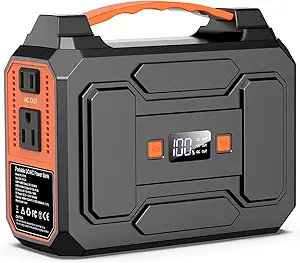
Portable Power Station, 146Wh 100W Solar Powered Power Bank with AC Outlet
At 3.3 pounds, this is the lightest true power station in the roundup — a category that usually starts at five-plus pounds. It gives you two AC outlets, USB-A, USB-C, and a 12V barrel, plus a built-in dual-mode flashlight, which makes it a genuinely practical grab-and-go unit for car camping or a power-outage kit. Against the 300W generator kit above, it sacrifices output (100W versus 300W) and solar hardware, but wins decisively on carry weight.
The 146Wh capacity comfortably covers a couple of laptop charges and a phone or two, sitting between the SinKeu’s 88.8Wh and the 32000mAh bank’s 118Wh while offering more outlet variety than either. The main frustration is that solar recharging requires a panel you must buy separately — a real cost the bundled kits don’t impose. Budget for that panel, or treat this as a wall-charged station with solar as a nice option later.
Pros:- Lightest power station form factor at 3.3 lbs
- Six outputs including two AC outlets cover mixed device needs
- Triple recharge options: wall, car, or solar
- Built-in dual LED flashlights add emergency utility
Cons:- Solar panel sold separately
- 100W AC ceiling limits larger devices
- 146Wh capacity falls short for multi-day, multi-device use
Best for: Car campers, emergency-prep builders, and anyone who wants AC outlets without hauling a heavy generator
Not ideal for: Buyers expecting true out-of-the-box solar charging — the panel costs extra and isn’t included
- Capacity:146Wh / 39600mAh
- Weight:3.3 lbs
- AC Outputs:2x 110V (100W)
- Other Outputs:2x USB-A, 1x USB-C, 1x DC 12V
- Recharging:AC adapter, car, solar panel (not included)
- Extras:Dual LED flashlights, battery management system
Our verdict“The right choice when portability outranks raw power and you’re willing to add a solar panel down the road.”
Selore & S-Global 65W Power Bank for Laptop, 18400mAh Portable Charger with Dual Built-in USB-C & Lightning Cables
Sometimes the best solar laptop charger is simply the one that’s actually in your bag when the battery icon turns red. The built-in USB-C and Lightning cables eliminate the dongle-and-cord mess that the 32000mAh PD bank demands, and the LCD readout keeps you informed without guesswork. At 65W it charges most thin-and-light laptops at or near full speed — the same ceiling as the SinKeu, but in a fraction of the footprint.
To be clear about its place: this is a wireless-recharge convenience product, not an off-grid workhorse. The 18400mAh cell covers roughly one laptop charge plus a phone top-up, well short of the SinKeu’s 88.8Wh, and it pairs with a solar panel rather than replacing one. It’s also heavier than its sleek white shell suggests at 14.5 ounces. But for daily commuters and frequent flyers who leave the panels at home, it’s the friction-free option.
Pros:- Built-in USB-C and Lightning cables mean nothing to forget or lose
- 65W output fast-charges most thin-and-light laptops
- LCD display shows real-time battery and charging status
- Four ports plus integrated cables cover a whole device family
Cons:- Heavier than its compact size suggests at 14.53 ounces
- Capacity covers only about one full laptop charge
- No solar or DC input — wall charging only
Best for: Commuters and frequent flyers who want laptop charging with zero cables to remember
Not ideal for: Off-grid campers — 18400mAh is roughly one laptop charge and this has no direct solar input story
- Capacity:18400mAh
- Max Output:65W
- Built-in Cables:USB-C and Lightning
- Ports:4
- Display:LCD
- Cell Type:Lithium Polymer
- Weight:14.53 oz
Our verdict“Pick this if your laptop charging happens in airports, cafes, and trains rather than campsites, and you value grab-and-go simplicity above capacity.”
SOARAISE Solar Power Bank 48000mAh Wireless Portable Charger with 4 Cables
Most solar power banks tack a token solar strip onto a battery, but the SOARAISE stands out for its four-panel array, which actually produces a worthwhile trickle of solar charge while you’re stationary at camp. The 48000mAh capacity translates into several full phone charges plus a partial laptop top-up, and having built-in cables means nobody in the group has to remember theirs. Compared with the similar-capacity Solar Power Bank 49800mAh, the SOARAISE leans harder into outdoor toughness with shockproof and dustproof construction alongside waterproofing. The tradeoff is genuine: this is a brick of a power bank that belongs in a backpack, not a jacket pocket, and solar input still can’t compete with a wall outlet. This pick makes the most sense for group campers who need one shared battery rather than several small ones.
Pros:- Four solar panels give meaningfully faster solar charging than single-panel rivals
- 48000mAh capacity handles multiple devices over a weekend
- Built-in cables eliminate the need to pack your own
- Waterproof, shockproof, and dustproof build survives camp life
Cons:- Heavy and bulky compared with slimmer power banks
- Solar charging is still slow relative to USB recharging
- Only three output ports despite the high capacity
Best for: Camping groups and families who want one shared high-capacity battery with cables built in
Not ideal for: Day hikers or commuters — its bulk and weight make it impractical to carry casually
- Battery Capacity:48000mAh
- Solar Panels:4
- Ports:3 (2 USB-A, 1 USB-C)
- Wireless Charging:Yes
- Output:5V / 3A with PD and QC 3.0
- Protection:Waterproof, shockproof, dustproof
- Dimensions:6.38 x 3.43 x 1.57 inches
Our verdict“Buy this if you’re powering a campsite of people; skip it if you need something pocketable for daily carry.”
FlexSolar 60W Foldable Portable Solar Panel Charger IP67 Waterproof
The FlexSolar takes a different approach from the power-bank picks here: instead of storing energy, it converts sunlight directly into 60W of live charging power — enough to run a laptop charger at close to full speed under good sun. With up to 24% conversion efficiency, it out-performs the 40W panel bundled with the Portable Power Station with 40W Solar Panel, making it the stronger choice if your priority is actually charging a laptop rather than just phones. The fold-down size of roughly 10 x 12 inches is genuinely portable at 2.6 lbs. Be clear-eyed about the compromises: there’s no internal battery, so you need a power bank or direct sunlight when you work, and the junction box isn’t waterproof despite the IP65 panel surface. A missing kickstand also means you’ll prop it against a rock or pack.
Pros:- 60W output is enough for real-time laptop charging
- 24% conversion efficiency leads this lineup
- Folds to a compact, backpack-friendly size at 2.6 lbs
- USB-A, USB-C, and DC ports cover most devices and generators
Cons:- No internal battery means no power storage
- Junction box is not waterproof despite IP65 rating
- No kickstand included for angle adjustment
Best for: Remote workers and van-lifers who need live laptop charging during daylight hours
Not ideal for: Anyone who needs power after sunset — with no battery, it produces nothing once the sun drops
- Power Output:60W
- Conversion Efficiency:Up to 24%
- Ports:QC3.0 USB-A, PD3.0 USB-C, DC
- Waterproof Rating:IP65 (panel surface)
- Weight:2.6 lbs (1.2 kg)
- Folded Size:9.8 x 12 x 1 inches
- Panel Material:A+ monocrystalline silicon
Our verdict“The right choice if you want to charge a laptop straight from the sun; pair it with a battery pack if you need evening power.”
Portable Solar Power Bank with AC Outlet 65W 110V
This option splits the difference between the pure battery banks and the bare-panel approach: a 24000mAh battery with a 65W AC outlet, plus a separate folding 30W solar panel that recharges it. That AC outlet is the headline — most laptop chargers plug straight into it without hunting for USB-C PD compatibility, something the SOARAISE 48000mAh can’t do at all. Compared with the SinKeu 24000mAh, the bundled panel here gives you a self-contained solar loop rather than just a battery that must come home to recharge. The compromises are real, though: the AC outlet must be manually toggled on, output is capped at 65W (fine for ultrabooks, not gaming laptops), and the panel’s junction box isn’t waterproof. This model is better suited to weekend adventurers with standard laptops than to power users with demanding machines.
Pros:- AC outlet accepts standard laptop chargers without adapters
- Includes both battery and folding 30W solar panel
- Recharges via wall outlet, car, or solar
- Built-in BMS protects against overcharge and short circuits
Cons:- AC output capped at 65W excludes power-hungry laptops
- AC outlet requires manual toggling each use
- Solar panel junction box is not waterproof
Best for: Ultrabook and MacBook owners who want AC charging plus a solar panel in one kit
Not ideal for: Owners of gaming or workstation laptops over 65W — the AC outlet can’t keep up
- Battery Capacity:24000mAh
- AC Output:65W / 110V
- Solar Panel:30W folding panel
- USB Ports:5V/2.4A and 5V/3A, 9V/2A Max
- DC Output:9V-12.6V / 10A Max
- Size:6.89 x 3.98 x 1.89 inches
Our verdict“A sensible middle path if you want stored power and solar recharge in a single purchase, as long as your laptop stays under 65W.”
Solar Power Bank 49800mAh – Wireless Portable Charger with 15W Fast Charging and Built-in Cables
If your laptop needs are occasional and your phone needs are constant, this 49800mAh brick changes the math. It’s built around endurance — multiple phone charges per day across a long trip — with 15W wireless charging and four built-in cables covering USB-A, USB-C, and Micro USB. Against the SOARAISE 48000mAh, it counters with a much stronger LED flashlight with multiple modes, which matters more than you’d expect during power outages and tent life. Its IP65 waterproofing and shockproof shell put it in the same durability class. The honest tradeoff: at 5V/3.1A output it won’t fast-charge most modern laptops — this is a phone-and-tablet workhorse that can top up a small laptop in a pinch, not a laptop-first solution. Solar input is a backup feature, not a primary recharge method.
Pros:- 49800mAh capacity covers days of phone and tablet charging
- Four built-in cables plus 15W wireless charging
- Bright multi-mode LED flashlight doubles as an emergency light
- IP65 waterproof and shockproof housing
Cons:- Output voltage too low for fast laptop charging
- Large footprint reduces everyday portability
- Solar recharging is far slower than USB
Best for: Multi-day campers and emergency-prep households prioritizing phones and tablets over laptops
Not ideal for: Laptop-first users — 5V/3.1A output is too slow for meaningful laptop charging
- Battery Capacity:49800mAh lithium polymer
- Output:5V / 3.1A
- Wireless Charging:Yes, 15W fast charging
- Ports:3 (USB-A, USB-C, Micro USB)
- Built-in Cables:4
- Waterproof Rating:IP65
- Extras:Multi-mode LED flashlight
Our verdict“Choose this for sheer device-charging endurance on long trips; look elsewhere if your laptop is the priority device.”
Portable Power Station with 40W Solar Panel, 100W Solar Powered Generator
For buyers who want a complete solar generator system rather than a gadget, this kit pairs a 100W power station with two AC outlets and a 40W folding panel, all with MPPT solar recharging at 22.8% efficiency. The advantage over the Portable Solar Power Bank with AC Outlet is redundancy: two outlets, six output options total, and three recharge paths including a 12V carport. Compared with bigger units like the 300W Portable Power Station, this one trades raw capacity for portability and price, which makes it a gentler entry point for solar newcomers. The 100W ceiling is the defining limit — laptops, cameras, and lights are fine, but a kettle or hair dryer is not. Note the maintenance requirement: the battery wants a recharge at least every two weeks even when idle, which occasional users may forget.
Pros:- Complete kit includes both power station and 40W solar panel
- Two AC outlets plus four USB outputs run several devices at once
- MPPT solar recharging with 22.8% efficiency
- Full BMS protection against shorts, overloads, and overheating
Cons:- 100W ceiling excludes most appliances and power tools
- Junction box of the solar panel is not waterproof
- Requires recharging at least every two weeks when stored
Best for: Solar beginners and weekend car campers building their first off-grid kit on a budget
Not ideal for: Anyone expecting to run appliances over 100W or who won’t maintain the recharge schedule
- Power Output:100W (2 x AC outlets)
- Solar Panel:40W folding panel
- Conversion Efficiency:22.8%
- Recharging:Wall outlet, MPPT solar, 12V carport
- USB Outputs:USB1, USB2, QC USB, USB-C
- Protections:Short circuit, over-current, over-voltage, overload, overheating
- Accessories:AC adapter, car adapters, solar panel kit, manual
Our verdict“The easiest way to own a full solar generator setup in one purchase, provided your devices stay under 100W.”
Portable Power Station 300W, 220Wh Solar Generator Backup Battery Pack
Among the sub-$150 power stations in this roundup, this 220Wh/300W unit stands out for raw capacity in a small footprint — it more than doubles the battery of the Takki Solar Generator while still weighing just 5 lbs. Seven simultaneous outputs means a laptop, phone, camera batteries, and a light can all run at once, which most power banks in this guide simply can’t do. The tradeoff is the classic one: no solar panel is included, so the “solar generator” label only becomes true after buying a panel separately — factor that into the total price. Compared with the Daran 89.6Wh station, you give up LiFePO4 chemistry for roughly 2.5x the stored energy, a fair exchange for weekend campers who need endurance over lifespan.
Pros:- 220Wh capacity is generous for the 5 lb size
- Seven outputs let you charge a full kit of devices at once
- Three recharge paths: AC, car, and solar
- Bright built-in LED light for camp use
Cons:- Solar panel sold separately, adding cost and setup
- 300W ceiling rules out kettles, hair dryers, and similar appliances
- 220Wh runs dry quickly on extended multi-day trips
Best for: Weekend campers and van-lifers who need to run a laptop plus several small devices off-grid without hauling a full-size generator
Not ideal for: Buyers wanting a complete out-of-box solar kit — the missing panel means extra cost and research, and 220Wh won’t run appliances over 300W
- Wattage:300W
- Battery Capacity:220Wh
- Weight:5 lbs
- Dimensions:8.5 x 6.7 x 4.1 inches
- Outputs:2x110V AC, 3 USB-A, 1 USB fast-charge, 1 DC vehicle port
- Recharge Options:AC wall, car, solar (panel not included)
Our verdict“This pick makes the most sense for campers who already own or plan to buy a solar panel and want the most stored energy per pound.”
PSOOO Power Bank 65W 27000mAh Laptop Battery Pack
If the goal is topping up a MacBook or USB-C laptop from a bag pocket, this 65W PD 3.0 bank does the job that bulkier stations can’t: it travels like a large phone charger rather than a small appliance. Its 27,000mAh reserve beats the SinKeu 24000mAh power bank while matching the 65W output of the Selore 18400mAh unit, making it a middle-ground pick for capacity-hungry travelers. The honest tradeoff is weight and shape — at this capacity it’s heavy and brick-like, so it’s better suited to a backpack than a jacket pocket. Unlike the YELOMIN solar bank, there’s no solar input at all, so its “solar” relevance in this guide is as a fast-charging companion to a separate panel setup rather than a standalone solar device.
Pros:- 27,000mAh delivers multiple laptop or several phone charges
- 65W PD 3.0 charges most USB-C laptops at near-full speed
- Built-in LED flashlight for emergencies
- Broad device compatibility with safety protections
Cons:- Heavy and bulky compared with ordinary power banks
- No solar input — it must return to a wall to recharge
- Devices without fast-charge support lose most of the speed benefit
Best for: Digital nomads and frequent flyers who need airline-legal laptop top-ups and fast multi-device charging from a bag
Not ideal for: Anyone expecting solar self-recharging — this is pure battery, and ultralight hikers will find it too heavy to justify
- Capacity:27000mAh
- Power Output:65W PD 3.0
- Charging Ports:Multiple, including USB-C
- Features:Built-in LED flashlight, safety protections
- Best Use:Travel, outdoor activities, long trips
Our verdict“The strongest choice here for travelers who value fast laptop charging over off-grid solar independence.”
Takki Solar Generator 120W Peak Portable Power Station with 21W Solar Panel and 88.8Wh Battery
This is one of the few entries in the roundup that actually ships with both halves of a solar system: an 88.8Wh station plus a foldable 21W panel, all for a starter-kit price. That completeness is its whole argument — the 220Wh station above and the Daran unit both require you to source a panel separately, which can easily add $60–100 and a compatibility headache. The catch is scale: 88.8Wh and an 80W sustained ceiling mean this is a phone-and-small-laptop solution, not a workstation, and Takki itself advises against charging devices while the station itself is being used. Solar recharge is also slow at 5–7 hours to 80%, so realistic buyers should treat the panel as a trickle top-up, not a rapid refill.
Pros:- Solar panel included — genuinely complete kit out of the box
- Very light at 2.29 lbs for the station, 0.92 lbs for the panel
- AC, USB, and DC outputs plus flashlight with SOS mode
- Fast 2-hour AC recharge to 80%
Cons:- 80W device ceiling excludes most laptops under heavy load and all appliances
- Can’t reliably charge devices while the unit itself powers others
- 21W panel is slow — expect a full sunny day for meaningful recharge
Best for: First-time solar buyers and casual campers who want one box with everything included and don’t need serious wattage
Not ideal for: Anyone powering a work laptop all day — 88.8Wh is roughly one full charge of a 13-inch laptop plus a phone, and it drains fast
- Battery Capacity:88.8Wh
- Peak Power:120W
- Solar Panel:21W foldable, 0.92 lbs
- Weight:2.29 lbs (station)
- Dimensions:5.7 x 4.13 x 3 inches
- AC Charge Time:2 hours to 80%
- Solar Charge Time:5–7 hours to 80%
Our verdict“The easiest on-ramp into solar charging here, ideal if you’d rather start small and complete than piece a system together.”
YELOMIN Solar Power Bank 10000mAh with Foldable Solar Panels, Wireless Charging, and Emergency Flashlight
Where other entries chase laptop-scale power, the YELOMIN plays a different game: a self-contained solar bank with four foldable panels built into the lid, so sunlight trickles in wherever it rides on a backpack. Its built-in USB-C and Lightning cables eliminate the forgotten-cable problem entirely — something neither the PSOOO bank nor the Takki station offers — and 15W wireless charging tops a phone without any cable at all. The honest limitation is capacity: 10,000mAh (about 37Wh) is roughly one laptop charge at best, and in practice this is a phone-and-earbuds device. Solar input from small foldable panels is also modest, so the panels are a life-extender between wall charges, not a primary power source. Compared with the SOARAISE 48000mAh bank, it trades capacity for portability and genuine weather resistance.
Pros:- Four built-in foldable solar panels — no accessories to buy or lose
- Integrated USB-C and Lightning cables
- 15W wireless charging for cable-free phone top-ups
- Durable, weather-resistant build with 3-mode flashlight
Cons:- Only ~37Wh — a single laptop charge at most
- Fold-out panels make it thick and heavy for everyday carry
- Solar charging needs direct, sustained sunlight to be useful
Best for: Hikers, day-trippers, and emergency-kit builders who want a pocketable phone charger that slowly refills itself in sunlight
Not ideal for: Laptop users — 10,000mAh can’t meaningfully sustain a notebook, and the folded panel array makes it bulky for a purse or pocket
- Capacity:10000mAh (~37Wh)
- Solar Panels:4 foldable panels
- Wireless Charging:15W
- Built-in Cables:USB-C, Lightning
- Flashlight Modes:3 (constant, strobe, SOS)
- Build:Durable, weather-resistant
Our verdict“The right pick if your priority is a self-recharging phone backup for the trail, not laptop-grade power.”
Daran Portable Power Station 89.6Wh LiFePO4 Battery 100W (200W Peak) Solar Power Bank
The Daran’s headline feature isn’t capacity or wattage — it’s chemistry. Its LiFePO4 battery is rated for 3,500+ cycles, meaning it should still hold strong after years of near-daily use, while standard lithium-ion units like the 220Wh station earlier in this list typically fade within 500–800 cycles. For someone who keeps an emergency station plugged in and cycling constantly, that longevity is worth more than raw capacity. Seven ports across two AC outlets, dual USB-C with PD, and dual USB-A cover a full desk’s worth of gear, and it recharges from AC, USB-C, car, or solar. The tradeoffs are real, though: 89.6Wh and a 100W ceiling match the Takki‘s class rather than exceeding it, and like the larger 220Wh pick, no solar panel is included. There’s also no app or Wi-Fi monitoring, so status comes solely from the onboard LED display.
Pros:- LiFePO4 chemistry rated 3,500+ cycles — years longer than typical lithium-ion
- Seven ports including 2 AC outlets and dual USB-C PD
- Silent, fan-free operation safe for bedrooms and tents
- Charges via AC, USB-C PD, car, or solar
Cons:- 100W sustained output limits it to small devices
- Solar panel sold separately
- No Wi-Fi or app connectivity for remote monitoring
Best for: Preparedness-minded buyers and home-office users who want a station that survives years of standby and cycling without battery degradation
Not ideal for: Off-grid power users without a separate solar panel, and anyone expecting app-based monitoring or appliance-grade wattage
- Battery Capacity:89.6Wh
- Battery Type:LiFePO4 (3,500+ cycles)
- Output Power:100W (200W peak)
- Ports:7 total: 2 AC, 2 USB-C, 2 USB-A, 1 DC5521
- Weight:2.54 lbs
- Dimensions:6.5 x 3.3 x 4 inches
- Charging Methods:AC, USB-C PD, car, solar panel
- Safety:12 protections via BMS
Our verdict“This model is better suited to buyers who play the long game — a compact, quiet, long-lived station for emergencies and light daily use.”
How We Picked
My ranking logic started with one question: can this product actually keep a laptop charged using sunlight? That meant separating true solar charging systems — panel-plus-battery kits with 40W or more of panel output — from power banks with decorative solar strips on the back. I evaluated each product on usable capacity in watt-hours rather than the advertised milliamp-hour figure, since inflated mAh ratings are the most common trap in this category. Panel output, charge controller quality, and whether the battery supports pass-through charging determined how well each option performs off-grid.
Beyond raw performance, I weighed portability, output versatility (PD wattage, AC inverter rating, number of ports), build quality, and price per usable watt-hour. A product like the Portable Solar Generator 300W ranks near the top because it scores well across every criterion, while the Takki kit earns a high value spot by trading panel output and capacity for a much lower price. Products with obvious flaws — slow solar input, undersized inverters, or misleading capacity claims — were ranked according to what they still do well and who they still suit, because nearly every option here serves some buyer even if none of them are perfect.
Factors to Consider When Choosing Solar-powered Laptop Chargers
Before picking a specific model, it helps to understand what actually separates a useful solar laptop setup from an expensive paperweight. These are the factors that shaped my rankings and the ones most buyers get wrong.Watt-Hours Beat Milliamp-Hours
The single most common mistake in this category is comparing products by mAh. A 48000mAh power bank sounds enormous next to a 146Wh power station, but mAh ratings are measured at 3.7V cell voltage — divide by a thousand and multiply by 3.7 to get watt-hours, and that 48000mAh bank is really about 177Wh at best, often far less once conversion losses kick in. Power stations advertise honest Wh figures, which is why their numbers look smaller. For laptop charging, plan on roughly 60–75Wh per full laptop charge, so a 150Wh unit gives you about two charges. Ignore the headline number on the box and do this conversion before comparing anything.
Panel Size Determines Whether Solar Is Real or Symbolic
A solar panel needs to be roughly the size of a laptop lid or larger to produce meaningful charging power. The small panels embedded in solar power banks typically generate 2–5W in full sun, which means a full day of direct sunlight adds maybe 15–25Wh — not even a third of a laptop charge. Foldable panels in the 40W–60W range can realistically add 150–300Wh on a clear day, which fully recharges the companion battery. If your plan involves actually living off-grid, buy the biggest panel you’re willing to carry. If solar is just an emergency insurance policy, a smaller integrated panel is acceptable — but know that’s the trade you’re making.
Check Your Laptop’s Charging Wattage Before Buying
Modern laptops fall into two broad groups: efficient ultrabooks and MacBooks that charge at 30–65W, and performance machines (gaming laptops, 16-inch workstation models) that want 100–240W. A 65W power bank or inverter will run the first group happily and either refuse to charge or charge painfully slowly on the second. USB-C Power Delivery is the cleanest path if your laptop charges over USB-C, so verify the bank’s PD output rating — a “100W” rating means it can deliver 100W over PD, not that the AC outlet provides it. And if you need an AC outlet, check the continuous wattage rating, not the peak rating, since inverters advertise surge numbers that only hold for seconds.
Battery Chemistry and Lifespan
Most portable units use lithium-ion cells rated for 300–500 charge cycles, which is fine for occasional camping trips but degrades quickly with daily use. A handful of models — like the Daran with its LiFePO4 chemistry — offer 2000+ cycles, meaning the battery outlasts the rest of the product several times over. LiFePO4 also handles heat better, which matters when the unit sits in a sunny campsite all day. The tradeoff is slightly lower energy density, so LiFePO4 units are a bit heavier per watt-hour. If you’ll use the charger weekly, the longer-lived chemistry is worth the weight penalty; for a twice-a-year festival or blackout kit, standard lithium-ion is the smarter buy.
Weight, Packability, and How You’ll Actually Carry It
There’s a wide gulf between a 1.5-pound power bank that slides into a laptop sleeve and a 7-pound power station that needs its own bag. Be honest about your transport situation: bikepackers and hikers should lean toward a lightweight bank paired with a foldable panel, while car campers and van lifers can carry a full station without noticing. Also check whether the panel folds into a protected configuration — exposed glass panels cracked in backpacks are one of the most common failure reports in this category. A carrying handle sounds trivial until you’re moving camp every day.
When to Skip Solar Entirely
If your off-grid stretches are under 48 hours, a high-capacity wall-charged power bank delivers more laptop charges per dollar and per pound than any solar option in this roundup. Solar earns its cost when trips run longer than two days or when you’re preparing for extended outages, because that’s when the ability to generate power matters more than storage density. Weekend users who buy solar rigs often discover the panel never leaves the trunk. The honest version of this advice: buy solar because you’ll use the panel, not because the marketing photos show one.
Frequently Asked Questions
Can a solar power bank actually charge a laptop from sunlight alone?
Almost never with the pocket-sized units. The tiny panels on most solar power banks produce 2–5W in ideal sun, and a typical laptop needs 50–75Wh for a full charge — that’s a full sunny day of panel time for a partial charge at best. What these products actually do is let you top up the internal battery slowly with sun between uses. If genuine solar laptop charging is the goal, a foldable 40W+ panel paired with a compatible power station is the only realistic path, which is why those combos dominate the top of my rankings.
How many laptop charges will I actually get from these products?
Take the watt-hour rating and divide by your laptop’s battery size — a 13-inch MacBook Air holds about 53Wh and a 14-inch Windows ultrabook runs 55–70Wh, so a 146Wh unit delivers roughly two charges. Gaming laptops with 90Wh+ batteries will get barely one. The inflated mAh figures on power banks make this hard to compare at a glance, so convert everything to watt-hours first. Also expect 10–15% conversion loss through the charging circuitry, and more if you’re using the AC outlet rather than USB-C.
Is a 65W power bank enough for my laptop?
It depends entirely on which laptop you own. Ultrabooks, MacBooks, and most 13–14 inch machines charge happily at 65W and will even run while charging. Larger performance laptops — 16-inch models, gaming machines, workstations with discrete GPUs — typically demand 100W to 240W, and a 65W source will either charge them very slowly with the machine off or not at all while in use. Check your laptop’s original charger wattage; if it shipped with a 96W or 140W brick, a 65W bank is the wrong tool and you should be looking at the 100W+ or 300W-class options in this guide.
Should I buy a power station with a panel, or a panel and power bank separately?
Bundled kits like the Portable Solar Generator 300W or Takki setup guarantee compatibility and usually save money, but the included panels are sometimes the weakest part of the package. Buying separately lets you pick a better panel — the FlexSolar 60W is stronger than most bundled panels — and a battery with exactly the outputs you need. The catch is verifying the panel’s connector matches your station’s input and that the station’s maximum solar input isn’t exceeded. If you’re not comfortable checking specs, buy the bundle; if you like optimizing, separate components win.
Are these products allowed on airplanes?
Power banks and small stations are governed by lithium content limits: batteries under 100Wh fly in carry-on without airline approval, 100–160Wh requires airline permission, and anything above 160Wh is banned from passenger aircraft. That means most of the large units in this roundup — the 146Wh, 177Wh, and 220Wh models — either need advance approval or can’t fly at all. Anything with an AC outlet and a big inverter also draws extra scrutiny at security. If your trips involve flights, a sub-100Wh option like the PSOOO 27000mAh or Selore 18400mAh bank plus a foldable panel checked or shipped separately is the practical combination.
Conclusion
For most buyers, the Portable Solar Generator 300W with 60W Solar Panel is the best overall choice — it’s the rare option where capacity, panel output, and inverter power are all adequate for real laptop work off-grid. Best value goes to the Takki 120W Solar Generator kit, which covers basic laptop charging at a fraction of the price, with the Portable Power Station with 40W Solar Panel as the step-up for anyone wanting faster solar recovery. On the premium end, the Portable Power Station 300W / 220Wh offers the most headroom for power-hungry machines and multi-device setups.
Beginners should start simple: the YELOMIN 10000mAh is a low-cost way to learn what solar charging can and can’t do before committing to a bigger system. Frequent travelers and minimalists will prefer the Selore 65W with its built-in cables, while bikepackers and hikers get the best setup from the FlexSolar 60W panel paired with whichever lightweight bank suits their laptop’s wattage. Buyers who want a set-and-forget backup for home outages should look at the Daran LiFePO4 unit, whose battery chemistry will still be healthy a decade from now. Match the pick to how you’ll actually use it — that’s the decision that matters more than any spec sheet.