
Portable solar power banks promise grid-free charging, but the category splits into two very different tools: pocket-size battery packs with a backup solar strip and larger solar generator kits built for real off-grid power. After comparing 15 leading options, the SOARAISE 50000mAh Solar Power Bank stands out as the best overall pick for its combination of massive capacity, 22.5W fast charging, and wireless topping-up. The Jackery Explorer 300 makes the most sense if you need to run small appliances rather than just phones, while the BLAVOR 10,000mAh is the lightest option that still covers a day of phone charges. The main tradeoff you’ll face is weight versus capability — the biggest banks charge more devices but stop feeling portable. Read on for the full breakdown of what each model does well and where it falls short.

Get backup power and energy gear delivered free — and shop member deals
- Fast, free delivery on millions of items
- Access to Prime Big Deal Days deals on October 6–7
- Prime Video, Amazon Music and more included
Key Takeaways
- Capacity claims above 25,000mAh deserve skepticism: several 49,800mAh and 50,000mAh models in this lineup weigh nearly as much as small power stations while delivering far less usable energy than the Jackery Explorer 300.
- The solar panels on pocket-size banks are emergency backup only — expect trickle-level charging that takes days to refill the battery, so models with fast USB-C PD input like the MINRISE 40000mAh recharge far faster from a wall outlet.
- Built-in cables (BLASOUL, Durecopow, SOARAISE) proved to be a bigger daily convenience than wireless charging, since they eliminate the most forgotten piece of gear on a camping trip.
- Hand-crank and flashlight features, like those on the FEELLE 50000mAh, add genuine emergency value but make sense only for buyers prioritizing blackout readiness over travel weight.
- The 10,000mAh–20,000mAh models from BLAVOR and the generic 20,000mAh chargers are the only picks that still fit comfortably in a jacket pocket — everyone else is choosing a bag-dwelling device.




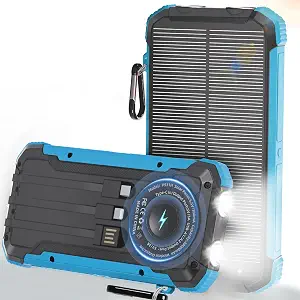


| portable solar power bank | Capacity | Wireless Charging |
|---|---|---|
| BLASOUL Solar Power Bank 49800 | 49800mAh | 15W max |
| Solar Charger Power Bank 49800 | 49800mAh | Yes |
| MINRISE Solar Power Bank 40000 | 40000mAh | — |
| Portable Solar Generator 300W | — | — |
| FEELLE Solar Power Bank 50000m | 50000mAh | — |
| Jackery Explorer 300 Portable | 292Wh | — |
| Solar Charger Power Bank 20000 | — | Yes |
| Durecopow Solar Charger Power | 20,000mAh | — |
| Solar Power Bank 40000mAh PD20 | 40,000mAh | — |
| Solar Charger Power Bank 49800 | 49,800mAh | Yes |
| SOARAISE Solar Power Bank 4800 | 48,000mAh | Yes |
| SOARAISE 50000mAh Solar Power | 50,000mAh | 15W |
| BLAVOR Solar Power Bank 10,000 | 10,000mAh | Yes |
| SOARAISE Solar Power Bank 4800 | 48,000mAh | Yes |
| Blavor Solar Power Bank 20000m | 20,000mAh | Yes, phones and Apple Watch |
More Details on Our Top Picks
BLASOUL Solar Power Bank 49800mAh Wireless Portable Phone Charger with Fast Charging and Built-in Cables
This model makes the most sense as my top pick because it solves the biggest frustration with solar power banks: cable clutter. With three built-in output cables covering iOS, USB-C, and Micro-USB, there is nothing to forget at home. Compared with the MINRISE 40000mAh, the BLASOUL offers roughly 25% more capacity plus 15W wireless charging, which the MINRISE lacks entirely. The 22.5W USB-C fast charging means a modern phone regains substantial power in under an hour rather than an afternoon.
The tradeoff is weight. At this capacity, it is a pack item rather than a pocket item, and solar input remains a trickle best treated as an emergency top-up rather than a primary charging method.
Pros:- 49800mAh capacity delivers multiple full phone charges
- Built-in cables for iOS, USB-C, and Micro-USB eliminate extra accessories
- 22.5W fast wired charging plus 15W wireless charging
- IP65 rating handles rain and dust at camp
Cons:- Large and heavy compared with 20000mAh alternatives like the BLAVOR
- Solar charging is slow and sun-dependent, not a reliable primary input
Best for: Campers and road-trippers who want one do-everything power bank that can charge several phones without carrying cables
Not ideal for: Day hikers or everyday commuters — the size and weight make it impractical for a jacket pocket or small sling bag
- Capacity:49800mAh
- Fast Charging:22.5W USB-C
- Wireless Charging:15W max
- Built-in Cables:3 output (iOS, Type-C, Micro), 1 input (USB-A)
- Water Resistance:IP65
- Extras:LED flashlight with SOS and strobe modes
Our verdict“If you want a single high-capacity power bank that covers every device and cable situation at camp, this is the one to buy.”
Solar Charger Power Bank 49800mAh Wireless Portable Phone Charger with Fast Charging and Multiple Outputs
Where this option stands out is sheer port coverage. With six outputs and three input methods, it can keep an entire camp’s devices alive at once — something the BLASOUL, with its three built-in cables, cannot match when four or five people need power simultaneously. The shockproof ABS and PC housing also gives it a durability edge over models that emphasize only water resistance.
The catch is physics: charging multiple devices splits the output current, so everything charges slower than the rated 3.1A, and the battery drains fast under group load. Its 5V/3.1A Type-C output also trails the BLASOUL’s 22.5W for single-device speed, so solo users are better served elsewhere.
Pros:- Six outputs let multiple users charge at the same time
- Waterproof, shockproof, and dustproof construction for rough handling
- Wireless charging plus built-in cables cover legacy and modern devices
- Three-mode flashlight useful for camp lighting and emergencies
Cons:- Simultaneous charging splits current and slows every device down
- Large footprint makes it awkward for everyday carry
Best for: Families or camping groups who need to charge four or more devices from one shared power bank
Not ideal for: Solo travelers who prioritize speed — single-device charging is slower than the BLASOUL’s 22.5W output
- Capacity:49800mAh
- Fast Charging:5V/3.1A Type-C
- Outputs:6 (USB-A, Type-C, Micro-USB)
- Inputs:3 (USB-C, Micro-USB, wireless)
- Wireless Charging:Yes
- Material:ABS and PC
Our verdict“Buy this if you are the designated power person for a group trip; skip it if it is just you and one phone.”
MINRISE Solar Power Bank 40000mAh, Portable Charger PD 20W Fast Charging
Compared with the 49800mAh crowd, this MINRISE trims capacity modestly in exchange for a lighter, cheaper package at 1.1 pounds — meaningfully easier to clip to a backpack. Its 10 ports and four input methods (solar, Type-C, Micro USB, USB-A) make it the most flexible recharger in this batch, since you can refill it from nearly any cable you already own. The 20W PD output keeps it competitive with pricier rivals for single-phone speed.
Be realistic about the solar panel: the manufacturer positions it as emergency-only, and it is honest about that. Drop-proofing and waterproofing are genuine advantages over the 300W solar generator in this lineup, which has a non-waterproof junction box.
Pros:- 40000mAh capacity at a lighter 1.1-pound weight than 49800mAh rivals
- 20W PD fast charging for quick phone top-ups
- Four input methods maximize recharge flexibility
- Waterproof, dustproof, and drop-proof construction
Cons:- Solar charging is slow and emergency-use only
- Still bulkier than 20000mAh options like the BLAVOR for everyday carry
Best for: Budget-conscious campers who want big capacity and PD fast charging without paying for extras like wireless pads
Not ideal for: Anyone hoping to solar-charge as a primary method — the panel is explicitly a backup, not a main input
- Capacity:40000mAh
- Output:20W PD, USB-C, USB-A
- Inputs:Solar, Type-C, Micro USB, USB-A
- Ports:10
- Dimensions:6.67 x 3.35 x 1.22 inches
- Weight:1.1 lbs (450 g)
- Durability:Waterproof, dustproof, drop-proof
Our verdict“The smart middle ground if you want near-flagship capacity and speed at a lower weight and price point.”
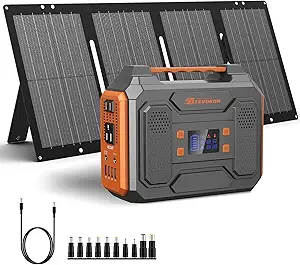
Portable Solar Generator 300W with 60W Solar Panel
This is a different category of product, and it earns its spot by being the only option here that can run AC-powered devices — laptops, camp fans, small appliances — via two wall-style outlets. Unlike every power bank in this roundup, its 60W monocrystalline panel at 20.5% efficiency actually recharges the battery at a usable rate in real sunlight, making genuine solar reliance possible rather than theoretical. Compared with the FEELLE 50000mAh, it sacrifices pocket portability for a complete off-grid power system with AC, car, and solar recharge options.
The limits matter: the 300W ceiling rules out kettles, heaters, or power tools, and the junction box is not waterproof, so panel deployment requires dry conditions and attention.
Pros:- Two AC outlets run devices no power bank in this lineup can handle
- 60W panel with 20.5% efficiency delivers genuinely usable solar recharge
- Recharges via AC wall power, car port, or solar
- Built-in BMS protection and cooling for safe operation
Cons:- 300W cap excludes higher-draw appliances
- Junction box is not waterproof and needs dry setup conditions
Best for: Car campers and off-grid cabin users who need to run laptops, lights, and small AC devices from real solar input
Not ideal for: Backpackers and day-trippers — the panel and battery together are far too heavy to carry on foot
- Power Output:300W
- Solar Panel:60W monocrystalline, 20.5% efficiency
- Outlets:2 AC, 1 DC, 3 USB, 1 quick-charge USB
- Recharge Methods:AC, solar, car power
- Safety:Built-in BMS with protection and cooling
- Accessories:AC adapter, cigarette lighter adapter, car cable, solar panel kit
Our verdict“Choose this over any power bank here if you need AC power and honest solar charging — just accept that it stays at the campsite.”
FEELLE Solar Power Bank 50000mAh Magnetic Portable Charger with Hand Crank
The FEELLE earns its role through one feature nobody else in this roundup offers: a hand-crank generator. In a genuine emergency — dead battery, overcast skies, days without grid power — cranking provides a last-resort charge that solar and wall power cannot. Add four solar panels versus the single panels on the BLASOUL or MINRISE, plus magnetic wireless charging for snap-on iPhone use, and this is the most redundant power source here. The built-in compass and shockproof, waterproof housing round out the emergency kit logic.
That redundancy costs you in weight and bulk — this is the heaviest option to carry. Magnetic charging also falters through thick phone cases, and the 5V/3A output lags the BLASOUL’s 22.5W fast charging for wired speed.
Pros:- Hand-crank generator provides charging with no sunlight or grid power
- Four solar panels offer more solar input than single-panel rivals
- Magnetic wireless charging snaps securely to recent iPhones
- Compass, flashlight, and shockproof waterproof build for emergencies
Cons:- Heavy and bulky from stacked features and 50000mAh capacity
- Magnetic charging weakens through thicker cases
- 5V/3A wired output is slower than the BLASOUL’s 22.5W
Best for: Emergency preppers and backcountry travelers who want solar, crank, magnetic, and wired charging in one survival-ready package
Not ideal for: Minimalist travelers — the weight and bulk of four solar panels and a crank exceed what casual users need
- Capacity:50000mAh
- Ports:3 (USB-A, USB-C)
- Output:5V / 3A
- Charging Methods:4 solar panels, hand crank, magnetic wireless, wired
- Cell Type:Lithium polymer
- Compatibility:iPhone 12–17, Galaxy, Android phones, smartwatches, tablets
- Extras:Built-in cable, compass, LED flashlight
Our verdict“If your priority is never being without power in a true emergency rather than everyday convenience, this is the pick.”
Jackery Explorer 300 Portable Power Station, 292Wh
Every other product in this roundup is a solar power bank; the Explorer 300 is something different — a true portable power station. That distinction matters for buyers. While the Durecopow 20,000mAh can refill a phone several times, the Jackery’s 292Wh battery and pure sine wave AC outlets can run a laptop, a small fan, or a camera battery charger for hours. Its LiFePO4 chemistry rated for 4,000+ cycles also outlasts the lithium-based packs here, which typically promise closer to 1,000 cycles.
The tradeoff is weight and cost of entry. At 7.5 lbs it’s no pocket companion, and the solar panel is sold separately, so pairing it adds to the total investment. Compared with the 40,000mAh PD20W pack, it’s dramatically bulkier — but it’s the only option here that replaces a wall outlet rather than just a USB port.
Pros:- AC outlets run devices no power bank here can handle, like laptops and small appliances
- LiFePO4 battery rated for 4,000+ cycles, roughly four times the lifespan of typical power bank cells
- Six output options (2 AC, USB-C PD, 2 USB-A, car port) cover nearly any device
- Fast solar input recharges the unit in about 4 hours with a compatible panel
Cons:- Solar panel is not included, so the total cost of a solar charging setup climbs quickly
- 300W rated output can’t run high-draw appliances like kettles or power tools
Best for: Campers, van-lifers, and photographers who need AC power for laptops, drones, or small appliances away from the grid
Not ideal for: Day hikers and everyday commuters — at 7.5 lbs plus a separate solar panel, it’s far too heavy for pocket or pack-strap carry
- Capacity:292Wh
- Weight:7.5 lbs
- Outlets:2 AC, 1 USB-C PD, 2 USB-A, 1 Car port
- Peak Surge:600W
- Battery Type:LiFePO4
- Charge Cycles:4,000+
- Charge Time:4 hours
- Dimensions:15.43 x 9.92 x 11.89 inches
Our verdict“If you need actual wall-outlet power in the field rather than just phone top-ups, this is the only pick in the lineup that delivers it.”
Solar Charger Power Bank 20000mAh with Wireless Fast Charging and Built-in Cables
This 20,000mAh pack earns its spot by eliminating the cable problem entirely. Built-in Lightning, USB-C, and USB-A cables plus 15W wireless charging mean there’s nothing extra to pack, lose, or tangle — a genuine convenience compared with the Durecopow 20,000mAh, which relies on four separate attached cables that add clutter and failure points. The fully waterproof, shockproof, dustproof housing and 3-mode flashlight with SOS round out a solid emergency profile.
Be honest with yourself about the solar panel, though. Like most power banks in this class, sun charging is a trickle, not a primary charging method — fine for stretching a charge over a long weekend, not for living off-grid. And while the listed weight is modest, the unit’s boxy footprint is bulkier than slim single-purpose chargers like the Blavor 10,000mAh.
Pros:- Built-in Lightning, USB-C, and USB-A cables mean zero accessories to carry
- Wireless fast charging works through compatible phone cases
- Waterproof, shockproof, and dustproof housing survives drops and rain
- 3-mode flashlight with SOS adds genuine emergency utility
Cons:- Solar charging is slow and unreliable in anything but direct, strong sunlight
- Bulkier and boxier than slim non-rugged power banks of similar capacity
Best for: Travelers and casual campers who want one grab-and-go backup with every cable already attached
Not ideal for: Anyone expecting meaningful solar recharge speeds — the panel is best treated as an emergency trickle charger
- Battery Capacity:20,000mAh
- Built-in Cables:Lightning, Type-C, USB-A
- Wireless Charging:Yes
- Output Wattage:15W
- Input:Type-C, Solar Panel
- Waterproof:Yes
- Flashlight:3-mode (steady, strobe, SOS)
- Weight:80 g
Our verdict“The cleanest all-in-one carry in this batch — ideal if your priority is never forgetting a cable, as long as you don’t count on the sun to fill it.”
Durecopow Solar Charger Power Bank 20,000mAh with 4 Cables and 3 Ports
Where most picks here charge two or three devices, the Durecopow is built for charging six devices simultaneously — four attached cables plus three ports. That makes this option better suited to a campsite with multiple phones, a headlamp, and a GPS unit all crying for power at once, something the 20,000mAh cable-free model simply can’t match in raw device count. The eco-friendly silicone rubber housing gives it a grippier, more drop-tolerant feel than hard-plastic rivals, and the built-in compass and dual flashlights lean fully into the hiking-kit identity.
The compromises are real. Four protruding cables are more snag-prone than a flush port layout, the 12-month warranty is shorter than what serious emergency gear should carry, and the stated 1,000+ cycle rating trails the longevity of the Jackery Explorer 300 by a wide margin. Solar input remains a backup, not a plan.
Pros:- Six simultaneous device charges handle a whole campsite from one pack
- Four cable types cover older Micro USB gear that newer packs have abandoned
- Silicone rubber exterior absorbs drops better than rigid plastic shells
- Dual flashlights and compass add backup navigation and lighting
Cons:- Four attached cables create snag points and long-term wear concerns
- Only 12 months of warranty coverage, shorter than most rivals here
Best for: Families and group campers who need to top up many small devices at the same time from one shared battery
Not ideal for: Solo minimalists who’d find four dangling cables and the extra bulk more annoying than useful
- Capacity:20,000mAh
- Cables:4 (Type-C, Lightning, Micro USB, USB-A)
- Ports:3 (Type-C in/out, 2 USB-A out)
- Waterproof:Yes
- Shockproof:Yes
- Recharge Cycles:Over 1,000
- Material:Eco-friendly silicone rubber and ABS PC
- Warranty:12 months
Our verdict“The group-trip workhorse of this batch — pick it when device count matters more than pocketability.”
Solar Power Bank 40000mAh PD20W Fast Charging Portable Solar Charger
Doubling capacity compared with the 20,000mAh picks while adding 20W USB-C Power Delivery is what separates this model. PD charging means a modern phone hits half-charge in roughly half an hour instead of the slower trickle most solar banks offer, and a 40,000mAh reserve can keep a phone alive for a full week off-grid or recharge a small group’s devices across a long weekend. Compared with the Durecopow, the faster USB-C input also cuts wall-recharge time noticeably before a trip.
The honest framing: the manufacturer itself positions solar as emergency backup only, so treat the panel as a last resort rather than a selling point. The unit is also physically large — closer to a hardback book than a phone — and two flashlights with four modes are nice-to-have extras rather than reasons to buy. It competes directly with the MINRISE 40,000mAh on features, so buyers should weigh port selection and build feel between the two.
Pros:- PD 20W USB-C charges modern phones at full speed in both directions
- 40,000mAh capacity supports roughly a week of phone use or several device recharges
- Waterproof, shockproof, and dustproof construction suits rough trail conditions
- Dual flashlights with four modes, including SOS and low-brightness, add emergency lighting
Cons:- Solar charging is explicitly slow and intended only as emergency backup
- Large footprint makes it awkward for everyday pocket carry
- Fast daily recharging requires a wall adapter, not the sun
Best for: Multi-day hikers and emergency-prep buyers who want fast PD charging and a big reserve without power-station weight
Not ideal for: Every-carry EDC users — the size makes it a bag item, never a pocket item
- Capacity:40,000mAh
- Fast Charging:PD 20W Type-C
- Input Ports:Micro USB, USB-C
- Output Ports:USB-C (in/out), USB-A
- Flashlights:2 with 4 modes (steady, SOS, strobe, low)
- Material:ABS
- Shockproof:Yes
- Dustproof:Yes
Our verdict“The sweet spot between capacity and charging speed for extended trips, provided you accept that the solar panel is a backup feature, not the main event.”
Solar Charger Power Bank 49800mAh with Fast Charging and Wireless Charging
For buyers who count recharges rather than grams, this 49,800mAh pack sits near the top of what’s practical in a handheld format. Its four USB-C and two USB-A outputs exceed the port count of every rival here, and QC 3.0 fast charging plus wireless pad charging let it feed a mix of devices without any matching cables. Compared with the 40,000mAh PD20W model, you gain raw endurance and ports but give up the cleaner PD standard in favor of Qualcomm’s older QC 3.0 — a real consideration if your gear specifically needs Power Delivery.
It shares the same caveats as the other 49,800mAh-class packs like the BLASOUL and SOARAISE entries: large, heavy, and slow to refill by solar alone. This pick makes the most sense for a base camp or an emergency kit at home, not for a summit push. Casual users will find the capacity and port sprawl more than they’ll ever use.
Pros:- Massive 49,800mAh reserve keeps multiple devices running for days without a recharge
- Six output ports (4 USB-C, 2 USB-A) handle the most device-dense setups in this lineup
- QC 3.0 fast charging and wireless charging cover both cabled and cable-free devices
- Rugged waterproof housing is suited to garage, kit, or campsite storage
Cons:- Large and heavy compared with every smaller-capacity pick in this roundup
- Solar charging is slow in anything but strong direct sunlight
- QC 3.0 lacks the broader device compatibility of USB-C Power Delivery
Best for: Emergency-preparedness households and base-camp campers who want maximum stored energy for many devices over many days
Not ideal for: Weight-conscious hikers or casual users — the size, weight, and feature count are overkill for topping up one phone
- Capacity:49,800mAh
- Charging Technology:QC 3.0 Fast Charging
- Wireless Charging:Yes
- Output Ports:4 USB-C, 2 USB-A
- Built-in Flashlights:Yes
- Waterproof:Yes
- Rugged Construction:Yes
Our verdict“Choose this when total stored energy is the priority — a base-camp or emergency-kit battery, not a trail companion.”
SOARAISE Solar Power Bank 48000mAh Wireless Portable Charger with 4 Cables
When a whole campsite needs power, seven simultaneous device connections is the number that matters, and this SOARAISE delivers more outputs than nearly anything else in this lineup. The four built-in cables mean nobody has to remember their own, which is exactly the kind of small convenience that keeps a group trip from descending into a charging-cable argument. Compared with the BLAVOR 10,000mAh model, the capacity gap is enormous — roughly four to five full phone charges versus two — but that power comes at a real weight cost. The four-panel solar array also charges meaningfully faster than single-panel rivals like the SOARAISE 50,000mAh unit, though it still works best as a trickle top-up rather than a primary power source. Anyone carrying it in a daypack will feel it.
Pros:- Charges up to seven devices simultaneously
- Four built-in cables eliminate the need to pack your own
- Four solar panels recharge faster than single-panel rivals
- 48,000mAh capacity handles multiple full phone recharges
Cons:- Heavy and bulky compared with compact options like the BLAVOR 10,000mAh
- Solar input still requires direct, sustained sunlight to be useful
Best for: Campsite leaders and family organizers charging phones, tablets, and earbuds for several people at once
Not ideal for: Day hikers and commuters who want something pocketable — the multi-panel design makes this one of the heaviest options here
- Capacity:48,000mAh
- Solar Panels:4 high-efficiency panels
- Ports:2 USB-A, 1 USB-C (input/output)
- Wireless Charging:Yes
- Built-in Cables:4 (USB-C, Phone, USB-A, Micro)
- Fast Charging:3A via USB-C
- Simultaneous Devices:Up to 7
Our verdict“This pick makes the most sense for groups who need one charger to feed everyone’s devices from base camp rather than on the trail.”
SOARAISE 50000mAh Solar Power Bank 22.5W Wireless Portable Solar Charger
This model stands out for treating a power bank like a survival tool rather than just a battery. Alongside the 50,000mAh capacity — the largest in this roundup — you get a compass, thermometer, and flashlight, plus a fully waterproof, shockproof, and dustproof shell. That ruggedness goes beyond the IPX5 rating on the BLAVOR 10,000mAh, making it the safer bet for a go-bag that lives in a car trunk through winter and summer. The 22.5W USB-C output also beats the 20W BLAVOR and Durecopow options when recharging tablets or larger phones quickly. The honest tradeoff: SOARAISE is clear that solar is backup only, so preppers should still plan to charge from the wall before an outage, not after.
Pros:- Largest capacity in the lineup at 50,000mAh
- Waterproof, shockproof, and dustproof construction
- Built-in flashlight, compass, and thermometer
- 22.5W USB-C fast charging outpaces most rivals
Cons:- Solar charging is explicitly a backup feature only
- Large footprint makes it awkward for everyday carry
Best for: Emergency-kit builders and off-grid campers who want maximum stored power plus survival tools in one rugged unit
Not ideal for: Anyone hoping solar alone will keep it alive during extended outages — the panel is a trickle charger, not a primary source
- Capacity:50,000mAh
- Wireless Charging:15W
- USB-C Power Delivery:22.5W
- Ports:2 built-in cables (USB-C, Lightning) plus 3 extra ports
- Waterproof:Yes
- Shockproof:Yes
- Dustproof:Yes
- Outdoor Tools:Flashlight, compass, thermometer
Our verdict“Compared with everything else here, this is the one to put in an emergency kit — big, tough, and stocked with survival extras.”
BLAVOR Solar Power Bank 10,000mAh Portable Wireless Charger for Cell Phones
In a roundup full of bricks, the BLAVOR is the one you’d actually carry every day. Its 10,000mAh capacity covers roughly two phone recharges, and its compact frame makes the 48,000mAh SOARAISE models look like luggage by comparison. The 20W USB-C fast charging means a quick top-up before heading out takes minutes, not an hour, and the IPX5 water resistance plus flame-retardant shell hold up to trail abuse better than a bare plastic charger. The honest tradeoff is solar efficiency: with a small panel, sun charging is genuinely marginal, closer to an emergency last resort than a feature. Compared with the 20,000mAh Blavor, this model trades capacity for pocketability — a sensible swap for day hikers who mostly recharge at home.
Pros:- Smallest and lightest solar power bank in the roundup
- 20W USB-C fast charging rivals larger models
- Waterproof, dustproof, shockproof build with flashlight and compass
- Flame-retardant ABS and PC construction
Cons:- Solar charging is too slow to be a practical primary source
- Higher cost per mAh than bulkier high-capacity rivals
Best for: Day hikers, travelers, and everyday-carry users who want solar as a backup rather than a lifestyle
Not ideal for: Multi-day off-grid campers — two phone charges won’t last a weekend, and the small panel can’t meaningfully refill it
- Capacity:10,000mAh
- Input/Output:USB-C with 20W fast charging
- Wireless Charging:Yes
- Material:Flame-retardant ABS and PC
- Battery Type:Lithium-cobalt
- Outdoor Tools:Flashlight and compass
Our verdict“If the bigger units here feel like overkill, this compact option delivers genuine portability with solar as a genuine emergency fallback.”
SOARAISE Solar Power Bank 48000mAh Wireless Battery Pack with 4 Cables
This model is essentially the simpler sibling of the 48000mAh SOARAISE group charger: same capacity, same four-panel solar array, same built-in cable strategy, but fewer simultaneous outputs. That trimmed connectivity is exactly why it earns a value slot — buyers get the big battery and fast 3A USB-C charging without paying for the seven-device hub features. The four integrated cables (USB-C, Phone, USB-A, Micro) still cover nearly every gadget a family carries, which puts it ahead of the MINRISE 40,000mAh and other rivals that make you supply your own. Against the compact BLAVOR, it’s the opposite philosophy: bulk in exchange for days of power. Its solar panels genuinely outperform single-panel competitors, but this remains a pack-in-the-car unit, not a pocket companion.
Pros:- 48,000mAh capacity matches pricier rivals at a lower feature count
- Four built-in cables cover nearly every common device
- Four-panel solar charging beats single-panel competitors
- 3A USB-C fast charging for quicker device top-ups
Cons:- Fewer simultaneous outputs than the seven-device SOARAISE flagship
- Heavy and bulky for anything beyond car camping
Best for: Budget-conscious families who want maximum capacity and built-in cables without paying for maximum connectivity
Not ideal for: Weight-sensitive backpackers — the four-panel design and large battery make it impractical to carry far
- Capacity:48,000mAh
- Solar Panels:4 high-efficiency panels
- Ports:2 USB-A, 1 USB-C (input/output)
- Wireless Charging:Yes
- Built-in Cables:USB-C, Phone, USB-A, Micro
- Fast Charging:Yes, 3A via USB-C
Our verdict“This is the smart pick if you want the flagship’s big battery and cables but don’t need to charge half a campsite at once.”
Blavor Solar Power Bank 20000mAh Wireless Charger for Phones & Apple Watch
The dedicated Apple Watch wireless charging is what separates this Blavor from every other model in this roundup — no one else here can top up a Watch without a separate cable or puck. Around that headline feature sits a sensible 20,000mAh battery, 20W USB-C fast charging, and a waterproof silicone-wrapped shell with the full outdoors kit: flashlight, camping light, compass, thermometer, even a carabiner and rope. Compared with its smaller 10,000mAh sibling, this one covers a full weekend for a phone-plus-Watch traveler. Against the SOARAISE 50,000mAh, the capacity is less than half, but so is the bulk, and the safety protections (overcharge, over-current, short-circuit) are spelled out in detail. The weight is still real — casual users may find the survival accessories more clutter than value.
Pros:- Only pick here with dedicated Apple Watch wireless charging
- 20,000mAh balances weekend capacity against manageable size
- Full safety suite: overcharge, over-discharge, over-current, short-circuit protection
- Rich accessory kit including carabiner, rope, and dual lighting modes
Cons:- Heavy for its capacity class compared with minimalist chargers
- Extra outdoor tools add complexity many buyers won’t touch
Best for: Apple Watch owners who camp or travel and want one device to charge watch and phone without extra cables
Not ideal for: Casual users who just want a phone top-up — the weight and outdoor gadget stack add bulk they’ll never use
- Capacity:20,000mAh
- Ports:3 (USB-C, USB-A, iOS)
- Wireless Charging:Yes, phones and Apple Watch
- Fast Charging:Yes, 20W via USB-C
- Battery Type:Li-polymer
- Material:Flame-retardant ABS+PC shell with waterproof silicone
- Additional Features:Flashlight, camping light, compass, thermometer, carabiner, rope
- Safety Features:Overcharge, over-discharge, over-current, short-circuit protection
Our verdict“If a Watch is on your wrist every day, this is the clear choice — everyone else can find lighter or larger alternatives elsewhere in this lineup.”

How We Picked
I evaluated each product through the lens a buyer actually cares about: how much usable power it delivers, how quickly it recharges, and whether you’d realistically carry it. Real-world capacity came first — I prioritized models with trustworthy cell configurations and fast USB-C PD input over headline numbers, because a 50,000mAh claim means little if refilling the bank takes a full day. Solar input honesty was another filter: panel surface area and wattage were compared against the battery size to flag which models can genuinely solar-recharge in a day versus which treat solar as a marketing bullet point.
From there, I weighed output versatility (number of ports, built-in cables, wireless charging, 110V AC on the power stations), durability for outdoor use, and weight-to-capacity ratio. Products are ordered so the most balanced all-around choices sit at the top, specialist picks (emergency, travel-light, appliance-powering) fill the middle, and the most niche or compromised options sit lower. Every product earned a distinct role so the ranking reflects who each one serves, not just raw specs.
Factors to Consider When Choosing Portable Solar Power Banks
Before settling on a specific model, it helps to understand what actually separates a useful portable solar power bank from an expensive paperweight. These are the factors that shaped this ranking and the mistakes I see buyers make most often.
Real Capacity Versus Advertised Capacity
The most common trap in this category is inflated milliamp-hour ratings. A genuinely compact bank physically cannot hold 50,000mAh of quality lithium cells — physics gets in the way — so many budget listings exaggerate capacity while packing smaller cells. A practical check: a trustworthy 20,000mAh bank weighs roughly one pound, so a “50,000mAh” model that weighs the same is almost certainly overstating itself. Also remember that usable output is about 60–70% of rated capacity after conversion losses, so a 20,000mAh bank really delivers around four full phone charges. If a deal looks too good to be true on capacity-per-dollar, treat the number as marketing rather than specification.
Solar Charging Is a Backup, Not a Primary Power Source
The folding solar panel on a power bank typically produces 1–5 watts, which means a full day of direct sunlight might add one phone charge to a large bank — not refill it. Buyers who expect to hike with the bank clipped to a backpack and arrive at camp fully charged will be disappointed; that workflow only works with dedicated 20–60W folding panels paired to a separate power station, like the 300W kit in this lineup. Treat the onboard panel as an emergency trickle charger for when outlets are completely unavailable for days. If solar recharging is your main goal rather than a nice-to-have, buy a higher-wattage panel and station combo instead of an all-in-one bank. That single decision avoids the most common disappointment in this category.
Input Speed Matters More Than You Think
Everyone compares output wattage, but input speed determines how usable the bank actually is between trips. A 50,000mAh bank charged through an old micro-USB port at 5W can take 30+ hours to refill, while a USB-C PD input at 18–20W cuts that to under six hours. This is why models like the MINRISE and the 22.5W SOARAISE rank higher than similarly sized competitors with legacy ports. If you recharge weekly at home, input speed is a convenience; if you recharge nightly on a trip, it’s the difference between a bank that’s ready each morning and one that’s perpetually half full. Prioritize USB-C PD input on anything above 20,000mAh.
Weight, Size, and Where the Bank Will Actually Live
Be honest about how you’ll carry the thing. A 1.5–2 pound bank sounds manageable until it’s competing with water and snacks in a daypack. Banks under about 12 ounces genuinely fit pockets and purses; anything heavier lives in a bag and changes your packing behavior. The 300W-class power stations are a different category entirely — they belong in a car trunk or base camp, not a backpack. Buyers frequently buy the biggest capacity available and then leave it home because it’s annoying to carry, which defeats the purpose entirely. Match the size to your real carrying habits, not your fantasy ones.
Built-In Cables, Wireless Charging, and Extra Features
Convenience features split into genuinely useful and gimmicky. Built-in output cables rank as the most practical addition — a charging bank without its cable is dead weight, and cables are the most-forgotten item in any packing scenario. Wireless charging is pleasant for topping up a phone overnight but adds drain and heat, so I’d never pay a large premium for it alone. Flashlights are near-universal and fine to have; hand cranks, like on the FEELLE, only earn their bulk for emergency-preparedness buyers. Waterproofing and drop resistance matter more than any of these if the bank will ride in an outer pocket through weather. Rank features by your actual use pattern, not the feature list length.
When to Skip Power Banks and Buy a Power Station
If your devices include anything beyond phones, tablets, and cameras — a drone battery, a CPAP machine, a 12V cooler, a laptop under heavy use — a power bank’s 20–25W ceiling becomes the limiting factor. Power stations like the Jackery Explorer 300 offer AC outlets, higher sustained wattage, and batteries rated in watt-hours rather than milliamp-hours, which makes capacity comparisons honest. The tradeoffs are weight, price, and the loss of pocket portability. A reasonable rule: if you only ever charge USB devices, stay with a bank; if you’ve ever wished for a wall outlet outdoors, you’re a station customer. Some buyers end up owning both — a station for base camp and a slim bank for day trips away from it.
Frequently Asked Questions
Can a portable solar power bank actually recharge itself in a day of sunlight?
Rarely, and only the smaller ones. A typical integrated solar panel produces 1–5 watts, so even in ideal direct sun, a 10,000mAh bank might fully recharge over one to two days, while a 40,000–50,000mAh model could need a week or more. The panels work best as emergency trickle charging when no outlet exists at all — keeping a bank from dying rather than refilling it. If self-sufficiency is the goal, pair a 20–60W folding panel with a power station like the 300W kit in this roundup, which can genuinely harvest a full day’s device power from sunlight. Any listing claiming a large bank solar-recharges in a few hours is misleading you.
Are 49,800mAh and 50,000mAh power banks legit, or should I buy a smaller capacity?
Treat those exact numbers with caution. Quality cell manufacturers don’t commonly produce a 49,800mAh configuration, and several ultra-high-capacity budget banks weigh far less than genuine cells of that size would. The practical result is that a “50,000mAh” bank often delivers the real-world runtime of a 20,000–30,000mAh unit. Reputable brands like BLAVOR and SOARAISE tend to have more honest ratings even when their numbers are large, and the power stations sidestep the issue entirely by rating capacity in watt-hours, which is easier to verify. If maximum verified capacity matters for an emergency kit, the Jackery Explorer 300’s 292Wh rating is a more trustworthy figure than any 49,800mAh claim.
Is wireless charging worth having on a solar power bank?
It’s a convenience feature, not a core capability, and it comes with real costs. Wireless charging tops out around 5–15W with meaningful energy loss to heat, so it drains the bank faster than a cable would and charges your phone slower. Where it shines is overnight bedside use at a campsite — drop the phone on the pad and forget it. The tradeoff is usually added thickness and weight, which matters on a device that’s supposed to be portable. If you’re choosing between two similarly priced banks and one has built-in charging cables while the other has wireless, I’d take the cables every time — cables are the thing people actually forget at home.
Do these power banks work in winter or cloudy conditions?
The battery function works in any weather, but cold degrades lithium cell performance noticeably — expect 20–30% less delivered capacity below freezing, and keep the bank in an inside pocket near body heat when possible. The solar panels are far more affected by clouds than the specs suggest; overcast skies can cut panel output by 80% or more, and the panel must face direct sun to perform even at its modest rating. Snow reflection can actually boost output slightly if the sky is clear, but winter sun angles and short days extend recharge times dramatically. For winter emergencies, plan around the outlet-charged capacity and treat solar as a bonus, not a plan.
Can I take a large solar power bank on a plane?
Airline rules cap lithium battery carry-on at 100Wh (roughly 27,000mAh at 3.7V), which rules out every 40,000mAh+ bank in this lineup — those must stay home or travel by car. Banks up to 100Wh are permitted in carry-on baggage only, never checked luggage, and airlines may require airline approval for banks between 100Wh and 160Wh. The BLAVOR 10,000mAh and the 20,000mAh models in this roundup all fit under the limit comfortably, making them the right choice for travelers. If you fly frequently, buy a compliant bank as your travel unit and keep the giant one for camping and home emergency storage. Always check your specific carrier’s policy, as enforcement varies.
Conclusion
The right pick depends entirely on how you’ll use it. For best overall, the SOARAISE 50000mAh 22.5W balances capacity, fast wired and wireless charging, and built-in cables better than anything else here. For best value, the 20,000mAh banks with built-in cables from Durecopow and BLASOUL deliver the features that matter at a sensible size. For a premium off-grid setup, the Jackery Explorer 300 or the 300W solar generator kit is the only choice that powers real appliances. Beginners should start with the BLAVOR 10,000mAh — it’s cheap, pocketable, and teaches you your actual usage before you spend more. Emergency-preparedness buyers get the most from the FEELLE with hand crank, and multiday campers who need to feed a whole group should look at the MINRISE 40000mAh with PD input. Whatever you choose, remember the category’s core truth: the battery does the daily work, and the solar panel is your safety net — buy accordingly.
Fall Picks
fall essentials
As an affiliate, we earn on qualifying purchases.