TL;DR
Solar-powered outdoor string lights use a photovoltaic panel to charge a battery that runs LED bulbs after dark. Their real-world runtime depends on sunlight, battery condition, temperature, and brightness, so place the panel in a sunny spot and treat advertised hours as estimates. They usually work best for ambiance; check lumens, weather ratings, and battery replacement details before buying.
A sunny patio can glow after dark without a single extension cord crossing the lawn. Solar-powered outdoor string lights turn daylight into stored energy, then use it to power small LEDs when evening arrives. That makes them handy for a balcony, garden, pergola, or a rental where adding an outdoor outlet is out of the question.

Get backup power and energy gear delivered free with Prime
- Fast, free delivery on millions of items
- Prime Video, Amazon Music and more included
- Member-only deals all year
The catch is that the word “solar” doesn’t tell you how bright the bulbs will be or how long they’ll stay on. A panel tucked under a deep eave may barely charge, while the same string with its panel in full sun can make a cozy dinner feel like an occasion. You’ll learn how to judge sun exposure, runtime, brightness, and weather protection, then install and care for the lights so they suit your space instead of disappointing you at dusk.
Think of the set as a small system: panel, rechargeable battery, LEDs, and cable. Each part affects the result. A few practical checks before you buy can save you from a pretty string that goes dark before dessert.
Place the panel in several hours of direct sun when possible; a separate panel can let the lights hang in a shady spot.
Treat advertised runtime as an estimate because sunlight, temperature, battery charge, and brightness settings affect it.
Check lumens and use solar strings for ambiance; add a separate task light for cooking, stairs, or detailed work.
Read the weather rating and instructions for the bulbs, panel, and battery compartment individually.
Look for battery replacement details, inspect the wiring, and clean the panel as the maker recommends.
How solar string lights store sunshine for later
Solar-powered outdoor string lights collect sunlight with a photovoltaic panel, store some of that energy in a rechargeable battery, and use the battery to run LEDs after dark. In everyday terms, the panel is the charger, the battery is the reserve, and the bulbs are the load. The important implication is that the system has a limited daily energy budget: the panel must collect enough energy during daylight to cover the hours and brightness you want at night. A small panel and battery can work well for a short, soft glow, but may struggle to sustain brighter settings or a long evening.
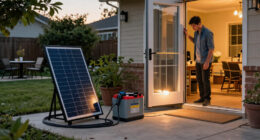
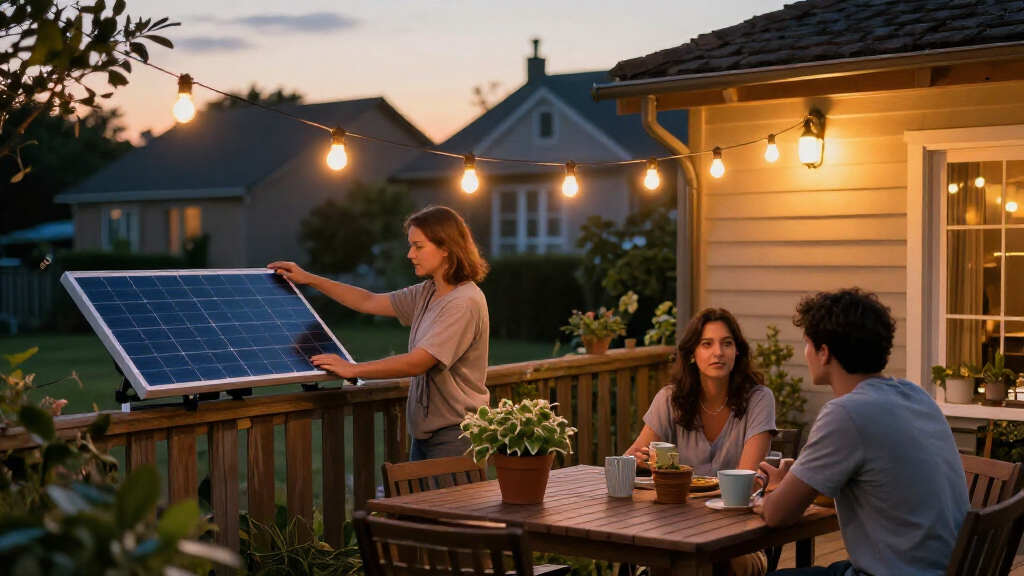
Many sets include a small panel on a stake, while others use a separate panel connected by a cable. A detachable panel gives you more freedom: hang the bulbs beneath a shady pergola, then stake the panel beside a sunny fence. For example, if your balcony faces a brick wall that blocks afternoon light, a panel on the rail’s open end may collect more sun than one clipped beside the bulbs. That flexibility can be decisive in a shaded space, though it comes with a tradeoff: you need a suitable mounting spot and enough lead length to reach it without creating a trip hazard or pulling on the connection.
Solar-powered outdoor string lights are popular for patios and temporary events because they can operate without a nearby outlet. That can simplify a garden party where you want warm points of light overhead but don’t want a cord running past chairs or across a walkway. The convenience depends on having a workable panel location, however, and the stored energy is finite. A set that runs through an early dinner may not stay bright through a late gathering, especially after a cloudy day. “Cord-free” therefore describes how the lights get power, not freedom from placement and runtime limits.
Recent designs often pair efficient LEDs with selectable modes, larger panels, or backup USB charging. These features vary by model. Efficient LEDs can make a given battery charge last longer, while a brighter mode generally uses that charge faster. A larger panel or USB backup may help in some circumstances, but adds little if you cannot position the panel well or do not have a practical way to recharge it. Check the manual and product listing to learn what the panel powers, how charging works, and whether a backup charge is supported.
Products Worth Considering

VIOFO A229 Plus 2K Dual-Channel Front and Rear Dash Cam

DEWALT 20V MAX XR Brushless 1/4-Inch Hydraulic Impact Driver (DCF870B)

Garmin Dash Cam 67W 1440p Dash Camera with 180-Degree Field of View
As an affiliate, we earn on qualifying purchases.
Put the panel in sun, even if the patio stays shady
For dependable charging, place the panel where it gets several hours of direct sunlight, following the manufacturer’s guidance. Sun exposure determines how much energy is available for that evening. Shade, short winter days, and cloudy stretches can reduce what the battery stores, so the effect often shows up later as fewer lit hours or dimmer bulbs. A cloudy day does not necessarily leave the set completely dark, but repeated weak charging can make the advertised runtime an unrealistic expectation.
Solar-powered outdoor string lights can work over a shady seating area if the panel sits somewhere sunnier. Picture a pergola tucked beneath a leafy maple: the lights can drape across the rafters while a panel on the edge of the lawn catches open sky. This separation lets you choose bulb placement for atmosphere and panel placement for charging, but only if the cable can span the distance. Before buying, measure the likely route and check the panel lead’s length. A few feet can make the difference between a sunny mounting spot and a panel trapped in shade; extending or rerouting a lead in a way the manufacturer does not allow may also compromise the setup.
Watch the sun’s path over the day, not just at noon. A roof overhang may cast a shadow in the afternoon, and a tree that looks bare in winter can block summer sunlight with a thick canopy. The panel’s usable exposure can change by season, so consider when you expect to use the lights most. If you move the panel during the season, secure its stake or mount so wind doesn’t twist the cable.
Keep the panel surface clear, too. Dust, pollen, and a flattened leaf can cover the small cells and reduce the light reaching them, which matters more when the panel already has only a short window of sun. Wipe away dirt with a soft damp cloth according to the maker’s care instructions. One quick cleaning after a windy week may help more than changing the lights’ setting. Light for the bulbs begins with light on the panel.
Set realistic expectations for brightness and runtime
Solar string lights usually create ambiance rather than bright, even task lighting, and their runtime changes with charging conditions and settings. Treat the manufacturer’s advertised hours as an estimate, not a nightly promise. The reason is that runtime reflects both the energy stored in the battery and the rate at which the lights use it. Battery charge, outdoor temperature, sunlight, and brightness level all affect that balance, so the same set can perform differently from one evening to the next.
Check the listed lumens when the manufacturer provides them. Lumens describe the total light output, helping you compare a soft decorative glow with a brighter string, though they do not by themselves tell you how evenly the light reaches a surface. A warm, low-output string can make a dinner table feel inviting, but it may not light a grill lid, a garden stair, or the whole patio. For instance, you might drape decorative bulbs along a fence for atmosphere and use a separate, properly rated fixture near the steps where you need to see each edge clearly. Using one light for both jobs can leave you choosing between a dim work area and a setting that feels too bright for relaxing.
Try the controls that fit your routine. Lower brightness can stretch the charge because the LEDs draw less power, while flashing modes may suit a party but feel restless during a quiet meal. A dusk-to-dawn sensor turns the set on automatically; a timer lets you set a shorter evening window. Those controls help allocate a limited charge to the hours you care about, but they cannot make a poorly charged battery last indefinitely. If you want the lights to glow through a late gathering, test the chosen mode over several evenings before relying on it for an event.
In winter or after several cloudy days, expect shorter or dimmer operation. That limitation matters most if you depend on light at a particular time, rather than using it as an optional accent. If your set has a backup USB charging option, check its instructions and whether the battery can be charged that way. Match the light to the job: mood lighting overhead, brighter fixtures for cooking and safe walking.
Compare the features that matter before you buy
The most useful solar string light comparison covers panel placement, battery replacement, light output, and weather ratings. Two strings can look similar in a product photo yet behave very differently through a cloudy week or a wet summer. Compare their instructions and specifications, not just bulb shape or advertised runtime; each feature affects either how reliably the set charges, how well it suits the space, or how long it can remain useful.
| Feature | What to check | Why it matters |
|---|---|---|
| Panel | Separate or attached; lead length | A separate panel can charge in sun while the lights hang in shade. |
| Battery | Capacity, type, replacement instructions | A replaceable battery may extend the useful life of the set. |
| Brightness | Lumens, brightness levels, light color | Helps you tell soft ambiance from useful task lighting. |
| Weather protection | Stated IP rating and manual | Protection may differ among bulbs, panel, and battery compartment. |
| Controls | Timer, sensor, modes, backup charging | Settings affect convenience and can change runtime. |
Imagine choosing between two strings for a balcony dinner. The first has classic exposed bulbs but a fixed panel that would sit in shade; the second has a detachable panel, fewer decorative extras, and clear battery replacement instructions. If the balcony gets limited sun, the second set may serve you better, even if the first looks more charming in the listing. But a detachable panel only solves the shade problem if its cable reaches a sunny location, and replaceable batteries matter most when you expect to keep using the string after its original battery wears down. These details are useful because they connect the listing’s features to the conditions you will actually face.
Weather resistant is not a universal promise. Read the IP rating and product instructions for each part, since a bulb string, panel, and battery box may have different protections. A rating helps you judge the conditions a component is designed to tolerate, but does not mean the set can be immersed or left out through severe weather. If the battery compartment has less protection than the bulbs, its location or seasonal storage may determine whether the rest of the set stays in good condition.
Install the lights securely and care for them through the season
Install solar string lights with a sunny panel location, a supported cable route, and enough slack to avoid pulling on the connections. Plan for both the path people use and the energy the panel needs: a beautiful bulb layout is less useful if the cable crosses a walkway or the panel ends up shaded. For a small courtyard, you could fasten the string along a fence and across a pergola beam, keeping the panel lead tucked neatly along the post.
- Test the layout on the ground. Check the cable length, bulb spacing, and panel reach before attaching anything. This helps reveal a route that is too short or puts bulbs where people will bump them.
- Secure the cable to approved supports. Use the clips or mounting method the maker recommends; don’t stretch the wire tightly between distant points. Slack reduces strain on the connections when wind moves the string or the mounting points shift slightly.
- Place and angle the panel. Choose a location with open sun exposure and fasten the stake or bracket so it won’t shift. A panel that moves or faces shade may collect less energy, making the lights’ evening performance less consistent.
- Test after dark. Confirm the sensor or switch works, then adjust the route if bulbs hang over a walkway or the panel lead catches. Testing reveals practical problems before people gather beneath the lights.
Most decorative solar strings use low-voltage power, but follow the product’s instructions and inspect the cable and housings regularly. Don’t use a set with cracked bulbs, damaged insulation, or a loose battery compartment; physical damage can undermine weather protection and make continued operation unreliable. If your project involves adding outdoor wiring, modifying an electrical system, or drilling into a roof or structure, hire a licensed professional and follow local code and permit rules. Turn power off before electrical work, and use appropriate PPE as directed by the professional.
Wipe dirt from the panel, look for frayed or pinched wire, and follow the manufacturer’s storage instructions when harsh weather or a long unused period is expected. Storage and routine checks protect the components that affect both charging and safe operation. Small checks help catch wear before the next gathering, when you’d rather be setting out plates than troubleshooting lights.
Decide whether solar lights fit your space and budget
Solar string lights are a practical choice when you want decorative outdoor light without a nearby outlet, provided the panel gets enough sun and the set lasts long enough for your needs. Their value depends on more than the purchase price. Consider how often you’ll use them, whether the battery can be replaced, and how much grid-powered lighting they actually replace. A low upfront cost may be less appealing if a sealed battery makes the entire set disposable when it wears out.
For example, a renter who hosts two summer dinners a month may value a cord-free setup that takes minutes to hang and doesn’t require an electrician. Someone who needs bright light every night for cooking may find a small solar string insufficient and choose a separate task light. Either choice can make sense; the key is comparing the light you need with what the product promises. The renter may accept shorter seasonal use in exchange for simple installation, while the cook may care more about predictable brightness than avoiding an outlet.
LEDs use relatively little power and run cooler than incandescent bulbs, but a solar product still contains a battery and electronics. Those parts eventually wear out and need replacement or disposal. If the battery is replaceable and the bulbs or string can be serviced, the set may last longer than one with sealed components. Check the maker’s guidance on battery type, replacements, and local disposal options. Serviceability can improve value over time, but only if replacements are available and practical to install.
Trends such as detachable panels, USB backup charging, and selectable brightness can solve particular problems, but they don’t guarantee better performance. A larger battery may help store energy, yet it still needs charging; an additional feature is valuable only when it addresses a real constraint in your space or routine. Buy for your actual pattern of use: a sunny spot, an evening’s desired runtime, and enough brightness for the job.
Frequently Asked Questions
How many hours do solar string lights stay on?
Runtime depends on the model, the battery’s charge, temperature, and the day’s sunlight. Treat the advertised number as an estimate; after cloudy weather or a dim winter day, the lights may run for fewer hours.
Do solar string lights work on cloudy days or in winter?
They may charge in indirect light, but usually more slowly than in direct sun. Short winter days and weaker sunlight can leave the battery with less energy, so expect shorter or dimmer operation.
Can I hang the bulbs in shade?
Often, yes, if the solar panel can sit in a sunny location and its cable reaches the string as the instructions allow. Check the lead length and plan the route before you buy.
Are solar string lights bright enough for a patio?
They often work well for a warm decorative glow, but they may not light an entire patio for cooking or safe stair use. Compare lumens and add a separate task light where you need to see clearly.
Can solar string lights stay outside in the rain?
Check the product’s stated IP rating and manual. The bulbs, panel, and battery compartment may have different weather protection, and a weather rating does not mean the set can be immersed or exposed to every severe condition.
Can I connect several solar light sets together?
Only connect sets if the manufacturer says they are designed to connect. Many solar strings operate as standalone systems, so linking them can damage the product or create a setup the maker does not support.
Conclusion
Before choosing a set, decide where the bulbs will hang, where the panel can catch sun, and whether you need a soft glow or useful task light. Then compare lumens, battery details, lead length, and weather instructions against that real setup. Those few checks matter more than a long runtime claim on a product page.
Give the panel a clear patch of sky and the bulbs a safe, supported route. When evening settles in, the small stored charge can turn a dark fence or pergola into a warm line of light—without a cord crossing your yard.