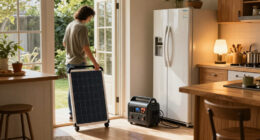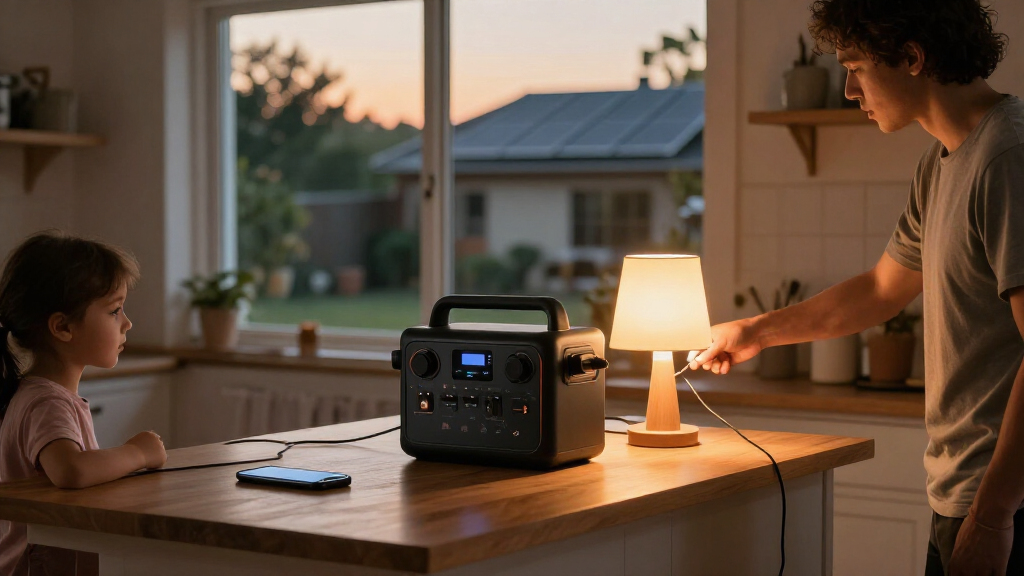

Choosing a portable power station for home backup is a tradeoff between carrying less equipment and having more power when an outage lasts. A compact 1 kWh model can keep phones, lights, a router, and selected small devices running, and it is easier to store or move. A high-capacity 2 kWh model offers roughly twice the stored energy, which can extend runtimes and support a wider set of appliances, but it costs more and is heavier.

Get backup power and energy gear delivered free with Prime
- Fast, free delivery on millions of items
- Prime Video, Amazon Music and more included
- Member-only deals all year

Jackery HomePower 3600 Plus Power Station, 3584Wh, 3600W AC Output
- ✔ Battery capacity: 3,584 Wh
- ✔ AC output: 3,600 W
- ✔ Parallel output claim: Up to 7,200 W

Jackery HomePower 3600 Plus & 2x200W Solar Panels, 3584Wh, 3600W AC Output
- ✔ Battery capacity: 3,584 Wh
- ✔ AC output: 3,600 W
- ✔ Included solar panels: 2 × 200 W

EBL 2400W Portable Power Station LiFePO4 Battery for Home Use
- ✔ Battery capacity: 1,843.2 Wh
- ✔ AC output: 2,400 W
- ✔ AC outlets: 4
Neither size powers an entire home by itself. The right choice depends on which devices you need, how long you expect to use them, and whether you can recharge during an outage. Choose the compact station for short outages and a few low-draw essentials; choose the larger one when longer runtime, higher power output, or fewer charging interruptions matter. Actual performance depends on each model’s specifications and the appliances connected.
At a Glance
| Criteria | Compact 1 kWh power station | High-capacity 2 kWh power station | Winner |
|---|---|---|---|
| Stored energy | About 1 kWh; suited to a limited set of essentials | About 2 kWh; more energy available between charges | B |
| Appliance output | Often enough for electronics and selected small appliances; check the model’s continuous and surge ratings | May support more appliances, subject to its output ratings and startup surge limits | Depends |
| Runtime | Shorter; depends on device draw and conversion losses | Longer for the same load, though not necessarily twice as long in real use | B |
| Portability | Usually lighter and easier to store or carry | Heavier and bulkier to move or store | A |
| Recharge flexibility | Can recharge from wall power or compatible solar; charging speed and input limits vary | Can accept wall or compatible solar charging; input limits determine recharge time | Depends |
| Upfront value | Lower initial cost, with less backup energy per outage | Higher initial cost, potentially better value when extra capacity is used regularly | Depends |
| Home integration | Typically used with individual devices; a home transfer setup may require compatible equipment | Still not whole-home backup by itself; connection method and installation requirements vary | Tie |
Jackery HomePower 3600 Plus Power Station, 3584Wh, 3600W AC Output
The standalone Jackery HomePower 3600 Plus is the strongest starting point here for households that want to keep several essential devices running through an outage. Its 3,584 Wh capacity and 3,600 W output exceed the EBL’s 1,843.2 Wh and 2,400 W figures, giving buyers more stored energy and more headroom for higher-demand appliances. The description also states that the system can expand, which offers a route to more storage if a buyer is prepared to invest in compatible additional equipment.Its home-backup case rests on more than capacity. Jackery lists four charging methods, including AC, solar, a gas generator, and hybrid AC-plus-DC charging, and says it can recharge quickly under specified conditions. In an extended outage, having more than one replenishment route can matter as much as the starting battery size. The product also describes parallel operation for 240 V output, but we would confirm exactly what equipment and setup are needed before counting on it for household circuits.Compared with the solar bundle listing, this version is the more flexible choice for buyers who already own compatible panels or prefer to choose their own charging equipment. Its drawback is that solar panels are optional, so the buyer must plan and source them separately if solar charging is part of the backup strategy. At 77.2 lb, it is also a substantial unit to move, even with its described wheels and telescoping handle. It makes less sense for shoppers who need a compact station they can lift easily or who only plan to power a router, lights, and phones.
Pros:
- 3,584 Wh capacity is nearly twice the EBL’s listed capacity.
- 3,600 W output provides more stated operating headroom than the EBL’s 2,400 W.
- Four stated charging routes include AC, solar, generator, and hybrid charging.
- Manufacturer describes expandable capacity and a wheeled, telescoping-handle design.
Cons:
- At 77.2 lb, it is considerably heavier than the EBL.
- Solar panels are optional in this listing, so solar readiness requires a separate purchase.
- The supplied information does not establish exact household runtime or the precise setup needed for 240 V use.
Best for: Households seeking a high-capacity portable station for prioritized appliances, with a plan to add compatible charging equipment or expand storage.
Not ideal for: Buyers who need a light unit, only require basic device charging, or expect a battery station to power an entire home for an extended outage without recharging.
Bottom line: We rank the standalone Jackery first for its combination of higher capacity, output, and stated expansion potential, provided buyers plan around its weight and finite runtime.
“We rank the standalone Jackery first for its combination of higher capacity, output, and stated expansion potential, provided buyers plan around its weight and finite runtime.”
Jackery HomePower 3600 Plus & 2x200W Solar Panels, 3584Wh, 3600W AC Output
This bundle pairs the Jackery HomePower 3600 Plus with two 200 W solar panels, making it the most straightforward option in the lineup for buyers who want solar hardware included with their backup station. The power station itself is described with the same 3,584 Wh capacity and 3,600 W output as the standalone Jackery, so its advantage is the package, not greater battery capacity. That distinction matters: the panels can help replenish the battery when conditions allow, but they do not give the station more stored energy at the start of an outage.Against the standalone model, the bundle reduces the amount of separate solar equipment a buyer needs to source, though Jackery notes that the station and panels may ship separately. The listed solar recharge estimate is four hours, but actual charging depends on sunlight, placement, and system conditions. Buyers should verify panel compatibility and the full set of included cables and accessories before relying on the bundle as a complete backup arrangement.For home use, this set makes the most sense when a buyer has a sunny place to deploy the panels and wants a way to recharge during a longer interruption. It retains the Jackery’s larger capacity and output advantage over the EBL, along with its 77.2 lb weight. That weight and the need to position panels outdoors make it less convenient for someone looking for a small grab-and-go station. It also costs the buyer space and setup effort even if solar charging is rarely practical at their home.
Pros:
- Includes two 200 W solar panels alongside the 3,584 Wh station.
- Keeps the Jackery’s stated 3,600 W output and expansion options.
- Solar charging provides a possible replenishment route during prolonged outages.
- Four stated charging methods support multiple recharge plans.
Cons:
- The station and panels may arrive in separate shipments.
- The panels do not increase the station’s starting 3,584 Wh capacity.
- At 77.2 lb, the power station remains heavier than the EBL and requires outdoor panel placement for solar charging.
Best for: Buyers who want the Jackery’s larger backup capacity and want two 200 W solar panels included for planned outdoor recharging.
Not ideal for: People who already own compatible panels, lack a suitable place to deploy them, or want the most portable and simplest single-box setup.
Bottom line: We recommend this bundle over the standalone Jackery when included solar panels are useful to your outage plan and you do not already have compatible panels.
“We recommend this bundle over the standalone Jackery when included solar panels are useful to your outage plan and you do not already have compatible panels.”
EBL 2400W Portable Power Station LiFePO4 Battery for Home Use
The EBL Acc2400 trades capacity for a smaller, lighter package. Its 1,843.2 Wh battery and 2,400 W output sit well below either Jackery listing, so we would treat it as a station for selected essentials rather than an equivalent to the larger HomePower. A router, lighting, phones, laptops, and other modest loads are a more natural plan than trying to sustain several major appliances. The exact runtime will depend on the devices connected and conversion losses, which the supplied information does not quantify.Port variety is a strength: the description lists four AC outlets, two USB-A ports, two 100 W USB-C ports, a car port, two DC ports, and a wireless charging panel. That makes it convenient for powering a mix of household electronics without crowding a small number of sockets. The EBL also states a 0.1-second emergency power switch, a useful claim for sensitive devices, but buyers should verify the supported mode and whether their particular equipment can safely rely on it as an uninterruptible power source.At roughly 54–55 lb, the EBL is easier to move than the 77.2 lb Jackery, though it is still not lightweight for frequent carrying. Its stated 3,500-plus charge cycles and LiFePO4 chemistry point toward longevity, but the smaller capacity remains the key home-backup limitation. Compared with the Jackery bundle, it also lacks included solar panels in the supplied listing, so buyers seeking solar replenishment need to confirm compatible panel support and acquire the necessary equipment separately.
Pros:
- Lower weight than the Jackery models at about 54–55 lb.
- 1,843.2 Wh capacity and 2,400 W output suit a focused essential-load plan.
- Broad mix of AC, USB, DC, car, and wireless charging outputs.
- LiFePO4 battery and stated 3,500-plus charge-cycle life.
Cons:
- Capacity is roughly half that of either Jackery, limiting outage runtime.
- Lower 2,400 W output offers less headroom for demanding appliances.
- No solar panels are listed as included, and compatibility details should be confirmed.
Best for: Households that want a more manageable station for essential electronics and a handful of moderate loads, without the bulk of a 3.6 kWh unit.
Not ideal for: Buyers planning to run high-draw appliances for long periods, power multiple major loads together, or seek a solar-ready package with panels included.
Bottom line: We place the EBL third overall but favor it for buyers who value easier handling and varied device ports more than maximum runtime or appliance headroom.
“We place the EBL third overall but favor it for buyers who value easier handling and varied device ports more than maximum runtime or appliance headroom.”
As an Amazon Associate we earn from qualifying purchases.
Key Differences
The clearest difference is how long the stations can serve the same load. A 1 kWh unit may cover communications, lighting, and a few small devices for a while, but a refrigerator or other frequently cycling appliance can use energy quickly. A 2 kWh unit gives more room for those loads or for a longer outage. It does not guarantee twice the runtime: inverter losses, battery reserve settings, temperature, and how often an appliance runs all affect usable energy.
Output is a separate question from capacity. Capacity measures stored energy; continuous output and surge capability determine which devices can run at once and whether a motor can start. The larger station may have stronger output, but size alone does not prove that. Compare each model’s ratings with the startup and running demands of the appliances you plan to connect. Both options require a realistic load plan, and neither should be treated as an automatic substitute for a permanently installed backup system.
The compact model’s advantage is practical: it takes less space, is easier to move, and asks for less money upfront. The larger model earns its premium when extra stored energy prevents a meaningful interruption, such as losing refrigeration or needing to recharge less often. Solar can extend either option’s usefulness if panels are compatible and conditions allow charging, but it does not remove the need to check input limits, weather, and expected loads.
Detailed Comparison
Stored energy (High-capacity 2 kWh power station wins — major)
The 2 kWh station has the clear capacity advantage, with roughly twice the rated energy of a 1 kWh unit. The gap is major for households that need several essentials running through a prolonged outage. For a short interruption with only a router, phones, and lights, the smaller reserve may already be enough. Rated capacity is not all available to appliances, so allow for conversion losses and keep a practical reserve.
Appliance output (major difference)
This is a model-specific comparison rather than a guaranteed win for the larger size. A higher-capacity station may also offer greater continuous output or surge power, but buyers must verify those ratings directly. That matters for refrigerators, pumps, and other motor-driven devices that can demand extra power at startup. If the compact unit meets the measured requirements, its lower capacity does not make it unsuitable for that appliance.
Runtime (High-capacity 2 kWh power station wins — major)
The 2 kWh option wins for the same connected load because it starts with more energy. The difference is major when that load runs often or the outage could last overnight. It may not deliver twice the real-world runtime, since appliances cycle and conversion losses reduce usable energy. Estimate consumption from the devices’ actual draw and expected hours of use before buying.
Portability and storage (Compact 1 kWh power station wins — moderate)
The compact station wins by being lighter and taking up less room. This is a moderate advantage for people who need to carry backup power between rooms, store it in a small apartment, or use it away from home. The larger unit reduces charging interruptions, but its weight can make frequent movement inconvenient. Check the actual weight and dimensions, especially if stairs are involved.
Recharge flexibility (moderate difference)
Both sizes may support wall charging and compatible solar panels, but the useful difference comes from their charging speed and input limits. A larger battery can take longer to refill unless the station accepts sufficient input power. A smaller one may recover more quickly under the same charging conditions, yet needs charging more often. Compare the specific recharge times and solar input ratings; capacity alone does not decide this criterion.
Upfront value (moderate difference)
The 1 kWh station usually costs less to purchase, making it the stronger value when the backup plan covers only low-draw essentials or brief outages. The 2 kWh unit costs more, but that premium can pay off if its additional energy regularly avoids a second station, an early recharge, or lost use of important appliances. Compare price against usable capacity, output, warranty, and charging features rather than capacity alone.
Home integration (minor difference)
Neither size automatically provides whole-home backup. Both are commonly used by plugging selected devices directly into the station. Connecting a station to household circuits can require compatible transfer equipment and a qualified installation, depending on the product and local rules. The difference is minor for device-by-device use; the station’s output and approved connection method matter more than its capacity.
Compact 1 kWh power station: Pros and Cons
Pros:
- Lower upfront cost
- Lighter and easier to move or store
- Often sufficient for communications, lights, and a small set of low-draw devices
Cons:
- Less runtime for the same load
- May require more frequent recharging during a long outage
- Can be limiting if several appliances need power at once
High-capacity 2 kWh power station: Pros and Cons
Pros:
- More stored energy for longer outages
- More headroom for running several essentials or a larger load, if output ratings support it
- Fewer interruptions to recharge for the same usage plan
Cons:
- Higher purchase price
- Heavier and bulkier to store or move
- May take longer to recharge, depending on its input rating and charging source
Who Should Choose What
Choose Compact 1 kWh power station if:
- You mainly need phones, lights, a router, and a few small electronics.
- You expect short outages and can recharge the station between them.
- You have limited storage space or need to carry the unit between rooms.
- Keeping the initial purchase cost down matters more than extending runtime.
Choose High-capacity 2 kWh power station if:
- You need selected appliances to run longer without a recharge.
- Your outage plan includes a refrigerator or other meaningful load, and the unit’s ratings support it.
- You want fewer charging interruptions and can manage the added weight and cost.
- You have a dependable way to recharge, such as suitable wall power when available or compatible solar input.
Skip both if: You need automatic, whole-home backup for high-demand equipment, central heating, or multiple large appliances. Compare an appropriately sized home battery or generator system with a qualified installer.
Value for Money
Paying more for the 2 kWh station is worthwhile when the extra stored energy changes what you can keep running or how long you can run it. Households that depend on refrigeration, need extended communications, or expect outages that can last overnight may get real value from fewer charging interruptions. The premium is harder to justify if the station will mostly charge phones and power a lamp for a few hours.
The 1 kWh model is usually better value for light, short-duration backup and tight storage. Compare the actual purchase prices alongside usable capacity, continuous and surge output, charging time, solar input, warranty, and battery lifespan. A cheaper station that cannot start a required appliance is poor value; so is paying for capacity that will rarely be used. Choose the smallest model that meets a written list of loads and runtime needs.
Final Verdict
For most households seeking basic outage coverage, start with the compact 1 kWh station if your plan is limited to communications, lighting, and small electronics. It is less expensive, easier to store, and adequate for a modest load. Move up to the 2 kWh station when longer runtime or fewer recharging breaks directly improves your backup plan, especially if essential appliances are involved and the unit’s output ratings fit.
The deciding factor is your expected load over time, not the capacity label alone. List the devices you need, check their running and startup demands, and estimate how many hours they must operate. If that requirement exceeds what either portable option can reliably deliver, choose a dedicated home backup system instead.
Frequently Asked Questions
Can a 1 kWh power station run a refrigerator?
Possibly, for a limited period, if its continuous output and surge rating can handle the refrigerator’s startup demand. Runtime depends on the refrigerator’s consumption, how often its compressor runs, and conversion losses. Check the appliance label or measured energy use and compare it with the station’s specifications.
Does a 2 kWh station last twice as long as a 1 kWh station?
It has about twice the rated energy, but real runtime is not guaranteed to double. Usable energy, inverter efficiency, connected load, appliance cycling, and operating conditions all affect the result. For the same steady load, expect longer runtime, then confirm it against the manufacturer’s usable capacity figures.
Can either station power an entire home?
Generally, a portable station is intended for selected devices rather than an entire home. Whole-home use depends on the unit’s output, connection method, household demand, and compatible transfer equipment. Follow the manufacturer’s instructions and consult a qualified electrician before connecting equipment to household circuits.
Is solar charging enough during an outage?
It can help recharge either station, but results depend on sunlight, panel compatibility, input limits, and how much energy your devices use. Cloudy weather or high loads may prevent solar from replacing the energy consumed. Treat solar as part of a charging plan, not a guaranteed continuous power source.